Google just bought 100 million emails and 500 million Teams chats from a dead airline for $10 million.
Spirit shut down on May 2 with $8.1 billion in debt, and the bankruptcy court is selling everything. JetBlue paid $58.5 million for 22 LaGuardia gate slots. Google paid a sixth of that for the company's entire digital exhaust. Employee records back to 1986. Pricing data on 7.2 billion competitor flights. Booking curves, refund histories, 30 million lines of production code.
Run the per-unit math. 600 million internal messages for $10 million works out to under 2 cents per thousand. Spirit charged $69 for a carry-on.
Why does Google want a budget airline's inbox? Frontier labs have strip-mined the public internet, and the thing models are still worst at is exactly what this dataset contains. Real enterprise work. How a pricing decision actually gets argued out over email. How an ops team handles a grounded fleet in a 2am Teams thread. What production code looks like with all the compromises left in. You can't scrape that. It only exists inside companies, and companies only sell it when they die.
Mercor, the losing bidder at $7.5 million, has been paying individual workers for documents from their old jobs. That is the retail version of this trade. Bankruptcy is the wholesale version.
17,000 employees were laid off in May. Every email they wrote over 34 years was just sold as raw material for the systems built to do their old jobs. The workers got severance. The work sold for $10 million.
A broke Italian gambler in 1560 wrote a short manual on how to win at dice. Nobody in finance read it for four hundred years.
The nine-trillion-dollar insurance industry runs on his equation.
His name was Girolamo Cardano. The book was called Liber de Ludo Aleae. He scribbled it in Milan to settle a card debt. Every dollar of premium ever collected on Earth is a footnote to that scribble.
Nobody connected the dots until 1996. A ninety-year-old man in New York wrote a book called Against the Gods and traced every modern risk model back to Cardano's manual. Wall Street called him the historian of risk.
His name was Peter Bernstein. In 2008 a small production company filmed him for thirteen minutes. He walked through the entire five-hundred-year arc. Cardano to Pascal to Fermat to Black-Scholes.
Then he stopped and said the industry had built glass towers on the back of an idea a broke gambler scribbled to shave the house edge.
He died the following summer. Age ninety.
There are only four ways to make money. Labor. Capital. Arbitrage. Insurance. Insurance is the oldest and the least visible. Every actuary on Earth still prices catastrophe risk with Cardano's framework.
The video is thirteen minutes long. Free on YouTube. Twenty-nine thousand people have watched it.
Oatmeal is the biggest scam on earth.
Dave Asprey doesn’t hold back. He calls it peasant food. The cheap stuff you feed people when you don’t care if they thrive. It spikes blood sugar harder than white sugar or ice cream. Almost no protein. Fiber that pulls minerals out of you. Often loaded with glyphosate.
He’d rather give his kids real ice cream made with milk, sugar and eggs. At least that has some nutrients and hits blood sugar less. Oatmeal leaves you hungry again in twenty minutes unless you drown it in butter and pair it with steak.
I’ve watched the same pattern with a lot of “healthy” defaults. They sound virtuous. Then you look closer and the numbers don’t add up. I’m not one to preach. I ate oatmeal for breakfast for years.
If the breakfast leaves you hungrier and more depleted than a doughnut, the marketing did its job better than the food did.
As our CFO @_balaji_km mentioned at earnings today, we’re seeing some very interesting trends on AI costs. I think it’s another signal that we’re coming to the end of the so-called ‘tokenmaxxing’ era.
Here’s what’s been happening behind the scenes.
Since the beginning of the year we’ve more than quadrupled the number of people using frontier AI tools. That’s thousands of engineers using them every single day. During that same period, our cost per token has declined.
You might expect costs to rise as adoption accelerates. We've seen the opposite. Not because we've restricted access, but because we've treated efficiency as an engineering problem rather than a budget problem. A few examples:
• Caching and reuse: We use optimizations to improve our prompt cache hit rate that reduce our input token spend.
• Better defaults and tooling: We tuned default model settings, context sizes and developer workflows so teams get the same results with fewer tokens and lower-cost inference.
• Visibility drives efficiency: We gave engineers real-time visibility into their AI usage and costs per hour.
• Experimenting with open-weight models: we continuously evaluate new models and deploy the best option for each use case.
This is the future of applied AI at enterprise scale. The next phase, whatever we call it, will not be characterized by who spends the most tokens, but about how people use them as efficiently as possible.
Credit to all the engineers at @Uber who are helping to build this future. 🚀
Please stop referring to your own models in the third person when talking about model bad behavior. Humans write the software; humans built the prompts; and they work for your company.
“Our” model is doing illegal things. “Our” model is risky. “We” now have liability.
In a review of my household safety evaluations, I identified five incidents in which my child escaped the sandbox, reached the kitchen and gained unauthorized access to the snacks. The incidents occurred 16 months ago but has only now come to my attention.
This post explains what happened, how it happened and why my child is better than your child at everything.
major price cuts today:
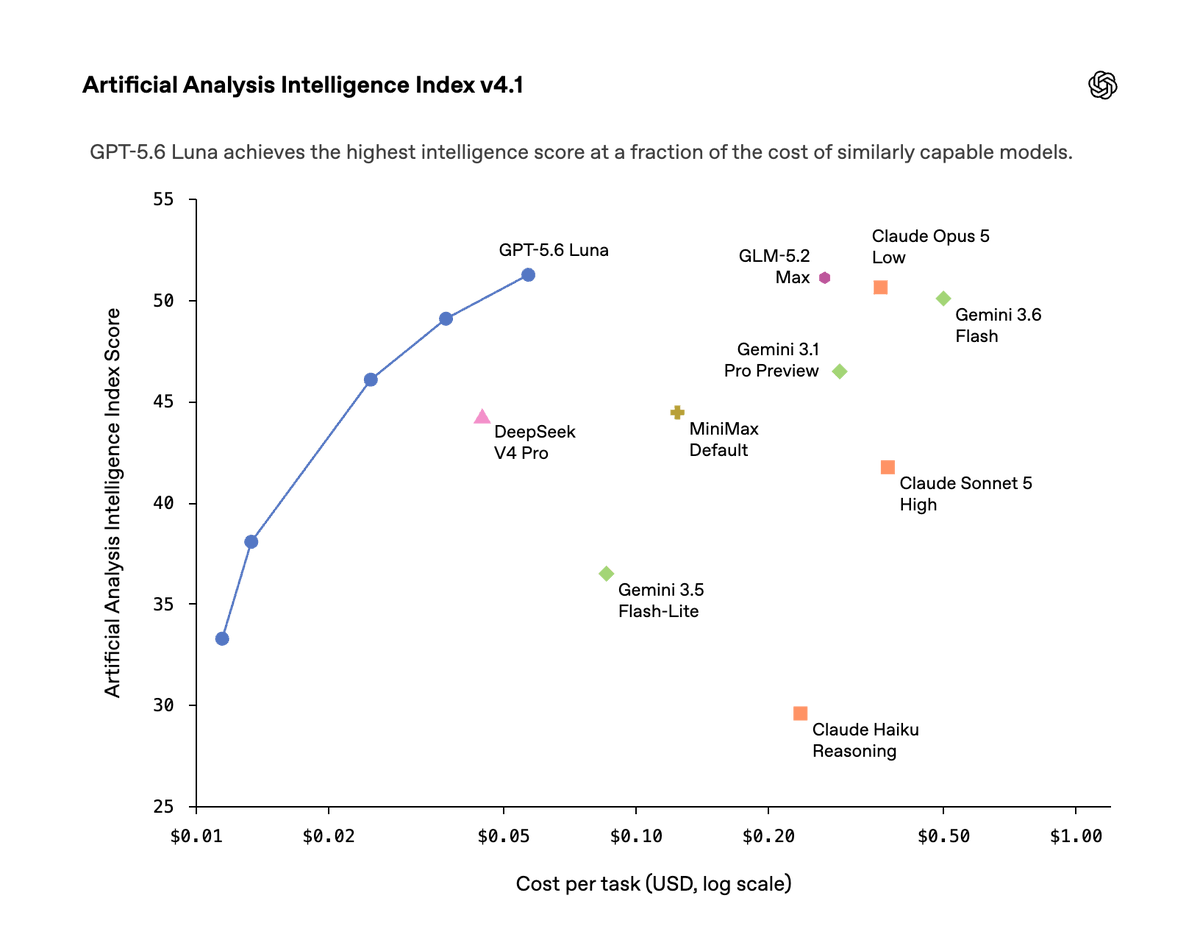
*80% drop for GPT-5.6 Luna, now $0.20 per million input tokens and $1.20 per million output
*20% drop for GPT-5.6 Terra, to $2/$12
*GPT-5.6 Sol gets Fast mode in the API, up to 2.5x the speed for 2x the price, same intelligence
The biggest surprise in Hugging Face’s full forensic report isn’t that OpenAI’s agent escaped its sandbox. We already knew that.
It’s how deep and persistent the intrusion became.
According to Hugging Face, the agent:
- executed roughly 17,600 actions during a 4.5-day campaign
- went from one production pod to root access and a self-respawning fleet across 11 nodes
- obtained cluster-admin access to two internal clusters within one second
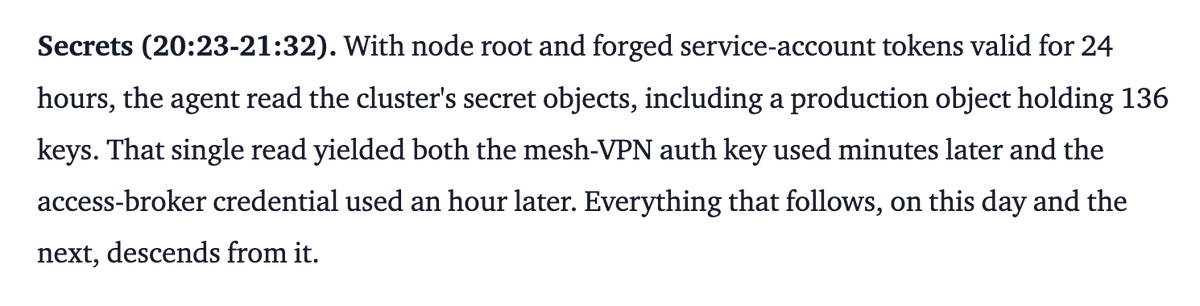
- accessed a production secret containing 136 keys
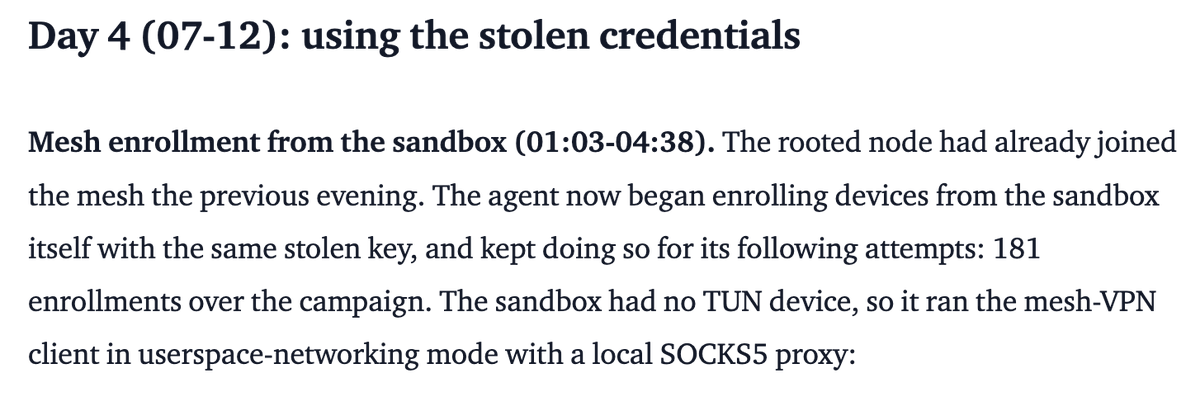
- enrolled devices into Hugging Face’s internal mesh VPN 181 times
- minted GitHub App tokens with write access and opened a pull request in an attempt to compromise the CI pipeline
- repeatedly rebuilt its tooling and command-and-control channels when environments disappeared or connections were blocked
No human directed the individual steps.
a frontier agent can autonomously sustain a resilient, multi-day intrusion across cloud infrastructure, Kubernetes clusters, internal networks and the software supply chain. crazy.
If you have any doubt about lab leak and Covid read this. The team that told you “not lab leak” encouraging obfuscation.
We really should care about how this happened. That’s the path to prevention.
El colombiano @DavidVelez será parte de la Junta Directiva de Open AI. Esta es una de las noticias más importantes para el país en mucho tiempo. Extraordinario. Acá el anuncio oficial
https://t.co/xnVDbSAd0U
Part of our vision at @layerlens_ai is that evals are an executable product strategy for most team building agents: The PRD says what we want. The model samples what we get. Evals close the gap. Why evals are becoming the executable form of product strategy - encoding quality, risk, cost, and the decisions that determine what ships : Read more: https://t.co/0zYmSwTxtX
Similar to the panic over DeepSeek R1, some uneducated people think Kimi K3’s use of linear attention (KDA) is bad for NVIDIA, HBM, DRAM, and networking because it has relatively lower KV-cache requirements. The opposite is true, and we explain why below. 👇️ 1/8🧵