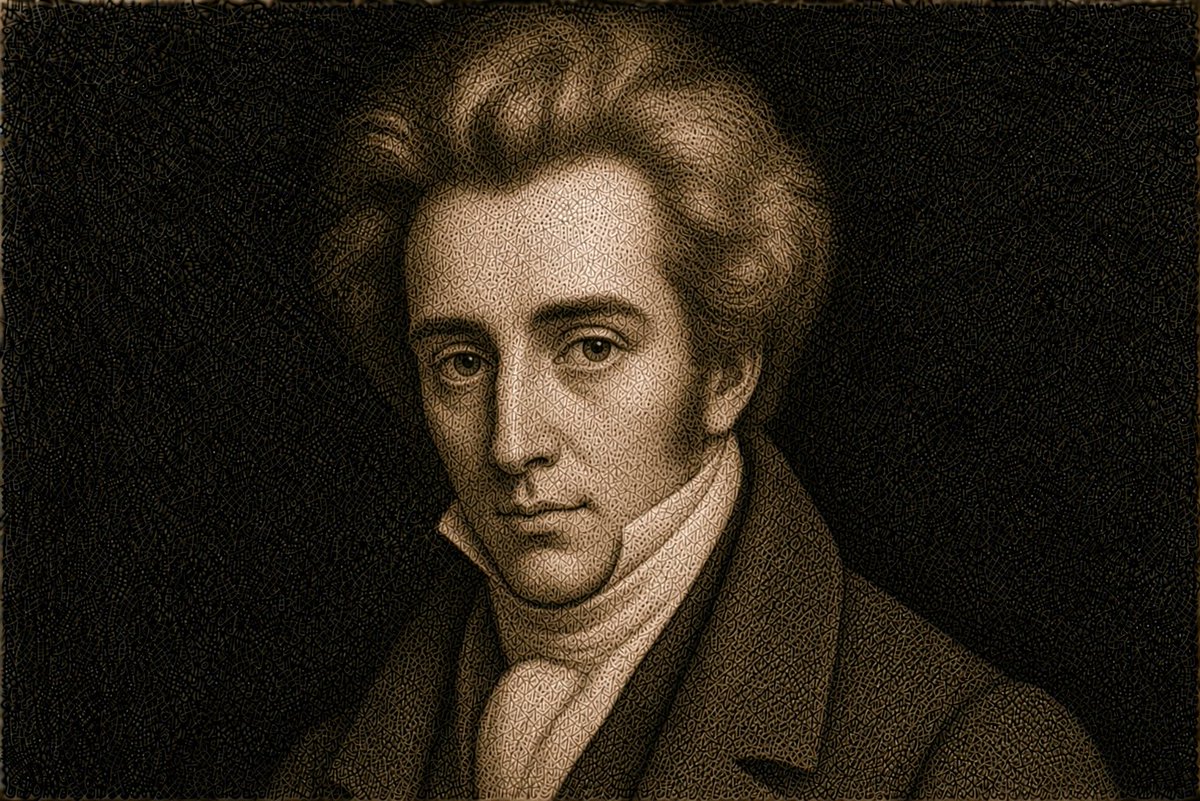
"Lorsque les femmes nous aiment, elles nous pardonnent tout, même nos crimes. Quand elles ne nous aiment pas, elles ne nous pardonnent rien, pas même nos vertus." - Balzac
a quant at a prop firm showed me a 5x5 grid on a napkin
said:
> this is our entire edge. we don't predict price. we predict which box the market is in and where that box historically leads
i didn't understand it for weeks. then it clicked
never looked at a chart the same way since
grid is called a Markov Chain transition matrix. the math is from 1906, it's in every probability textbook on earth
and hedge funds use it because it asks a completely different question than retail traders ever ask
retail: will this go up or down
quant: what state is this market in, and where does this state typically go
every market lives in one of maybe 5-6 states at any given moment
tight range, volatility compression, trending with momentum, post-spike reversal, pre-breakout coil
not random labels - clusters you identify from actual data using volatility, volume, and momentum readings stacked together
once you have the states, you build the matrix:
P(state 2 -> state 4) = 73%
P(state 4 -> state 1) = 61%
P(state 1 -> state 3) = 68%
each cell is a historical probability. now when the market is in state 2, you're not guessing
you're betting on 73% historical completion. you size it with Kelly. you take the trade when the math says to, not when it feels right
i built this on BTC using 2 years of 4-hour data. identified 5 states
one i labeled "volatility compression below 20-day mean for 6+ consecutive candles" transitioned to a directional move above 1.8 ATR in 71% of cases
average reward/risk on those trades: 5.4
that's not prediction. that's reading a probability table the market keeps filling in for you every single day
the part that should bother you: the data to build this is free. the framework is in any quant textbook
python to implement it is maybe 200 lines
what Renaissance Technologies has that you don't isn't secret data or proprietary signals
it's this framework applied to higher-resolution data with more sophisticated state definitions
you're not missing information
you're asking the wrong question every single time you open a chart
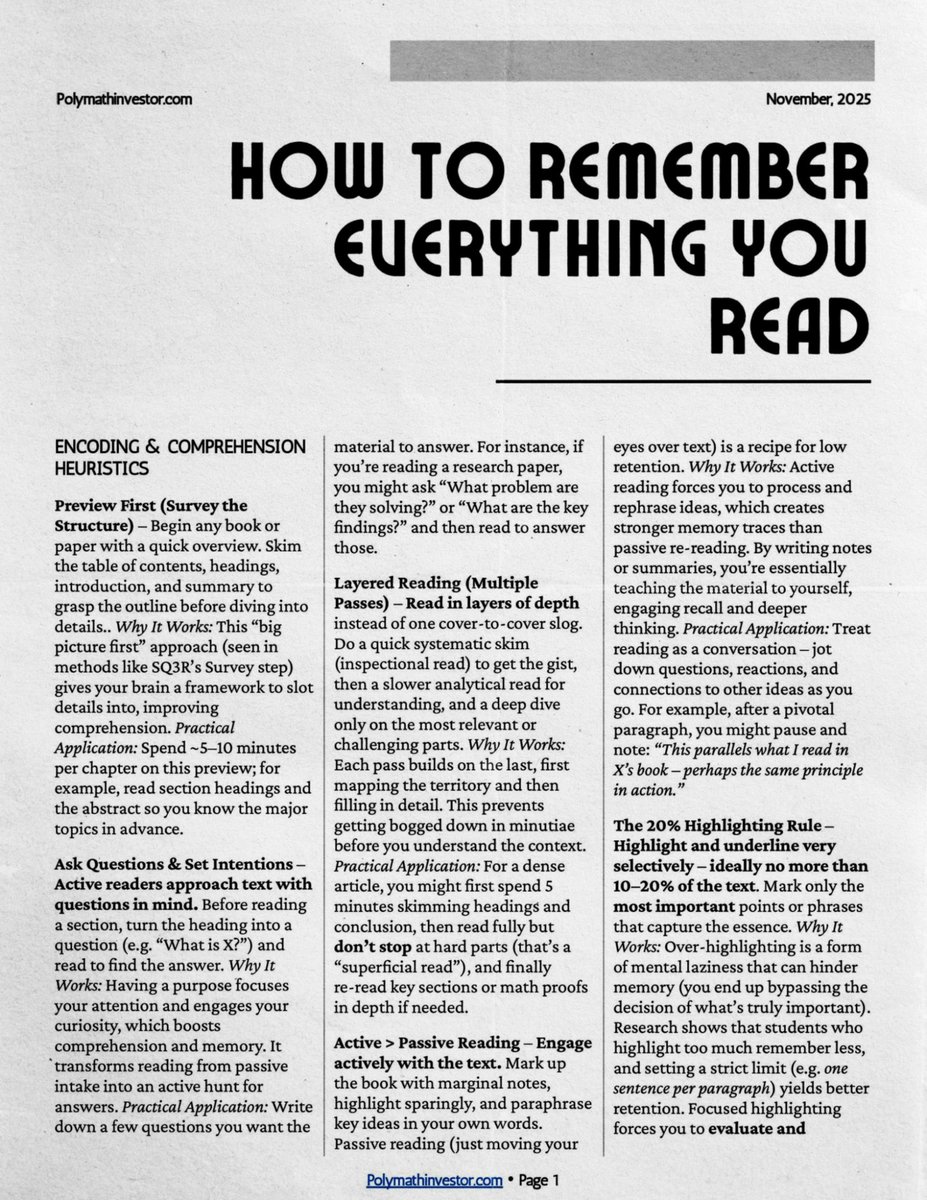
A few months back, I published this guide on how to remember everything you read.
Re-sharing it here for anyone who finds these protocols useful.
(1/11)
Charlie Munger’s most powerful daily habit:
"I read The Richest Man in Babylon which taught the joys of underspending your income and investing the difference and how wonderfully it would work over time"
"I got the idea that I had a mental compound interest thing too, and so I finally decided I was going to give the best hour of the day to improving my own mind"
"That may have been a very selfish thing to do but it worked"
it is an unwritten rule of life that after every prolonged period of hardship and uncertainty, there is going to be a period when you are going to achieve quantum leaps across multiple areas of your life. the only requirement is that you do not give up on yourself
A lesson I wish I learned earlier: You don’t need to impress people, you need to become someone you respect. Build habits you’re proud of. Make decisions you can stand behind. Live in a way that feels honest. Self respect removes the need for outside validation.
The universe will make sure you'll win if you just believe in yourself. Universe doesn’t reward talent, luck, or intelligence first , it rewards the one who believe in themselves. let me remind you every good thing that you have in your life came after you decided to believe in it. even when nothing seems to be working. even when it feels quiet. even when your faith starts to shake a little. keep believing. keep visualizing. Keep showing up like it's already yours. Universe moves in silence before it reveals its magic. what you can't see is still unfolding. what feels delayed is simply on its right time. your belief is the bridge between where you are and where you're meant to be. Hold the vision a little longer cause It's already on its way to you. Manifest the sh!t out of it!!!
Absolute bombshell on CNN.
CNN confirms precise Iranian strikes have caused unprecedented destruction to the majority of US military sites.
At least 16 American installations are heavily damaged and virtually unusable.
The Pentagon is hiding a massive defeat.
I realized nobody actually knows what they’re doing. Everyone is just figuring it out as they go . You don’t need permission, qualifications, or expertise -you can just do things.
"What I actually learned is that position sizing is probably 70 to 80 percent of the equation. It's not just about being right or wrong, it's about how much you make when you're right."
— Stanley Druckenmiller
My grandma once told me the “Chair Theory” and I never looked the relationships the same way.
She said…
If you walk into a room and there aren’t enough chairs for everyone, pay attention.
Some people will grab another chair for you.
Some will offer you theirs.
Some will shift around to make space.
And some people?
Will stay exactly where they are
while you’re left standing.
That’s when people reveal themselves.
Because life works the same way.
Some people naturally make room for you.
They support you, include you, and genuinely want to see you grow.
Others will watch you struggle
without ever moving an inch.
Notice the ones who make space for you.
Those are your people.
The rest?
Let them stay where they are.
En este interesante debate llevaba la voz cantante el que fue muy crítico con la religión y embajador en su día de España (aunque nacido en Cuba) en el Vaticano.
— Gonzalo Puente Ojea.
Charlie Munger saved pilots' lives by asking one question: "How can I kill them?"
It’s the same thinking that made him a billionaire.
"I have a good mind, but I'm way short of prodigy. And I've had results in life that are prodigious. That came from tricks. I just learned a few basic tricks from people like my grandfather."
Someone asks: "What were those tricks?"
Munger laughs:
"It's too late for you old guys. But there are all kinds of tricks I just got into by accident in life. One: I invert all the time."
He shares a story from his time as a weather forecaster in the Air Corps:
"Being a weather forecaster is a lot like being a doctor that reads X-rays. It's pretty solitary. You're in the hangar in the middle of the night, drawing weather maps, briefing pilots. The minute I was actually making weather forecasts for real pilots, I said: 'How can I kill these pilots?' That's not the question most people would ask. But I wanted to know what the easiest way to kill them would be, so I could avoid it."
Munger explains what he found:
"I thought it through in reverse. I figured out there were only two ways I was ever going to kill a pilot. I was going to get him into icing his plane can't handle, and that will kill him. Or I'm going to get him someplace where he's going to run out of gas before he can land because all the airports are sucked in. I just was fanatic about avoiding those two hazards."
He adds a sobering note:
"If Kobe Bryant had somebody like me, he'd still be with us. It was so stupid to kill yourself that way."
Munger traces this back to his grandfather:
"My grandfather would say to me when I'm swimming, 'Swim as long as you want, but stay near the shore.' You can laugh, but he was a very wise man."
On why inversion works:
"It's like a lot of practical problems in algebra. If you invert, you can solve it easily. If you don't, you can't solve it easily. Most people say, 'How can you help India?' I would approach it differently. I'd say, 'What could I do which would most easily hurt India?' And approaching it in reverse that way, I got better results. You look at the vulnerabilities."
Munger shares another trick, bracketing:
"I was in ROTC in both high school and college. The ROTC taught me to fire mortar shells, one shot over, one shot short, and then kapow. I never shot any damn shells. But I've been using that mental trick all my life. That's how I determine what size to make something. Over and under, and kapow."
On thinking in three dimensions:
Munger tells a story from his days as a young lawyer:
"I had a client who owned a bunch of hilly ranch land on the edge of civilization in Southern California. The Edison Company wanted a new easement through his land. He hired the leading appraiser in Orange County, very pompous, very old, very distinguished. My client thought he should get $250,000 for the easement. The appraiser told him, 'No, I'm sorry, it's only $125,000.'"
The client asked Munger to talk sense into the appraiser:
"I looked at his problem. What he had done is what he was taught to do in appraisal school; he thought the problem through in two dimensions. He figured out from comparable sales what the value per acre was. He computed the acreage. He added a little bit for the damage the easement would do to the remaining property. But it was all done in two dimensions."
Munger saw the real issue:
"I said to the appraiser, 'You've got to do this in three dimensions. God gave us three dimensions. If they put big transmission line towers, it's going to freeze the grade. The logical way to develop hilly land is to lop off the top of the hills and put them in the valley. That's how hilly land is developed. They're doing enormous damage by freezing the grade.'"
The appraiser wouldn't budge:
"He wouldn't change a damn thing. So I said to my elderly client, 'I think you have to fire this twit, and I will hire you an appraiser who can think.' I got him $600,000. It wasn't hard at all, because I was dealing with a bunch of honest engineers at Edison who did think in three dimensions."
Munger reflects:
"You'd be surprised how many lawyers would screw that one up. People like that appraiser, who didn't know his own business very well because he didn't pay attention to the fundamentals, those people are always with us. If you just have the mental trick of constantly going back to the basics, you'll be fine."
On knowing when you have enough information:
Someone asks about the Anadarko deal, a big oil company Munger invested in quickly:
"Warren and I have been together so long that with just one grunt, we can speak a volume. The Permian Basin is our number one oil reservoir. We don't have another like it. It's perfectly obvious. You have a preferred stock that gives you an advantage over everybody else, plus an upside. We've done this kind of thing before. Of course we did it. It's not very difficult."
Munger criticizes excessive due diligence:
"You don't need perfect. If you're 96% sure, that's all you're entitled to in many cases. I see these people doing endless due diligence. The weaker they are as thinkers, the more due diligence they do. It's just a way of laying an inner insecurity. And of course, it doesn't work."
He gives an example:
"In America now, they do these leveraged buyouts and these firms do what they call 'due diligence.' They send armies of young lawyers out at high rates per hour to riffle through all the purchasing orders at a place like ISCAR. You don't have to look through the purchasing orders to know that ISCAR is a good business. I don't think people that are that insecure mentally ought to be in positions of decision-making."
Munger summarizes his approach:
"I revolve possibilities. I rag problems hard. If they don't yield, I come back. This is just a bag of tricks. It enables a non-prodigy man to get prodigious results."