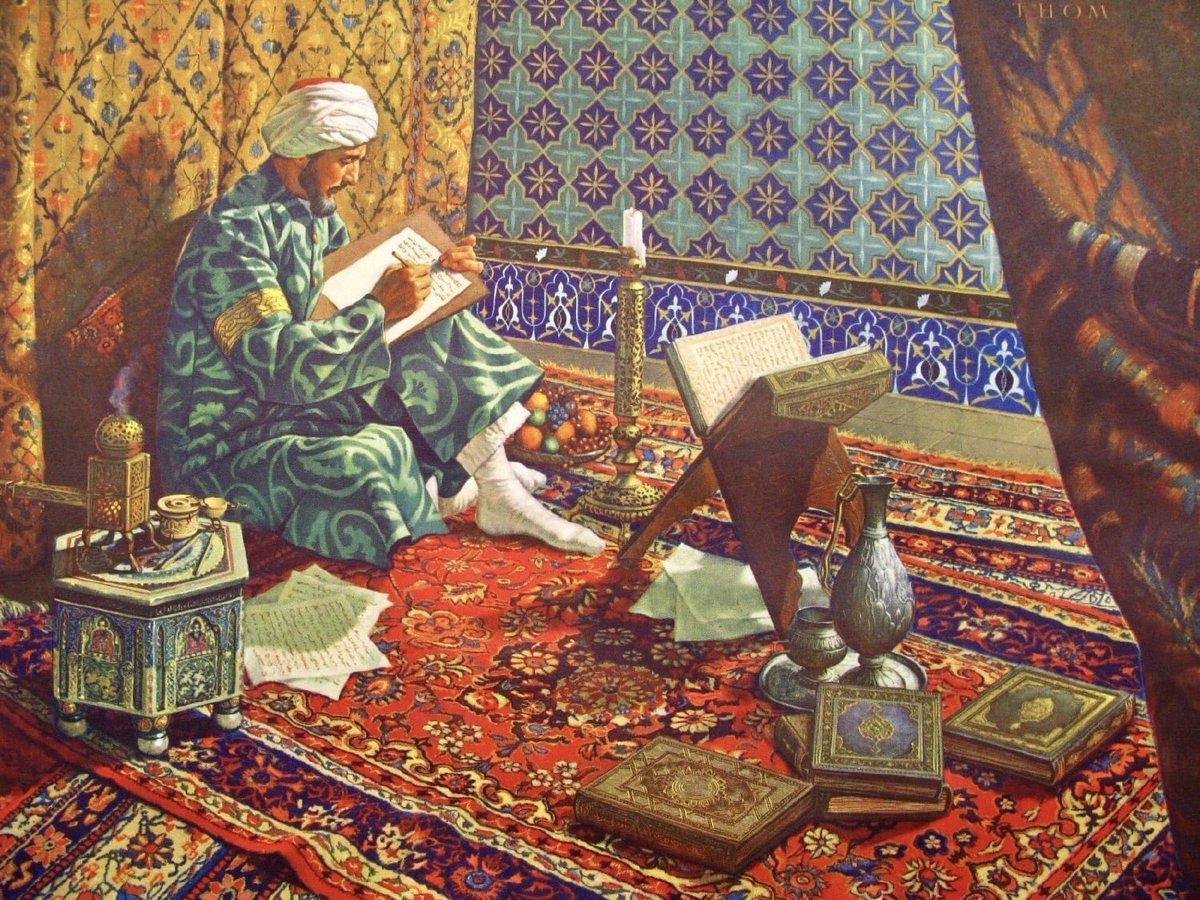
Did you know that the Persian scholar of medicine, Ibn Sina (980-1037) suspected some diseases were spread by microorganisms.
To prevent human-to-human contamination, he came up with a method of isolating people for 40 days.
A thread on Ibn Sina & his impact on modern science…
🗣️ "They've got the number one ranked batter in Babar Azam"
🗣️ "Their spinners are a little out of form"
Nasser Hussain and Eoin Morgan discuss how Pakistan are looking ahead of the World Cup 🇵🇰
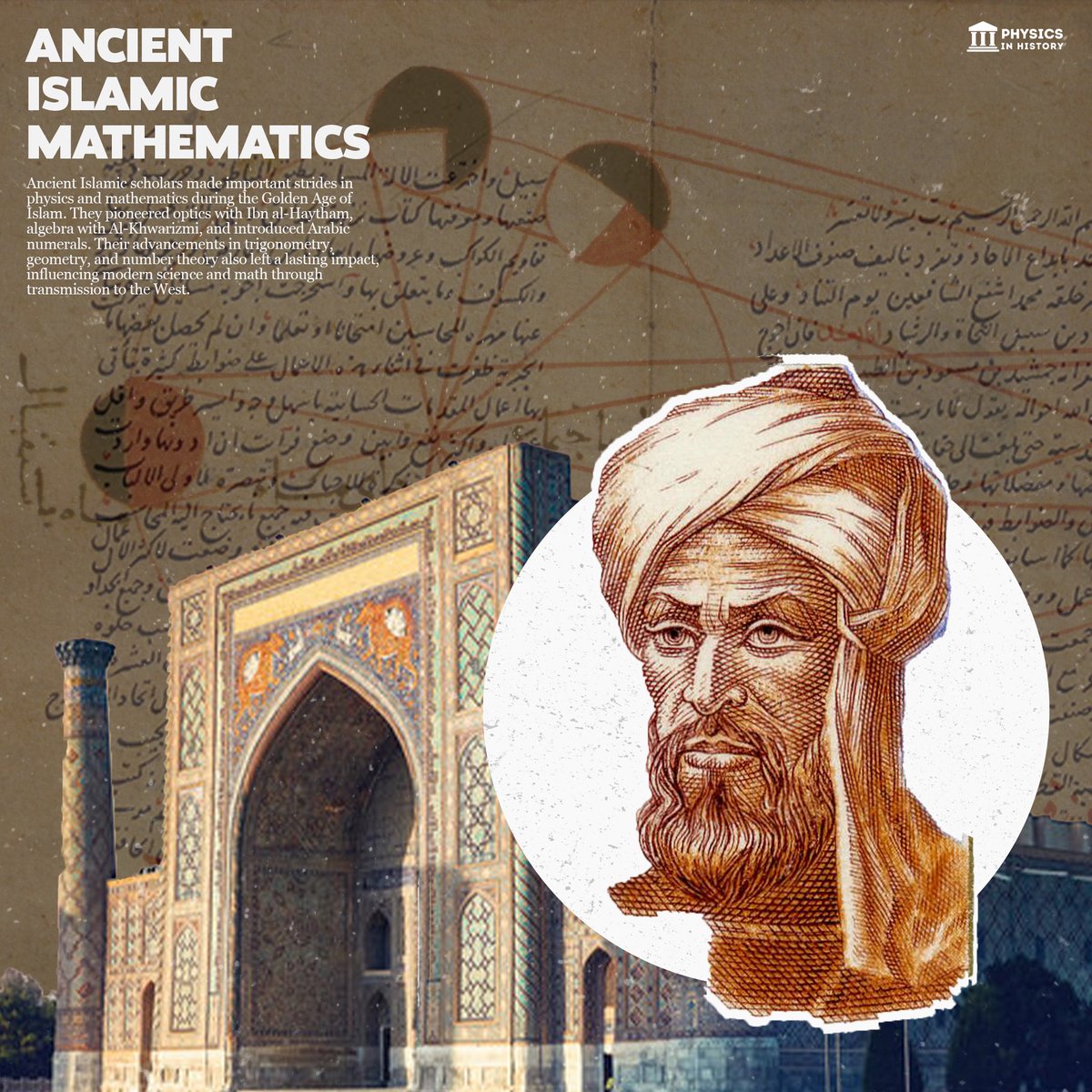
Islamic Scholars and the development of Physics and Mathematics ▲
Mathematics and physics were greatly developed by ancient Islamic scholars and scientists during the Golden Age of Islam, which spanned from the 8th to the 13th century.
Al-Khwarizmi (c. 780-850): He is considered the father of algebra, a term derived from his book al-Kitab al-mukhtasar fi hisab al-jabr wa’l-muqabala (The Compendious Book on Calculation by Completion and Balancing). He also introduced the Arabic numerals and the decimal system to the Western world, and wrote influential works on astronomy, geography, and trigonometry.
Ibn al-Haytham (c. 965-1040): He is regarded as the father of modern optics, as he made significant contributions to the theory and practice of optics, vision, and light. He wrote the Kitab al-Manazir (Book of Optics), which was a landmark in the history of physics and psychology. He also studied the laws of reflection and refraction, the nature of colors, the structure of the eye, and the mechanism of vision. He also proposed the scientific method of experimentation and observation, and criticized Aristotle’s physics.
Omar Khayyam (c. 1048-1131): He was a renowned poet, mathematician, astronomer, and philosopher. He is best known for his Rubaiyat, a collection of quatrains that express his views on life, love, and fate. He also contributed to algebra, geometry, number theory, and binomial theorem. He also calculated the length of the solar year with remarkable accuracy, and devised a calendar reform that was more accurate than the Gregorian calendar.
Al-Biruni (c. 973-1048): He was a polymath who excelled in various fields of science, such as astronomy, mathematics, physics, geodesy, geography, geology, mineralogy, chemistry, pharmacology, anthropology, history, and linguistics. He wrote over 146 books on various topics, and is considered one of the greatest scholars of all time.
He measured the radius and circumference of the Earth using trigonometry, determined the specific gravity of various substances using hydrostatics, described the heliocentric model of the solar system, and studied the motion of planets and comets.
Al-Farabi (c. 872-950): He was a philosopher, logician, musician, and scientist who wrote influential works on metaphysics, ethics, political philosophy, cosmology, psychology, music theory, and logic. He synthesized the ideas of Plato and Aristotle with Islamic theology, and developed his own system of classification of sciences. He also studied sound waves and musical harmony, and invented several musical instruments.
These contributions from ancient Islamic scholars laid the groundwork for the advancement of physics and mathematics in the subsequent centuries. Their works were translated and disseminated in Europe during the Middle Ages, playing a crucial role in the Renaissance and the development of modern science and mathematics.
"God does not play dice with the universe" is one of the most famous quotes attributed to Albert Einstein, who used it to express his dissatisfaction with the concept of quantum mechanics. The phrase was used by Einstein in response to a letter from the German physicist Max Born. It originates from a series of heated debates between Einstein and fellow physicist Niels Bohr that took place mostly in the late 1920s and early 1930s.
It refers to one of the key features of quantum mechanics called indeterminacy or uncertainty, which was fiercely debated during the early days of quantum mechanics. This concept fundamentally challenged the deterministic view of the universe that had held sway in physics since the time of Isaac Newton.
In classical physics, if you knew the initial state of a system perfectly (that is, if you knew the positions and velocities of all the particles), then you could, in theory, calculate the future behavior of that system with absolute certainty. However, in 1927, Werner Heisenberg proposed what is now known as the Heisenberg Uncertainty Principle, which states that it is impossible to simultaneously know both the exact position and momentum of a particle. This introduces a fundamental element of randomness or "chance" into the predictions made by quantum theory.
Einstein, being a classical physicist at heart, was uncomfortable with this inherent randomness in nature. He held a deep belief in a cosmos where the rules were so strictly determined that randomness simply had no place. Hence, the phrase "God does not play dice" encapsulated Einstein's belief in an orderly, predictable universe, as opposed to the probabilistic universe implied by quantum mechanics.
This philosophical disagreement led to a series of debates, primarily between Einstein and Niels Bohr, who was one of the chief architects of quantum mechanics. These debates peaked at the Solvay Conferences, where they would often continue their arguments about the completeness and soundness of quantum theory. Despite Einstein's various "thought experiments" designed to expose what he believed to be flaws in the theory, Bohr was always able to defend quantum mechanics successfully.
Ironically, although Einstein was never comfortable with quantum mechanics, his work on the photoelectric effect (which demonstrated the particle-like properties of light) was one of the key stepping stones that led to its development. It was for this work that he was awarded the Nobel Prize in Physics in 1921.
To this day, the interpretation of quantum mechanics remains a contentious topic, and Einstein's words still echo in the philosophical debates around determinism and randomness in the universe. However, despite Einstein's objections, quantum mechanics has stood the test of time and experiments, becoming one of the most successful theories in the history of physics.
[Image photographed in 1925 by Paul Ehrenfest]
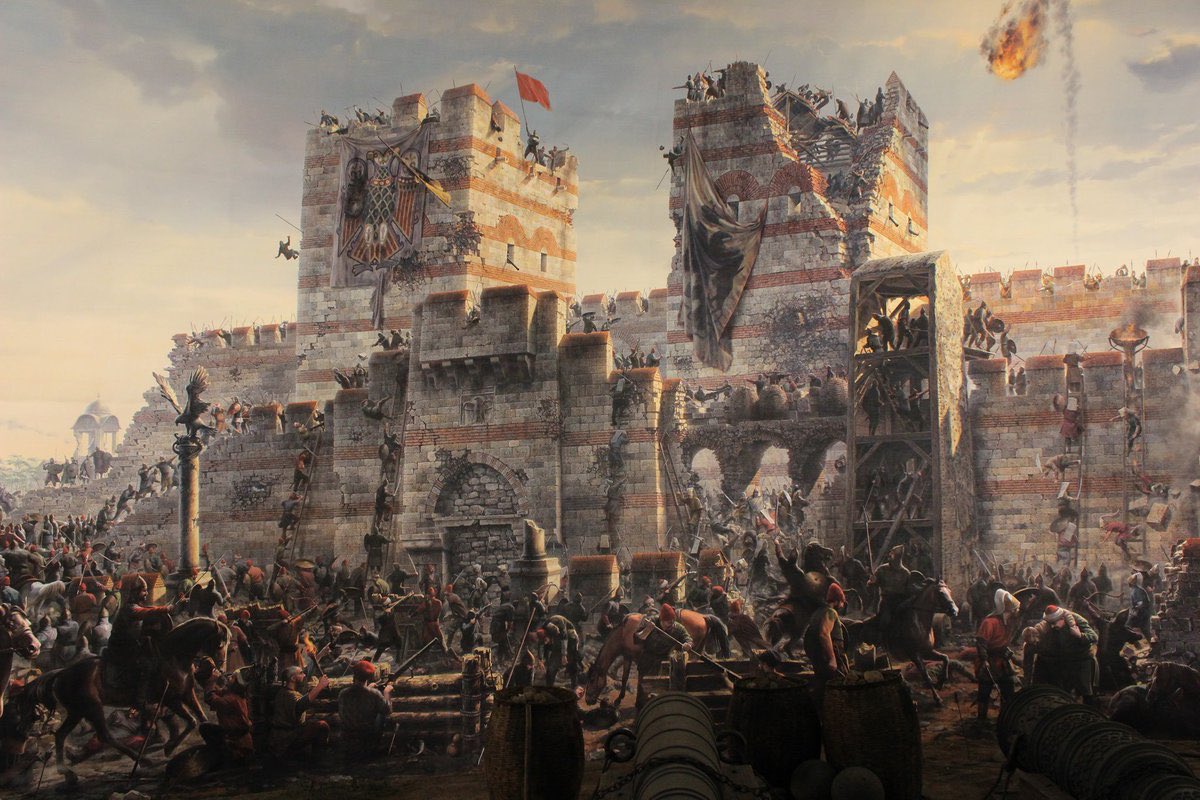
Today, 570 years ago, Ottoman Janissaries poured over the Theodosian Walls. The Genoese fled when their leader, Giovanni Giustiniani, was injured. The Emperor threw himself into the hopeless struggle & died with his men. After over 2,000 years, the Roman Empire was no more.
Welcome to our innovative office, where ideas come to life! 🌟💡
With a diverse and talented team, we create an environment where creativity knows no limits. Together, we are shaping the future of #Education. Join us on this exciting journey!
#LifeAtRedMarker#RedMarkerSystems