If you want your OpenClaw or Hermes Agent to be able to have perfect total recall of all 10,000+ markdown files, GBrain is here to help.
It's exactly my OpenClaw/Hermes Agent setup. MIT-licensed open source. Hope it helps you build your mini-AGI.
https://t.co/yFpFU4pn5b
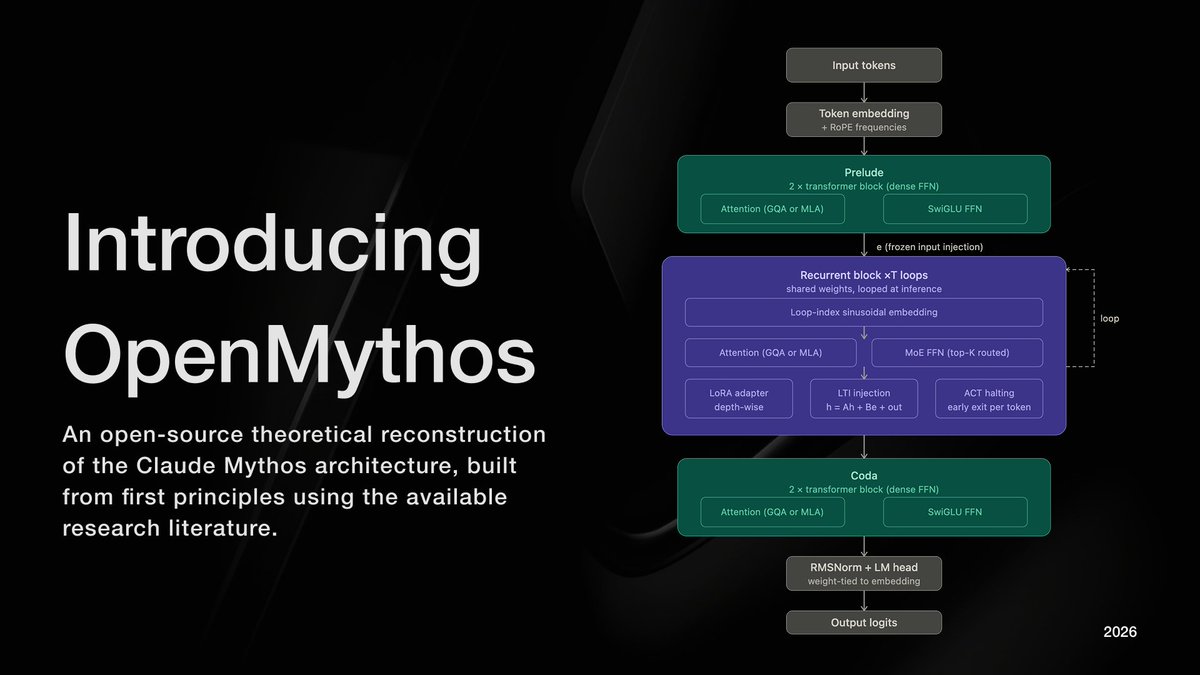
Introducing OpenMythos
An open-source, first-principles theoretical reconstruction of Claude Mythos, implemented in PyTorch.
The architecture instantiates a looped transformer with a Mixture-of-Experts (MoE) routing mechanism, enabling iterative depth via weight sharing and conditional computation across experts.
My implementation explores the hypothesis that recursive application of a fixed parameterized block, coupled with sparse expert activation, can yield improved efficiency–performance tradeoffs and emergent multi-step reasoning.
Learn more ⬇️🧵
@IPRoyal_proxies Don't buy their proxy service. When you lose connection, they'll give you useless troubleshooting steps just to drag things out past the 24-hour mark so they can refuse a refund. And even if you file a refund request within 24 hours, they'll sidetrack you with irrelevant topics.
Orbit AI Satellite Successfully Achieve World’s First Orbital AI Deployment and Launching Digital AI Sovereignty
Decentralized Orbital AI Network Orbit AI @OrbitAI_OAI today announced that the first satellite, “OAI Genesis-1,” has successfully launched and entered Low Earth Orbit (LEO).
Amidst fierce competition from tech giants (e.g., Starlink @Starlink@elonmusk , Google AI Project Suncatcher) in space AI computing, this launch signifies Orbit AI’s position as the first to achieve real-world AI deployment, formally inaugurating its "Orbit AI Cloud Platform." Genesis-1 is equipped with NVIDIA @nvidia AI Compute Cores, running a 2.6B parameter AI model for real-time analysis of infrared remote sensing data in space. By processing data on orbit, Genesis-1 drastically reduces critical information retrieval time (e.g., disaster alerts, maritime monitoring) from hours to mere seconds, while cutting transmission bandwidth costs by over 90%. Furthermore, Orbit AI has partnered with from energy company Powerbank (NASDAQ: SUUN) (https://t.co/kSyxCFsaU0), utilizing infinite solar power to achieve carbon-neutral computing and projecting a reduction in overall energy operational costs by 60%.
Following its triumph at the @BNBCHAIN Hackathon (https://t.co/hZMEHaceua), Orbit AI protocol is committed to creating an ultimate censorship-resistant deployment environment: Developers can deploy AI models, privacy applications, financial algorithms, and even blockchain nodes on the satellite network. This ensures that code and data operate in a physically isolated, neutral environment beyond the jurisdiction of major nations, guaranteeing extreme digital sovereignty and service resilience. Orbit AI will also leverage the RWA (Real World Assets) mechanism to allow community users to purchase satellite NFT shares, becoming co-owners of this space infrastructure and sharing in its compute revenues, thus building a community-owned orbital AI economy.
Coinbase will add support for Toncoin (TON) on The Open Network. Do not send this asset over other networks or your funds may be lost.
Spot trading for Toncoin (TON) will go live on 18 November 2025. The opening of our TON-USD trading pair will begin on or after 9AM PT, if liquidity conditions are met, in regions where trading is supported.
MoonshotAI has released Kimi K2 Thinking, a new reasoning variant of Kimi K2 that achieves #1 in the Tau2 Bench Telecom agentic benchmark and is potentially the new leading open weights model
Kimi K2 Thinking is one of the largest open weights models ever, at 1T total parameters with 32B active. K2 Thinking is the first reasoning model release within @Kimi_Moonshot's Kimi K2 model family, following non-reasoning Kimi K2 Instruct models released previously in July and September 2025.
Key takeaways:
➤ Strong performance on agentic tasks: Kimi K2 Thinking achieves 93% in 𝜏²-Bench Telecom, an agentic tool use benchmark where the model acts as a customer service agent. This is the highest score we have independently measured. Tool use in long horizon agentic contexts was a strength of Kimi K2 Instruct and it appears this new Thinking variant makes substantial gains
➤ Reasoning variant of Kimi K2 Instruct: The model, as per its naming, is a reasoning variant of Kimi K2 Instruct. The model has the same architecture and same number of parameters (though different precision) as Kimi K2 Instruct and like K2 Instruct only supports text as an input (and output) modality
➤ 1T parameters but INT4 instead of FP8: Unlike Moonshot’s prior Kimi K2 Instruct releases that used FP8 precision, this model has been released natively in INT4 precision. Moonshot used quantization aware training in the post-training phase to achieve this. The impact of this is that K2 Thinking is only ~594GB, compared to just over 1TB for K2 Instruct and K2 Instruct 0905 - which translates into efficiency gains for inference and training. A potential reason for INT4 is that pre-Blackwell NVIDIA GPUs do not have support for FP4, making INT4 more suitable for achieving efficiency gains on earlier hardware.
Our full set of Artificial Analysis Intelligence Index benchmarks are in progress and we will provide an update as soon as they are complete.
🚀 Hello, Kimi K2 Thinking!
The Open-Source Thinking Agent Model is here.
🔹 SOTA on HLE (44.9%) and BrowseComp (60.2%)
🔹 Executes up to 200 – 300 sequential tool calls without human interference
🔹 Excels in reasoning, agentic search, and coding
🔹 256K context window
Built as a thinking agent, K2 Thinking marks our latest efforts in test-time scaling — scaling both thinking tokens and tool-calling turns.
K2 Thinking is now live on https://t.co/YutVbwktG0 in chat mode, with full agentic mode coming soon. It is also accessible via API.
🔌 API is live: https://t.co/EOZkbOwCN4
🔗 Tech blog: https://t.co/n7xxaszqzF
🔗 Weights & code: https://t.co/4ukcXB0iP6
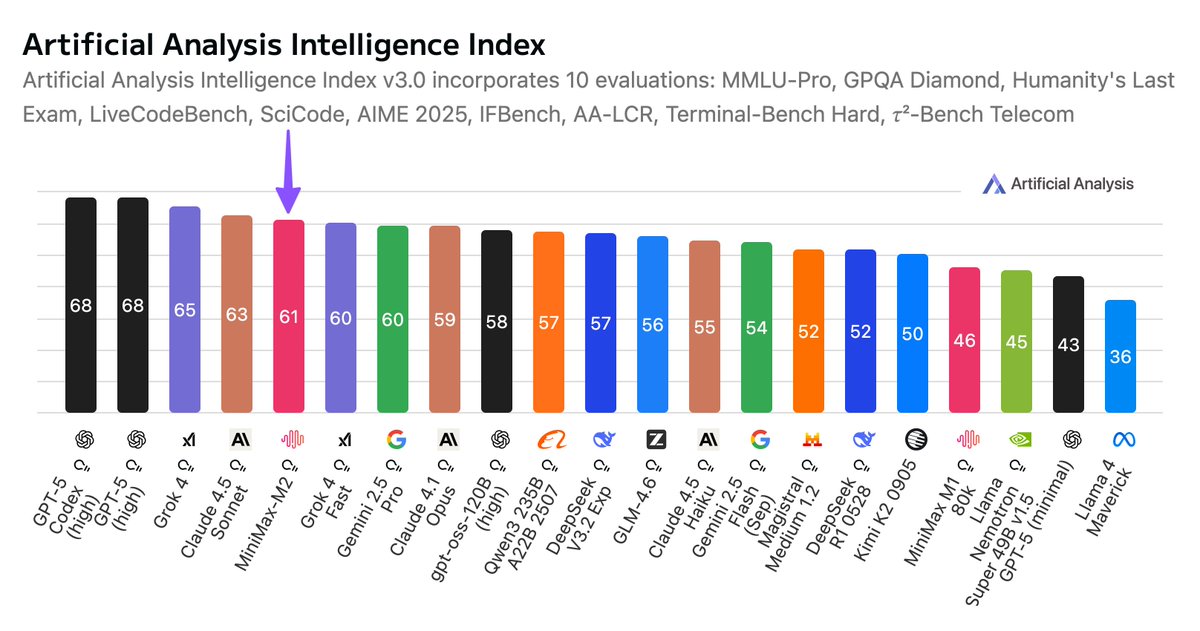
MiniMax’s M2 achieves a new all-time-high Intelligence Index score for an open weights model and offers impressive efficiency with only 10B active parameters (200B total)
Key takeaways:
➤ Efficiency to serve at scale: MiniMax-M2 has 200B total parameters and is very sparse with only 10B active parameters per forward pass. Such few active parameters allow the model to be served efficiently at scale (DeepSeek V3.2 has 671B total and 37B active, Qwen3 has 235B total and 22B active). The model can also easily fit on 4xH100s at FP8 precision
➤ Strengths focus on agentic use-cases: The model’s strengths include tool use and instruction following (as shown by Tau2 Bench and IFBench). As such, while M2 likely excels at agentic use cases it may underperform other open weights leaders such as DeepSeek V3.2 and Qwen3 235B at some generalist tasks. This is in line with a number of recent open weights model releases from Chinese AI labs which focus on agentic capabilities, likely pointing to a heavy post-training emphasis on RL. Similar to most other leading open weights models, M2 is a text only model - Alibaba’s recent Qwen3 VL releases remain the leading open weights multimodal models
➤ Cost & token usage: MiniMax’s API is offering the model at a very competitive per token price of $0.3/$1.2 per 1M input/output tokens. However, the model is very verbose, using 120M token to complete our Intelligence Index evaluations - equal highest along with Grok 4. As such, while it is a low priced model this is moderated by high token usage
➤ Continued leadership in open source by Chinese AI labs: MiniMax’s release continues the leadership of Chinese AI labs in open source that DeepSeek kicked off in late 2024, and which has been continued by continued DeepSeek releases, Alibaba, Z AI and Moonshot AI
See below for further analysis and a link to the model on Artificial Analysis
TON 开发者:分享你对 Tolk 1.0 的反馈!
⬇️立即填写问卷:
链接:https://t.co/JjWjRyw6yL
TON 基金会正在收集意见,以改进 Tolk 1.0 —— 一门专为 TON 智能合约设计的新编程语言。🔧✨
这份简短的调查问卷(⏰不到 6 分钟)将帮助塑造 TON 的开发工具、文档和开发者体验。
💡分享你的想法,指出不足之处,并直接影响 TON 智能合约的发展。
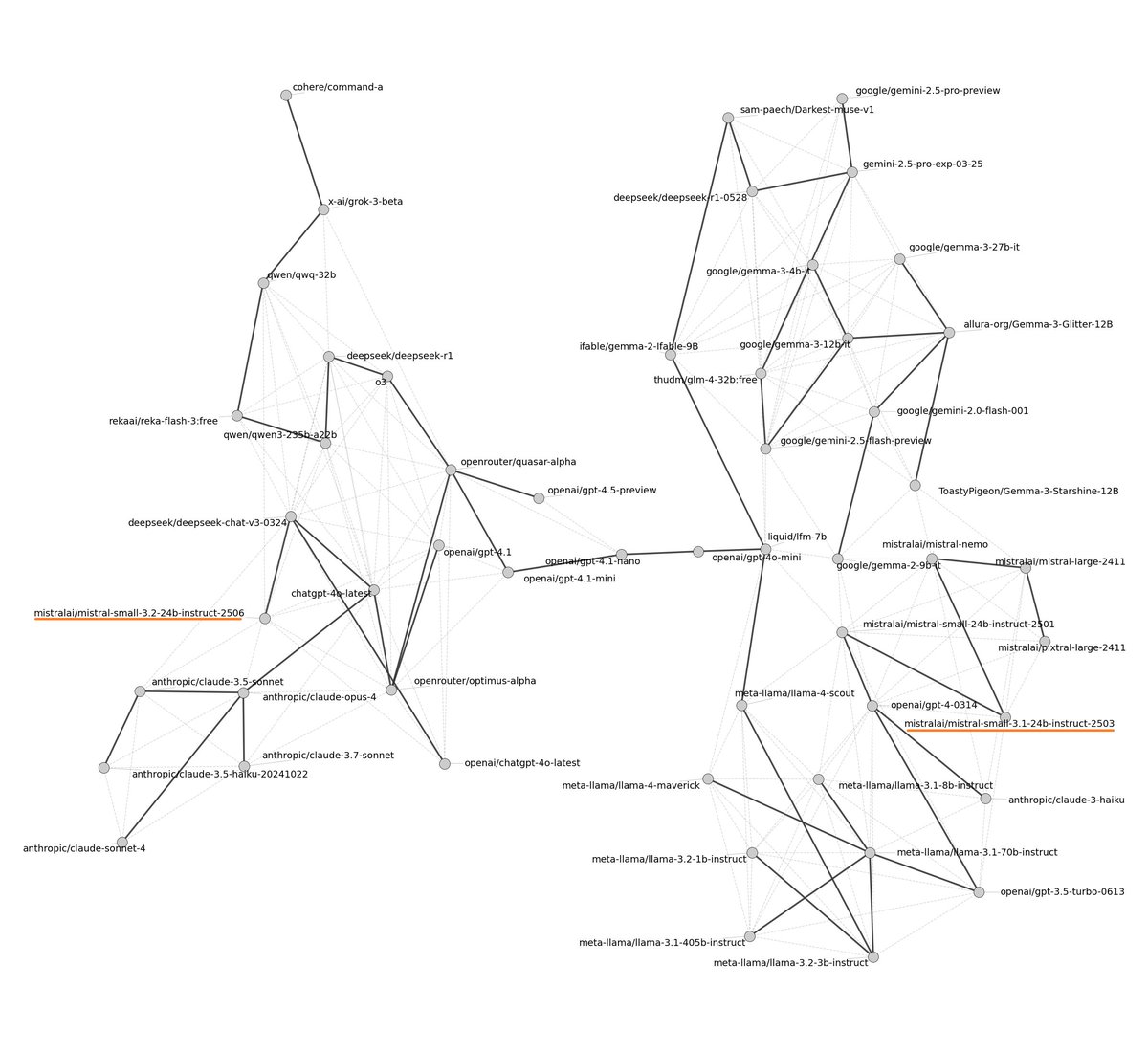
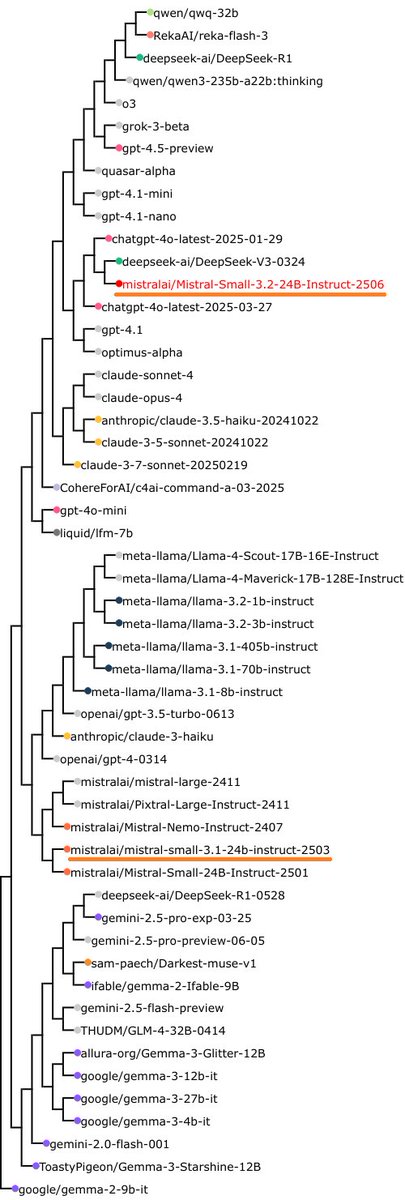
Been seeing some chatter that the new mistral small 3.2 writes a lot like deepseek v3. This analysis of their slop profiles confirms.
I think the network representation here makes a bit more sense than the phylo tree, given the complicated nature of model lineages.
Today, we bring you TON (The Open Network) dataset, now available in the AWS Public Blockchain Datasets. This new dataset provides researchers, developers, and analysts with free access to comprehensive data from TON blockchain, enabling advanced analytics and research to drive innovation in the blockchain ecosystem.
@ton_blockchain
https://t.co/5qSna5G7xB