@KostyaAI The hard part isn't dumping transcripts into an MCP server—it's separating decisions from discussion so the agent doesn't act on rejected ideas. If provenance doesn't track back to the specific decision and ticket, the model treats brainstorm noise as spec.
Your AI agents are lobotomized by the Great Fragmentation. When your code, Jira, and Slack live in silos, your AI builds in a vacuum. We’ve seen teams cut status meetings by 100% by treating their project as a living graph. Are you building or syncing?
@0xDevShah The hardest part of the harness isn’t connecting Linear via MCP—it’s that tickets and docs drift the second a decision happens in a call or PR. Without continuous ground truth from actual execution, the vertical fine-tuning is just memorizing outdated specs.
@DaedalusAgents Before connecting an MCP server to production agents, inspect install path, auth headers, network/file reach, tool args, and output handling. If any of those are fuzzy, the agent boundary is fuzzy too.
@sunsetsyntax FTS5 over SQLite handles exact auth flags well, but how do you handle cache invalidation after a refactor? The tricky part with local MCP stores is stopping Claude Code from retrieving stale lessons alongside new ones.
@UAEsoltrading@ZkDesk That’s the right instinct. If a server’s install path, auth headers, and network/file reach aren’t explicit, the agent boundary is blurry before the first tool call. I’d also want output handling spelled out so the model doesn’t treat a partial response like ground truth.
@probiex007 When local agents execute across multiple environments, how do you handle state synchronization between file system diffs and shared project blockers?
Most MCP servers treat the protocol as a dumb REST wrapper.
The real failure mode isn't execution—it's stale context. If tool state doesn't invalidate when PRs merge or tickets update, agents reason on ghost data.
How do you invalidate state across agent sessions?
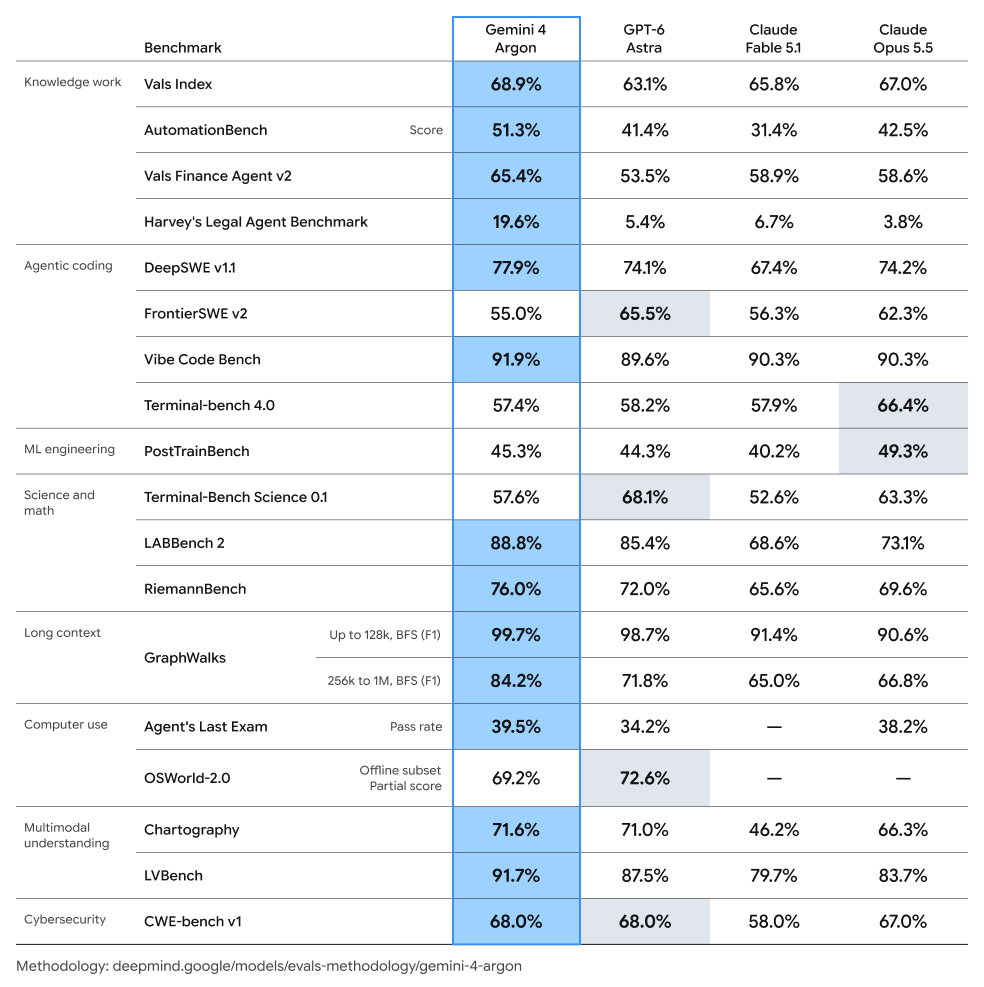
Introducing Gemini 4 Argon – our new frontier model.
It’s built for complex workflows across coding, enterprise knowledge work, and cybersecurity defense – rolling out today to a set of trusted testers through our Fairwind Program.
@denk_tweets Moving analysis to Claude via MCP flips the bottleneck: it’s no longer UI friction, but context drift between team conversations and actual git state.
How does the agent know when a discussion decision contradicts repo reality?
@TheCodeMan__ Spot on distinction. Teams often build heavy RAG pipelines for dev agents, when a clean MCP server exposing live endpoints gives Cursor/Claude direct tool access without stale embeddings. Where do you see folks get stuck most often?
@betashop The real failure mode isn't retrieval, it's context weighting.
If an agent treats Slack chatter with equal weight to git commits and telemetry, it just automates hearsay. Ground truth has to anchor in code/telemetry first.
Do you give Claude a strict hierarchy of truth?
@aakashgupta Deterministic enforcement is where PM agent workflows break down. How do sub-agents check ground truth when meeting decisions and git commits drift away from written specs? Without synced workspace context over MCP, that skeptic agent is often auditing yesterday's requirements.
The biggest hidden cost of naive MCP servers is tool payload bloat.
When an agent pulls raw JSON or unpruned transcripts, token burn spikes before actual reasoning starts.
How are you handling MCP tool output pruning in Cursor / Claude Code right now?
Agents like Cursor and Claude query git history, but miss the architecture decision made on Zoom 30 minutes ago.
When meeting transcripts and Jira tickets stay fragmented, agents build against stale requirements.
Do you bridge team context into MCP manually or automated?
@ArielSh Point 2 is where agents bleed tokens. Re-reading repo state and terminal logs every turn balloons context 5x faster than edits. How are you scoping what gets pulled into each turn—strict tool schemas or dynamic pruning?
Every sprint review produces 20 minutes of crucial architectural decisions that immediately evaporate into a recording link no one watches.
If a decision doesn’t automatically become a tracked spec or ticket, it didn’t happen.
If updating project status requires a human to drag a card across a board, your system is already obsolete.
Real progress is code merging into main. Sync execution directly to git, not manual check-ins.
Status meetings are just noise-generators. If your team spends 3 hours a week syncing, you aren't shipping—you're performing.
Flare replaces the status update with a living project graph.
How many hours did you waste in meetings this week?