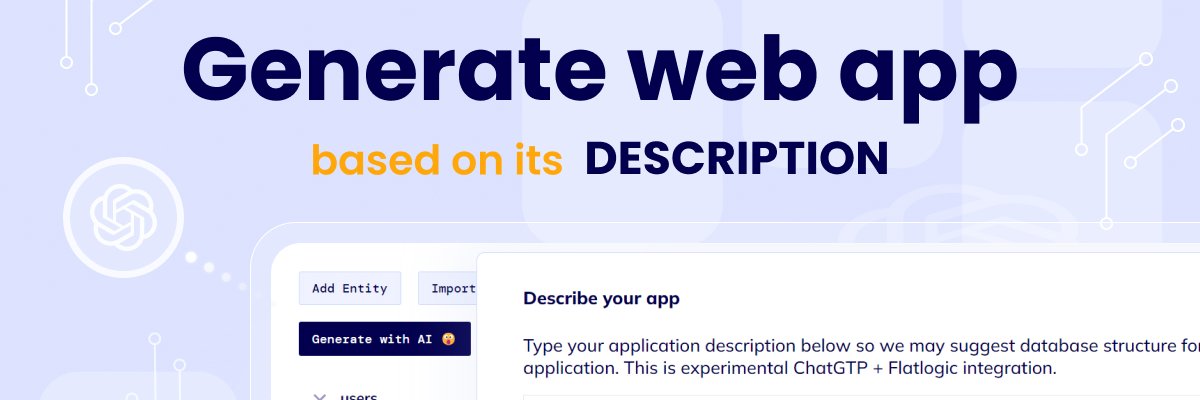
Easily generate web-based applications using plain English. You get front-end, back-end, and database, all connected and deployed to the Cloud.
https://t.co/rIwXfcMlpz
You own the Source Code, gaining the speed of Low-Code while keeping the flexibility of Custom Development.
@BoboZivkovic@PiikLabs That retail background is a real advantage. At @flatlogic , we’d start from domain pain: which repeated operational problem has budget behind it, and which AI capability would customers actually trust enough to pay for?
@kushmergedeck At @flatlogic , the pattern we keep seeing is this: AI founders can build almost anything now, but the expensive mistake is choosing the wrong capability. The real discovery question is what customers already need badly enough to pay for and adopt.
@James_M_South This is where discovery and adoption meet. If customers won’t trust the AI-built workflow after launch, it was never a paid capability, just a prototype. At @flatlogic , we’d validate that trust boundary before treating it as product.
@i_mika_el The feature worth paying more for is usually the one tied to a workflow customers already feel pain around. At @flatlogic , we’d validate whether users would pay for that AI capability before deciding it belongs in the product.
@iamvibecoder@X@claudeai@OpenAI For AI SaaS builders, the hard question is not what can we automate? It’s which workflow has enough pain, budget, and trust for customers to adopt it. That’s the discovery problem @flatlogic helps founders answer.
@kloss_xyz This works because it forces the product to face a stranger, not the builder’s assumptions. At @flatlogic , we’d use the same logic earlier: can users understand, trust, and value the AI capability before more product work happens?
@clicknify This is the right question. For AI SaaS, early paying users should shape capabilities, not just the roadmap. At @flatlogic , we’d study why paid users chose the product before deciding which AI feature deserves more build time.
@rohitdotmittal Vertical AI SaaS needs more than AI in a category. The discovery question is which workflow has budget, urgency, and repeated use. At @flatlogic , we'd pressure-test that before months go into building the wrong capability.
@BoboZivkovic@PiikLabs That retail background is a real advantage. At @flatlogic , we’d start from domain pain: which repeated operational problem has budget behind it, and which AI capability would customers actually trust enough to pay for?
@kushmergedeck We’re looking at this from the discovery side at @flatlogic : before building the AI feature, which customer workflow is painful enough to pay for, and where have existing tools already failed? That answer matters more than another feature list.
@kloss_xyz This is a useful test because it forces the product to face a stranger, not the builder’s assumptions. At @flatlogic , we’d apply the same idea earlier: validate whether the AI capability is clear, trusted, and tied to a workflow customers would actually pay for.
@kushmergedeck At @flatlogic , the pattern we keep seeing is this: AI founders can build almost anything now, but the expensive mistake is choosing the wrong capability. The real discovery question is what customers already need badly enough to pay for and adopt.
@i_mika_el The feature worth paying more for is usually the one tied to a workflow customers already feel pain around. At @flatlogic , we’d validate whether users would pay for that AI capability before deciding it belongs in the product.
Industry expertise + AI = new software opportunities. See how Flatlogic helps experts build AI-powered products. #AI#SoftwareDevelopment https://t.co/2l4sRtAXtN via @ein_news
A lot of new product ideas start with what is technically possible. That's understandable. Building is exciting.
But at @flatlogic , we try to bring the conversation back to the customer's existing reality. Is there already a painful process? Is someone already losing time? Is there a reason this matters now?
The technology only becomes valuable when it meets a problem customers already recognize.
In vertical SaaS, the best product ideas often don't sound exciting at first. They sound like some annoying internal process customers have accepted as just how work gets done.
A delayed approval. A report nobody fully trusts. A manual check before something can move forward.
@flatlogic keeps finding that these boring details are usually where the useful product opportunities live.
One of the easiest traps as a SaaS founder is mistaking excitement for evidence. A customer says the idea sounds useful, the team gets energy from it, and suddenly it feels like the roadmap is obvious.
At @flatlogic , we've learned to slow that moment down. The real question is usually not do they like it? It's what are they already doing because this problem hurts enough?
@AsaadMahmood5 The rough app is getting easier to copy. At @flatlogic , we think the harder-to-copy part is buyer insight, workflow depth, onboarding, and the product constraints that make it useful inside a real business.
@allwellai Custom fields are where workflow reality shows up. It’s rarely users want one more field. At @flatlogic , we often see it as evidence that the product needs to match how the customer’s process actually works.
@tonytonggg The demo is cheap now; the durable workflow is still expensive. That’s why at @flatlogic we think founders should validate the exact capability customers will pay for before turning an AI prototype into a full SaaS product.