@Esychology Excuse my poor Eng. I mean the NCAs still encoded course info of image, right? Im thinking of using NCAs or handcraft a "physical rule", and all appearance shared that (decided by gene). Or maybe add another hierachy such as FlowLenia - NCAs - rendering NNs. Just brainstorming
Im thinking about similar things and realize that, if the goal is ONLY to recon a image, one can just grow a local coords map (as cell state) by a simple rule, and map (x, y) to a image (simply sampling). Sure the dynamic won't be cool, but they are basically the same.
Neural CAs are amazing, but they've never scaled past low resolution.
We propose a simple solution that allows an ~8x resolution boost with minimal extra parameters.
The core idea: Treat cells as local neural fields instead of pixels.
Try the demo: https://t.co/Nnq8VFOGbB
🧵
@Esychology Sure! I'm very impressed by how beautiful and high-res it can produce with such small size. My perspective is a bit different cuz' I want to use NCA to make interaction design or even game. So I'm thinking about decoupling dynamics & rendering, to obtain more control.
Vibe coded a rhythm analysis app. Unlike other similar tools, no. of pulses and phase offset can be set individually for each track, suitable for poly-rhythms. Analysis panel implements key concepts from the book "The Geometry of Musical Rhythms".
https://t.co/K7gu3unEoa
Using head pose estimation to control character to move/orient; 2 mice to control 2 weapons.
Quite intuitive operability. Feels like VR, but with no special device.
Going to impl another melee combat demo, which might be more suitable for this operation.
#gamedev#indiegame
Working on several game concepts with "DOUBLE MOUSE" (& one foot on joystick to move). Here's the 1st one.
Cam & Weapon r controlled separately. Imaging u r a robber and cops surrounded u, u need to keep them within view and escape.
That's my first try. Well it's really tough🤣
Working on several game concepts with "DOUBLE MOUSE" (& one foot on joystick to move). Here's the 1st one.
Cam & Weapon r controlled separately. Imaging u r a robber and cops surrounded u, u need to keep them within view and escape.
That's my first try. Well it's really tough🤣
I like python because it uses the keyword "self", which explicitly expresses "self-consciousness". But the underlying "functional" implementation means that self-consciousness is just illusion.
I mean the characters are human performing living in a game world, but not really living.
After all, my hope is still to see a totally new language emerged by RL and evolution algorithms.
GPT for character is metafictional. Their knowledge exceeds the system of the game. Character can know 'table', but cannot know 'table leg' if table object cannot be separated or table leg cannot be implicitly interacted in the game. Language is projection of world.
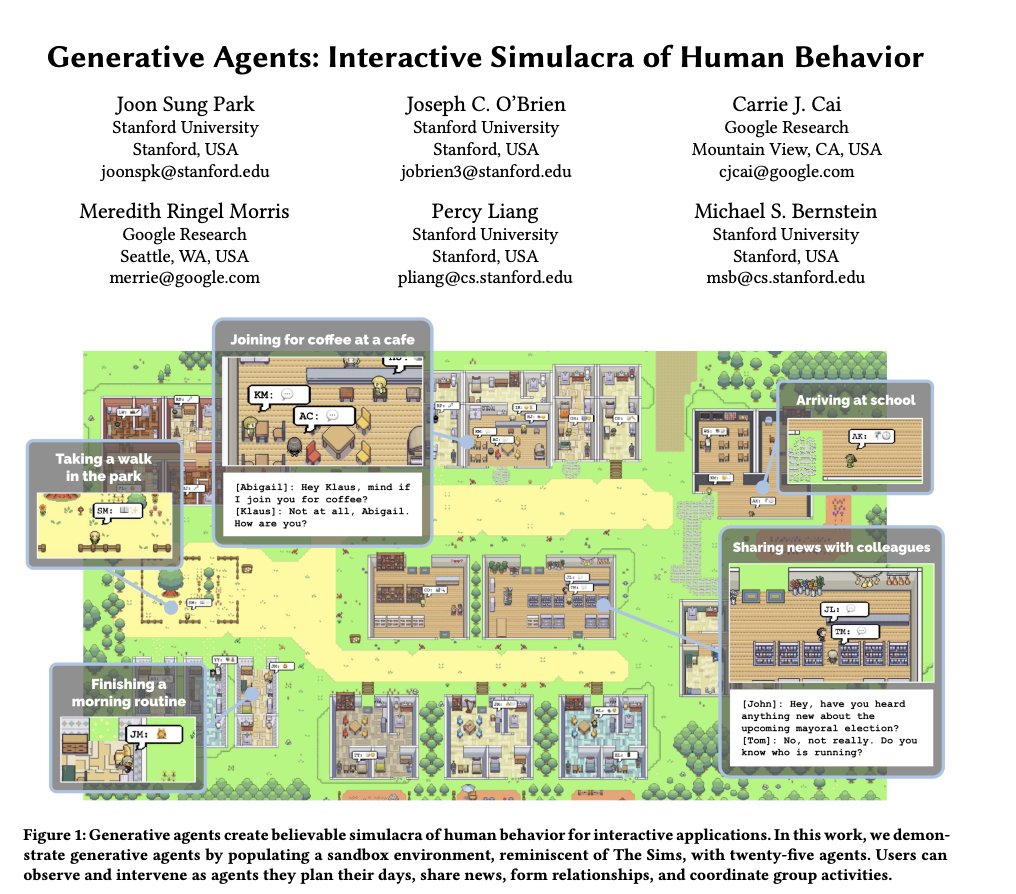
Here is another simulation run (~ 2 days). The blue creatures here are equipped with sensors not only for the fruits, but also for their peers. They now seem to act in a more coordinated way.
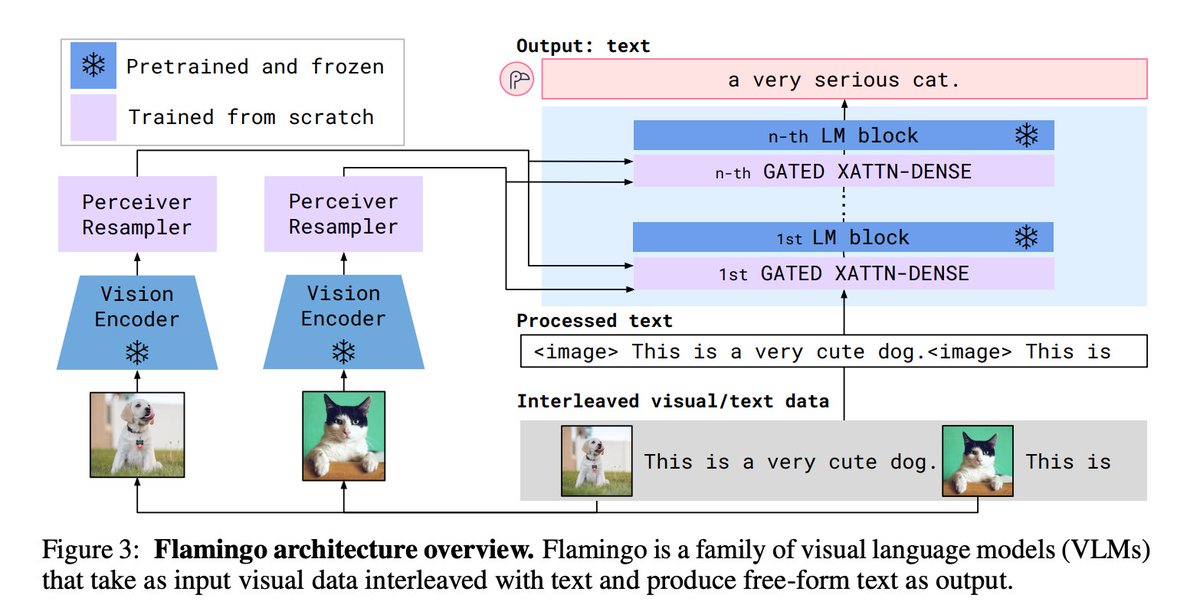
We are reproducing Flamingo, a vision and language model developed by Deepmind (https://t.co/GeLI64VN71).
We spent a good amount of time fighting training divergences (aka "instabilities"). Surprisingly, even at the ~2-3B scale.
Some learnings from overcoming these 🧵:
@AjdDavison@AalokPat Thanks to your awesome paper!
Makes sense. I'm not familiar with planning but used to work on local obstacle avoiding algos, e.g. RVO, which analytically calculate collisions, so I noticed this as a big difference.
I just done it and it's surprisingly fine! (but my code is slow😂
I'm new to probability stuffs, so it takes some time to learn and implement. Found this a fascinating approach for planning! Though delta t needs to be tuned according to max velocity and robot radius, otherwise 'tunneling' may occur.
https://t.co/vhblCkZVOR
Using Gaussian Belief Propagation as in Robot Web, we now show dynamic multi-robot *planning* via p2p comms, no central solver needed. In a scaled simulation, cars slide closely past each other at motorway speeds. @AalokPat@rmurai0610, Dyson Robotics Lab, https://t.co/9EKjCNkovs
Here we go!
Microsoft introduces a multimodal large language model called Kosmos-1.
Achieves great performance on language understanding, OCR-free NLP, perception-language tasks, visual QA, and more.