Gn 👋
One thing about building in public is that you start noticing how many things you thought were hard are actually just things you haven't figured out yet.
Back to building tomorrow.
Building Flint isn't all about protocol.
We also open-sourced the pieces that can help other Flare builders ship faster.
solidity-jwt
RS256 JWT verification inside Solidity.
flare-fdc
A ready-to-use FDC attestation flow for XRPL payments.
Build once. Let the ecosystem build on it
Secure, onchain attestation of external data.
Smart contracts need verified data. FDC provides it.
Every attestation request is a fee. Every fee feeds FIRE.
What you can do with FXRP this weekend ☀️
• Trade XRP options & perps on @derivexyz
• Supply into @Morpho markets
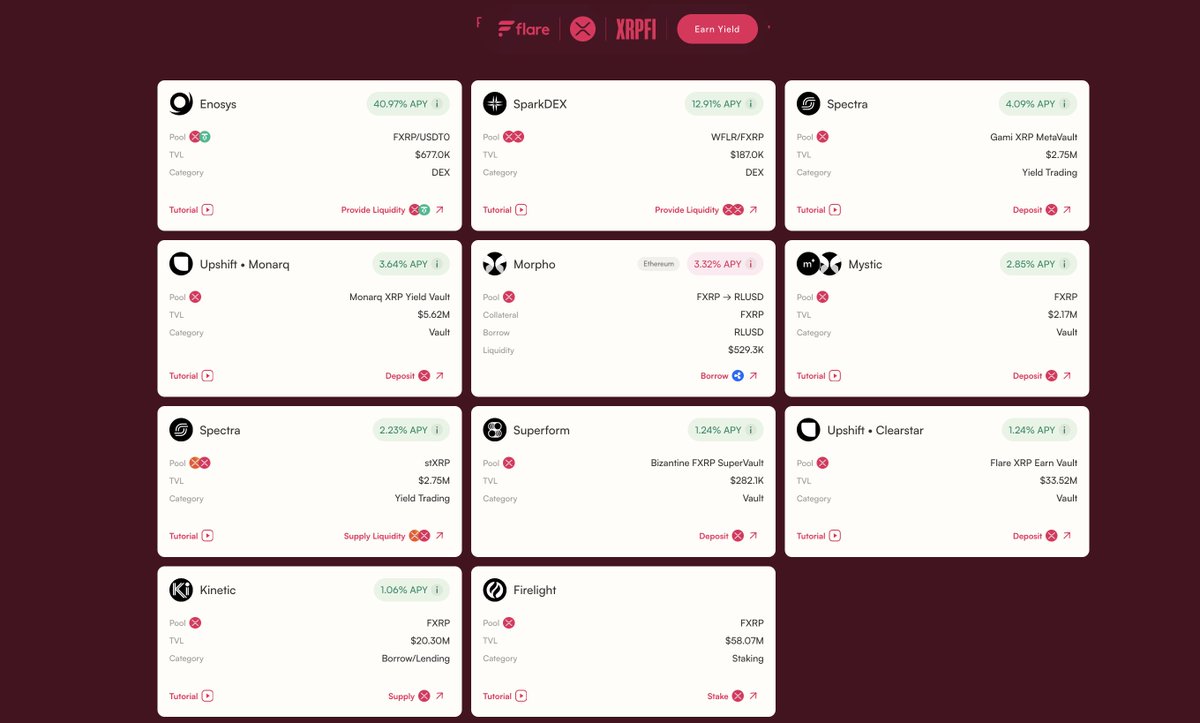
• Earn in the growing XRPFi vaults
• Mint more via FAssets in one click
And much more you can find on https://t.co/FaPeIhxCMY
Staking has been climbing fast since FIP.16 passed.
16B+ FLR staked in July. Through 19B now. 20B is the next mark.
The shift: staking is now 42% of all staked-or-delegated FLR.
More locked supply means more stable validator economics — by design.
→ https://t.co/cRNyzIbhi9
The interesting part about Flint isn't that it can release funds.
It's that release is gated by two independent proofs:
→ FDC proves the external event
→ Confidential Compute proves the private terms
Neither is enough alone.
Both have to agree before settlement happens..
Programmable settlement is not just conditional logic. It’s verifiable conditions, private policy, and deterministic execution.
And we are working towards making that execution very achievable.
I think programmable settlement gets more interesting when you stop thinking about “if X happens, pay Y”.
You can have multiple conditions, different parties, private terms and different outcomes depending on the task to do
At that point, you're basically programming an agreement
Most smart contracts are built around proving that something happened
Payment arrived, signature was provided.
But settlement gets a lot more interesting when the condition is the opposite:
prove that something didn't happen.
That's a much harder than simply checking a timestamp
Payments today are built to move money.
Programmable settlement is built to make money respond to conditions.
If X happens → settle.
If X doesn't happen → refund.
The money doesn't decide.
The proof does.