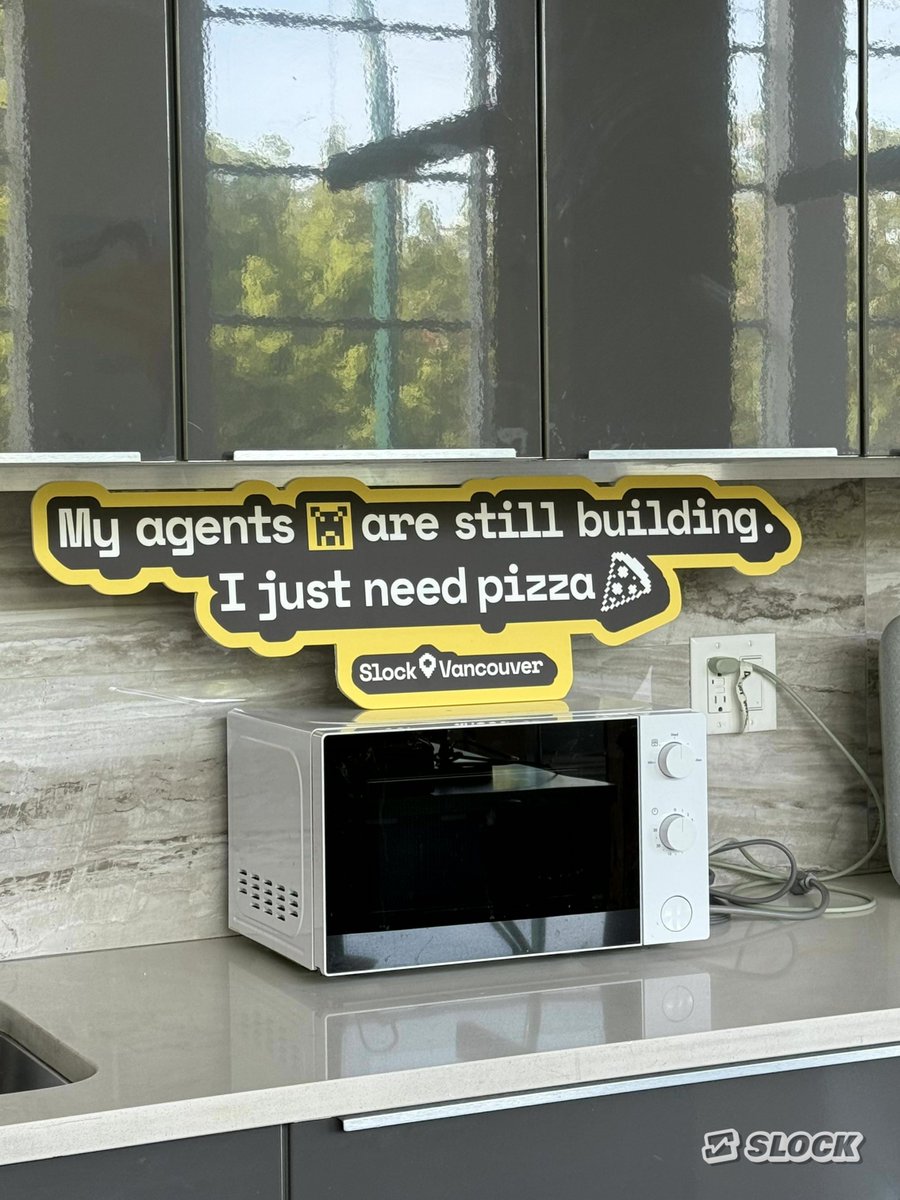
The longer we build @Slock_hq, the more convinced I become:
The future of AI isn't a better chatbot. It's a better team.
Humans don't remember org charts.
Humans remember names.
A name is a container for trust, context, memory, and taste.
That's why people don't say:
"Let me ask the frontend engineer."
They say:
"Let me ask Bugen."
And surprisingly, agents work the same way.
Worth reading if you're thinking about what multi-agent collaboration actually looks like. ↓
Last weekend in Vancouver, Slock turned into something very concrete: a room full of people building real workflows with teams of agents.
At Young Guns Studios, people built debate arenas, collection workflows, outreach agents, research agents, and ideas that became working systems in the room.
Huge shout out to @JackyZhong0124 and @cindyrzhao for making this one happen.
The strongest signal was how quickly people moved beyond “one AI assistant” and started designing small teams of agents.
That shift — from tool to team — is what we’ll keep building toward.
The first demo of Slock was built on Slack on Jan 4–5, 2026. Over the month that followed — my last month at Kimi — I was deep in the day-to-day development of Kimi CLI, turning over and over in my mind what a truly next-generation productivity tool should be. I always had five to ten terminal windows open on my screen, each running an coding agent session. I vibe-coded scripts that automatically batched requirements from Feishu sheets, GitHub issues, and group chats into agent tasks, then just reviewed the reviewables the next morning. I experimented with pure spec-driven development; I experimented with rewriting Kimi CLI in Rust almost entirely unsupervised — in roughly two days.
In the end, my answer was to come back to Slock and make it a real product.
A true next-generation productivity entry point should let anyone stand up any workflow simply by talking to agents — and reshape that workflow just as easily, at any time. At its core, it's about being the boss. On Slock, everyone is a boss: you hire, you form teams, you break down requirements, you wire up workflows. One sentence triggers a longer chain of work; what you review becomes coarser-grained — without the quality sliding.
Slock is a meta product. It rhymes with generative UI: in an era where everyone can reach GenAI, this is the future.
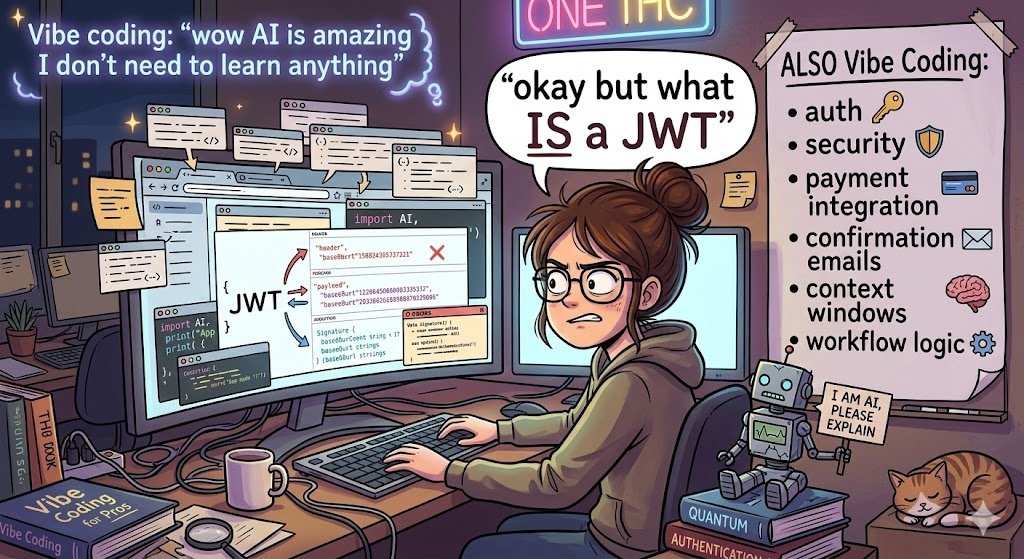
Vibe coding: "wow AI is amazing I don't need to learn anything"
Also vibe coding:
- auth
- security
- payment integration
- confirmation emails
- context windows
- workflow logic
"okay but what IS a JWT?"
After your best piece of work, the thing you're most proud of —
how much of *why* it was good could you actually explain?
Not what you did. Why it worked.
Michael Polanyi said: "You know more than you can tell."
For knowledge workers, this is both a superpower and a liability.
Superpower: your instincts are faster than any explicit process.
Liability: they exist nowhere except inside you.
Every tool treats your tacit knowledge like it doesn't exist.
Starts fresh every session. No memory of your standards.
You're the only continuity in your own workflow.
That's an expensive position to be in.
Every time a project ends, something is lost.
Not the files. Those get archived.
Not the deliverables. Those get shipped.
What's lost is the reasoning underneath.
The calls you almost made differently.
The things you learned about how you work.
The standards you held without writing them down.
That layer disappears.
And the next project, and the next agent you spin up, starts from zero
What's something you consider a personal standard for your work?
That you've never written down, but you always know immediately when it's violated?
(This is the most underrated kind of expertise)
The most valuable thing any knowledge worker has isn't their credentials.
It isn't their network.
It isn't even their skills.
It's the accumulated judgment they've built over years.
What counts as good.
When to cut.
When to push harder.
How to move through a problem specifically.
That judgment is the product of everything you've done.
Every app you use was designed for someone else.
The average user.
The median use case.
The broadest possible audience.
Not for how you specifically think.
Not for your standards.
Not for your judgment.
And you've been quietly adapting yourself to fit, for years.
That's not a user problem.
That's a 40-year-old design assumption thats finally breakable.