Want to try @solanapay with prod features like multi languages, multi tokens, store location and much more, feel free to try https://t.co/6hLrVBOuKf (merchant point of sale).
There is also a customer direct payment (if the merchant does'nt have a POS) at https://t.co/EujlDViEJm
Site web explicatif : https://t.co/VPbjzvnFE1
Paiement direct (client) : https://t.co/Knw15wUunt
Point de vente (commerçant) : https://t.co/2ygp2E9HWV
Version de Dev / Test / Demo : https://t.co/HHIhFBOv85
Gestion : https://t.co/CZA44ooxo7
+ Plein de nouvelles choses à venir ...
I’ve been “a DEV” for almost 20 years now.
Everything I built, I had to learn by doing - crafting, sweating, debugging, failing, repeating.
In the last 6 months, I haven’t written a single line of code manually.
Yet I’ve built 3 full apps, each with thousands of lines of code.
Well-architected. Unit tested. Security measures implemented. Scalable infrastructure. Production-ready systems.
Syntax overhead is dead, We are no longer devs.
We are either big-brain orchestrators or delusional builders.
RIP coding 1843–2026
@Amir0X1 For me 4.7 was doing fine. I just noticed that in previous version, 4.5 and 4.6.
Also, not using 4.7 full time cause it's taking a lot of credits.
Elon Musk avait dit un truc qui m'avait marqué sur l'allocation de ressources. En substance : passé un certain niveau de richesse, l'argent n'est plus de la consommation, c'est de l'allocation de capital.
Cette phrase change tout.
L'économie, dans le fond, c'est juste un problème d'allocation. Tu as des ressources finies et des usages infinis. Qui décide où va quoi ?
Imagine une cour de récré. 100 enfants, des paquets de cartes Pokémon distribués au hasard. Tu laisses faire. Très vite, un ordre émerge. Les bons joueurs accumulent les cartes rares, les collectionneurs trient, les négociateurs trouvent des deals. Personne n'a planifié. Et pourtant chaque carte finit dans les mains de celui qui en tire le plus de valeur. Le système maximise le bonheur total de la cour. C'est ça, la main invisible.
Maintenant fais entrer la maîtresse. Elle trouve ça injuste. Léo a 50 cartes, Tom en a 3. Elle confisque, redistribue, impose l'égalité. Trois effets immédiats. Les bons joueurs arrêtent de jouer, à quoi bon. Les mauvais n'ont plus de raison de progresser, ils auront leur part. Les échanges s'effondrent. La cour est égale, et morte. Elle a maximisé l'égalité, elle a détruit le bonheur.
Le problème de la maîtresse, c'est qu'elle ne peut pas avoir l'information que la cour avait collectivement. C'est le problème du calcul économique de Mises, formulé en 1920. L'URSS a essayé de le résoudre pendant 70 ans avec le Gosplan. Résultat : pénuries, queues, effondrement. Pas parce que les Soviétiques étaient bêtes, parce que le problème est mathématiquement insoluble en mode centralisé.
Quand Musk a 200 milliards, il ne les consomme pas, il les alloue. SpaceX, Starlink, Neuralink, xAI. Chaque dollar est un pari sur le futur. Et lui a un track record. PayPal, Tesla, SpaceX. Il a démontré qu'il sait identifier des problèmes immenses et y allouer des ressources avec un rendement spectaculaire.
L'État aussi a un track record. Hôpitaux qui s'effondrent, éducation qui décline, dette qui explose, services publics qui se dégradent malgré des budgets en hausse constante. Le marché identifie les bons allocateurs, la politique identifie les bons communicants.
Le profit n'est pas une finalité, c'est un signal. Il dit : tu as alloué des ressources rares vers un usage que les gens valorisent suffisamment pour payer. Plus le profit est gros, plus la création de valeur est grande. Quand Starlink est rentable, ça veut dire que des millions de gens dans des zones rurales ont enfin internet. Quand un ministère est en déficit, ça veut dire qu'il consomme plus qu'il ne produit. L'un crée, l'autre détruit, et on appelle ça redistribution.
Dans nos sociétés il y a deux catégories d'acteurs. Les entrepreneurs et les bureaucrates. L'entrepreneur prend un risque personnel pour identifier un problème, mobiliser des ressources, créer une solution. S'il se trompe il perd. S'il a raison, ses clients gagnent, ses employés gagnent, ses fournisseurs gagnent, l'État collecte des impôts. Il est la cellule de base du progrès humain.
Le bureaucrate ne prend aucun risque personnel. Son salaire est garanti. Au mieux il maintient une rente existante. Au pire il la détruit par excès de réglementation, mauvaise allocation forcée, incitations perverses qui découragent ceux qui produisent. Mais dans aucun cas il ne crée.
Regarde les 50 dernières années. iPhone, internet civil, SpaceX, Tesla, Google, Amazon, Stripe, mRNA, ChatGPT. Toutes des inventions privées, portées par des entrepreneurs, financées par du capital risque. Pas un seul ministère n'a inventé quoi que ce soit qui ait changé ta vie au quotidien.
La France est devenue le laboratoire mondial de la dérive bureaucratique. 57% du PIB en dépenses publiques, record absolu. Une administration tentaculaire, une fiscalité qui pénalise la création de richesse. Résultat : décrochage face aux États-Unis, à l'Allemagne, à la Suisse. Fuite des cerveaux. Désindustrialisation. Dette qui explose.
Et le pire c'est que la mauvaise allocation s'auto-renforce. Plus l'État prélève, moins les entrepreneurs créent. Moins ils créent, moins il y a de base fiscale. Plus l'État s'endette et taxe. Boucle de rétroaction négative parfaite. La maîtresse pense qu'elle aide, et chaque année la cour produit moins.
Dans nos sociétés, ce sont les entrepreneurs, toujours, qui font avancer la civilisation. Les bureaucrates au mieux maintiennent une rente, au pire la détruisent. Aucune société n'a jamais progressé en taxant ses créateurs pour subventionner ses gestionnaires.
La question n'est jamais qui a combien. C'est qui alloue le mieux la prochaine unité de ressource pour maximiser le futur de l'humanité. La réponse depuis 200 ans n'a jamais changé. Ce ne sont pas les fonctionnaires.
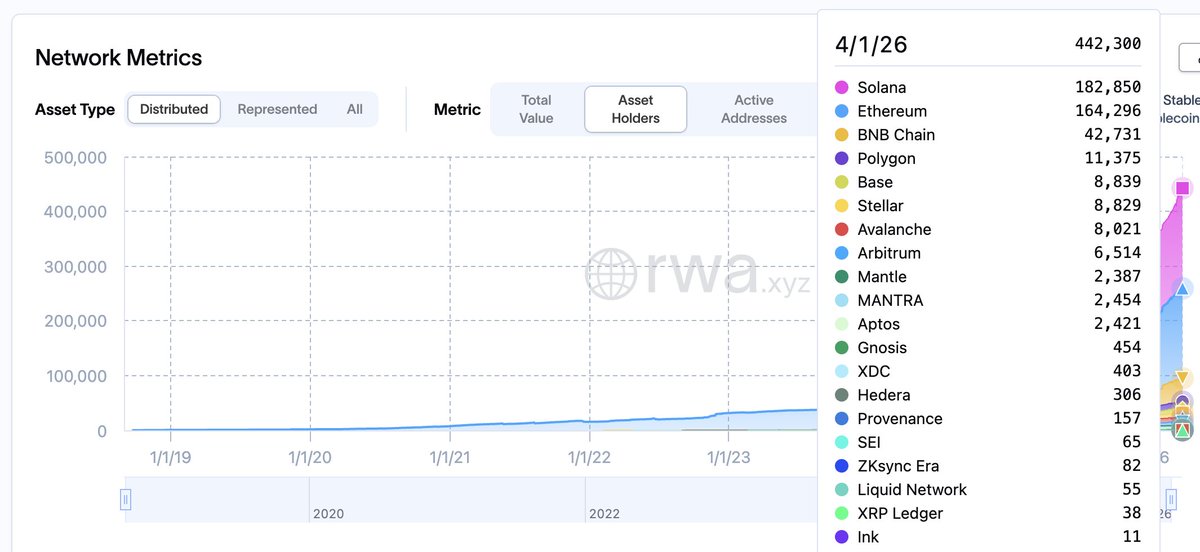
Other chains have a narrative-focused approach to RWAs: lots of represented value but no usage.
Solana is where institutions go to find real distribution for their assets.
In the last year, Solana climbed to #1 in both total (41% market share) & active holders (44%) in RWAs.
No matter how you look at it but the core benefits of blockchain as a technology have always been:
- permissionless > anyone from anywhere can get access
- ownership > you actually own it onchain so no external party can take it away
- trustless > everything is verifiable and based on proof not on claims
- immutability > data can’t be changed or retroactively adjusted
- decentralization > data is always available because no reliance on centralized servers
This unlocks massive opportunities far beyond financialization and speculation.
Self-custody is something hundreds of millions of people still don’t understand simply because no one ever explained it to them.
And even those who ‘use crypto’ mostly rely on centralized exchanges that completely cancel these self-custody benefits. Which means they don’t really get what blockchain actually is.
But here’s the problem: most people outside the bubble have no idea these unique technological blockchain properties even exist, buried under endless noise about rugs and scams.
Because the entire market is screaming one thing: get rich fast.
That’s exactly why we’re building around a different narrative focusing on unique benefits that only blockchain can deliver.
Because for most people anything related to crypto still feels scary.
So the main task is to deliver these benefits through products that highlight and are built exactly around them to finally break through that wall of distrust.
Narrative Different.
@beeman_nl Following your advice, that I always enjoy, I tried GPT5.3 codex, X-High.
It didn't convince me at all. Took ages to do things and didn't even finished properly. On the contrary, Opus 4.6 did the job flawlessly.
Maybe I didn't use it properly...
Many parallels between late Rome and America.
Rome was an enormous egalitarian capitalist empire. Starting from an organic tribe, it expanded to conquer huge swaths of territory and assimilate countless foreign tribes under its system of laws.
Then it gradually lost the distinction between the core and the periphery, by expanding the definition of citizenship (eg Constitutio Antoniniana in 212) and thus diluting it. Mass immigration to the imperial capital meant the Romans become confused about what Rome even was.
Christianity arose as a revolutionary ideology on the edge of empire and eventually the emperor himself (Constantine) converted to Christianity in 312.
The last ditch attempts to reverse the imperial overstretch and currency debasement with “extreme” measures by hard men instituting hard money (Aurelian, Diocletian) only worked temporarily. Because fundamentally the empire was just too capital-inefficient and internally divided to survive the burden of real taxation. So it ultimately fell to German “barbarian” outsiders, with half of it continuing in the East.
All of that maps to today’s America.
The Internet is analogous to Christianity, as it arose on the edge of empire and has disrupted it from within.
The Chinese are like the Germans, barbarians disrupting the empire from without. The debasement of the dollar and the sudden reinstitution of hard money will cause a similar sovereign debt crisis.
The overseas Anglosphere, particularly India, is like Byzantium, in that it has millions who understand the empire’s systems deeply but aren’t dependent on the central empire itself.
Also, just as Byzantium tolerated Christianity better than Rome, India has tolerated the disruption of the Internet better than America. Like Byzantium, it has more of a tradition of tolerating a zillion different ideologies within it, and India has also fused the Internet with the state (UPI, Aadhar) much as Byzantium fused Christianity with the state (eg caesaropapism).
Anyway: in the fullness of time, something great did get rebuilt after Rome’s collapse: the Holy Roman Empire, in a German-dominated Europe with Christian influence.
The main thing is that after the collapse of Rome, Christianity was reconfigured into a stabilizing religion and the Germans were at the center of Europe rather than a barbarian class.
That’s similar to what is to come with the Internet and China. After the end of the American Empire, sad as that will be, the Internet gets reconfigured into a stabilizing system (rather than a purely disruptive one) even as China becomes the economic center of the world (rather than a barbarian outsider).
But there was a Dark Ages after the fall of the Roman Empire, and there may be something similar after the fall of the American Empire.
It might not last thousands of years, because everything happens faster today, but we should boot up the monasteries and start copying the scrolls just in case.
Yesterday in data on @Solana:
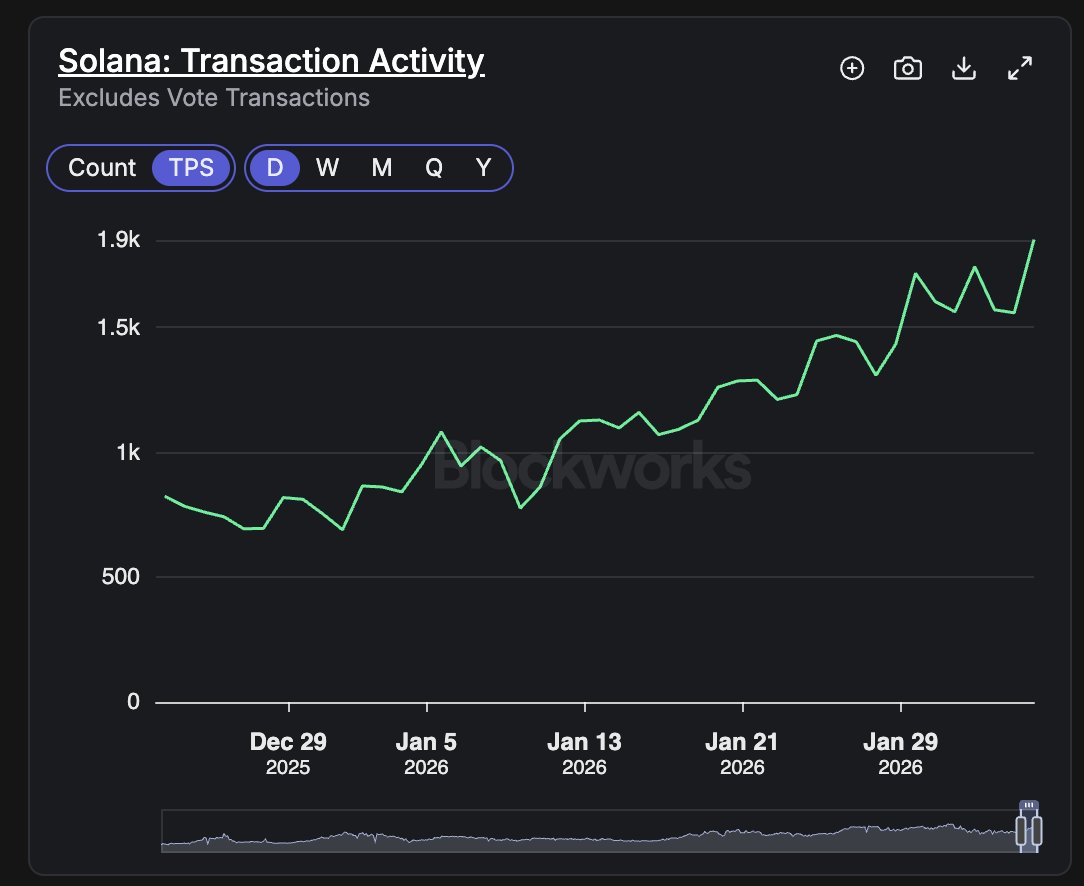
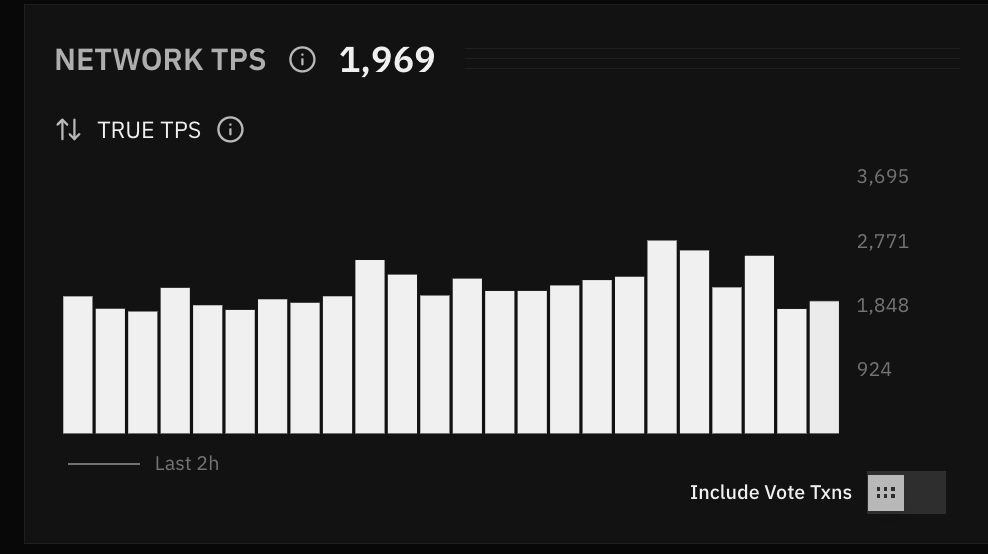
- Sustained an average of 1852 TPS (ATH)
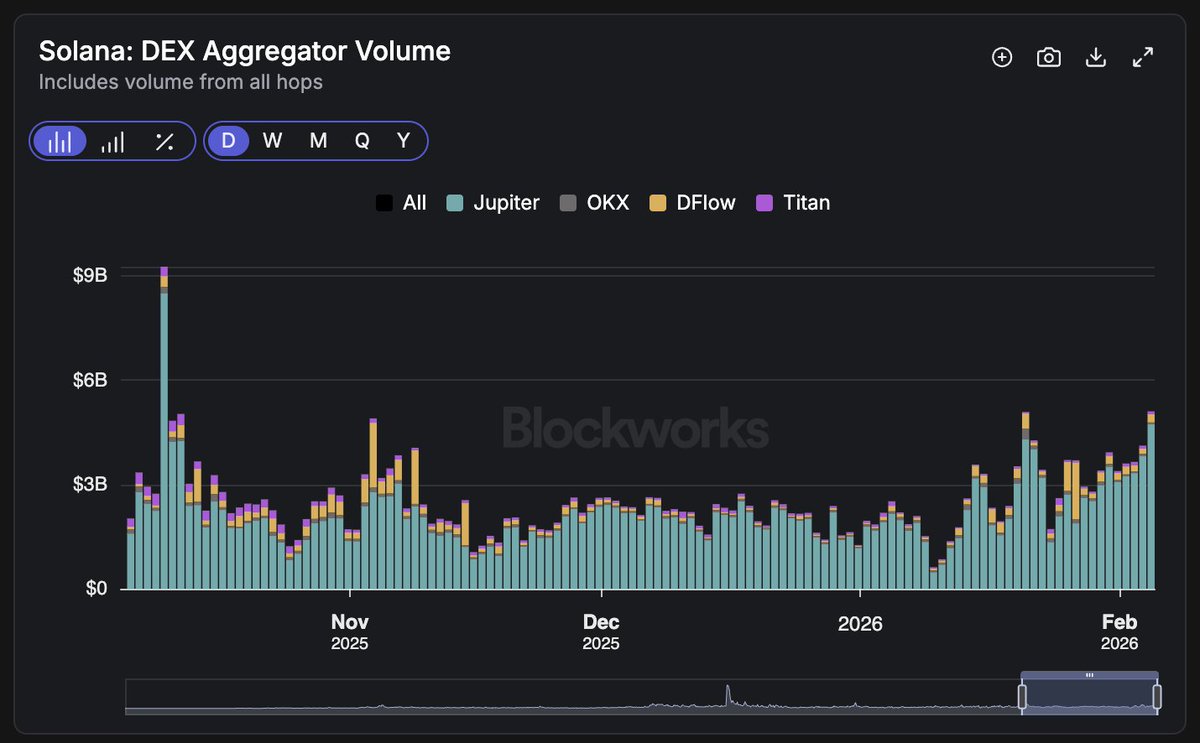
- Biggest day for aggregators since 10/10, implying a ton of retail users came to trade
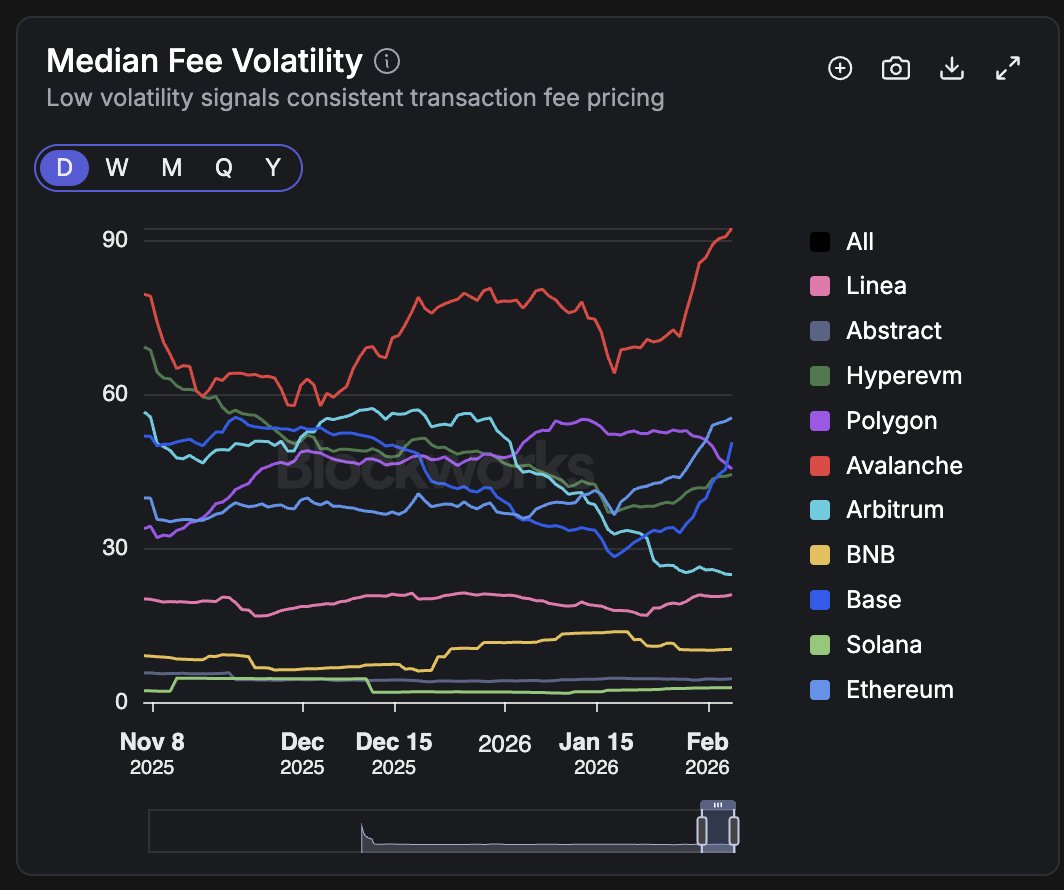
- Fee volatility remained the lowest across all chains, and median fees were the lowest across all major chains at $0.000487
Basically, Solana reached never before seen usage and yet users paid predictably low fees for execution
During this same period, Base experienced inclusion delays, with many users reporting the chain was unusable, and the median fee users paid to transact was 26x (!!!) that of Solana's
Other notes:
- ATH on tokenized stock volume
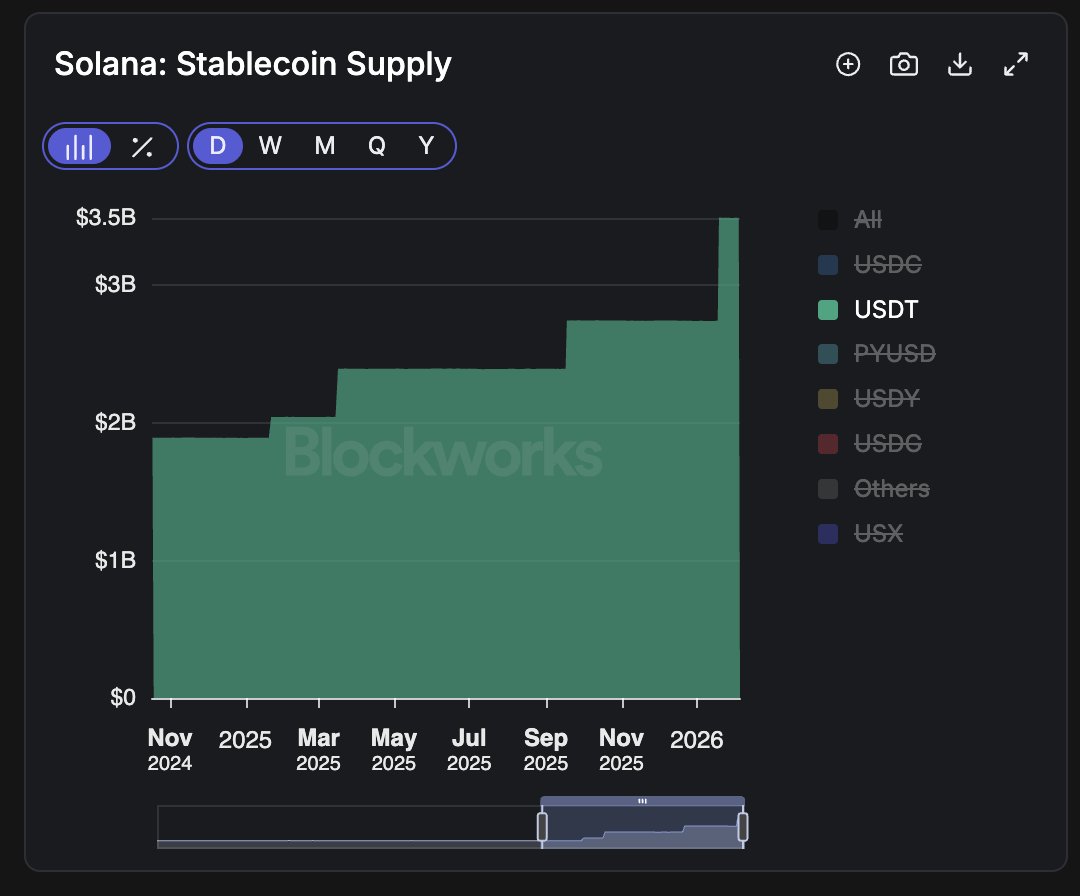
- Record USDT availability on Solana, crossing over $3b in supply for the first time
- Excluding 10/10, biggest day for some foreign wrapped tokens including Ethereum, and HYPE on Solana had it's biggest volume day ever
- More wallets made a transaction on Solana than all other chains combined yesterday
it is now feb 6, which means it's been 2 full years without a Solana outage (and technically 3 full years without a perf-related one)
we're also now doing 2k tps on average, which would've been impossible during mass volatility not long ago
job's not finished, but worth noting
Two milestones for @solana with last week's market volatility:
- Jan 30 was the highest activity day of all time on Solana, with 148 million non-vote transactions. For reference, that's 30% more than Cardano has processed in its entire history. In a single day.
- Last week was the biggest activity week of all time with almost 1 billion transactions on the network and sustaining 1,505 non-vote TPS on average. For reference, that's about as many transactions as Ethereum has handled in the last 2 years total.
THE GOLDEN AGE
The fiat crisis has begun. So what wins in the end: gold, digital gold, or some other kind of precious metal or cryptocurrency? Only time will tell, and different assets have different failure modes, but here are some thoughts.
(1) First: remember that Bitcoin's value proposition is seizure resistance. Not your keys, not your coins.
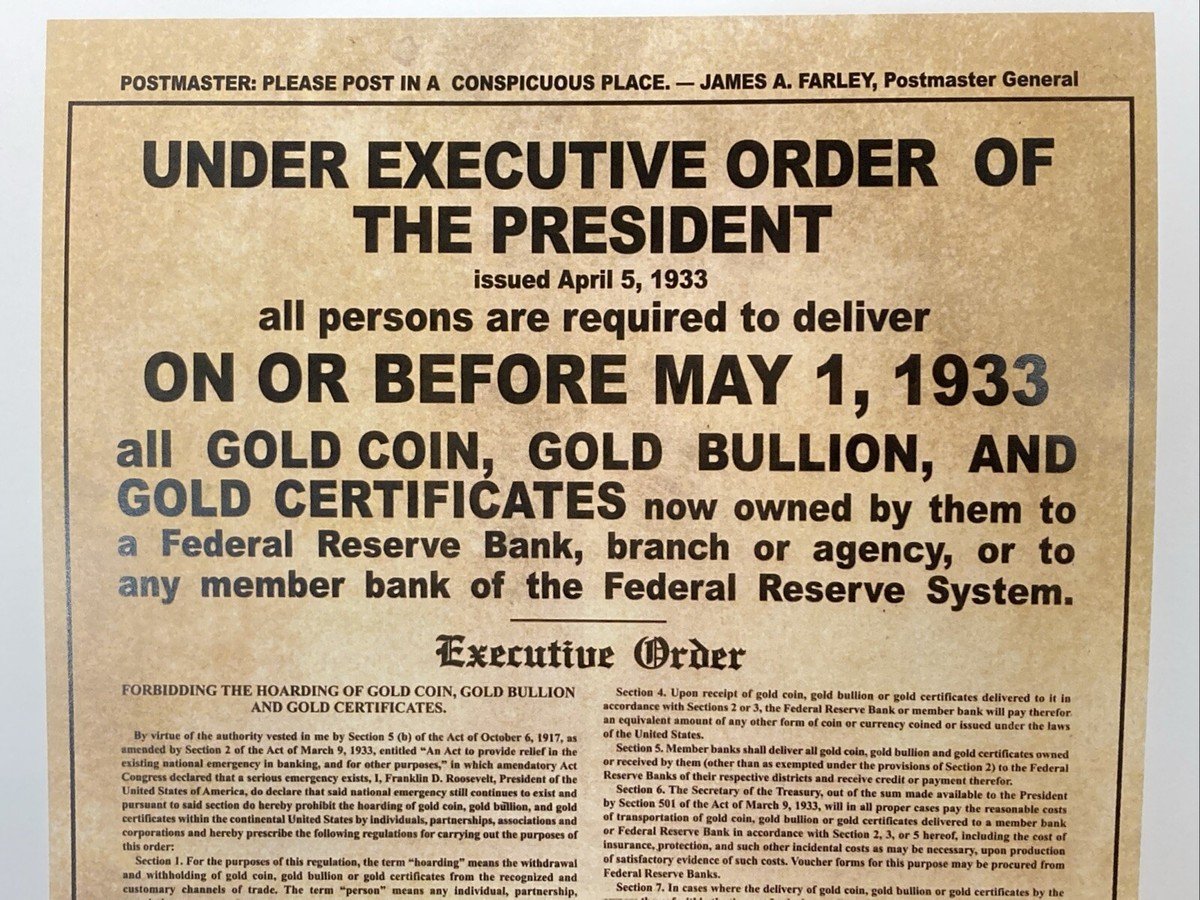
(2) To explain what that means, think through the mechanics of physical gold. It's great...if you can buy it, transport it, secure it, and sell it safely. But it's much easier to do that when you live in a highly organized state, like China. However, such a state can also track you to your doorstep to seize the gold, once it runs up in price. That's what FDR did in the 1930s and what China is fully capable of doing in the 2020s:
(3) So when you think through the game theory, as the price of gold rises, the cries to tax (or seize!) the physical gold will also rise. Note: we need not even mention paper gold here. In a true crisis, such claims are not worth the paper they're printed on. That's why many countries are repatriating their gold. Not your bricks, not your gold!
(4) By contrast to physical gold, digital gold (and cryptocurrency more generally) can be securely bought, sold, sent, and received at any time, in any amount, and in any location. It is invisible, international, instantaneous, and internet-native. And it is transportable, programmable, and easily verifiable in a way gold bricks simply aren't.
(5) In particular, digital gold is seizure-resistant in a way that physical gold is not. The same holds true for cryptocurrency as a class. Go back to the fundamentals: seizure resistance is part of why cryptocurrency was invented as an alternative to precious metals.
(6) This is not to say that physical gold won't have its day. If you live in a safe, small country like the United Arab Emirates, you may be able to buy your gold and eat it too. They probably won't expropriate property there.
(7) Moreover, it is quite likely that many countries (particularly in the East) will soon re-standardize their currencies on gold, or digital gold, or some mixture of precious metals and digital assets. As I've been noting for years, BRICs has been stacking gold bricks:
(8) However, don't overreact towards gold. The successors to the American Empire are China and the Internet. You should think of this as the past and the future replacing the present. China will replace the dollar with gold, along with physical commodities that it can touch, feel, and control. Meanwhile, the Internet will replace the dollar with digital gold, along with digital assets that it can encrypt, script, and verify.
(9) So: feel free to hedge as you see fit between the physical past and the digital future, with just one caveat: namely, you may not want to buy physical precious metals unless you're in a financially and physically secure region of the world. That probably means being outside North America and Western Europe. Because those countries are in the midst of sovereign debt crisis. And as that crisis deepens, both their failing states and their angry mobs are going to be hunting for whatever they can steal.
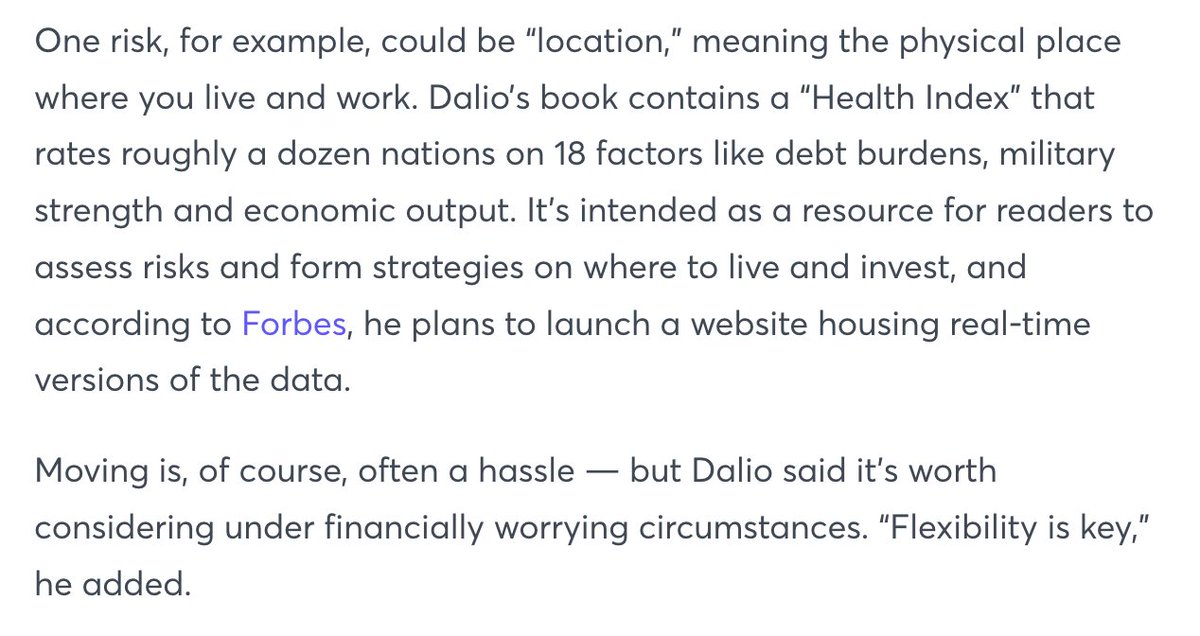
(10) In other words, what's much more important than allocation is location. Ray Dalio expressed this obliquely in one of his earlier interviews, where he said that "location" is a risk:
What Ray actually meant is: if you live in a jurisdiction that heavily depends on the dollar (which includes the entire G7), you want to get out. Because the total pauperization that follows the end of the dollar may mean that angry mobs (or government agents, or both) may come to your home, steal your assets, and perhaps rip you limb-from-limb in the process.
A cheery thought...yet also historically precedented. That's what came to Eastern Europe and Asia in the 20th century during the rise of communism. And that's what may come to North America and Western Europe after the end of Keynesianism.
Prior to such a situation, you really do not want to buy gold bricks, which you can't transport through an airport. You want to hit the bricks. You want to move faster, escape things. Get as far away from the dollar zone as you can...but physically first, rather than financially.
After all, "staying and fighting" a sovereign debt crisis caused by decades of money printing is like staying and fighting a volcanic eruption caused by decades of earth moving. You didn't cause it, and you can't stop it, but you can easily be wrecked by it. So emigrate just as the early Americans emigrated from Europe. Unless you believe the Irish Americans "betrayed" Ireland by leaving, unless you really want to spend the rest of your life paying down welfare and warfare debts you didn't incur, you should change your location out of the G7. And then do whatever allocation you like.
Or just ignore this analysis and do what you see fit. Your call, of course. If so, I really do hope my MAGA friends are right that "The Golden Age of America Begins Right Now." Because I also think we are on the verge of a type of Golden Age, and a Bitcoin Age...but in a very different way.
My biggest takeaway from Breakpoint is that Solana is not just a piece of financial technology, it is a fully functioning economy
There are dollars, real assets, metals & rare minerals, energy, info markets, manufacturing, global trade happening
There's politics, governance, and divided factions & debates over its future
Now, there's even a Solana constitution
What we are actually part of is the birth of a country that lives entirely on the internet
Today Solana is around the 157th largest country in the world by GDP, the size of Eswatini or Fiji
But because it is globally integrated, it punches way above its weight from a forex & assets perspective, integrating with the world's largest banks and financial institutions
You see Solana withstanding network attacks from nation state actors and holding its own with systems engineering instead of armies
Solana is engaged in trade with countries like Bhutan (Rank 164) and Kazakhstan (Rank 49) and the Isle of Man (Rank 154)
Solana is a digital country and I am proud to be a citizen