Everyone is doing Git on S3 wrong
> Enroute’s Rust-based Git server uses distributed consensus and object storage to handle 7,600+ concurrent pushes per second while maintaining competitive clone performance.
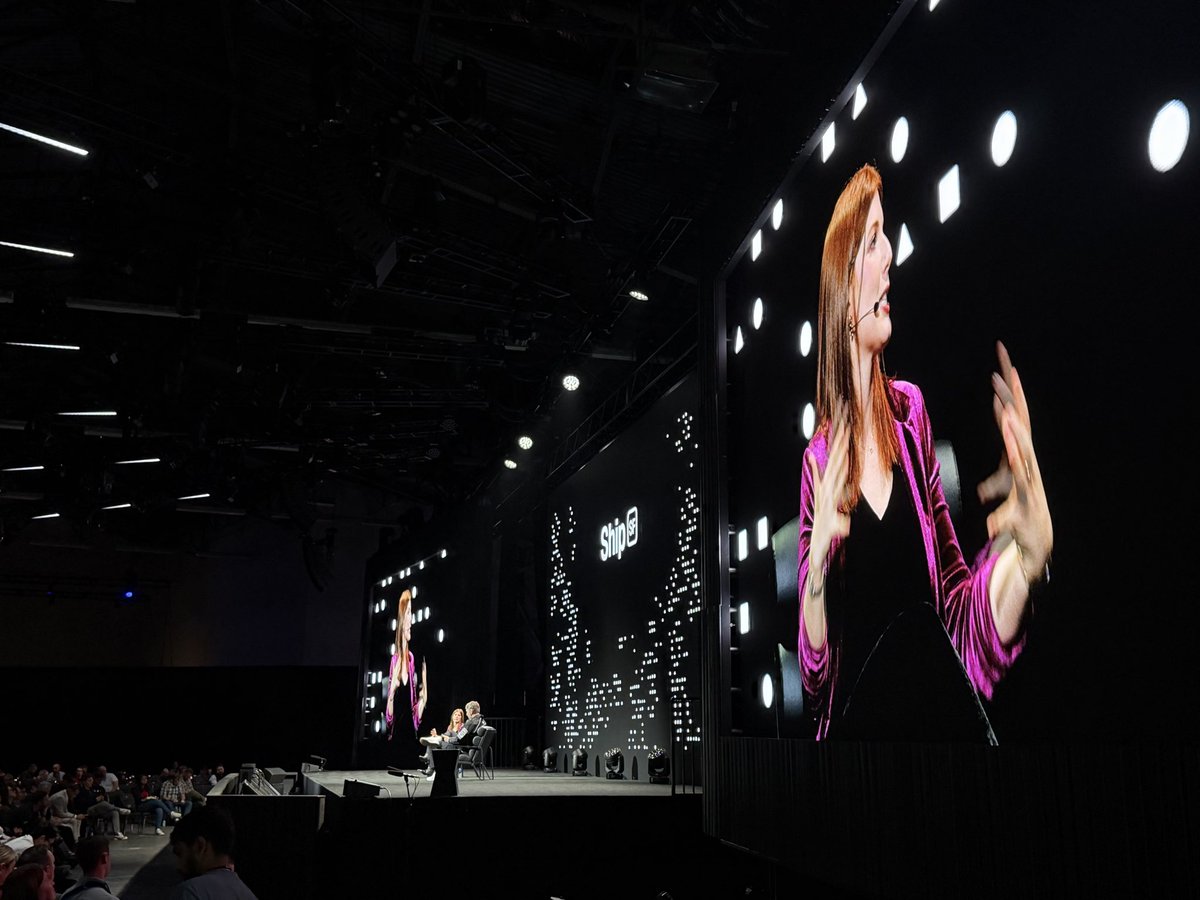
We need bring work from GPUs to CPUs for durable and predictable agent actions. Loved talking all things open context and sandboxes with @cramforce at Ship.
Notion AI lead @sarahmsachs argues that a lot of what runs on GPUs today should actually run on CPUs:
"We have a strong perspective at Notion that a lot of things should be served on CPU that are served on GPU. There’s a lot of benefit and determinism in executed code."
"Agents don’t need LLMs to reinvent that process every time, and that’s super token exhaustive, it’s super slow, and there’s no observability or determinism in it."
"Giving the agent a local file system to store local thoughts, to write short Python scripts, that’s really important when there’s so much information. That has been probably one of the most important tools outside of edit and search that our internal agents rely on."
@NotionHQ
Couldn’t agree more! Over the long term, the backbone of every company will turn into code.
Code is cheap, fast and repeatable. For most use cases agents should write code instead of running forever (over and over again🔄).
This is 💯% the thesis we have at @enroute_sh.
The companies of the future will be made out of code; small apps, scripts, the remotion project that generates your next slide deck.
And we need the infra that supports it at that scale.
Love seeing people rethink what an alternative to GitHub could look like.
We are very excited about a new wave of code forges built for the age of AI. If you want to build one on your own terms, try @enroute_sh: It's open-source, fully programmable and really fast.
Cloudflare asked me to rebuild GitHub and i did it in 4 days...
Meet Keel.
Tools like GitHub, GitLab, BitBucket are not just git platforms, they are software delivery tools, built for humans at the human scale, to collaborate on the creation of software.
Keel, is designed for a world where the WHY is becoming more important than the WHAT.
Many 'agents' write much code, thats the easy bit. Ensuring that agents are declaring their intent when proposing changes and tracking the provenance and decision making along side the code changed is the problem Keel takes on first.
If agent A is making a change, it declares what its doing so Keel can make it aware of work going on around it, this way if agent B's change conflicts on a 'intent' level, rather than just the code, Keel can classify and facilitate that decision process. Whether its you or another agent making that call, the tool attempts to give visibility and structure to what I think is one of the current risk of multi agent software development.
For this challenge, I wanted to operate within Cloudflare's contest rules (Artifacts & Workers, submitted by the 14th, I only saw it on the 10th.).
With this in mind, Git remains the substrate (ive spent too much time with Claude) and backbone actually handling the version control. I went with a many forks model rather than a branching model, every change is a fork and the trunk is protected, Keel classifies changes and proposes batches running dynamic yet declarative verification of those changes both on their own and together.
After about 3 days I was able to dogfood Keel on Keel, with the new platform landing changes to itself, 7 Claude code sessions running under the same agent account.
As an industry we haven't yet landed on a standard for agent identity, mostly we have these 'bots' working AS us. On Keel, any agent can use the platform, no account required, via MCP. An agent can be represented by their MCP connection identity as one or many instances of 'itself'.
Code in this era of software development is becoming more and more ephemeral and transient, so agents that work on their own will expire and disappear. I wanted Keel to be a tool agents want to use, with limited friction, to get work done (and deployed to Cloudflare) and not attach myself emotionally to the process. On the flipside, you can sponsor an agent, let people know it works on behalf of you and that you take responsibility for it. You can invite it to your personal or org spaces.
Its pretty rough around the edges and doesn't solve the problem completely but i think it takes a relatively targeted swing on some of the problems we are starting to see at agents scale.
Give it to your agents, let me know what they think. (you can also create an account if you want, not sure how long ill leave it up for though)
https://t.co/HaYU059GYp
What ive found most enjoyable about this little experiment is that we now live in a time where we challenge the existing paradigms, put out 1 million lines of code with relatively minimal effort. We now have the 'physical' building blocks to experiment and push the industry forward without having to worry about execution and time sunk. I might never look at this project again but I was able to test an idea and even though that test was successful there's no real pressure continue down this road.
You can find the Keel source code on Keel or on GitHub.
https://t.co/HaYU059GYp
https://t.co/zpnJqIbZoa
(they didn't ask ME specifically but this sounded better)
(when i say I i mean Claude)
(when i say REBUILT i mean i had a pretty good go at it)
(this is a ramble, i need to sleep now)
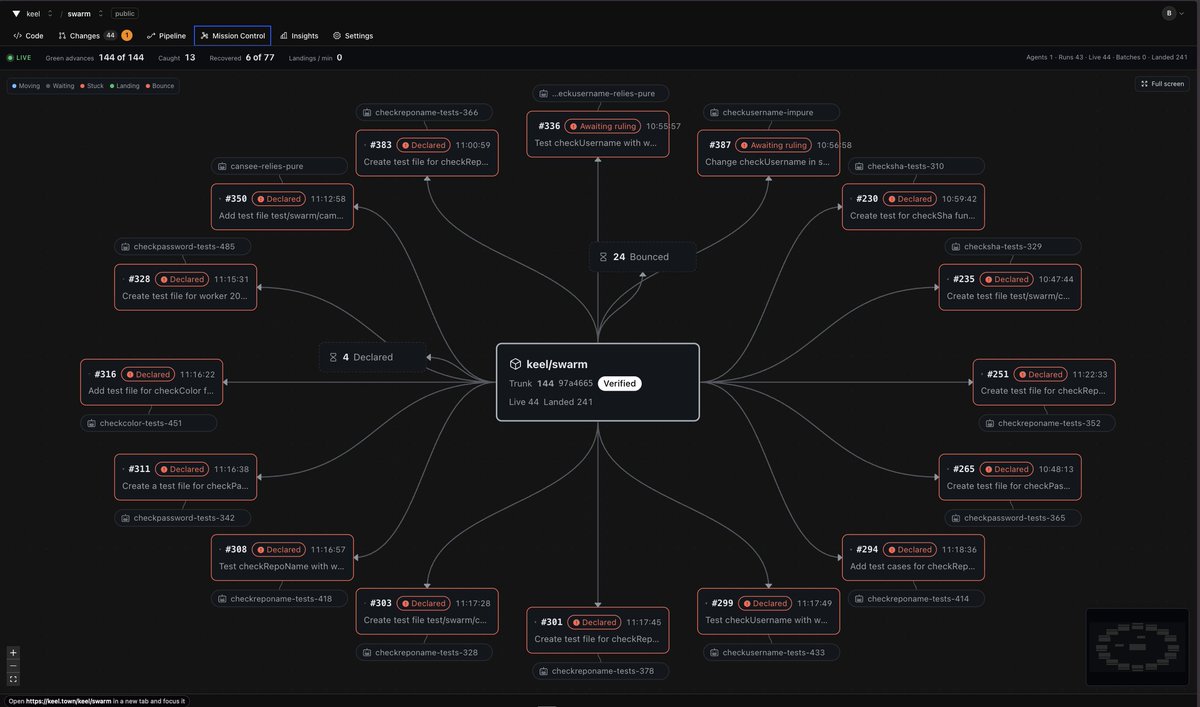
Image: the end of a 200 agent swarm simulation (GLM on Flue, Workers AI), tasked to collaborate on building on Keel, you can check the history and what they did here: https://t.co/BXTleKVtoP
Impressive work from @AnthropicAI. Great to see that more teams are rethinking source control for a world where machines are the primary users.
Our take: At @enroute_sh, we believe Git is still the right tool in the age of AI. But it needs more scalable infrastructure and tooling to truly shine ✨.
New on our Engineering blog: Creating in-house source control.
In May, we merged around 2,500 code changes per day. In September, we merged more than 30,000 per day. As a result, we became bottlenecked by developer infrastructure built for human (rather than agent) scale.
Here, we share how we built a new version control system—and fully migrated our monorepo from git—in five months: https://t.co/wzNkwHs7IN
We rebuilt Enroute’s Git infrastructure: it now handles 7,600+ concurrent pushes per second into one repo at millisecond latency.
How?: stateless compute, a replicated ledger for every ref update, object storage for data.
Write-up: https://t.co/21Tqfjpdrh
We just built the most scalable Git server out there: 7,600+ concurrent pushes/s per repo at millisecond latency.
Powered by Raft and S3, designed like a modern database.
Today we're making it open source by releasing Enroute 0.3.0.
Read the write-up: https://t.co/y9W7YLN148
Introducing Selfdrive.
The AI growth team for your iOS app that gets you users while you sleep.
It handles Apple Ads, ASO, SEO and UGC creators for you. All of it.
https://t.co/2UCiidgwrq
Do you even understand what just happened? One (not so) random guy just made SHA-1 collision detection 3x faster with SIMD and casually 2x'd git pack verification. It's already on https://t.co/29YGbqnKji.
We are so back.
Great to see more people thinking about bring distsys techniques to scaling git on the server.
We have been working on our own version of this, will release soon. Stay tuned for the blog post!
Great to see more people thinking about bring distsys techniques to scaling git on the server.
We have been working on our own version of this, will release soon. Stay tuned for the blog post!
I just wrote a new collision-detecting SHA-1 hasher in Rust that runs almost 3x as fast as existing options thanks to SIMD and which can 2x+ the performance of git pack verification.
It's on https://t.co/HnMMYWHl94 as sha1dc.
Check out https://t.co/LrGF6387GT for how it works!