📢Paper and press releases day! We report the first-ever unambiguous detection of WHIM/missing baryons in a single cosmic filament using @ESA_XMM and @JAXA_en Suzaku data! It's the first time observations agree with LCDM simulations for the nature of WHIM https://t.co/ozeCaZLjXs
Registration for our school is open!
Luca Amendola: Dark Energy
Florian Pacaud: Galaxy Clusters
Emille Ishida: Data Inference & ML
Marek Lewicki: Testing Fundamental Physics with GW
see https://t.co/zDZb5gzONV
#WSCtonale#cosmology#astronomy#passodeltonale
@Wittod2@EricLagadec Ce serait tentant, mais c'est un peu plus compliqué. Comme l'explique bien @EricLagadec , ce genre de problème s'est posé plusieurs fois dans l'histoire de la physique. Dans certains cas, il ne s'agissait que de pis aller, comme pour l'ether. Dans d'autres non, comme Neptune.
@EricLagadec@leJourJ1 Heureusement, cela ne marche plus en refaisant la mesure depuis plusieurs points du globesimultanément. Dans ce cas on obtiendrait des mesures de distance du Soleil incohérentes entre elles. Je suis surpris que les platistes n'utilisent pas ce principe comme expérience critique !
@EricLagadec@leJourJ1 Sauf que Eratosthene n'a pas démontré pas la rotondité de la terre. Il en mesure la circonférence en partant de l'hypothèse d'une Terre ronde et d'un Soleil à une distance en pratique infinie. Sur une Terre plate, on pourrait retourner l'argument et mesurer la distance du Soleil.
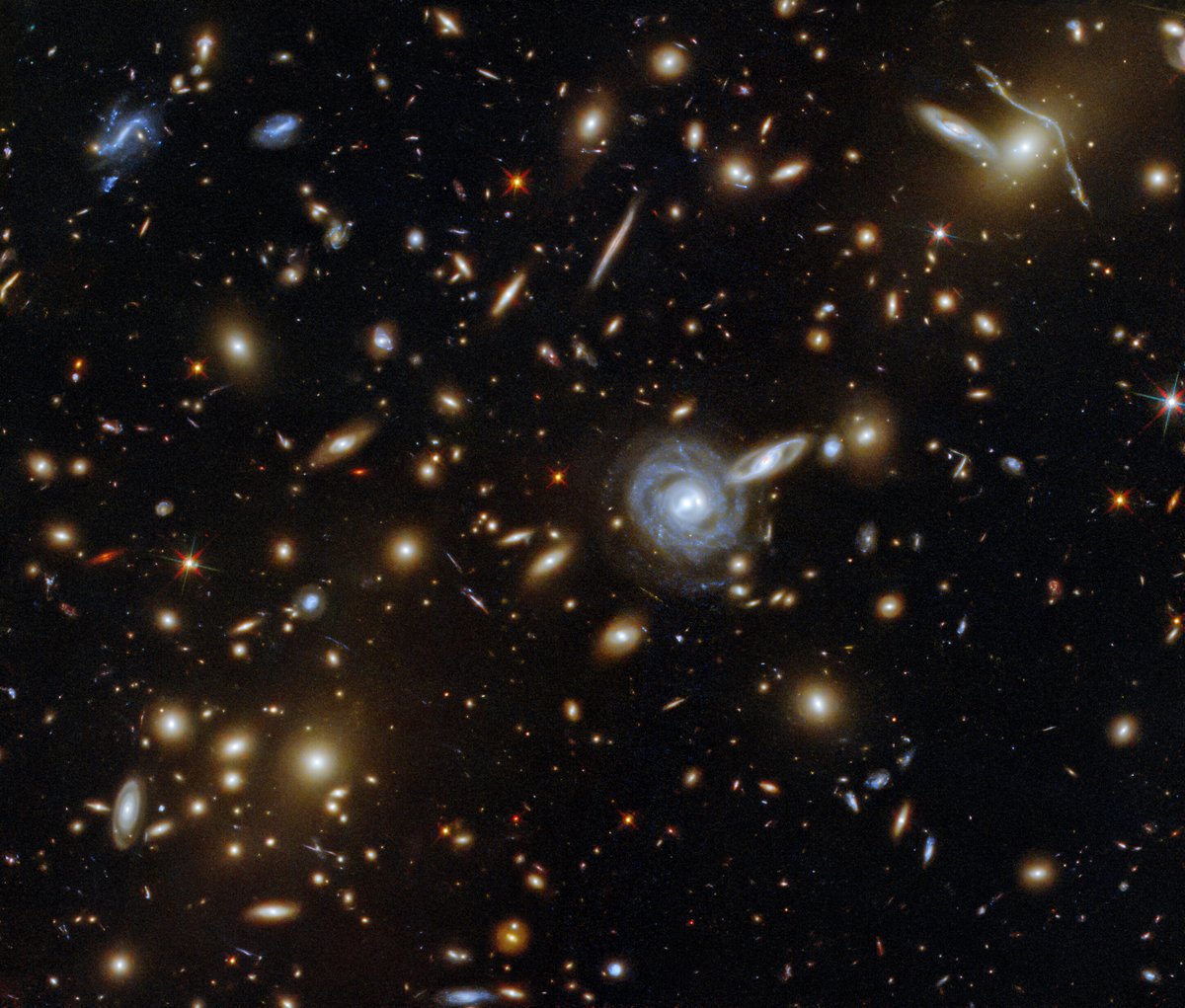
This packed ESA/Hubble Picture of the Week showcases a menagerie of galaxies: the galaxy cluster ACO S 295 and a jostling crowd of background galaxies and foreground stars.
Credit: @ESA / @Hubble_Space / @NASA , F. Pacaud, D. Coe https://t.co/Yh5RWQhdw6
📷 This NASA/ESA @HUBBLE_space Telescope image shows galaxy cluster ACO S 295, as well as a crowd of background galaxies and foreground stars.
Please take a moment and read that again, 'background GALAXIES'! Hundreds of them, each billions of stars 😮👉 https://t.co/e3ANaq9lkv
Our new cluster anisotropies paper is out today! We use 10 scaling relations to see if H0 looks isotropic locally or if there are strong bulk flows. We find an apparent 9% spatial change in H0, or equivalently, a 900 km/s bulk flow out to 500 Mpc... (1/n)
https://t.co/PkDQMgHmdd
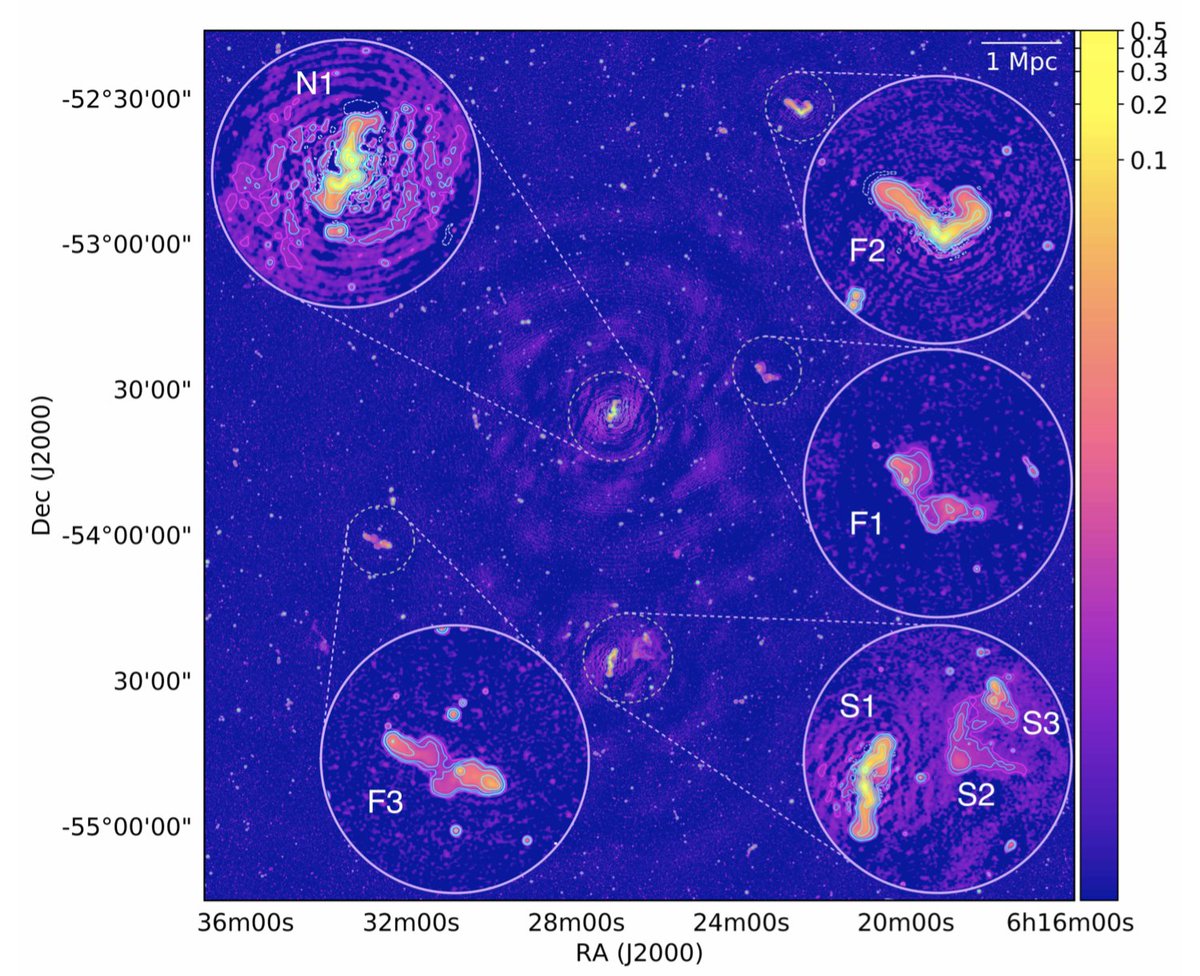
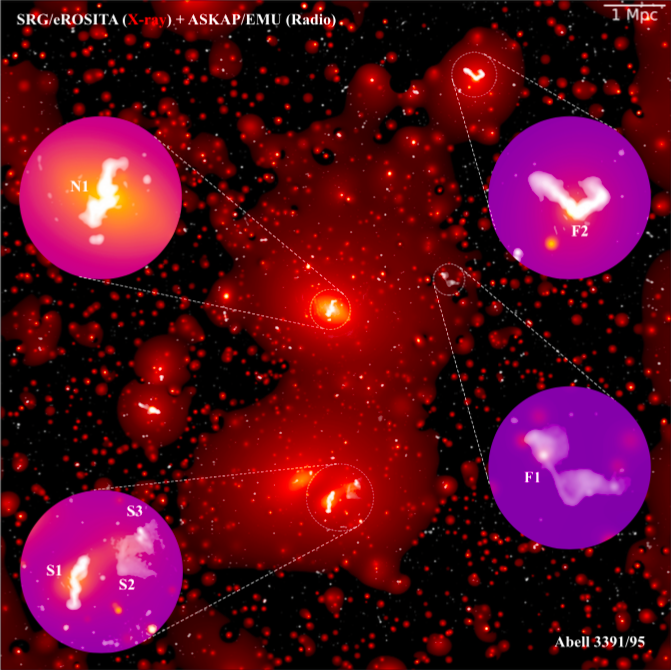
what happens when galaxy clusters are en route to collide? check out Abell 3391/95 and the new papers out today!
X-ray eROSITA (Reiprich et al. https://t.co/MMUuq4fRZN)
&
radio EMU ASKAP (Brüggen et al. https://t.co/T2OCu1eAzM)
@ThomasReiprich @eROSITA_SRG@HambObs
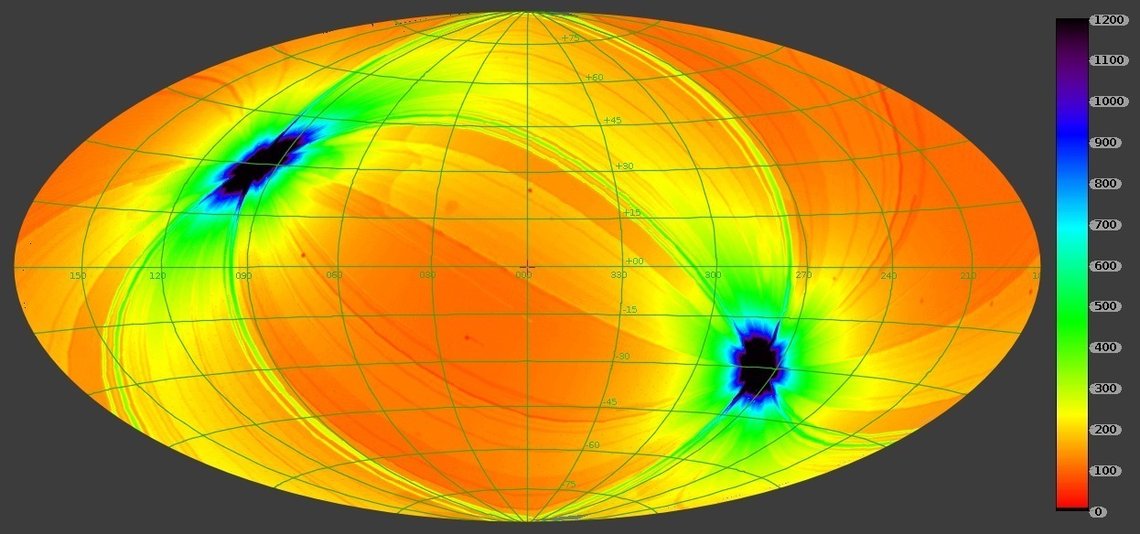
#eROSITAdventCalendar Day 16: SRG/#eROSITA completes its second all-sky survey.
Six more months of operations, a second X-ray scan of the entire sky is completed! This new all-sky picture will be used, in combination with the first one, to explore in greater detail the X-ray sky.
@AlexeyVikhlinin@eROSITA_SRG Cannot promise anything about the selection function yet, but we are working on it really hard ! Surely, the very stable instrumental background will be of help compared to what we are currently doing with e.g. @ESA_XMM .
"High-redshift galaxy groups as seen by @AthenaXobs@esa_athena / WFI" https://t.co/vqC0keYZti "Athena can detect ∼20 high-z galaxy groups with masses of M_500≥ 5×10^13 M⊙ and z≥2, and almost half of them will have a gas temperature determined to a precision of ΔT/T≤25%"
@dresrabulbul @xioxox@RiccardoSeppi I'd say Miriam and Esra, for being the funniest. Then Florian, for his ability to turn Zoom's failures into features.
@ManamiSasakiDE @vicgrinberg Same here, this is not just a woman problem ... I really wonder how so many fathers manage to appear very professional in these strange times.
@kainoeske@ESA_Euclid@NASAWFIRST@eROSITA_SRG@AthenaXobs Just so you know: we are working with the first eROSITA catalogues and intend to renew our study of cosmic anisotropy based on a larger sample with more accurate luminosities.
Results expected within 2 years. Stay tuned ...
@astrophysics @ThomasReiprich @AlexeyVikhlinin Sorry, I meant for a survey at higher z. Clearly, for z<0.1 survey, it would show in any sort of luminosity measurement.
@astrophysics @ThomasReiprich @AlexeyVikhlinin The results would rather point to H(z~0) being different in different directions. If this was coming from a local inhomogeneity, then this may very well abrage out at higher redshifts. In that case the tests you propose would not show any sign of anisotropy.