Exciting new position in my team on the intersection of human genetics, digital technologies and drug development. Work with enthusiastic & brilliant scientists like @floriansohler@creatules@alexanderhilli7 https://t.co/uV8M00lZwp
@_MiguelHernan They sampled only from Gangelt where the proportion of confirmed cases was 5% before the study, as I understand it. But Gangelt had very high testing rate as one of the first strong local outbreaks in Germany.
Das Robert-Koch-Institut sucht dringend Studenten, die den örtliche Gesundheitsbehörden helfen, Kontakte von Covid19-Infizierten nachzuverfolgen: https://t.co/F8SkpGoJA7
Great to see our work published today. https://t.co/tLMCLV2RNs @benjamin_georgi@skathire@amitvkhera We were interested in Factor XI, a target of the coagulation cascade currently in clinical development (Ph II). We used two common genetic variants, previously shown to be
On the way to https://t.co/wlcEr7bD2U in Mainz, I just passed Bonn where I had my first computer science classes with Arnold Schönhage, inventor of the famous matrix multiplication algorithm, who taught us to "never waste a factor of two".
I love train rides 😀
@jon_y_huang @uk_biobank Thank you for the suggestion. I did not know that. I really have no experience with these methods dealing with endogenous variables, but I'm trying to get my head around it.
Is there any hope to estimate the influence of a genetic variant on mortality within a disease population? Here's the typical causal DAG, as I see it. I'd like to estimate the effect of the variant on mortality in HF patients in @uk_biobank. Maybe #EpiTwitter can help?
@stevesphd@FriTagDan@uk_biobank@mendel_random ... to emulate a clinical study in HF with the variant as proxy for a treatment. As you say, selection bias is the problem, because for relevant variants we expect an effect on HF and mortality after the HF diagnosis.
@stevesphd@FriTagDan@uk_biobank@mendel_random Thanks for the reference, looks interesting. I'm not sure yet how to apply it but I'll definitely read through it.
To answer your questions: Yes, we are interested in patients with previous HF only, i.e. how does the genotype influence survival type. Basically, we would like...
Just ordered my first #betterposter on fabric, based on @mikemorrison's template. Hope it turns out nice and helps people to get the message quickly. I will present it at the cGMP conference https://t.co/hZVzZoth7v.
Next Monday in Berlin, I will present our approach to predict drug effects quantitatively using genetic data: https://t.co/EhS6TAzujh
We built a Bayesian model with @mcmc_stan to integrate data sources and provide consistent uncertainty estimates.
@ermeel_
Just published "Efficient Leave-One-Out Brier Score for time-dependent evaluation of Bayesian Survival Models", a case study where I show how to implement an efficient leave-one-out estimator of the Brier Score to evaluate Bayesian Survival Models. https://t.co/30mjbhn1IS
@Eric_Fauman@rplenge That's right. I didn't check for LD in this rather crude implementation. But it's good to see that ldlink actually has an API. I think I'll try that out.
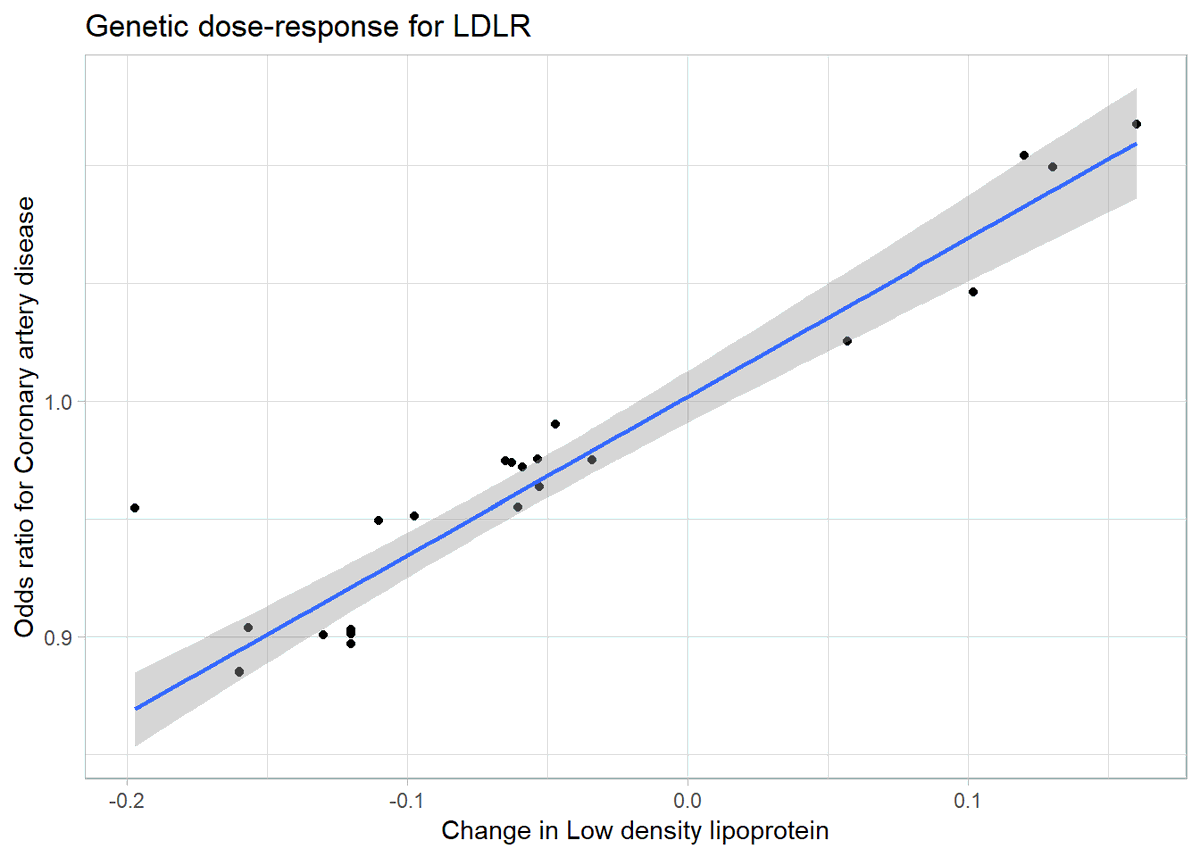
I have started a blog about my genetics side projects and how to use public genetics ressources in #rstats . The first post is about genetic dose-response curves https://t.co/GPTekr9rWm, as @rplenge likes them (in much more elaborate ways).
@davidadambarr @rlmcelreath (2/2) If a have a genetic variant that improves outcome (e.g. reduces number of myocardial infarctions), and you look at its effect in CAD patients only, you can introduce collider bias if that variant also influences CAD.
After attending a presentation by @rlmcelreath on #causalinference, I realized how relevant #colliderbias is for some of the topics I'm working on. So I wrote a little #rstats shiny app to simulate what can happen. It's terrifying 😱. Have a look: https://t.co/OcEFWSG9oA
@davidadambarr @rlmcelreath (1/n) My question would be if anti-hypertensive drugs improve outcome in patients that have CAD (maybe compared patients having kidney disease). This is still not an issue in actual clinical studies, because of the randomization, but my interest is in genetics.