@aandr314@AndrewGYork showed it to me a few years ago and we've used it since to align our OPM. Not sure if that's the original source though.
It is possible without, but once you've experienced the comfort of it you wouldn't want to do complex alignments with just hands and posts.
This is _clearly_ one of the best ideas in imaging of the decade.
I strongly encourage people to play around with this if they have a few spare hours — watching a *dye* clear a tissue in front of your eyes for the first time is an amazing experience.
Recording many image planes simultaneously is a great time saver for 3D imaging. A wonderful tool for such multifocus microscopy is @FourierPower's Multifocus Grating: Here is a short video on how they work and how to make them (without a cleanroom). https://t.co/Jq6zhvqYFB
You can read the full paper (open access) at https://t.co/dqRMvFCYPQ. Finally, thanks a lot to Jon-Richard Sommernes and @amsikking - it was a pleasure working with you on this project! 4/n
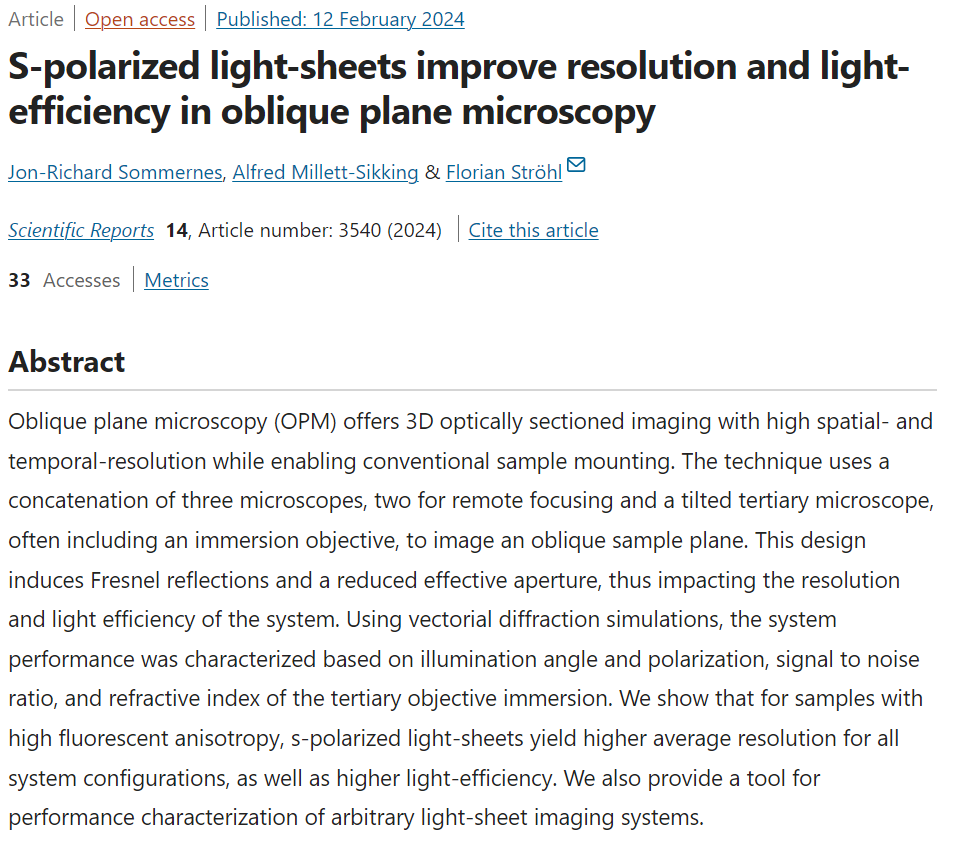
Snouty-style OPMs offer volumetric imaging with high spatial- and temporal resolution, but the setups can suffer from polarization-dependent light reflections which reduce the effective aperture and transmission in the remote image space. 1/n
If you want to figure out the theoretical limits of your own LSM system, we also provide a software tool that can simulate any light-sheet microscope. The tool has a GUI and is straightforward to use. 3/n https://t.co/S3OoLlIvtc
@AmirSTORMic @jsdaniel02@xyzDrch@carlasssmith It's a single exposure in SOLIS: when you put a multifocus element in the detection path, then the entire lightsheet plane is mapped onto the rolling shutter line on the camera. Scanning the sheet then maps the 3D volume onto the camera plane with rolling shutter camera exposure
@jsdaniel02@xyzDrch@carlasssmith You can probably add Hari Shroff's multiview confocal microscope to the list of oblique linescan microscopes with rolling shutter detection. SOLIS is a more than that though: it also uses multiplane detection to image the full lightsheet illumination and not just the line's focus
How to draw optical layout / schematics?
First, start with vector graphics tool. Inkscape is free and good.
Secondly, there are libraries of nicely drawn basic optical elements such as https://t.co/tqqeE0Yous @gwoptics & Alexander Franzen
1/N
The slight disappointment with being scooped is more than compensated by the very nice results and demonstrations of reduced photobleaching/toxicity with NIR co-illumination in this paper by Ludvikova et al: https://t.co/pR7ugwK12k
When you show up to #FOM2023 with the whole squad :D
Fantastic presence and presentations by the #UiT nanoscopy group at this year's conference. And thanks to Olli for the video ..