Interested in working on a state-of-the-art connectomics pipeline at its birthplace as a postdoc? We’d love to hear from you! :)
https://t.co/RkhoxzuJqE
I have two job adverts open at the minute:
- A PhD position on fast MLIPs for biomolecules (https://t.co/06TAnh6kF2)
- A postdoc position on developing a universal molecular mechanics force field (https://t.co/VxvVfUbjiT)
Feel free to get in touch with questions.
Two available postdoc scholarships at Norlin Lab in Lund!
1. Optical Engineering: OPM/light-sheet microscopy and lensless imaging https://t.co/5N43oJrqfO
2. Flexible Position: Related to spatial-omics method development or LLMs for life science research. Email/DM if interested
A nice use of multispectral microscopy to study the organelle signatures of neurons and astrocytes in 2D+t and 3D! I look forward to playing with the data they've generously made available at https://t.co/hUKdLeN16c.
Preprint alert! Led by Shannon Rhoads, we used 🌈🔬 to elucidate the #organelle signatures of #neurons and #astrocytes at baseline and in response to neurodegenerative-disease associated stressors. See Shannon's awesome tweetorial below! https://t.co/9nVdUB5FXY
@cohenlaboratory I just managed to download both raw and unmixed data within five minutes of going to look for it, which is probably the best data download experience I've had in a while! The only thing I'm missing are the mixing matrices, but I guess Zen makes it hard to export those.
@ZuninoAle@RunningPhoton ...we use the KL divergence between the full reconstruction and the two split images to stop the iterations (if both increase compared with the last iteration, go back a step and stop). I'd tried to do this a long time ago, but my code had a bug that meant it didn't work well.
Following a poke from @RunningPhoton, I've fixed a bug in my KL divergence calculation function which means our parameter-free deconvolution approach now *really* has no hand-tuned parameters at all:
https://t.co/OAImWfbEHi
Feedback always welcome.
https://t.co/dYkihjPuL8
We (@AndrewGYork, @RunningPhoton, @microRussell and I) are still working on the manuscript describing our automatic parameter-free deconvolution approach, but we've made a Google Colab notebook where you can try it out without needing to install anything:
https://t.co/7NpsTQrwBO
@ZuninoAle@RunningPhoton Before, there was a check that said that if the maximum relative pixel change you made this iteration was <= 0.5 %, you should stop. In practice that worked well, but the number was totally arbitrary (and I spent a long time checking if other values would work better). Now...
If you find these kind of incisive scientific discoveries - fluorescence microscopy is not cat photos - interesting then please come and work with me on the project! Details here, deadline 11 November -> https://t.co/wZPCIkkgBs
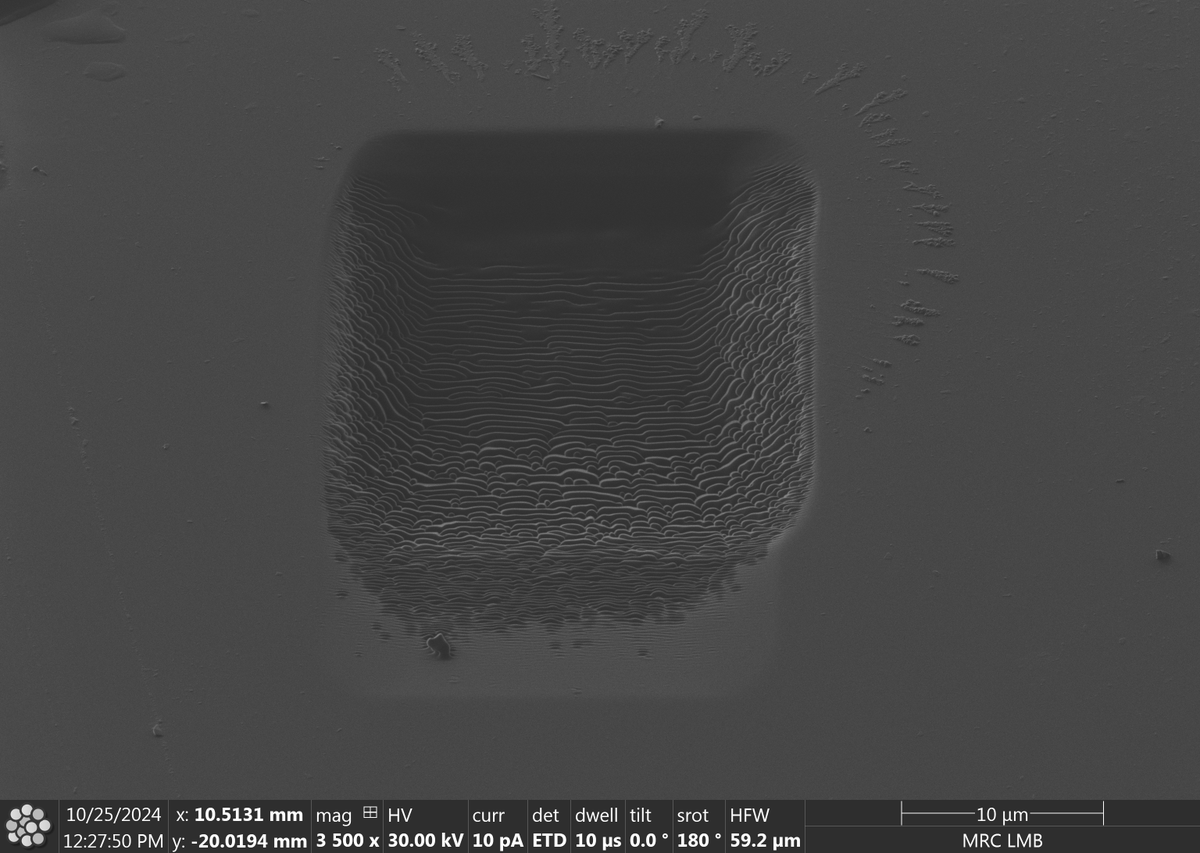
And if we try milling some flat glass, we see interesting undulations in the milled surface. If any of us ever form a band, we all thought this would make a good album cover.
8/8
For science, Jacob Lamb, Hugh Wilson and I had a fun morning using a focussed ion beam to image a @Thorlabs CS165MU/M camera.
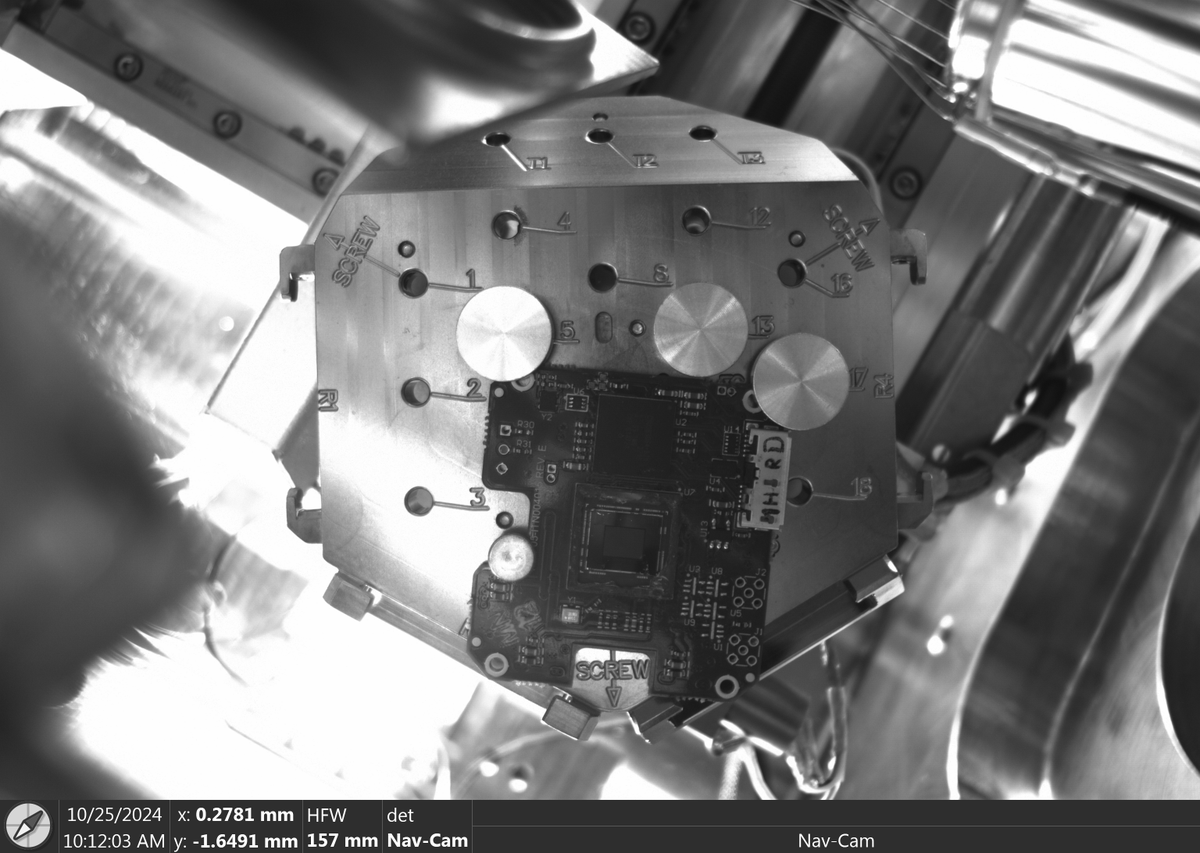
Here's the board loaded into the sample chamber...
1/8
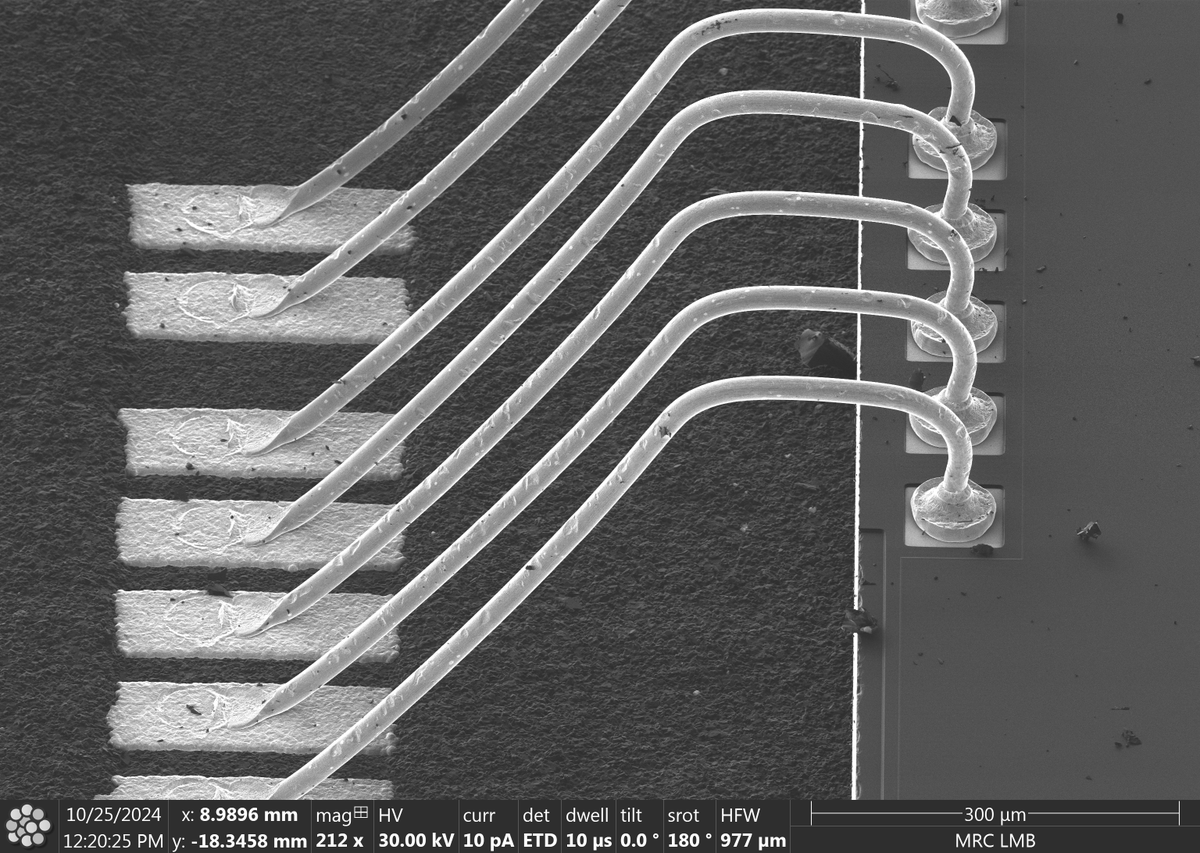
We also see nice contrast with the tiny gold wires that connect the sensor chip to the main board. The ion beam showed good contrast over most of the board, which gives us confidence that it'll be a good tool for inspecting chips after some semi-destructive modification.
7/8