It’s been 30 yrs since Zwanzig’s “non-eq stat mech”
As written, it has solidified the notion that theory develops models, and MD (perhaps) should be left to parametrize.
Maybe it’s time to re-pitch the work using functional integrals & tie this formulation to likelihoods :)
act through suppression of host to host transmission of gut-expelled prey (E. Coli) bacteria in the environment rather than acting within the host!
This further exaggerates the stochastic effect of rare gut colonization on steady state host gut populations.
New preprint
“𝗦𝘁𝗼𝗰𝗵𝗮𝘀𝘁𝗶𝗰 𝗰𝗼𝗹𝗼𝗻𝗶𝘇𝗮𝘁𝗶𝗼𝗻 𝗮𝗻𝗱 𝗵𝗼𝘀𝘁-𝘁𝗼-𝗵𝗼𝘀𝘁 𝘁𝗿𝗮𝗻𝘀𝗺𝗶𝘀𝘀𝗶𝗼𝗻 𝘀𝗵𝗮𝗽𝗲 𝗴𝘂𝘁 𝗯𝗮𝗰𝘁𝗲𝗿𝗶𝗮𝗹 𝘃𝗮𝗿𝗶𝗮𝗯𝗶𝗹𝗶𝘁𝘆.”
https://t.co/iBGIFD70mh
Using C. elegans as host, we find that bacterial predators (bdellovibrio)
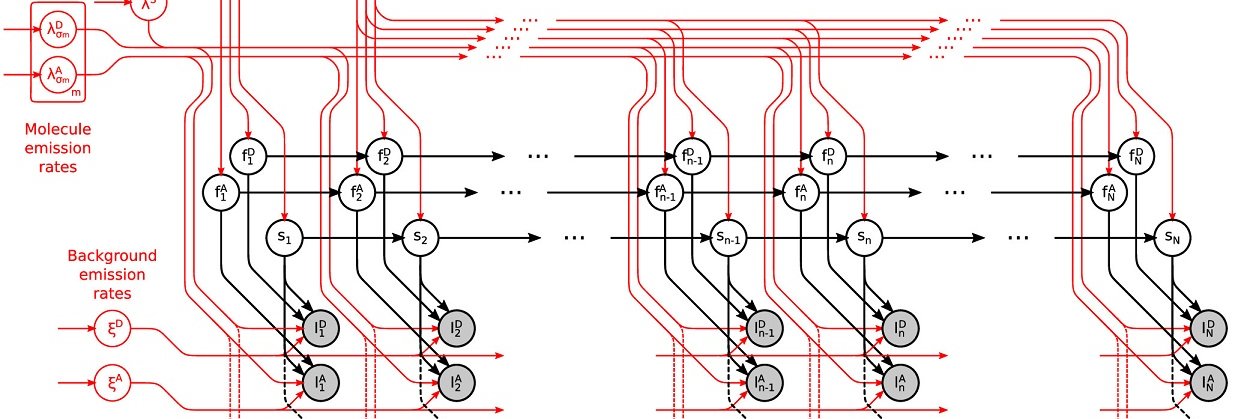
How do we quantify molecules inside a cell?
Often, we make them fluorescent.
Thus, In single-cell experiments, it is natural to interpret a bright cell as a cell that is highly active.
In our new PNAS, we show how this can be misleading.
https://t.co/mpyyO0Ea1H
In our recent PNAS paper, we showed that explicitly accounting for this memory across cell divisions can qualitatively change the inferred biology. In a yeast stress-response system in yeast we observe that cells were only active ~5% of the time
@nanocardiology@nanoEPlab Congrats to you and Prez! The combinatorially exploding number of functions available to biology upon clustering is just very reminiscent of where our beautiful field of biophysics is headed (cf., condensates).
Our PNAS is out 📢📢
https://t.co/0RDoqborsy
Biological snapshots can be misleading: fluorescence in a cell may reflect protein inherited from previous generations, not only current expression.
We fix account for this using simulation-based inference to recover hidden memory.
No likelihood? No problem
The class of stochastic models we can simulate is A LOT larger than the ones we can write likelihoods.
What if we could learn the likelihood directly from simulation? See the 🧵👇
https://t.co/4qgHg1IfG1
#SimulationBasedInference#Neuralnetworks#AI
Hiring a postdoc!
Join us in heavenly Vancouver to develop nonequilibrium statistical mechanics, thermodynamics, and information theory to understand free-energy transduction in biomolecular machines, in close collaboration with experimentalists.
Details: https://t.co/Z740OJgTRh
The number of grant applications is rising sharply. Our capacity for their evaluation isn’t.
ERC President Maria Leptin explains why stricter resubmission limits are being introduced for 2027 calls and what this mean for applicants.
https://t.co/YavrW4P8FJ
Given the quality of recent reviews, as a matter of principle, every revision letter should start with: “We thanks Editors, Reviewers, and GPT for their feedback”
When is it ok to invoke a small Reynolds number approximation in finite temperature fluids?
For spatially correlated fluids, curiously the answer is…never? 🧐
https://t.co/BFbMi68iEE
#fluids#fluidphysics@ASU@ASUPhysics
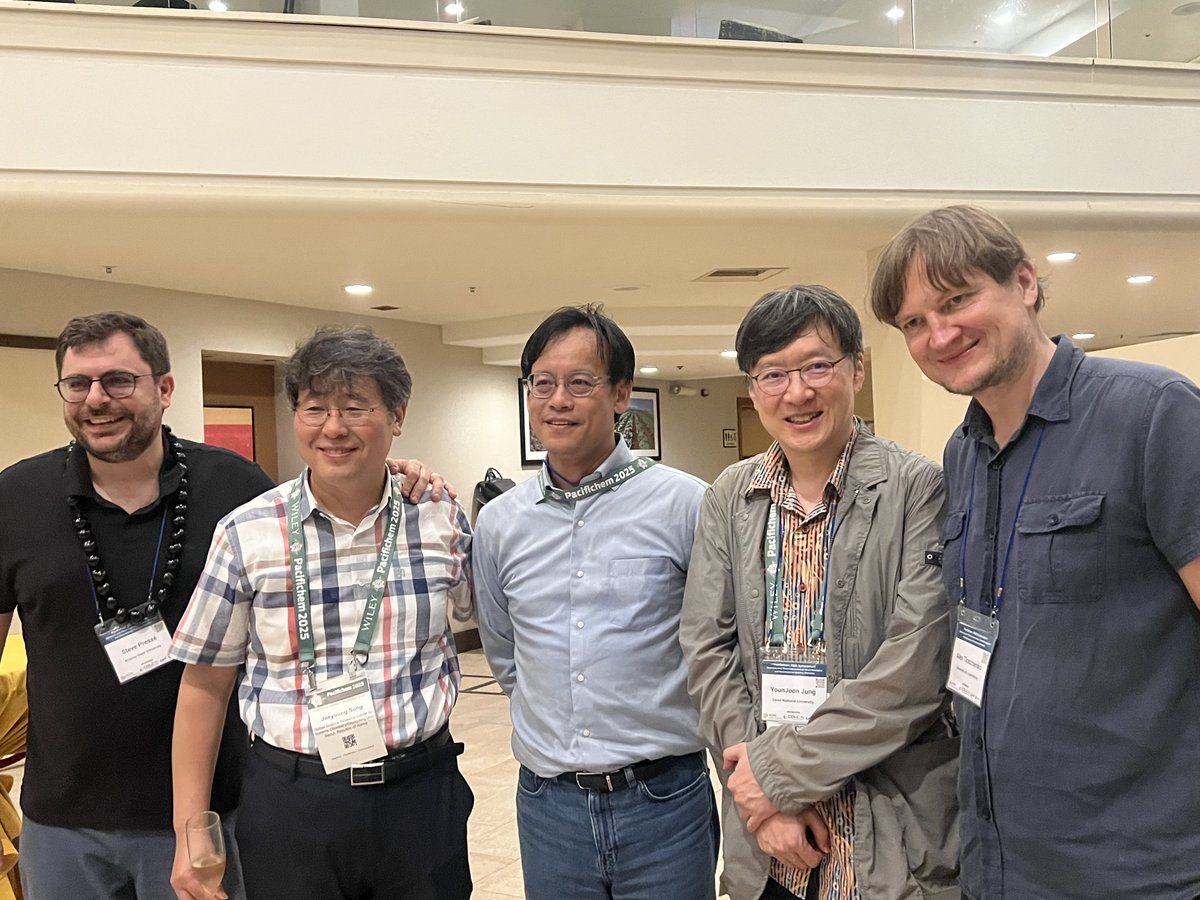
A bit of an emotional pic.
A Silbey lab reunion of sorts in Honolulu. L2R: @LabPresse, Jaeyoung Sung, Yuen-Chung Cheng, YoonJoon Jung, Alex Tkachenko.
Haven’t seen some people in ~20 yrs 😢
Happy to be @AmerChemSociety#pacifichem with L2R Banu Ozkan, Jaeyoung Sung, Matthias Heyden, and @LabPresse for our joint @ArizonaState Center for Biological Physics - Chung Ang GCSC symposium.
Especially happy about Mai Tai’s 🍹