

Top Tweets for #bayesian

Can AI model water systems when observations are sparse and biased? This Comment examines the limits of physics-informed learning, Bayesian inference, neural operators, and LLMs—and argues that reliable extrapolation and honest uncertainty assessment matter more than apparent accuracy.
https://t.co/B1gRCaA07W
#DataScarcity #hydrology


Founders sit on operational data and usually have no way to price it. DealPrice gives a license-value range for video, CAD, workflow and CRM from sourced signals, Bayesian P10/P50/P90 bands and Monte Carlo deal economics.
https://t.co/D5l3JFqMkO
If your company has years of video, CAD, software workflow or CRM history, that data may be licensable to AI labs. DealPrice estimates a license range from sourced comps, a Bayesian model and Monte Carlo deal math, aimed at the seller's return.
https://t.co/D5l3JFqMkO
Built in public: DealPrice prices operational data (video, CAD, workflow, CRM) for licensing to AI labs. Sourced comps, Bayesian P10/P50/P90, Monte Carlo deal math, and a proprietary algorithm that maximises seller return.
https://t.co/D5l3JFqevg
Good training data is scarce and poorly priced. DealPrice estimates license value for video, CAD, workflow and CRM data from sourced signals, Bayesian bands and Monte Carlo deal math. Code and the live tool are public.
https://t.co/Ip7GVw6frL
We shipped an agent that prices operational data for licensing to AI labs. Sourced comps, a Bayesian model, Monte Carlo deal math, and a proprietary algorithm aimed at maximising the seller's return.
https://t.co/pIBfPH7bJ5
Most operational datasets still go unpriced. DealPrice estimates license value for video, CAD, workflow and CRM data from sourced comps, a Bayesian hierarchical model (P10/P50/P90 plus confidence) and Monte Carlo deal economics.
https://t.co/pIBfPH6DTx
Sellers of operational data rarely know what it's worth. DealPrice prices video, CAD, workflow and CRM for licensing from sourced comps, a Bayesian P10/P50/P90 model and Monte Carlo deal math, with a proprietary algorithm that maximises seller return.
https://t.co/D5l3JFqevg

Leveraging state-of-the-art AI structure predictors to generate atomic resolution ensembles of intrinsically disordered proteins
1. The study extends bAIes, a Bayesian/MD framework that turns AI-predicted distograms into atomistic conformational ensembles for intrinsically disordered proteins (IDPs), and shows it works robustly across six predictors: AlphaFold2, AlphaFold3, Boltz-1, Boltz-2, ESMFold, and ESMFold2.
2. Core idea: instead of treating an IDP as a single “best structure”, bAIes samples an ensemble from a posterior p(X|D) that combines (i) a physics-based prior (a fast random-coil force field derived from amber99SB-ILDN, simplified to avoid structural bias) and (ii) AI-derived distance information D from selected residue-pair distance distributions.
3. Methodological innovation: bAIes uses an explicit uncertainty model for each AI-derived restraint. It fits a Gaussian peak to each selected distogram contact and marginalizes over an unknown σ using a Jeffreys prior, effectively down-weighting unreliable or noisy predicted contacts during sampling.
4. Predictor comparison at scale: using PeptoneDB-CS (659 proteins with NMR chemical shifts; balanced ordered vs disordered), the distograms are broadly consistent across predictors, but disagreements increase with disorder—especially for long-range contacts. Ordered proteins share ~84–93% of predicted contacts between predictor pairs; disordered proteins drop to ~50–85%.
5. A notable predictor-specific effect: Boltz-2 predicts ~50% more short-range (i,i+4) contacts for disordered proteins than other predictors, consistent with its broader training exposure to ensembles (NMR/MD-derived heterogeneity). Despite that, downstream bAIes ensemble accuracy remains broadly comparable across predictors.
6. Engineering contribution: bAIes was reimplemented natively in OpenMM (via CustomBondForce) for GPU scalability. On an NVIDIA A40, the coil model reaches ~379 ns/day for a 500-residue chain; restraint overhead is modest and mainly noticeable for proteins <200 residues. The authors also generated ensembles for thousands of DisProt regions and deposited a large non-overlapping subset to PED.
7. Experimental validation across predictors (17-IDP benchmark with NMR/SAXS): for IDPs with residual secondary structure, bAIes improves agreement with chemical shifts relative to the coil prior across all six predictors, indicating that local conformational preferences encoded in distograms are consistently converted into realistic atomistic ensembles.
8. Comparison to long all-atom MD (Aβ40, PaaA2, ACTR, α-synuclein): bAIes ensembles built from all six predictors are competitive with state-of-the-art force fields (e.g., a99SB-disp, CHARMM36m). Performance differences between predictors emerge for proteins where long-range contacts are ambiguous; for Aβ40, “over-contacting” predictors can bias ensembles away from near-random-coil behavior.
9. Strengths and limitations are consistent across predictors: bAIes performs best on local observables (chemical shifts, RDCs, J-couplings), while agreement is weaker for long-range/global observables (PREs, SAXS), reflecting both lower inter-predictor agreement on long-range contacts and limited long-range IDP signal in predictors trained largely on folded structures.
10. Benchmark vs other ensemble generators on PeptoneDB-Integrative (16 IDPs; compared without experimental reweighting): bAIes is among the best on chemical shifts and RDCs (often leading, with bAIes-ESMFold slightly ahead on local metrics), but is less strong on PRE/SAXS than several alternatives. The paper also flags a shared failure mode: condition-dependent folding (ligands/ions/ribosome context) is often predicted as folded by structure predictors, and bAIes inherits that bias.
💻Code: https://t.co/KQE4XRJoDW
📜Paper: https://t.co/6LtfqhuW0R
#IDP #IntrinsicallyDisorderedProteins #ProteinEnsembles #MolecularDynamics #OpenMM #AlphaFold #ESMFold #Boltz #NMR #SAXS #ComputationalBiology #StructuralBiology #BayesianInference


@weegledocs Aku juga bingung bahas apaan wkwkw. Udah ngelewatin bayesian, terus balik lagi ke statin pun tetep plonga plongo

⚡ Safer optimization for floating offshore wind turbines!
A Safe Bayesian optimization framework cuts platform pitch motion by 20.3% and tower fatigue loads by 12.8%, without compromising power production.
🔍 Find out more: https://t.co/COuveXAEr8
#SciOpen #TUP #WindEnergy #Science

@SmokeamHQ @ScienceBlog3 Oh, you learned a new word? Bayesian.
Unfortunately for your rookie mistake, Bayesian Optimization cannot overcome the fundamental physical limits outlined by Heather Graven regarding radiocarbon 14C signatures.
BO is a search and optimization algorithm.
1/

Yes, individual global gross fluxes cannot be measured instantly by sensors; that is why earth science uses Bayesian optimisation and data assimilation to bind the parameter space to real-world observations from SOCAT and GLODAP.
You completely played yourself with your own lecture: by the very definition of equifinality, every single one of those alternative parameter vectors must still map to the exact same output vector.
The undeniable, immense rise in atmospheric CO2.
No matter how much you tune the internal dials of your imaginary null space, you cannot mathematically cheat the system into making natural sources responsible for the net increase whilst natural pools are acting as net sinks.

@weegledocs 1. Stokastik (essay) : mirip² pengprop
2. Bayesian (pilgan)
3.Mekanika dan kalor (dlu masih fisika umum . Keknya mirip)
4. AVD (mirip pengstat level 1)
5. SIM (bisa gk pake belajar)
BASIS DATA gk pernah dapat matkul ini.

▫️Toward Scalable Bayesian Uncertainty for Machine Learning with the Ray Tracing Sampler
▫️OCT-Based Pose Estimation of Surgical Instruments
▫️Mechanistic Analysis of Template-Injection Jailbreaks in Diffusion Language Models
▫️Toward SED Reconstruction of Type la Supernovae With Rubin Observatory Simulation

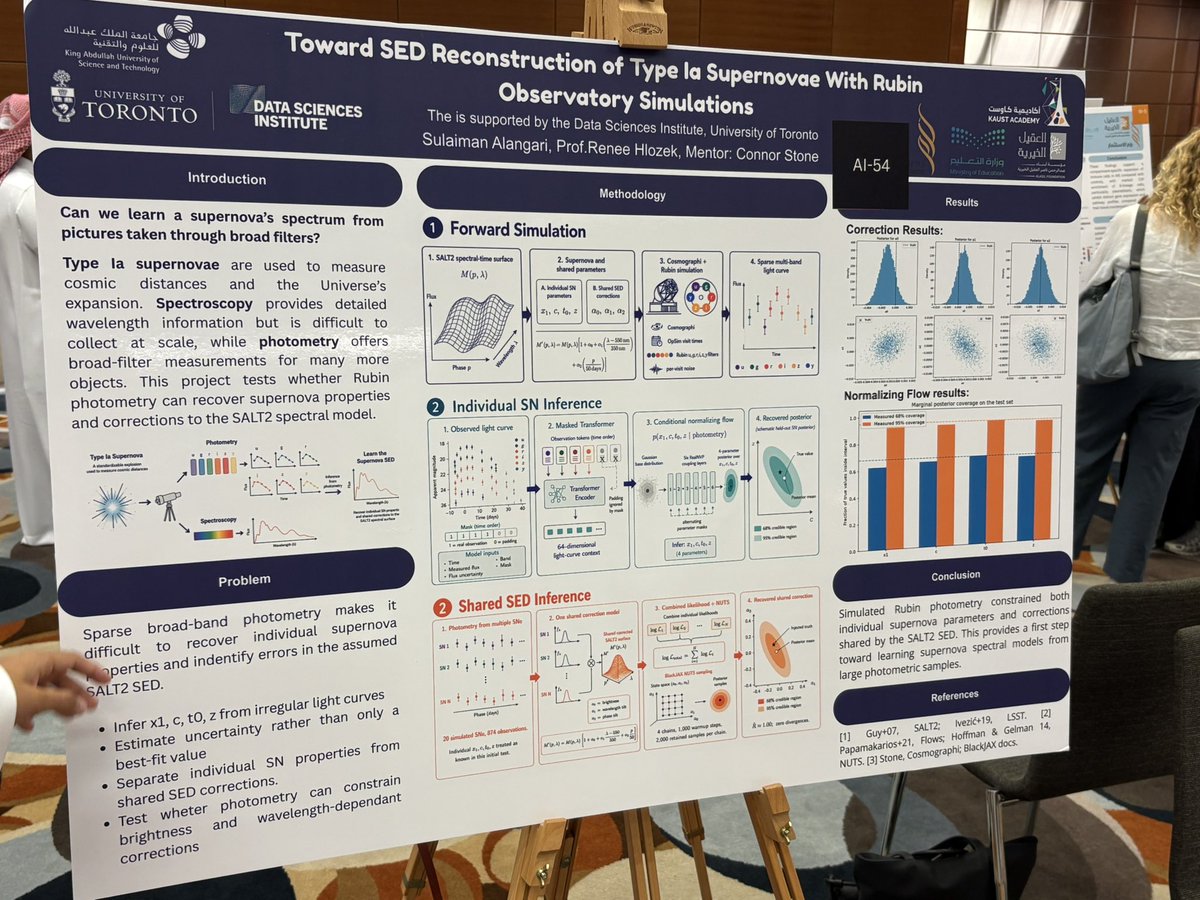

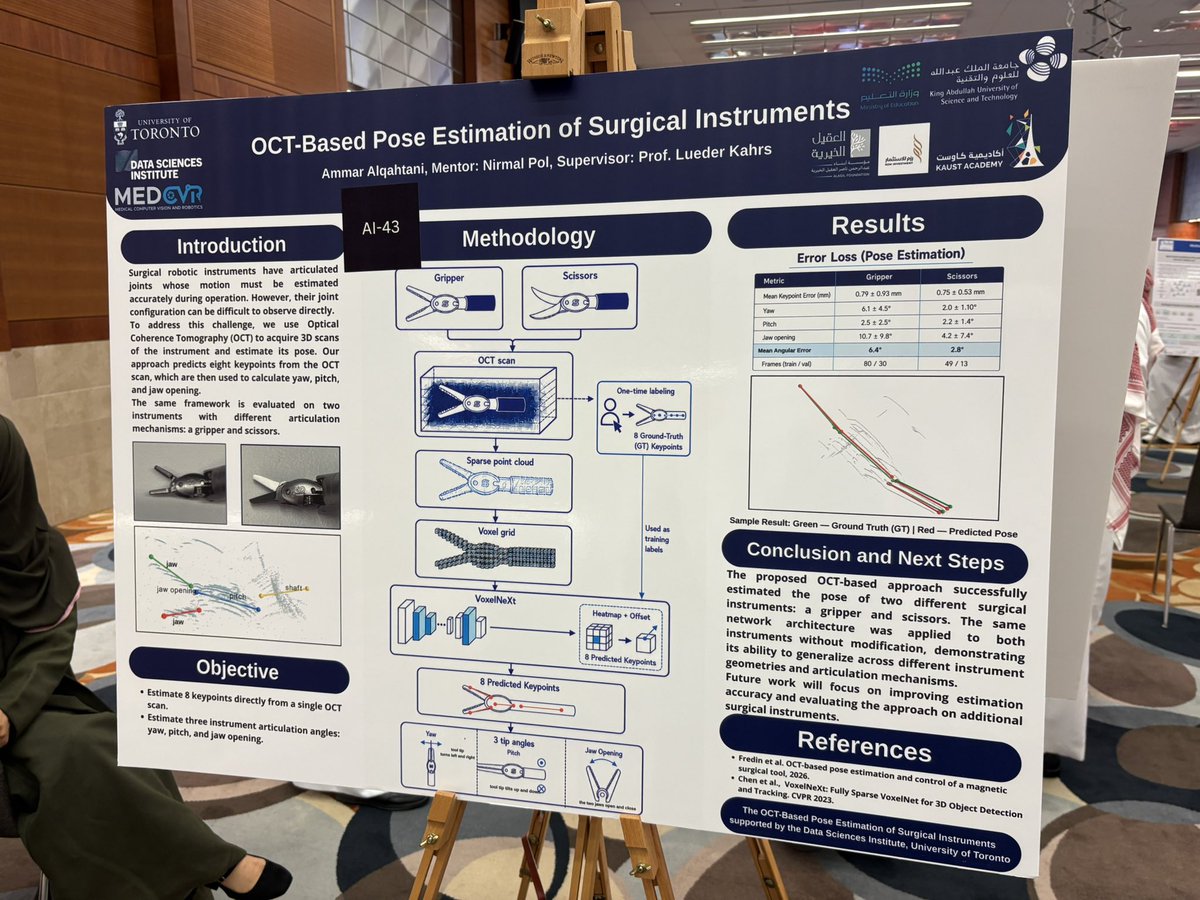
Can fragmented electronic health records show how a person’s disease risk changes over time? A study of more than 683,000 people and 348 diseases used a structured Bayesian model to identify 21 patterns of disease risk. The next question is how to make these predictions more reliable and useful for clinical decisions.
https://t.co/tptpNBPlTb
#electronichealthrecords


Are there any practical readings/intros in:
1. Use available AI within existing applications?
2. Use of hobbyist AI like Edge AI on single board computing platforms. What can it do?
3. Use of Bayesian math in existing apps as predecessor work -- the excluded middle of AI?

@T_A_Activist I already cited this in my Bayesian model. What about them? It does what for your point? & where are the names? Etc it’s being applied too?

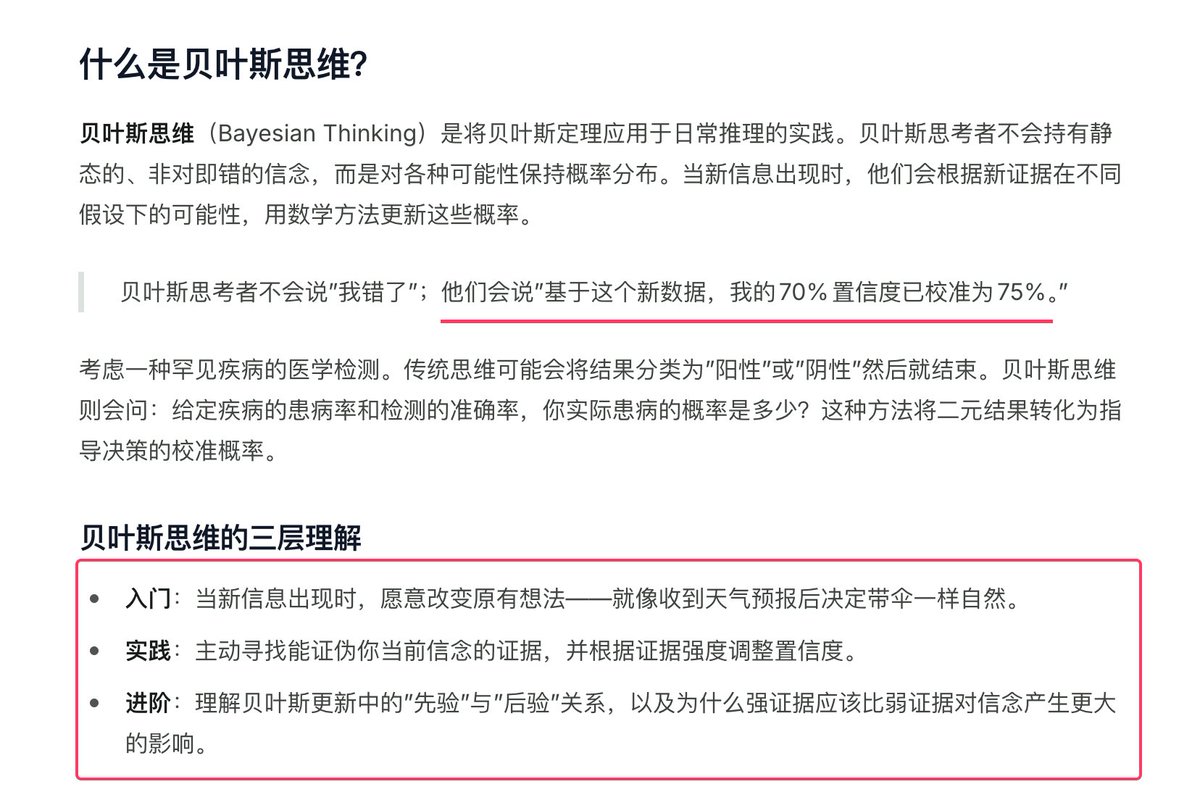
贝叶斯思维(Bayesian Thinking)是一种在获得新证据时系统性地更新概率信念的实践,由托马斯·贝叶斯于 1763 年用数学公式形式化。
核心启示:优秀的思考者会保持足够的开放心态,让证据改变他们的信念,而非在面对矛盾数据时固守初始假设。
https://t.co/tuI0PeD6Uq


📢A warm welcome to Yan Liu, PhD, of @Carleton_U, who joins BP’s Editorial Board.
Dr Liu’s research spans #healthpsychology, ADHD and well-being, psychometrics, machine learning and generative AI, and Bayesian methods.
👉https://t.co/vsNXJleVbR
#Psychometrics #AI #ADHDResearch

FlexiTAC enables controllable PROTAC linker generation across diverse structural settings using a Bayesian flow network with posterior guidance
1 FlexiTAC is a 3D, fragment-conditioned linker generator for PROTACs that jointly predicts linker atom types and 3D coordinates given a fixed warhead + E3-ligand context, aiming to preserve fragment poses while producing chemically valid, geometrically plausible connections.
2 The central modeling choice is a Bayesian Flow Network (BFN): sampling starts from high uncertainty (uniform atom-type probabilities + Gaussian coordinate prior) and performs sequential Bayesian updates that progressively reduce uncertainty, enabling fast sampling while handling the mixed discrete (chemistry) + continuous (geometry) nature of linker completion.
3 A key contribution is controllable linker flexibility at inference time: the study defines a conformational ensemble-derived rigidity score (CERScore) that combines (i) rotatable-bond freedom, (ii) anchor-distance fluctuation across conformers, and (iii) long-range intra-linker distance fluctuations, capturing “shape stability” beyond topology-only descriptors.
4 Flexibility control is implemented via posterior gradient guidance: a differentiable CERScore predictor provides gradients during sampling to steer the generated linker distribution toward more rigid or more flexible designs without retraining the base generator, enabling “test-time tuning” for different design goals.
5 To address data scarcity and inconsistent component annotation, the authors build PROTAC-3D: a quality-controlled, component-resolved dataset of 63,554 PROTAC structures with standardized conformers (RDKit conformer generation + MMFF94 optimization, lowest-energy conformer retained) and atom-level fragment masks/anchors for training.
6 PROTAC-3D is produced with a multi-stage PROTAC-Splitter pipeline (Transformer splitter + XGBoost fallback + vocabulary-guided substructure matching + iterative repair/re-splitting) to recover reliable warhead/linker/E3-ligand boundaries from full-molecule records, yielding ~10× more usable fragment-conditioned examples than PROTAC-DB 3.0 alone.
7 The work also introduces PROTAC-Bench, a unified evaluation suite designed to reflect practical linker-design requirements: it stratifies generalization into both-unseen, E3-unseen, and warhead-unseen settings, and evaluates validity plus fragment preservation, geometric fidelity, conformational stability after relaxation, reference recovery/coverage, motif coverage, and sampling efficiency.
8 On PROTAC-Bench, FlexiTAC improves validity versus the best 3D baselines by ~12.0–12.7% and reaches the highest PoseBusters pass-all rate (79.5–80.0%), indicating stronger end-to-end 3D plausibility (bond lengths/angles/torsions, sterics, connectivity, etc.) than competing 3D linker generators.
9 The model remains robust under challenging geometric constraints: it maintains higher validity across anchor separations spanning 3.1–27.1 Å and shows stronger performance as difficulty increases (longer linkers and larger anchor distances), where several baseline 3D methods degrade sharply.
10 FlexiTAC is designed for diverse structure-input provenance: it can consume fragment poses from ternary crystal structures, redocking into experimental protein structures, or docking into predicted POI–E3 complexes; auxiliary modules can predict attachment atoms and linker size when annotations are missing, supporting partially specified real-world workflows.
📜Paper: https://t.co/wGoJmRHx9b
#PROTAC #TargetedProteinDegradation #GenerativeModels #MolecularGeneration #StructureBasedDrugDesign #ComputationalChemistry #BayesianFlowNetworks #DiffusionModels #Cheminformatics #Bioinformatics

贝叶斯思维(Bayesian Thinking)是一种在获得新证据时系统性地更新概率信念的实践,由托马斯·贝叶斯于1763年用数学公式形式化。
核心启示:优秀的思考者会保持足够的开放心态,让证据改变他们的信念,而非在面对矛盾数据时固守初始假设。
https://t.co/tuI0PeCz4S
Multitask Bayesian Neural Networks for Multiparameter Protein Engineering
1. The study targets a common bottleneck in protein engineering: optimizing multiple properties at once (e.g., activity, stability, selectivity) when experimental datasets are scarce and noisy, and when properties can be dependent or trade off.
2. Instead of training separate models per property, the authors benchmark multitask learning combined with Bayesian neural networks to jointly predict multiple phenotypes while also quantifying uncertainty for each prediction.
3. A major contribution is a curated benchmark of 27 standardized multiparameter protein datasets (2–16 measured properties; 41 to 12,294 variants), prepared with FAIR-style metadata and traceable preprocessing, enabling more consistent comparisons across methods.
4. They systematically evaluate three multitask Bayesian NN architectures spanning different Bayesian “depths”: Monte Carlo Dropout (approximate Bayesian baseline), Bayesian Last Layer (deterministic backbone + Bayesian output layer), and a Hierarchical Bayesian Network with global + task-specific Bayesian components.
5. The benchmark is unusually broad: 16 sequence representations (One-Hot plus 15 protein language model embeddings) and an additional supervised PCA (SPCA) dimensionality reduction setting, totaling 2,592 trained models, all assessed with leakage-aware splitting and rank-based Spearman correlation.
6. Main modeling result: Bayesian Last Layer (BLL) provides the best overall balance of accuracy, generalization, and calibration, ranking as the top-performing architecture on 70% of datasets (before SPCA). This suggests partial Bayesian parameterization can be more reliable than fully Bayesian hierarchies under typical protein-engineering data constraints.
7. Dimensionality reduction is a key practical lever: SPCA improves predictive performance across architectures (reported gains up to ~42%) and can substantially improve uncertainty calibration (up to ~57%). After SPCA, the performance gap between architectures narrows, and MCD becomes more competitive in several regimes.
8. The paper highlights regime-dependent behavior: dataset size alone doesn’t explain performance; some small datasets match or exceed large-dataset performance, pointing to data quality and assay noise as major determinants. Label correlation also matters in nontrivial ways—strong multitask performance is not restricted to highly correlated properties.
9. A notable representation finding: simple One-Hot encoding is often competitive, achieving top performance on ~25% of datasets, especially in higher-data regimes—challenging the assumption that large pretrained embeddings always dominate for fitness/property prediction.
💻Code: https://t.co/6WVZ5X3PHv
📜Paper: https://t.co/XurvPtBm1v
#ProteinEngineering #MachineLearning #BayesianNeuralNetworks #MultitaskLearning #UncertaintyQuantification #ProteinLanguageModels #DirectedEvolution #ComputationalBiology #Bioinformatics


@ichlassdesmaso Using a Bayesian approach is still the way to proceed.

@bayesianasi1hv DM me yours aren't open
Coevolution-informed Bayesian optimization for sample-efficient protein design
1 ALSEBO (Active Learning Sequence Exploration via Bayesian Optimization) is presented as a protein-design loop that couples a generative candidate space with Bayesian optimization, but with a key twist: it featurizes sequences using Direct Coupling Analysis (DCA) coevolution statistics to make optimization work under very small evaluation budgets.
2 The central claim is an explicit inductive bias in the DCA encoding: an algebraic identity makes the DCA Hamiltonian (coevolutionary “energy”) appear along a single linear direction in feature space, concentrating the dominant organizing signal of the fitness landscape into very few effective dimensions and yielding a smoother, funnel-like objective that a low-data GP surrogate can navigate.
3 Candidate generation is built on a Latent Generative Landscape (LGL): a VAE trained on an MSA embeds sequences into a 2D latent space; decoded sequences across a 500×500 grid are scored by a DCA Hamiltonian to map low-energy basins that correspond to family-consistent, structurally plausible regions. This compresses the search from 20^L to a tractable library while retaining diversity (for avGFP, 2,143 sequences with 0–60 mutations; median 26).
4 On a virtual avGFP fluorescence benchmark (digital twin trained on Sarkisyan et al. data), ALSEBO repeatedly finds the library optimum in ~40–45 total evaluations (6–8 BO cycles with batch size 5), even when initialized with only 5–15 diverse sequences. Trajectories show early exploration followed by convergence into the high-fitness basin under a GP-UCB acquisition strategy.
5 The top avGFP design (R9) is a 9-mutation variant: Y37N, S63T, S70A, F97S, N103T, Y143F, M151T, V161A, I169V. Eight substitutions align with known superfolder GFP consensus mutations (with alignment offset), supporting interpretability rather than purely opaque optimization.
6 Representation benchmarking across 100 campaigns compares DCA features (235D), ESM-2 embeddings (640D), and raw 2D latent coordinates. Ordering in sample efficiency is DCA best, ESM-2 next, latent worst; mean steps to optimum: 31.1±9.5 (DCA), 36.3±8.1 (ESM-2), 59.7±17.6 (latent), with success rates 1.00, 1.00, and 0.95 respectively (random search ~0.03).
7 The paper links performance differences to landscape topology in each feature space: DCA produces a strong global funnel (Fitness–Distance Correlation FDC ≈ −0.94) and smoothness; latent coordinates preserve a coarse funnel but lose local resolution (poor GP predictability); ESM-2 yields a more rugged topology (FDC ≈ −0.54) but retains enough local structure to optimize reliably.
8 A key control addresses “shared representation” concerns (avGFP oracle is DCA-SVR): the authors rebuild representation-neutral oracles using one-hot encodings and physicochemical descriptors, then rerun optimization. DCA remains strong (success ~1.00 on one-hot; ~0.98 on physicochemical), indicating the advantage is attributed to a transferable coordinate system rather than memorizing an oracle’s basis.
9 Structural plausibility is probed via all-atom MD (1 µs each) on avGFP variants along the trajectory (R6–R10) plus baseline S65T. R9 shows barrel rigidification signatures, reduced chromophore hydration (low water coordination near phenolate oxygen), preserved chromophore-pocket packing, and chromophore planarity—mechanistic correlates consistent with fluorescence competence (while noting classical MD does not simulate emission).
10 Transfer is tested on divergent GFP orthologs (amacGFP ~82% similarity; cgreGFP ~41%) and a non-GFP enzyme Ube4b with a CNN oracle trained on deep mutational scanning. From only 5 initial sequences, ALSEBO reaches high-fitness basins in ~30 evals (amacGFP) and ~50 evals (cgreGFP). For Ube4b it finds an optimized sequence in ~35 evals; across 100 runs: success 0.99 (cgreGFP, 64.2±13.4 evals), 0.95 (amacGFP, 22.8±12.1), 1.00 (Ube4b, 17.6±10.6). MD on Ube4b suggests the optimized sequence preserves U-box dynamics despite high divergence (~20% similarity to wild type).
💻Code: https://t.co/MOg7YgGeko
📜Paper: https://t.co/NXUNzRd4KS
#ProteinDesign #ActiveLearning #BayesianOptimization #Coevolution #DCA #GaussianProcesses #VAE #ProteinEngineering #ComputationalBiology #MolecularDynamics

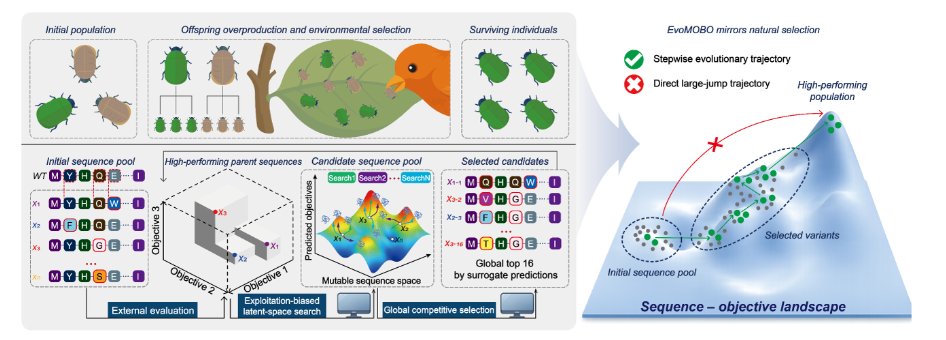
Evolution-inspired Multi-objective Bayesian Optimization for Protein Engineering
1. The preprint introduces EvoMOBO, an active-learning framework for protein engineering that explicitly handles multiple objectives while operating under tight evaluation budgets, aiming to navigate rugged, epistatic sequence–function landscapes without enumerating full combinatorial libraries.
2. EvoMOBO extends LaMBO’s path-dependent, latent-space sequence generation by adding unified global competition: it runs many repeated searches per round (64), pools a large candidate population (up to 1,024), then globally selects a small batch (top 16) for evaluation based on surrogate-predicted marginal hypervolume gains.
3. It also uses an exploitation-biased acquisition strategy (qNEHVI with reduced uncertainty weight, from 1.0 to 0.75) so candidate generation is more driven by predicted performance—intended to better match realistic protein-engineering settings where only a few variants can be tested.
4. On a complete ~160k-variant steroid receptor DBD landscape (4 sites; objectives: minimize ERE activity, maximize SRE activity), global selection boosted target-region enrichment under the same budget: target hits increased from 9.09% to 27.58%, and stringent hits from 3.90% to 16.55%; adding exploitation bias further raised them to 37.16% and 18.24%.
5. A systematic module comparison showed that representation and surrogate choice matter: among tested encoders (one-hot, mCNN, ProtBERT, ESM variants), ESM-2 650M gave the best balance of Pareto-front progress and target-region enrichment; among surrogates, a Gaussian process performed best overall; among acquisitions, exploitation-biased qNEHVI gave the strongest enrichment while maintaining competitive hypervolume.
6. With the final configuration (ESM-2 650M + GP + exploitation-biased qNEHVI + global competition), cumulative DBD enrichment rose sharply relative to baseline LaMBO: target-region hit rate increased to 80.91% and stringent-subset hit rate to 50.38%, alongside higher final normalized hypervolume (~0.78 vs ~0.72).
7. Benchmarking against ALDE and EVOLVEpro on DBD (two-objective) showed EvoMOBO’s explicit multi-objective setup enriched desired variants more effectively than scalarization: with 38 single-site initial labels, explicit EvoMOBO reached ~72.45% target hits and ~48.72% stringent hits after 10 rounds, while also recovering more diverse solutions (higher mean pairwise Hamming distance among hits).
8. On the complete ParD3 antitoxin landscape (3 sites; 8,000 variants), EvoMOBO’s advantage increased as objectives expanded: for the 3-objective task (minimize fitness vs ParE3 and V5L/A66F-ParE3; maximize fitness vs ParE2), scalarized methods largely failed (ALDE ~0.72% hits; EVOLVEpro ~0.11%), while explicit 3-objective EvoMOBO reached 17.98% hits and higher hypervolume (~0.52 vs ~0.40–0.42).
9. A key practical angle is label flexibility: EvoMOBO can optimize using simulation-derived mechanistic descriptors instead of experimental labels during iterative rounds. In DBD, MD-derived geometric descriptors correlated with measured activities (Pearson 0.67 and 0.80) and guided optimization that still enriched experimentally favorable variants (40.43% target; 23.40% stringent) without using experimental activities for selection.
10. Two enzyme case studies used mechanism-derived objectives for the full optimization loop with experiments reserved for final validation: for GkOYE non-native oxidative dehydrogenation, 16/26 tested variants beat wild type and the best (C26A/Y28K/A104F/I253V) improved conversion from 17.5% to 95%; for AoFOx stability, MD descriptors targeting reduced fluctuation and aggregation propensity yielded aggregation-resistant variants, and two nearly doubled diethyl phthalate degradation in a photoenzymatic cascade when normalized to the same initial activity.
💻Code: https://t.co/eysjn9hxIj
📜Paper: https://t.co/GIkTfk4BRC
#ProteinEngineering #BayesianOptimization #ActiveLearning #MultiObjectiveOptimization #ProteinDesign #DirectedEvolution #ProteinLanguageModels #GaussianProcesses #MolecularDynamics #EnzymeEngineering

Decouple sensing from execution via Bayesian action filters. Cross-validate DOM signals with secondary telemetry (ad spend, API routes), vary headless fingerprints, and apply hysteresis thresholds to dampen algorithmic tit-for-tat honeypots.
Most Popular Users

Elon Musk 
@elonmusk
240.1M followers

Barack Obama
@barackobama
118.6M followers

Cristiano Ronaldo
@cristiano
114.4M followers

Donald J. Trump
@realdonaldtrump
111.7M followers

Narendra Modi
@narendramodi
106.9M followers

Rihanna
@rihanna
98.6M followers

NASA
@nasa
92.1M followers

Justin Bieber
@justinbieber
91.7M followers

KATY PERRY
@katyperry
89.9M followers

Taylor Swift
@taylorswift13
83.9M followers

Lady Gaga
@ladygaga
75.4M followers

Virat Kohli
@imvkohli
73.3M followers

Kim Kardashian
@kimkardashian
70.8M followers

YouTube
@youtube
68.6M followers

Neymar Jr
@neymarjr
66.3M followers

Bill Gates
@billgates
65.2M followers

Selena Gomez
@selenagomez
63M followers

The Ellen Show
@theellenshow
62.1M followers

CNN
@cnn
61.7M followers

X
@x
60.6M followers