David’s life’s work was a disposable prop for MIT to market its virtue to a woke audience.
Some are even arguing that David deserved to lose his career because he was romantically involved with a woman in the workplace. That is an absurd and hypocritical justification for what MIT did to him.
Reducing the destruction of his career to a workplace relationship policy violation is grotesque hypocrisy. A romantic relationship at work is an ordinary part of academic life for administrators and an excuse for destroying a laboratory when it involves someone they don’t like.
His relationship with Knouse even began before Whitehead updated its relationship policies in August 2018.
If a workplace relationship warrants professional destruction, MIT and all universities, for that matter, have a great deal of firing to do. Erin O’Shea, who was instrumental in firing David from HHMI, dated and married someone who earned his PhD in her own laboratory. Ruth Lehmann, who forced David out of Whitehead, has a long-time partner who was a fellow scientist at NYU, where she worked. MIT’s president, Sally Kornbluth, is married to an MIT biology professor. These administrators know perfectly well that scientists form romantic relationships within their professional communities.
Scientists spend enormous portions of their lives in their laboratories and around other scientists. They develop relationships within that world because they devote themselves to their craft and have little social life outside it. Universities know this, and so do their administrators.
The court also rejected Knouse’s claim that she experienced quid pro quo sexual harassment from David. The court found that David did not condition professional benefits or consequences based on sex. She directed her own lab and she went on to obtain a tenure-track position at MIT. Invoking a poorly defined “power imbalance” does not erase the court’s rejection of her claim.
https://t.co/DQWDZ8saem
@silvirouskin@DMSabatini@PershingSqFdn Thank you for sharing this. It’s nice to hear how David supported you and your lab.
These accounts of his encouragement and generosity toward younger female colleagues deserve to be heard, and I’m glad you added yours.
The issue is legal sufficiency. On a motion to dismiss, the court assumes the facts are true and asks whether they establish an actionable claim.
I think Whitehead and Lehmann benefited from a privilege protecting communications from legal exposure.
For public statements, remember that these institutions have sophisticated legal operations that vet their language. They know how to make someone look bad while minimizing exposure to defamation claims. They did not release all their communications. Full disclosure would have exposed them too.
Avoiding liability should not be confused with behaving honestly or responsibly. An employer or supervisor can treat an employee like garbage without that treatment being illegal.
Science magazine’s account is riddled with inaccurate and misleading reporting.
Start with the verdict.
The jury awarded David $500,000 for defamation, $3.2M for interference with contractual relationships in a category explicitly naming MIT et al., and $2.3M for interference with prospective professional relationships. It rejected Knouse’s claims of sexual harassment, hostile workplace and educational environments, and retaliation.
These are findings in a court of law, not competing opinions to balance against the losing side’s disappointment.
Of the $6M awarded, $5.5M concerned interference with David’s professional relationships. Science obscures the connection to MIT et al. and the administrators whose actions inflicted those losses.
Causation was central to what David had to prove. In “but for” legalistic terminology, the losses would not have occurred without the conduct at issue. If David would have suffered the same losses anyway because of a culture survey, an investigation, or anything else independent of Knouse’s conduct, those losses could not be attributed to her interference or her words. Science never examines that implication. MIT et al.’s actions on based Knouse's behavior were how allegations became lost employment, a lost laboratory, and a lost career.
Yet Science tells readers the verdict “has no direct impact on the conclusions of Whitehead’s probe.” That framing ignores the causal connection established by the interference and defamation findings and treats the institutional investigation as insulated from the verdict.
Science also returns to allegations of a sexualized or “toxic” environment as something David merely denies. Knouse sued him over those allegations. The verdict form explicitly asks whether she proved a sexually hostile workplace or educational environment. The jury answered no to both.
Recycling those allegations while giving the losing attorney space to attack the jury’s competence protects the institutional narrative from scrutiny. Allegations retain their authority. The verdict becomes an inconvenient opinion.
MIT et al. exercised the power that destroyed David’s career. Science should scrutinize their actions with the same aggression it directed at him. Institutional prestige is not evidence, and “independent investigation” is not a magic phrase that makes the verdict disappear.
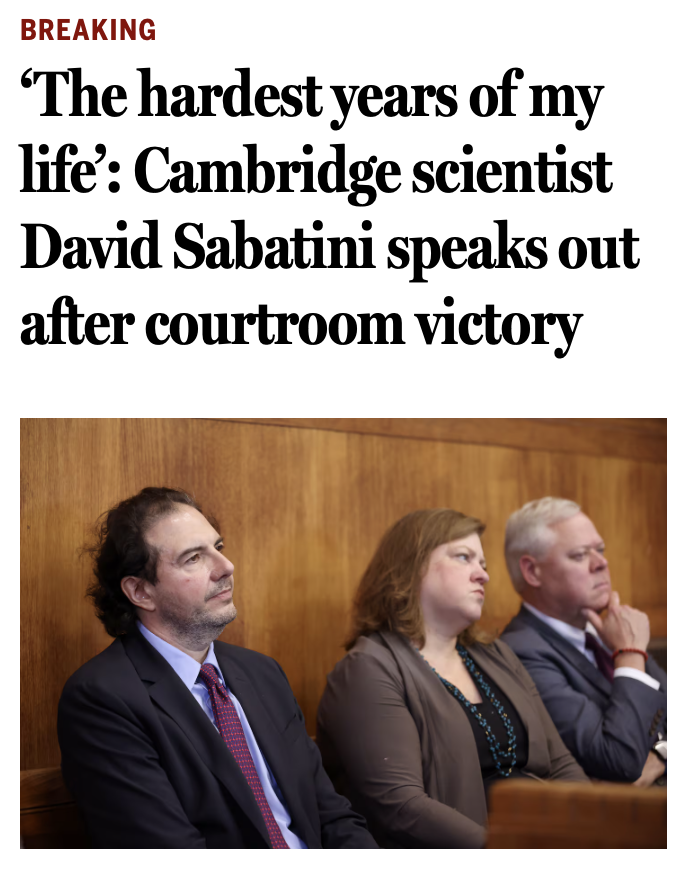
A Massachusetts jury has awarded biologist David Sabatini $6 million—plus interest—in damages in his defamation case against Kristin Knouse, a former colleague at the Whitehead Institute for Biomedical Research.
The physician-scientist’s claims led one research institution to fire Sabatini and precipitated his resignations from Whitehead and the Massachusetts Institute of Technology, where he was a tenured faculty member.
Read more: https://t.co/2265T4oNZ7
There is no better learning experience than being forsaken by the vast majority of people you knew professionally. After spending so many years within that circle, you finally see what it is really about. You learn what matters and what is disposable. Much of what once consumed your attention turns out to be irrelevant. Perhaps a few relationships inside prove worthwhile. Sometimes none do. But lights emerge where you had never seen them before, and you remember who stood by you.
You learn not to care so much about the minutiae of a world whose people were so quick to throw you in the trash. Their approval loses its importance. Whatever rat race they are still running no longer seems worth so much of your time. What once seemed indispensable turns out to be something you can live without, because you have lived through its absence.
You also begin to see perspectives from outside that circle that you excluded or ruled out while working within it. You appreciate views you would not have given the time of day before. You see more clearly what is actually important to your life. There is a great deal to learn when a world you devoted yourself to decides it can do without you—including how much of that world everyone else can do without.
It is incredibly devastating to the psyche when the cancel mob comes for you
In your darkest hour, the true heroes and villains in your life will emerge with clarity. The villains will outnumber the heroes, overwhelmingly, and you will despair.
At times you will feel as though that knowledge was purchased by the loss of illusions that you’d rather have kept, but in time, those departures reveal themselves as a kind of necessary clearing. You can rebuild a new life and it may not be as glamorous, but it will be pure of heart.
The broader conclusion is that MIT and its administrators were not truthful about their actions and cannot distance themselves from the unlawful conduct that caused the damage.
The tortious interference claims, proven through a unanimous verdict from a majority-female jury, make this even clearer. The jury awarded the majority of the damages on those claims, finding that Knouse unlawfully interfered with David Sabatini’s employment and prospective jobs. This further established a causal connection between her conduct and the destruction of his livelihood.
The implication is that Knouse’s conduct drove the loss of his lab, his job, and future opportunities, rather than those losses occurring for unrelated reasons arising from a so-called "independent” and opaque investigation or MIT’s purported findings about his lab environment. That is the basis for calling MIT’s public explanation dishonest.
It is a repudiation of the dirty tactics universities use to take out faculty they don’t like while claiming to be fair and objective. This should prompt a further reckoning with the lack of trustworthiness in our academic institutions.
MIT claimed that its actions against David were based on findings about the culture in his lab. The $6M verdict invalidates that explanation.
The jury awarded David $6M for damages caused by Knouse’s defamation. This means not only that false statements were made, but that those statements were proven to have caused a huge amount of damage. A causal connection between Knouse’s statements and the harm David suffered was established in court. The damage he endured came from the actions of MIT, Whitehead, and HHMI and their authority over him.
The implication of the court ruling is that those actions occurred because of the false statements, rather than for other reasons such as a vaguely defined lab culture.
A “toxic work environment” is a vague, slippery, often unfalsifiable slur that can be attached to anyone directing a laboratory or any group of people. Falling back on that label was a way to hide the real reasons for their actions from the public and look good to their base. Nobody likes an abusive boss, especially students who like to protest.
But I knew so many people who had worked under his supervision. They did not see him or his lab that way, even though they were not speaking publicly.
Some are saying that because MIT and Whitehead were not held liable, they are exonerated from this mess. Nothing could be further from the truth.
These institutions have sophisticated, eight-figure legal operations and substantial resources devoted to shielding them from liability. They know how to word damaging public statements while protecting themselves against defamation claims. They also know how to invoke attorney-client privilege, work-product protection, and other privileges to shield their dirty business from public scrutiny. Their ability to defend themselves legally should not be confused with institutional integrity.
Faculty employment is generally at will. That means an employer can fire someone for any or no reason. Tenure is a policy, not a legal right. Faculty are sold the promise of its security, but finding out what protections they can actually enforce when push comes to shove can take years and enormous legal fees. Sally Kornbluth, now MIT’s president, even admitted in court once that tenure does not carry the legal protections faculty believe it does (Shaughnessy v. Duke, see her deposition excerpts in the summary judgment materials). Employment law provides no remedy for many destructive decisions universities make.
Civil rights laws offer protection against discrimination, and pursuing those claims is often the only recourse faculty have in court against a university. But proving discrimination is difficult, especially for a scientist with a unique position and record. David pointed to Knouse as someone treated differently. She also ran a laboratory and had NIH funding, but I think the court ruled they were not similarly situated. He did have a more senior rank and a larger lab. So be it.
But discrimination law only addresses discrimination. You can treat people like garbage and run your institution into the ground without committing actionable discrimination. This is where public accountability must come into play.
The jury found that Knouse defamed David and unlawfully interfered with his livelihood. MIT, Whitehead, and HHMI held the authority, and through their actions, the false allegations against him became career-destroying consequences. That is why this verdict demands accountability from those institutions. They bear responsibility for the damage those actions caused.
After you are abandoned by a trusted institution and publicly shamed, the headlines and mobs eventually fade. What you are left with is isolation.
People who claimed to be your friends abandon you. Very few will say anything positive about you. People generally pretend you are dead. Others dismiss or worse take credit for your work and try to write you out of history. Vultures swoop in from every direction.
This is what happens when fourth-rate administrators make decisions affecting people’s livelihoods without concern for what they are doing to their lives. These are scientists who were among the best in the world at what they did. They passed up careers in pharma, finance, tech and administration that could have paid them vastly more for their skills.
When I was younger, people in my programs who gave up on science early went on to make fortunes on Wall Street, in biotech, and in Silicon Valley. Those who stayed pursued their passion for the love of it at the cost of millions of dollars.
When an administrator steps in and dismantles that life’s work, far more than a job is erased. Laboratories take years to build, and scientific problems take years to develop and eventually solve. Experiments, research materials, collaborations, and accumulated expertise cannot simply be restarted somewhere else. The field keeps moving while your work is stopped. The time lost is also the time lost that could have been spent making money - that part a court will never be able to figure out because juries are ordinary people not dedicated scientists.
Then comes the gaslighting. People assume it must have been your fault because an institution like MIT or Duke is supposedly so trustworthy and meritorious that it would never do this to someone who was not guilty. Institutional prestige is a substitute for examining the evidence.
I recently attended a meeting on academic freedome at MIT where Dorian Abbot’s name kept coming up as their fallen hero. They cited a cancelled lecture of his at MIT as their rallying cray. It was treated as an institutional catastrophe. It was insane. David was an afterthought among people supposedly concerned about the climate at MIT and self-appointed to change the culture there.
They simply believed MIT’s PR messaging that they have always been focused on merit despite some small missteps like the canceling of a controversial lecture. I had to point out repeatedly that MIT is not the MIT they attended 30–50 years ago. The priorities reflected in its newer hires and leadership have moved far from the scientific excellence they associate with it.
Some are saying that because MIT and Whitehead were not held liable, they are exonerated from this mess. Nothing could be further from the truth.
These institutions have sophisticated, eight-figure legal operations and substantial resources devoted to shielding them from liability. They know how to word damaging public statements while protecting themselves against defamation claims. They also know how to invoke attorney-client privilege, work-product protection, and other privileges to shield their dirty business from public scrutiny. Their ability to defend themselves legally should not be confused with institutional integrity.
Faculty employment is generally at will. That means an employer can fire someone for any or no reason. Tenure is a policy, not a legal right. Faculty are sold the promise of its security, but finding out what protections they can actually enforce when push comes to shove can take years and enormous legal fees. Sally Kornbluth, now MIT’s president, even admitted in court once that tenure does not carry the legal protections faculty believe it does (Shaughnessy v. Duke, see her deposition excerpts in the summary judgment materials). Employment law provides no remedy for many destructive decisions universities make.
Civil rights laws offer protection against discrimination, and pursuing those claims is often the only recourse faculty have in court against a university. But proving discrimination is difficult, especially for a scientist with a unique position and record. David pointed to Knouse as someone treated differently. She also ran a laboratory and had NIH funding, but I think the court ruled they were not similarly situated. He did have a more senior rank and a larger lab. So be it.
But discrimination law only addresses discrimination. You can treat people like garbage and run your institution into the ground without committing actionable discrimination. This is where public accountability must come into play.
The jury found that Knouse defamed David and unlawfully interfered with his livelihood. MIT, Whitehead, and HHMI held the authority, and through their actions, the false allegations against him became career-destroying consequences. That is why this verdict demands accountability from those institutions. They bear responsibility for the damage those actions caused.
Dear President Kornbluth and Chairman Gorenberg,
Yesterday, as I am sure you are aware, a Boston jury unanimously found that @MIT professor Kristin Knouse defamed David Sabatini, falsely accused him of rape and sexual harassment, and tortuously interfered with his contractual arrangements including his tenure at MIT.
MIT and its tenure review committee relied on Professor Knouse’s statements when it took away David’s tenure and terminated him.
MIT's policies explicitly prohibit harassment, retaliation, and fabrication of claims. Falsely accusing a colleague of rape and sexual harassment and pushing for his termination under false pretenses are clearly violations of MIT policy.
In light of the unanimous findings of the jury after five years of discovery, many legal motions and countermotions by both parties, and a three-week trial in Suffolk County Superior Court in Boston:
Is MIT going to take away Knouse’s tenure and terminate her?
If not, why not?
Is MIT going to restore David’s tenure, and apologize for firing him?
If not, why not?
In light of what has transpired in this grave miscarriage of justice, MIT has the opportunity and the obligation to right a serious wrong here.
At a minimum, the public deserves transparency into what actions MIT is taking in this case as taxpayers are major funders of MIT.
Sincerely,
Bill Ackman
I generally reserve singling people out for university and hospital administrators collecting large salaries while greasing the system.
But it is entirely reasonable to examine her record and the hiring standards MIT used. We need to look at the standards adopted and what those standards are producing across academia.
In the 2010s, universities increasingly emphasized DEI in faculty recruitment. MIT sets an example that institutions across the country aspire to follow, including places like Duke and Cornell.
Hiring rewarded alignment with institutional priorities while giving too little weight to tangible scientific accomplishments. Publication records that would previously have been considered insufficient appeared acceptable when candidates fit the institution’s preferred politics, activism, or demographic priorities.
By 2026, those hiring decisions are shaping the next generation of scientists. The consequences extend far beyond MIT, particularly in biology which already struggles with too much soft science in its discipline.
Is it OK for an MIT professor with own lab to publish 3 review articles in 5 years and no original research? Now that we know that @DMSabatini was innocent it may not be so inappropriate to ask. Would I hurt anyone's feelings? https://t.co/xhrr9RQjJt
David was actually employed and fired by the Howard Hughes Medical Institute
HHMI’s investigator program was built around identifying the best scientists in the country and giving them the resources to thrive. They became HHMI employees, receiving salaries and substantial research funding, including payment for their lab space, while keeping their university appointments and access to students.
David was identified as one of those talents. By the late 2010s, HHMI had become far more interested in identity politics than the merit that had given the program its standing for decades.
Following MIT/Whitehead’s metoo investigation, HHMI fired him.
The jury’s findings raise serious questions about the integrity of HHMI, a non profit organization that gets enormous tax benefits, including what it is actually funding, and the people it chooses to select, retain, or dismiss.
A civil jury ruled in favor of ex-MIT scientist David Sabatini, who was accused by a younger colleague of inappropriate sexual conduct in his Cambridge research lab, and awarded him $6 million in damages. https://t.co/lXDcUxIKmx
There are countless people who have suffered the same fate as David. But he was one of the most prominent biologists in the country at the time and held one of the most coveted positions at MIT. His case got attention after MIT publicized it, exposing him to worldwide condemnation over allegations of sexual misconduct.
Yes, Ackman took up his case, but David was also one of the few who chose to fight it out and go the distance in a five-year court battle. Most don’t have the stomach for that. Very few choose to fight, and those who do are labeled troublemakers, with a shadow cast over them in perpetuity.
I know so many people this has happened to, and they remain unemployed for years. The older ones typically retire and drop out of the spotlight. I even know someone who went through 25 years of medical and doctoral training, only to end up coaching tennis in his later years.
It is important to realize that this type of maniacal witch-hunt could happen on just about any campus. The witch hunters are ready and willing, and they have the power. This poor man had Bill Ackman to help him; others similarly framed and ruined, I suspect have no one.
This verdict was a resounding vindication for David.
Defamation cases are very difficult to win, and he prevailed in a case involving metoo allegations in politically left-leaning Massachusetts. A $6M award is an enormous sum to ordinary people serving on a jury.
The jury’s findings invalidate the narrative used to explain his treatment. They demand intense scrutiny of MIT, its peer institutions, and what they did to his career. Their legitimacy as institutions is called into question when conduct they relied on is found to be unlawful.
The victory is small in relation to the institutional transformation still needed. That change requires administrators held accountable for their actions, colleagues willing to speak, media outlets committed to reporting honestly, and institutions that put truth ahead of politics and image. Hopefully, David’s victory will help make some of that change happen.
David won a small victory in court, but the jury’s $6 million award is nowhere near enough to compensate for losing his job, his life’s work, and the other damage done to him and his family.
David faced a weaponized metoo situation involving an ex-girlfriend. He endured public ridicule, colleagues abandoning him, student protests, online bullying, and repeated pile-ons. STAT, Science, and many other outlets published hit pieces, including coverage that portrayed him as some loser who kept losing in court.
MIT’s senior administrators recommended firing him. The board at the Whitehead, the MIT-affiliated institute where he ran his lab, backed his removal. These people dismantled a scientist’s career, yet there is little discussion within academia of accountability for their actions.
Ruth Lehmann, Whitehead’s director, remains in her position, with a salary exceeding $1 million. She was appointed to another five-year term. I also remember news coverage of her publicly responding in a demeaning way to David’s claim that he had been discriminated against as a white man.
MIT invokes evidence, merit, and accountability while its administrators escape the standards they say they want to impose on everyone else. Lehmann, the administrators involved, and the colleagues who contributed to and later celebrated his departure should be held accountable.
Instead, I expect the same people will keep collecting appointments and honors while MIT congratulates itself on its values. STAT, Science, and other outlets will keep treating them as authorities without examining their conduct with the aggression they directed at David. Those outlets should answer for their own role in the pile-on too.
Don’t get me wrong. This verdict was a resounding vindication for David. Defamation cases are very difficult to win, and he prevailed in a case involving metoo allegations in politically left-leaning Massachusetts. A $6M award is an enormous sum to ordinary people serving on a jury.
The jury’s findings invalidate the narrative used to explain his treatment. They demand intense scrutiny of MIT, its peer institutions, and what they did to his career. Their legitimacy as institutions is called into question when conduct they relied on is found to be unlawful.
The victory is small in relation to the institutional transformation still needed. That change requires administrators held accountable for their actions, colleagues willing to speak, media outlets committed to reporting honestly, and institutions that put truth ahead of politics and image. Hopefully, David’s victory will help make some of that change happen.
David won a small victory in court, but the jury’s $6 million award is nowhere near enough to compensate for losing his job, his life’s work, and the other damage done to him and his family.
David faced a weaponized metoo situation involving an ex-girlfriend. He endured public ridicule, colleagues abandoning him, student protests, online bullying, and repeated pile-ons. STAT, Science, and many other outlets published hit pieces, including coverage that portrayed him as some loser who kept losing in court.
MIT’s senior administrators recommended firing him. The board at the Whitehead, the MIT-affiliated institute where he ran his lab, backed his removal. These people dismantled a scientist’s career, yet there is little discussion within academia of accountability for their actions.
Ruth Lehmann, Whitehead’s director, remains in her position, with a salary exceeding $1 million. She was appointed to another five-year term. I also remember news coverage of her publicly responding in a demeaning way to David’s claim that he had been discriminated against as a white man.
MIT invokes evidence, merit, and accountability while its administrators escape the standards they say they want to impose on everyone else. Lehmann, the administrators involved, and the colleagues who contributed to and later celebrated his departure should be held accountable.
Instead, I expect the same people will keep collecting appointments and honors while MIT congratulates itself on its values. STAT, Science, and other outlets will keep treating them as authorities without examining their conduct with the aggression they directed at David. Those outlets should answer for their own role in the pile-on too.
A civil jury ruled in favor of ex-MIT scientist David Sabatini, who was accused by a younger colleague of inappropriate sexual conduct in his Cambridge research lab, and awarded him $6 million in damages. https://t.co/lXDcUxIKmx
Now a jury has awarded David $6 million for defamation and tortious interference. The Boston Globe and The New York Times soon after reported the outcome. Science despite running countless negative articles shaming David is nowhere to be found today.
Science repeatedly portrayed David’s efforts in court as futile or unsuccessful by emphasizing selected pretrial rulings on court motions while significant claims were still awaiting trial. Those decisions did not determine the outcome of the claims the jury has now decided.
This goes beyond leaving out part of the story. Relentlessly publishing damaging allegations fuels the public shaming and online bullying of a person. That carries a responsibility to give a verdict in his favor comparable visibility—and to account for the narrative those articles helped establish.
David has lived with the consequences of this coverage for years. Science owes him a prominent account of this verdict and a serious reckoning with its own role in the spectacle.
My friend David Sabatini continues to be relentlessly targeted by gossip-driven tabloids pretending to be trusted scientific institutions. Science magazine’s latest piece is yet another one-sided hit job — downplaying or ignoring that the legal outcome was mixed, with some claims proceeding to trial and others moving to appellate review.
I’ve spoken to dozens of his former lab members, all of whom describe him as a generous and dedicated mentor. I’ve also talked to many women who worked closely with him and never had concerns about anything resembling a sexualized work environment. Yet most remain silent.
David was railroaded in a metoo-era mob campaign amplified by click-hungry reporters and social media trolls. All he’s ever wanted is to return to doing science — the work that defined his life.
As long as Science and outlets like it continue pretending to be arbiters of truth while operating as gossip mills, reputations will keep being destroyed - and truth will remain secondary to spectacle.
https://t.co/2OeqiIDMui
@neerajadeshp 😂. That was quite the lineup for a trust in science conference.
They managed to book so many of the reasons people don’t trust science to explain why people should trust them.
@AndriiKopach Yes. I don’t see allegations that he harmed the careers of anyone working with him including those complaining. He supported them and they advanced their careers. Infuriating. Not to mention getting tortured by a scam invitation.