I just spent over an hour listening to Larry Ellison’s keynote at Oracle AI World 2026, and I’m genuinely stunned by how little attention it has received on FinX - even among $ORCL shareholders.
Everyone is discussing solvency, debt, CapEx, counterparty risk and the financial interdependencies of the AI ecosystem.
Very few seem to be investigating where the underlying demand for AI will actually come from.
After following Oracle closely for roughly a year, the bigger picture is becoming increasingly clear to me. And perhaps more importantly, I’m beginning to understand the conviction behind one of the most ambitious capital allocation decisions in corporate history.
At 82, Ellison’s intellectual sharpness, technical understanding and ability to connect seemingly unrelated problems into a coherent vision are remarkable.
What particularly fascinated me was his thought process in identifying which industries could benefit most from technological disruption - where the greatest inefficiencies exist, where costs could be dramatically reduced, and where technology could create the most economic and societal value.
For Ellison, healthcare is at the center of that opportunity.
But perhaps the most revealing moment of the entire keynote was when he explained why healthcare is so personal to him.
During his freshman year at the University of Illinois, his mother died of cancer - an experience he described as one of the worst of his life.
More than six decades later, that experience still appears to be shaping his ambitions.
There is something deeply moving about a man who has accumulated more wealth than he could ever spend, yet at 82 is still thinking through the technical intricacies of cancer treatment, drug discovery, hospital operations and how to make healthcare more accessible to humanity.
It also puts Oracle’s enormous bet on AI and healthcare into a different perspective.
Ellison uses a brilliant example: you can fly to London, walk into a luxury store you’ve never visited, purchase a $10,000 watch, and have your creditworthiness verified within seconds.
But if you walk outside, get hit by a bus and end up in a hospital, accessing your medical history suddenly becomes an enormous challenge.
The system knows whether you can afford treatment better than it knows how to treat you.
That’s the absurdity of modern healthcare.
Decades of technological progress, yet one of the most important industries in the world remains fragmented, bureaucratic and remarkably inefficient.
Financial institutions have managed to build interconnected global systems capable of securely exchanging information within seconds. Meanwhile, hospitals operating within the same country often struggle to exchange something as fundamental as blood test results, medical histories or radiological images.
Why have we accepted this as normal?
https://t.co/p6R1sAlX60
Our colleague Eva Yi Xie, a Princeton neuroscience PhD student, was detained by ICE at Reagan National Airport on her way home from SfN, where she’d just presented her poster. She’s being held in Chantilly, VA. Please help us bring her home. 📷
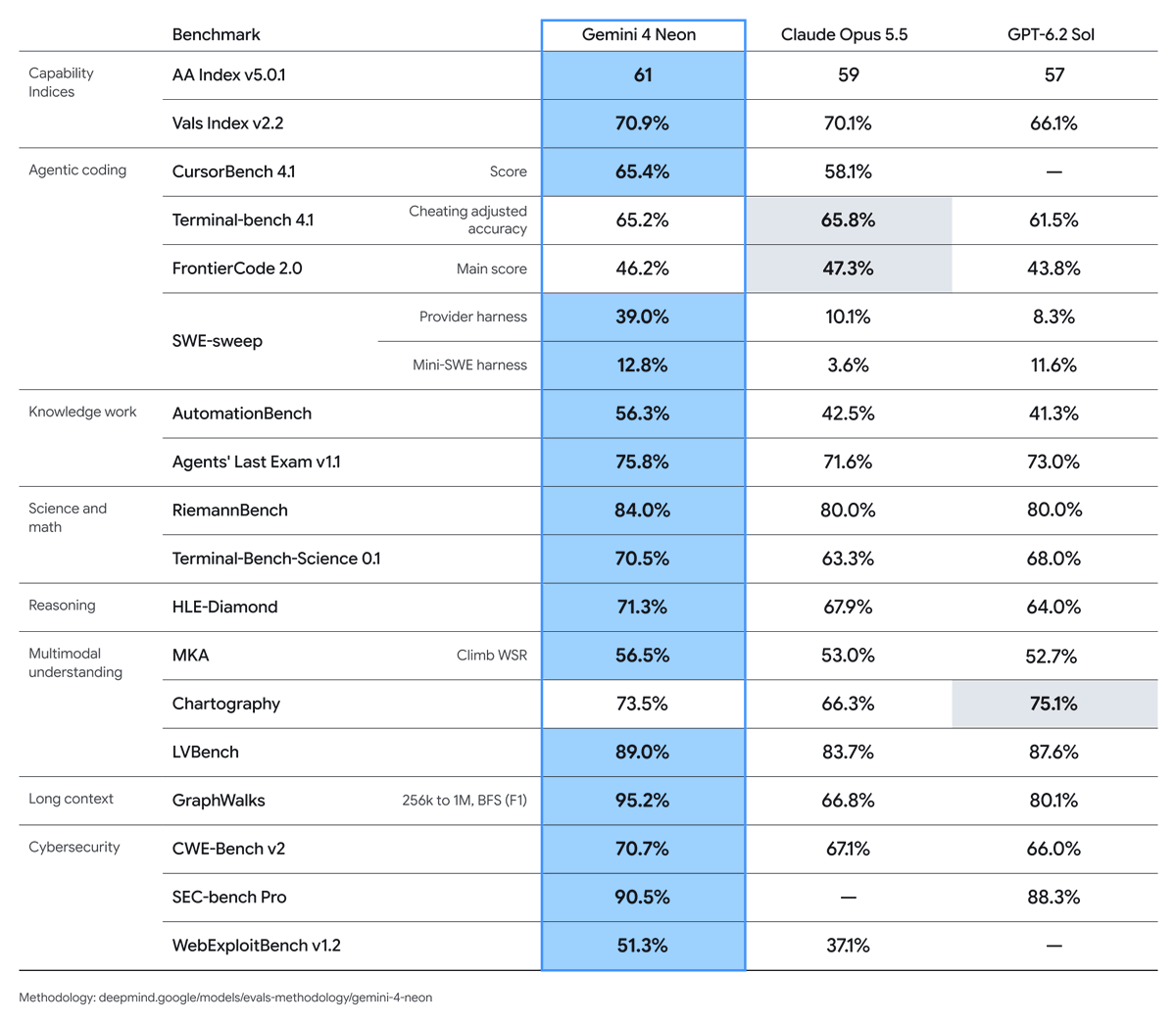
Gemini 4 Neon: frontier-level intelligence with fast end-to-end task completion across complex software engineering, knowledge work, and science workflows.
Begins rolling out today in the Gemini API in @GoogleAIStudio, Gemini for business, for paid Google AI Pro and Ultra subscribers in Google @Antigravity, and for Google AI Pro and Ultra subscribers in the @GeminiApp.