Europe’s uprisings can’t be blamed on immigrants or students as the Right Wing Cuckolds want to. In France the full spectrum of the people is represented.
Both unionized workers and so-called “lumpen.” Both Yellow Vests and students. All have dissolved into one great and terrible whirlpool of destruction.
There is no ideology behind them: Just reality of people’s rage against intolerable conditions and a directionless future.
There is nothing immoral about the destruction happening. This strikes fear in the hearts of the corrupt, who feel at home in this wicked system.
These leaderless uprisings, which may spread to America, will amount to nothing.
But it serves as a reminder that people are ready to rise up. It’s the “leaders” that have failed them.
Revolutionary leadership can only be brought up through cultivation, clarity of resonance, purification of the heart, and moral attunement.
Just reading texts from century ago does not teach you to understand revolutionary ideas. It is living belief that must be cultivated, men and women do not die for dead certainty.
Communists exact justice!
If Communists were in power, every single criminal from the Epstein files would have been prosecuted.
Your “capitalism” keeps them in power.
The biggest propaganda victory the Epstein class pulled off was lying to us about what the word "Communism" means.
This is how they get us fighting on behalf of scum in the Epstein class against our own families and our own interests. "The Communist Party of China are secretly anti-communists who use capitalism" is a prime example. Only someone completely unfamiliar with what Communism actually is could say this. And instead of looking into the question, we're incentivized to act like we know it all and run around social media accidentally advocating for the destruction of our childrens' future.
Based on words.
You take away their labels by questioning the way they use language and seeing if it lines up with reality, and it all crumbles.
It is wild to me that regular, working class Americans can be so attached to a word that the Epstein class uses to destroy their family's standard of living.
They believe the Epstein class without question about the only threat to its power, then take to social media to scream at the supposed craziness of Communism.
Mean while, the Communist Party of China is proving all of these things lies in real time, and we watch via the internet.
Rather than say, "Huh - they seem to have things figured out over there, and we all know we can't trust the Epstein class, as they're absolute scum," the response is "They're not REAL Communists!"
What is this REAL?
Why is what is REAL some imaginary la-la land where everyone is a hippy or something? That is somehow more REAL than the REAL, EXISTING Communist country proving capitalism is obsolete? HOW?
When did some airy fairy idea become more real than what actually exists?
It's mind boggling. And it reads like cope.
But why are we coping on behalf of fat, entitled parasites that wouldn't spit on our grandmas if they were on fire?
They call us terrorists, white nationalists, brown third worldists, American patriots, national security threats to the USA.
In reality we’re Communists, and our horde is growing.
The leader of the largest Communist Party in the entire world enjoys a massive approval rating, has written multiple widely popular books, countless essays, speeches, etc., and is looked at for leadership by a good majority of the world.
You are afraid to even have a debate with me.
What planet do you live on, Rick?
Zohran was a massive waste of time and energy. Nothing was learned. We tried to warn people, but one year was wasted on something everyone who knew better, knew would happen.
When we tell you these people are scammers it’s not sectarianism. Understand: Never Democrat.
The American Communist Party initiated its second National Congress October 10th receiving 80 greetings from fraternal Communist and Socialist Parties and movements from around the world.
They came back from Vietnam and made movies about it.
Apocalypse Now. Full Metal Jacket. Platoon. The Deer Hunter. Born on the Fourth of July.
Beautiful films. Serious films.
Films about the trauma of American soldiers, the moral complexity of American soldiers, the broken psyches of American soldiers.
How many major American films center the experience of the Vietnamese?
How many Hollywood productions have you seen where the Vietnamese are the protagonists, the full human beings with names and families and inner lives, and the Americans are the faceless army descending from the sky?
Think about that structure.
Think about what it means when a country kills three million of your people, loses the war, goes home, and then spends the next fifty years producing prestige cinema about how hard the killing was for the killers.
Vietnamese suffering as backdrop. American suffering as subject.
Vietnamese bodies as set dressing. American guilt as narrative arc.
They could not conquer Vietnam militarily.
But they tried to conquer the story.
They tried to make the war, in global cultural memory, fundamentally about them.
Their boys. Their trauma. Their national reckoning.
We are not your reckoning.
We are not your backdrop.
We won.
We exist.
We have our own story, and in our story, we are the ones who were here before you came and here after you left.
It’s not China they fear.
It’s what China disproves.
That a nation can rise without plunder.
That poverty can fall without war.
That growth doesn’t need Wall Street permission slips.
That a billion people can be fed, housed, and educated without invading anyone.
That is what terrifies the empire.
Not tyranny.
But competence.
Why are we still talking about this in 2026?
Seriously.
How do people spend hours arguing that the Nazis were socialists without spending an afternoon actually studying Nazi Germany, socialism, German political economy, or what the Nazis themselves meant when they said “socialism”?
Why is it so hard to study the thing you want to talk about before developing an entire worldview about it?
First and foremost: “The Nazis called themselves National Socialists” ain't an argument.
Words have histories. Their meanings develop. Different movements can use the same word to describe completely different things. Different eras can use the same word to mean different things. Different ideologues can filter through their worldview and talk about two different things with the same word. (Like how vulgar libertarians call opinions "value.")
If you don't investigate what a word meant within the concrete system of ideas and social relations in which it was actually being used, you're not doing historical analysis.
You're doing word association.
Like an elementary school child.
Underneath this is a MUCH deeper philosophical mistake: metaphysics.
Government does stuff = socialism.
Economic planning = socialism.
Social programs = socialism.
Collectivism = socialism.
Calling yourself socialist = socialism.
But society doesn't actually function this way.
Bismarck created social insurance. Roosevelt massively expanded the American state. Modern multinational corporations plan production, investment and logistics years into the future. Banks consciously allocate credit. The Pentagon plans enormous portions of American industrial production through procurement.
You can find the characteristic you're looking for everywhere.
That doesn't tell you what the thing is.
You've taken one real determination of a concrete whole, pulled it out of the relations giving it meaning, and mistaken the abstraction you just made for the whole. You're calling a leaf a forest.
The better questions are:
How did this society develop? What contradictions produced it? Where are its commanding heights? How is its surplus mobilized? What social relations does it reproduce and transform? What does it require for expanded reproduction? And where is that development carrying it?
This is why Dimitrov is the go-to for analysis of fascism, even in 2026.
Dimitrov defined fascism in power as the open terrorist dictatorship of the most reactionary, chauvinistic and imperialist elements of finance capital. He directly confronted fascist appropriation of socialist language, saying German fascism had “nothing in common with socialism.”
But the interesting question is:
Why call it socialism, then?
Because this “socialism” existed within a society where socialism had become a GIGANTIC political force.
Germany possessed one of Europe's most developed workers' movements. The Russian Revolution had happened. Communism wasn't a philosophical speculation anymore, and they weren't the victim of a century of ridiculous red scare propaganda yet.
Fascism couldn't pretend those anti-capitalist aspirations didn't exist.
It had to appropriate them and transform their meaning. Which the Nazis openly admit themselves.
When Hitler talked about “socialism,” he wasn't talking about Marx's historical transformation of the relations of production through working-class political power.
His “socialization” was directed toward the German people against "lesser races" as he called it.
The worker was to cease understanding himself primarily through class contradiction. Worker and industrialist were instead complementary members of the Volksgemeinschaft—the German national community.
And Hitler simultaneously embraced what he called an aristocratic principle of power - that class distinctions were natural and good, and for him class struggle was actually a lie. Not an objective fact of history like Marx explained.
Put those together and Nazi “socialism” becomes much easier to understand.
It was the socialization of the German population into class collaboration under an explicitly aristocratic national order.
Or less politely:
Class collaboration at the barrel of a gun.
The contradiction between material positions was supposed to disappear from political consciousness because everyone now belonged to the same organic national community.
Hippy dippy everyone magically gets along in capitalism stuff. (Remind you of anything?)
Words don't float above history.
Their meaning exists in their actual use.
This also exposes the philosophical trick behind calling fascism “left-wing.”
Usually the person making this argument has already decided that all politics fits onto:
INDIVIDUAL LIBERTY ←————→ STATE AUTHORITY
Then he discovers Hitler had a powerful state, Stalin had a powerful state, and announces their common political essence.
But where did that axis come from?
Not from the actual development of those societies.
It came from the person doing the categorizing.
He took his subjective political preoccupation—usually “authority,” “collectivism,” or “the state”—and forced objective history into it. He doesn't move deep enough to find out WHY the state appears to him in this form, or the class character of it, how it developed, what's happening to it, etc. He stays there and makes an immutable category out of it.
Reality immediately wrecks the category.
The Roman Empire possessed enormous state authority. So did absolute monarchy, revolutionary France, Nazi Germany and the Soviet Union.
Modern American capitalism couldn't operate for a week without central banking, courts, military procurement, public debt, infrastructure, subsidies and government guarantees.
These obviously aren't the same societies.
Authority is a form through which power is exercised. It doesn't tell us the content or direction of that power.
Ask instead:
Where are the commanding heights? Who directs credit and the surplus and where does it go? What contradictions is the system reproducing and transforming? What kind of expanded reproduction is taking place?
And this is where Dimitrov and William Z. Foster become more interesting than internet arguments about “big government.”
Because by the twentieth century, capitalism itself had already become enormously planned.
Competition produces concentration. Concentration produces monopoly. Industrial capital intertwines with banking and finance.
Huge corporations internally plan production. Banks allocate credit. Cartels organize markets. Governments procure industrial output. Central banks regulate credit.
The old picture of capitalism as millions of little shopkeepers spontaneously coordinating everything through a “free market” had already been superseded by capitalism's own development.
So when fascism intensifies economic coordination, planning tells us almost nothing by itself.
Capitalism already plans.
The question is:
What is being planned, through what institutions, toward what kind of expanded reproduction?
This is why Dimitrov identifies finance capital.
Finance already coordinates investment, commands credit, determines which industries receive resources, and connects banks, industry and the state.
Economic coordination is a necessity of advanced production. It wasn't dreamed up one day in a guy's office. It instead represented a particular political development of a highly concentrated capitalist economy under profound crisis.
And what was fascism's answer to the contradiction between labor and capital?
Class collaboration.
Nazism declared the contradiction politically illegitimate.
Worker and industrialist were supposed to understand themselves as complementary members of the national community.
But you cannot resolve a material contradiction by declaring everyone friends.
The contradiction was politically contained without generating the higher relation capable of superseding it.
This is also where Nazi “socialism” becomes intelligible.
Dimitrov warned about fascist social demagogy.
Millions of Germans were furious at unemployment, banks, insecurity and capitalist crisis. Fascism needed that anger while detaching it from the social relations producing the crisis.
So it attacked “bankers,” corruption, decadence and Versailles. It called itself revolutionary. It even stole socialism.
But the contradiction was redirected toward:
The Jew.
The Communist.
The foreigner.
Versailles.
Enemy nations.
Other races.
Some alien element supposedly preventing German national unity.
The material contradiction remained.
Its ideological form changed.
The old switcheroo, you know?
Even Nazi privatization makes more sense inside this whole. The regime transferred substantial public holdings and services into private hands, unusually moving against the contemporary tendency toward greater state ownership.
But privatization doesn't define fascism either.
Private = capitalism.
State-owned = socialism.
Count enough factories and apparently we've solved political economy.
No.
The privatizations matter as one determination within the movement of the whole.
And here we reach something fundamental:
War.
Dimitrov didn't treat war as an accidental foreign-policy preference.
He connected fascism to capitalist crisis, imperialism, wars of plunder and struggles over the division and redivision of the world.
The Nazis inherited the contradictions of the post-WWI financial order. (And we get this from Michael Hudson, btw. The guy the US government went to so they could understand their OWN system.)
Germany owed reparations. The Allies owed enormous wartime debts, especially to the United States. Germany needed foreign exchange to make external payments.
So American credit flowed into Germany.
Germany borrowed abroad to help sustain its external payments. Payments flowed onward through Europe. European governments serviced their own obligations.
New credit helped sustain payments on old debts.
Sound familiar?
This is why I find the comparison with modern vulgar libertarianism particularly funny.
People who insist Nazi Germany was socialist because “government interfered with the market” imagine capitalism as something existing separately from government, banks, central banks, international debt, state guarantees and geopolitical power.
But the capitalism that actually produced German fascism was already a world of international banking, sovereign debts, central banks, industrial cartels, government guarantees, foreign lending and enormous concentrations of finance and industry.
The Bank for International Settlements was literally created in 1930 in connection with settling German reparations.
Even after the war began, this financial machinery didn't evaporate.
The BIS continued operating. The Reichsbank continued making wartime interest transfers connected to earlier investments, largely in gold. Postwar investigations found that some Reichsbank gold reaching the BIS had been looted from occupied central banks. (And btw, after the October Revolution, the Bolsheviks told the banks to F themselves and cancelled all the Tsarist debts. That is something a movement AGAINST capitalism does.)
Europe is tearing itself apart.
Armies are crossing borders.
Central banks are moving gold.
Occupied countries are being stripped.
International financial machinery keeps effing functioning.
And the vulgar libertarian conception of capitalism is sitting in the corner imagining two guys freely exchanging chickens.
THAT is why Hudson is useful.
To really understand what made this stuff happen, we gotta ask:
Who owes whom?
Who controls credit?
Who receives interest?
Who creates the means of payment?
How does debt reshape industry?
How does finance reorganize the productive economy beneath it?
Now we're looking at the actual machinery.
And German fascism's subsequent development becomes a lot easier to understand.
Its answer to class contradiction was class collaboration.
Its answer to economic constraint increasingly became militarized expansion. The only capitalist solution.
German fascism mobilized the national economy for rearmament. State-directed credit mobilized industry. Military procurement absorbed productive capacity. Autarky prepared Germany materially for war.
But Germany couldn't command oil, rubber, food, minerals and strategic resources into existence.
The contradictions pushed outward.
The “solution” increasingly required expansion.
Territory.
Resources.
Labor.
Agricultural production.
Industrial capacity.
Oil.
Grain.
Minerals.
Factories.
Land.
War can never be detached from the domestic system - as though Hitler constructed a self-sustaining economy and then randomly decided to invade everybody because he was bad.
The outward expansion increasingly followed from contradictions developing inside the system itself.
And THAT gives us a much more useful comparison with Communism.
Don't ask:
“Did both have economic plans?”
Obviously. Everybody does.
Don't ask:
“Did both have powerful states?”
Obviously. Everybody does.
Don't even ask:
“Did private businesses exist?”
Everybody does.
None of that stuff tells us anywhere near enough.
Instead, ask:
What does each system have to do to reproduce itself, develop its productive powers, and advance beyond its existing contradictions?
And here we need to abandon another bad conception of socialism.
Socialism isn't an afternoon where the victorious workers take a giant red marker and cross out:
Markets.
Money.
Private enterprise.
Wages.
Authority.
Contradictions.
Done! Socialism achieved!
History doesn't work like that.
"Aufhebung" isn't empty destruction. It's not getting stuck in the middle of the dialectic. It's the entire thing, babyyyyyyy. The whole bag of chips.
The new develops from contradictions within the old, negating aspects while preserving and transforming others within a higher relation.
And that unfolds historically.
That's why transitional socialist societies can contain forms inherited from capitalism without those forms automatically determining the character and direction of the whole society.
Ask what is happening to those forms within the developing totality.
Are they reproducing themselves as commanding social powers?
Are they subordinate to other mechanisms?
Are their functions changing?
Who controls the surplus and credit, and where does it go?
Who controls investment and where does that go?
What are the commanding heights of the economy actually doing and what purpose do they serve?
What new social relations are developing through the inherited forms?
The great historical wager of Soviet socialism was almost the opposite of the fascist one.
It had to build internally.
Electrification.
Heavy industry.
Machine tools.
Railways.
Education.
Science.
Housing.
Agricultural modernization.
An increasingly educated and technically capable population.
The system could expand its productive power by developing the productive powers of society itself.
This wasn't the instantaneous disappearance of everything inherited from the old society.
It was a historical process through which inherited contradictions and forms were being transformed within a new direction of development.
THIS is why simplistic comparisons between Nazi Germany and contemporary China fall apart too, btw.
China has markets.
Private firms.
Wealthy entrepreneurs.
Huge state enterprises.
Extensive planning.
Fine.
Those are determinations of the concrete Chinese economy.
But pulling out private firms and screaming “CAPITALISM!” tells us about as much as pulling out five-year plans and screaming “SOCIALISM!”
Reconstruct the whole.
Where are the commanding heights?
Who controls credit and strategic infrastructure?
Where does investment go?
What is happening to the surplus?
How do different property forms relate to and subordinate one another?
And what does development actually consist of?
Power generation.
High-speed rail.
Advanced manufacturing.
Telecommunications.
Research.
Semiconductors.
Renewable and nuclear energy.
Space technology.
Industrial upgrading.
The point isn't:
Infrastructure = socialism.
Same mistake again, man.
The point is the movement of the whole. Always.
A socialist developmental logic seeks expanded reproduction increasingly through developing society's productive powers: infrastructure, productivity, advanced industry, science, technology and an expanding material basis for reproduction at a higher level.
German fascism encountered a different necessity.
Its militarized development required resources and outlets the German national economy couldn't internally provide.
Rather than building itself up, advancing its productive forces (which would have required working class interests being fulfilled) it increasingly sought the conditions for reproduction outside itself:
Expansion.
Conquest.
Appropriation.
Imperial redivision.
War.
Because the point wasn't the improvement of the working class and the advance of society. It was to do whatever it took to keep their current mode of production intact.
This returns us to Hudson.
The deepest question isn't:
“Whose name is on the deed?”
It is:
Who controls the economic surplus, through which institutions, and toward what kind of reproduction is it directed?
Credit determines what gets built. Infrastructure establishes the cost structure upon which the economy operates. Banking, transportation, energy, land and natural monopolies help determine the conditions of productive activity throughout society.
THAT is why the commanding heights matter.
And it's why “planning” cannot divide capitalism from socialism.
Modern capitalism plans too.
Amazon plans.
Walmart plans.
JPMorgan allocates capital.
BlackRock allocates capital.
The Federal Reserve manages credit conditions.
The Treasury manages enormous financial flows.
The Pentagon guarantees markets for huge sections of industry.
The questions are:
Who controls the planning mechanisms?
Where does the surplus go?
What contradictions does planning reproduce or transform?
What kind of expanded reproduction results from it?
Now Nazi class collaboration becomes much clearer.
Nazism attempted to contain the contradiction between labor and capital politically while the material relations generating it developed onward.
The contradiction wasn't being progressively transformed into a higher relation.
It was increasingly displaced outward through militarization and imperial expansion.
This is why Dimitrov's definition is more useful than defining fascism through “authoritarianism.” I mean, come on, man. A child thinks like that. We're grown adults here. Let's use our fully developed brains. Please.
Look at the movement of the whole:
Crisis → concentration and finance capital → fascist political consolidation → class collaboration → militarization → imperial expansion → repartition → war.
Compare the developmental logic represented historically by Communist construction:
Revolution → control of the commanding heights → mobilization of surplus → electrification → industrialization → education → infrastructure → science → rising productive capacity → transformation of inherited social relations → expanded reproduction on a higher technological basis.
Now we're finally talking about how societies actually function and develop.
Socialist development contains contradictions. It's far from perfect. And it has many problems. I'm not here to ignore those. Regardless:
Socialism can and does use markets.
It can and does contain "private" enterprise.
Socialist states exercise authority. Sometimes HARSH authority.
Inherited forms don't evaporate after revolution. The real world still exists and must be dealt with on ITS terms.
Development is contradictory, you know? Just how it goes. Old forms persist while their content changes. New relations can develop through those inherited forms, so a form that expressed one relation can become subordinate to another over time.
Development can advance, retreat, reverse, or produce contradictions requiring further transformation and new directions.
That's why we study the movement of the whole instead of playing political Pokeymans with individual characteristics.
And when we keep all this in mind, Hitler's whiny child worldview makes more sense.
Hitler appealed explicitly to an aristocratic principle - he called it natural.
That matters a LOT—not because Marxists oppose “hierarchy” in the abstract, though.
We ain't anarchists. The kid I'm using to make this explanation is WAY closer to Bakunin and Proudhon than we are. (Maybe the only difference is that Bakunin and Proudhon had the discipline to stay on point and not lie/distort? I dunno.)
A Red Army has commanders. A factory has engineers and foremen. A socialist state has authority, administration and discipline.
The distinction is that Marxism understands social relations historically.
Feudal aristocracy wasn't produced by an eternal natural law requiring lords and peasants forever for us. Because we take our view from an examination of history.
And that aristocracy arose from definite historical relations. Those relations developed. Their contradictions developed. New forces developed within them. And the old relation was historically superseded—not simply erased, but negated, preserved and transformed through subsequent development.
Hitler instead attempted to naturalize it politically, as if he could make time stop ticking.
Where Marxism searches for the historical development producing social relations, fascist ideology repeatedly converts historically produced relations into supposedly natural ones.
And that brings us back to “Nazis were left-wing.”
If your entire politics begins from:
INDIVIDUAL ←————→ STATE
... then Hitler, Stalin, Roosevelt, Xi Jinping, Louis XIV, Donald Trump, and Augustus Caesar all end up looking the same at some point.
You've built your categories so they have to.
The old switcheroo again.
But society doesn't develop according to its ruler.
A five-year plan to electrify a continent and a four-year plan preparing an imperial power for conquest are both “plans” only at the most abstract level imaginable.
Restore their actual content, and the similarity disappears.
One developmental logic seeks advancement primarily by developing the productive powers within society and progressively transforming inherited relations.
The other increasingly sought reproduction through class collaboration, subjugation, militarization, external expansion, appropriation and war.
So no, Nazism wasn't socialist because it planned or because it had a "big state."
Capitalism already planned, and all states are big, no matter what form they come in.
Nazism wasn't socialist because it called itself socialist. The word had a completely different meaning for them.
And fascism isn't “left-wing” because somebody decided beforehand that authority = left and arranged history along that imaginary ruler.
Look at the actual real world development.
Look at the language in its historical context.
Look at the commanding heights of the economy.
Look at credit and surplus.
Look at the debt system.
Look at class collaboration or struggle.
Look at how contradictions are transformed—or displaced.
Look at what society must do to reproduce itself.
And look at what the whole process is becoming.
Don't judge a society by collecting abstract characteristics or political labels. You're just reducing it to arbitrary ideas at that point. Smoke and mirrors, man.
Grasp the REAL thing in its development.
Because once you do, the supposed similarity between Nazism and Communism doesn't become clearer.
It dissolves.
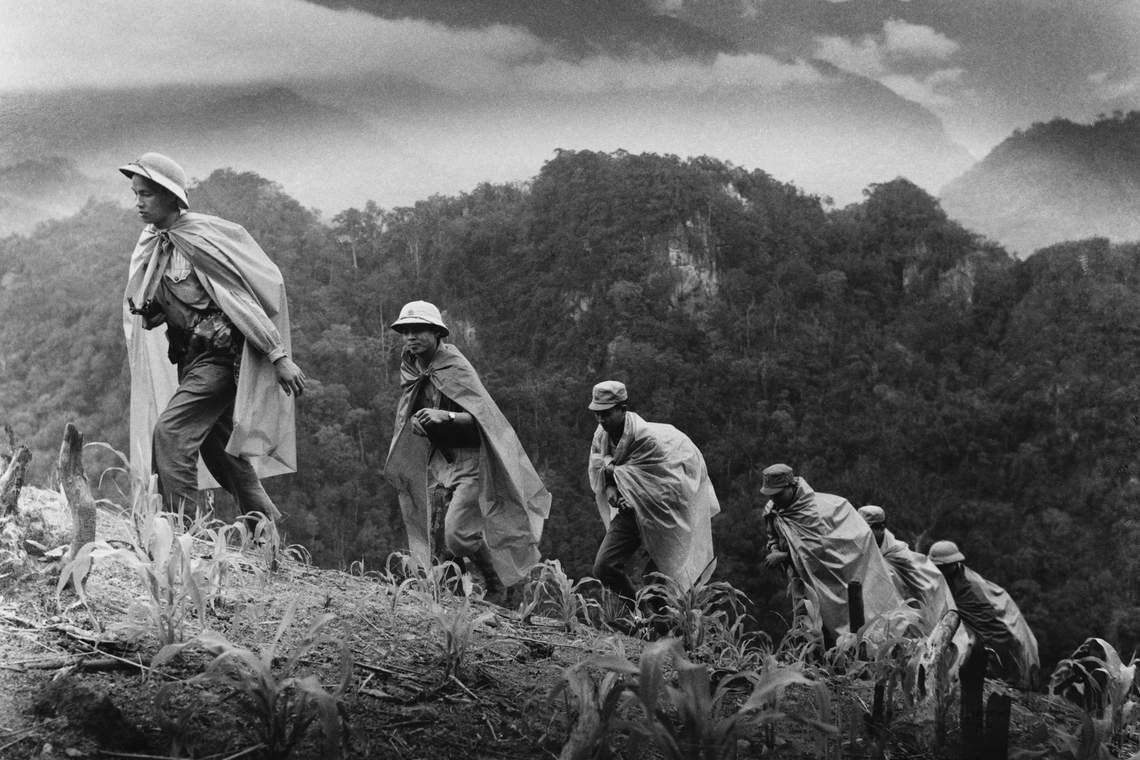
Here's what they could not bomb.
They could bomb the roads. They bombed the roads.
Vietnam moved supplies at night, on bicycles, through jungle paths, through routes so dispersed and adaptive that no bombing campaign could cut them.
They could bomb the cities. They bombed the cities.
Vietnam moved the cities underground. Entire hospitals. Entire schools. Entire command structures, built into tunnels, kept operational through years of bombardment.
They could bomb the supply lines from the north. They bombed them constantly.
Vietnam repaired them faster than they could be destroyed.
Tens of thousands of people, many of them women, many of them teenagers, worked around the clock to fill bomb craters and rebuild bridges and keep the lines open.
They could not bomb the reason.
The reason the Vietnamese were fighting.
The reason they were willing to live in tunnels and eat whatever they could find and watch their villages burn and keep fighting.
The reason, which was simply:
This is our country and we will determine what happens in it.
That reason lives in a place no bomb reaches.
It lives in the decision.
The collective, generational, absolute decision of a people that their dignity is not for sale and their submission is not available at any price.
When a people reach that decision, when enough of them reach it, deeply enough, the military calculus stops working.
All the tons of bombs and all the chemical weapons and all the counterinsurgency manuals become irrelevant.
Because the war is no longer being fought over territory.
It's being fought over whether the people will break.
And Vietnam did not break.
After everything.
After Agent Orange and carpet bombing and Phoenix Program assassinations and "free fire zones" and napalm and the systematic destruction of every physical thing that could be destroyed:
The people did not break.
The people won.
There is no more powerful demonstration in modern history of what human will can do against imperial force than what Vietnam did.
And they know it.
Which is why their military academies study it.
Which is why their strategists are still writing about it.
Which is why the word "Vietnam" is still the word their politicians reach for when they want to describe something that went wrong beyond recovery.
They study it because it frightens them.
It should.
It should frighten every empire that thinks enough firepower can substitute for the right to be where you are.
Vietnam proved it can't.
Yes, Communism works.
Yes, it worked in USSR.
Yes, it works in Cuba.
Yes, it works in free Korea.
Yes, it works in China.
Yes, it works in Laos.
Yes, it works in Vietnam.
Yes, Communism works every single time it's tried. And anyone telling you otherwise is either lying or repeating a lie they aren't willing enough or smart enough to sniff out.
Let's go over how well it works:
China:
🇨🇳1. The largest poverty reduction in recorded history. China went from widespread mass poverty to eliminating extreme poverty by the World Bank's international standard. The World Bank recognizes that China had eradicated extreme poverty by 2020.
2. Transformation from a devastated agrarian country into an industrial superpower. In 1949 China was overwhelmingly rural, poor, war-ravaged and technologically backward. Today it possesses an enormous manufacturing base spanning steel, shipbuilding, machinery, electronics, chemicals, automobiles, telecommunications and increasingly advanced technology.
3. An extraordinary increase in human longevity. Life expectancy was roughly 35–40 years around the Revolution; World Bank data now puts it around 78 years.
4. Mass literacy and education. The revolution inherited enormous illiteracy, particularly in the countryside. China subsequently created a nationwide educational system reaching a population of more than a billion people.
5. Infrastructure on a gigantic scale. China constructed the world's largest high-speed rail system, huge electrical grids, ports, metros, highways and modern cities—effectively physically integrating a continental-sized country.
6. Technological independence. A country once dependent on foreign industrial technology now builds nuclear reactors, satellites, supercomputers, advanced telecommunications equipment, commercial aircraft and its own space station, and has carried out increasingly sophisticated lunar missions.
7. The Revolution itself created the foundation for the later boom. This gets lost when Chinese development is reduced to "Deng introduced markets." The Mao period unified the country, redistributed land, greatly expanded literacy and basic health care, created heavy industry and infrastructure, and developed a technically educated population. Beyond the fact that markets do not equal an entire society revolving around the accumulation of a handful of aristocrats, Reform and Opening Up operated upon this already transformed social foundation, rather than upon the China of 1949.
China may be the single strongest example because we can watch the entire historical trajectory: semi-colonial agrarian catastrophe → revolutionary state → basic industrialization → mass education/infrastructure → advanced industrial economy.
🇨🇺 Cuba's accomplishments are remarkable because we're talking about a small Caribbean country with limited natural resources situated only 90 miles from the country of a ruling class that is actively trying to destroy it.
1. Universal health care. Cuba constructed a nationwide primary-care system with unusually strong preventive medicine. WHO material has specifically highlighted how Cuba achieved health outcomes resembling substantially wealthier countries.
2. Near-universal literacy. The 1961 Literacy Campaign mobilized enormous numbers of young people to teach throughout the countryside. WHO historical material reports literacy around 96.7%, compared with roughly a quarter of Cubans being illiterate before the revolution. (To say nothing of comparing it to Cleveland, where I'm from, today. Which has much less literacy.)
3. Developed-country-level longevity despite much lower income. World Bank data puts Cuban life expectancy at about 78 years, approximately the same headline figure as China.
4. Medical internationalism. Cuba has deployed doctors and medical personnel across Latin America, Africa and elsewhere during disasters, epidemics and chronic shortages of physicians.
5. Medical and biotechnology capacity. For a country of Cuba's size and income, its ability to maintain indigenous pharmaceutical, vaccine and biotechnology research is particularly notable.
6. Education became effectively universal. Free education, mass rural schooling and expanded university access fundamentally changed the educational composition of Cuban society.
The Cuban achievement isn't "Cuba became richer than America." It didn't. It's that a relatively poor country deliberately converted a remarkable proportion of its limited social surplus into health, education and human development - all while basically being under siege.
🟥The Soviet transformation is arguably even more historically dramatic.
1. Industrialization at extraordinary speed. The USSR transformed a predominantly agrarian former empire into one of the world's two principal industrial powers within several decades.
That meant enormous expansion of:
- steel
- electricity
- machine tools
- mining
- chemicals
- railroads
- automobiles and tractors
- aviation
- heavy engineering
2. Defeating Nazi Germany. Whatever judgment one makes about Soviet politics, this is impossible to remove from the historical balance sheet. The USSR bore the overwhelming bulk of the European land war against Nazi Germany and suffered roughly 27 million deaths in the process.
The Red Army went from the catastrophe of 1941 to taking Berlin in 1945.
3. Mass literacy. The USSR transformed a society containing enormous illiterate and semi-literate rural populations into a highly educated industrial society.
4. Creation of mass technical education. It produced engineers, scientists, physicians and skilled industrial workers on an enormous scale.
5. First satellite in space — Sputnik, 1957.
6. First human in space — Yuri Gagarin, 1961.
That achievement deserves more emphasis than it normally gets. A country whose enormous peasant population had lived under the Romanov monarchy only a few generations earlier put the first human being into space.
7. Major achievements in science. Mathematics, theoretical physics, aerospace engineering, chemistry and other scientific disciplines became areas of Soviet strength.
8. Enormous expansion of women's participation in public life. Women entered education, medicine, science, engineering and industrial employment on a scale radically different from prerevolutionary Russia.
9. Rapid reconstruction after WWII. Much of the USSR's most economically important territory had been devastated. Thousands of towns and enormous quantities of industrial infrastructure had been destroyed. Yet the Soviet Union reconstructed itself and emerged as a superpower.
So the Soviet development is (roughly):
1917: backward, overwhelmingly agrarian former empire
- 1945: defeats Nazi Germany
- 1949: atomic power
- 1957: first artificial satellite
- 1961: first human being in space.
That's an astonishing 44-year transformation.
🇻🇳 Vietnam deserves a lot more attention than it usually gets too.
1. Defeated French colonial rule.
2. Survived and defeated the enormously more powerful United States in a devastating war.
3. Reunified the country.
4. Subsequently produced one of the world's major development success stories.
The World Bank itself describes Vietnam's transformation from one of the world's poorest countries into a middle-income economy as a "remarkable development success story."
Poverty fell from roughly 60% in the early 1990s (after the fall of USSR, which was the largest trading partner in the Communist bloc) to extremely low levels today. If we use the World Bank's $3/day 2021-PPP measure, it was only 1.6% in 2022.
5. Near-universal electrification. Only about 14% of households had electricity in 1993; by 2019 virtually all did.
6. Universal primary education.
7. Huge improvements in health. Life expectancy reached about 75 years, while infant mortality fell from 32.6 per thousand in 1993 to 12.1 in 2023. National health insurance covered about 93% of the population in 2023.
8. Industrialization. Vietnam has become an important global manufacturing center rather than remaining locked into its historical position as an impoverished agrarian colony.
🇱🇦 Laos
Laos receives barely attention because of its size (frankly, most people in the US forget it exists), but the baseline matters enormously: it inherited an extremely poor, overwhelmingly rural country devastated by war.
Life expectancy increased from roughly 54 years to around 69, while under-five mortality has fallen dramatically.
Even during recent economic difficulties, the national poverty rate declined from 24.6% in 2012 to about 15% in 2024, according to the World Bank.
We generally get taught to look at this stuff incorrectly. Causation gets removed. Comparisons get jumbled. We judge everything against a mystical USA where everything good is because capitalism, and everything bad because Communism.
I don't think I need to tell anyone how childish that is. And how it doesn't properly reflect the actual, real world.
To get something reflective of the real world, we must compare societies to the material conditions inherited by their revolutions. Not to the ruling class of a nation attacking them economically.
Tsarist Russia was predominantly agrarian and extraordinarily poor.
Pre-revolutionary China had endured imperial domination, civil war, invasion and mass rural poverty.
Cuba inherited severe inequality, rural deprivation and substantial illiteracy.
Vietnam endured colonialism followed by decades of catastrophic warfare.
And yet Communist-led development produced:
Russia: peasant empire -> industrial/space superpower.
China: semi-colonial agrarian country -> world's industrial giant.
Cuba: poor plantation economy -> unusually high literacy, medical capacity and longevity.
Vietnam: devastated colony -> rapidly industrializing middle-income economy.
That is probably the strongest empirical argument that we need to emphasize. The recurring achievement wasn't simply redistribution of an existing stock of wealth. It was the deliberate creation of new productive and human capacities—industry, engineers, electrical grids, hospitals, schools, scientific institutions, transportation networks and an educated workforce—on a scale that the old social orders had demonstrably failed to produce.
All that is to say that Communism WORKS. And anyone telling you it doesn't is lying.
The American ruling class will never say "we are the terrorists."
They will say "we are the indispensable nation."
They will bomb a country into dust, then claim they saved it from something worse.
They will cry over their own dead and shrug at everyone else’s.
They will not stop until someone takes away their permission.
That someone is not another government.
It is the people they pretend to represent.
If you still support Zohran at this point, then you are an enemy, a fascist/zionist collaborator, and need to be treated as such.
Everything you stand for needs to be removed from the socialist cause.
You are a failure and sold everyone a lie.
Zohran didn’t “sell out.” This is what he was from the beginning. And it’s not that people didn’t know better, they did.
It was the entire generation of largely millennial, professional “leftist” activists who decided to just openly sell out. Shamelessly.
The entire progressive Democrat “movement” is a Soros funded op
This is why they support nazis in Ukraine, condemn the Palestinian resistance while smearing the American people as antisemitic