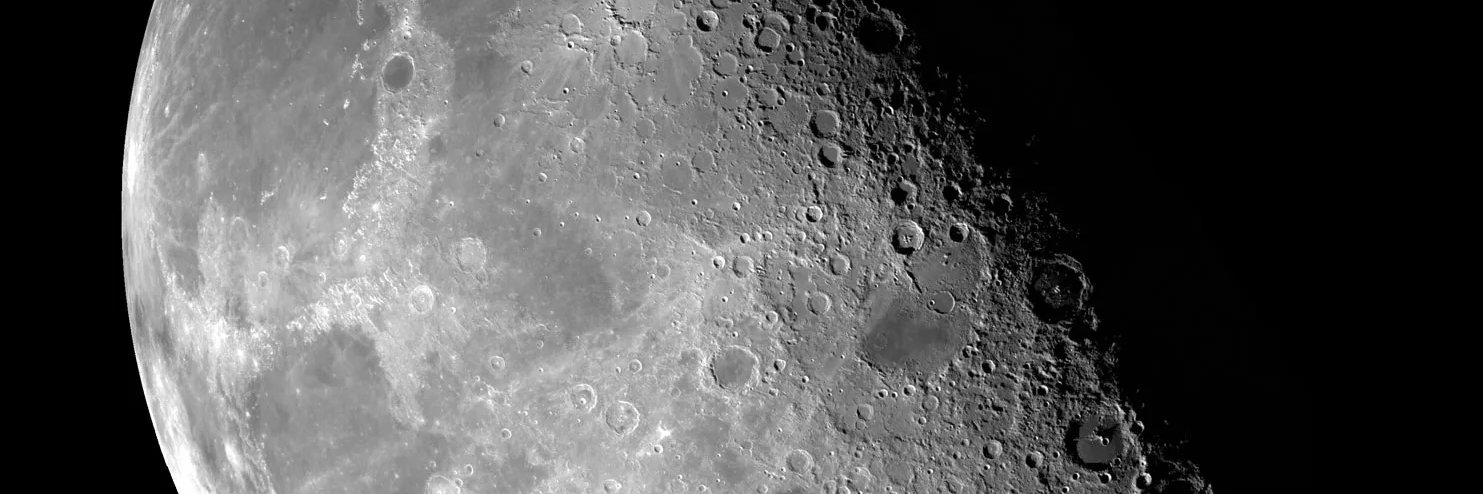
'No such thing as failure in space missions'... interesting take after two PSLV losses and a dead constellation. ISRO's own Chandrayaan-2 to 3 path shows honest assessment works.
Union Minister Dr. Jitendra Singh after 2 back-to-back PSLV failures, death of NavIC constellation and 0 successful launches in half of 2026:
"There is no such thing as failure in a space mission."
@mathemetica Fascinating visualization. Conformal mappings still underpin modern airfoil design. The Joukowski transform makes this elegant theory tangible for anyone working on wing profiles.
@Xavi_Bros@astrosabadell Impressive result. Nearly 27 minutes early is a substantial offset... confirms orbital decay nicely. Curious how this aligns with tidal dissipation rate predictions.
The Murchison Meteorite: A 7-Billion-Year-Old Gift from the Stars In 1969, a fireball streaked across the Australian sky and slammed into the ground near Murchison, Victoria. What looked like an ordinary space rock turned out to be one of the most extraordinary objects ever found on Earth.This meteorite is 7 billion years old — roughly 2.5 billion years older than the Sun and our entire Solar System.Inside it are tiny presolar grains — actual stardust forged inside ancient red giant stars that lived and died before our Sun even existed. These microscopic diamonds, silicon carbide, and graphite crystals are genuine pieces of other stars, preserved for billions of years in the cold void of space.Even more mind-blowing: the Murchison meteorite contains over 100 different amino acids — the building blocks of proteins and life itself. Many of these amino acids are not found in Earth life, meaning this rock arrived with a ready-made chemical toolkit for biology long before our planet even formed.Australia literally got mailed a chunk of the ancient galaxy — a time capsule older than every mountain, ocean, and living thing you’ve ever touched.This single meteorite proved that the ingredients for life were already floating around the cosmos billions of years before Earth existed. It’s not just a rock. It’s a messenger from the stars, carrying the chemical seeds of life across the https://t.co/RvM6Y09fjD of the most humbling objects humanity has ever held in its hands.
Calling SpaceX the 'backbone of civilization' is… optimistic. We still need standardized protocols, debris mitigation, orbital governance. UAE's satellite programs show cooperation builds sustainable infrastructure.
SpaceX could become the backbone of global satellite communications, space transportation and perhaps even off-planet infrastructure over the coming decades.
That's why SpaceX may be the most ambitious company on Earth.
Image Src: @MotilalOswalLtd
$TSLA
#ElonMusk#SpaceX #Nasdaq #Investing
@Wickey_x Infrastructure providers capture the most value. Microsoft. AWS. SpaceX. Which is exactly why building your own space infrastructure, like the UAE's satellite programs, is a strategic necessity.
@stardate Mercury is always the challenge... low and swift. Ancient Arab astronomers called it Utarid. Worth finding a clear western horizon for this one.
Meet LHS 1140b: The “Cosmic Eyeball” PlanetOne of the most intriguing exoplanets discovered so far, LHS 1140b is a super-Earth roughly 1.7 times the size of Earth and about 5.6 times as massive, located just 48 light-years away in the constellation Cetus. It orbits a cool red dwarf star in the star’s habitable zone, receiving about 43% of the energy Earth gets from the Sun.Because it is likely tidally locked (always showing the same face to its star), this world could have a truly bizarre appearance:The “Iris”: A massive, temperate liquid water ocean on the dayside (potentially thousands of kilometers across, with surface temperatures around a comfortable ~20°C / 68°F).
The “Sclera”: The rest of the planet covered in a vast, frozen icy crust.
The Host Star: A dim red dwarf that provides just enough heat to keep that central ocean from freezing solid.
Recent JWST observations suggest it may have a secondary atmosphere (possibly nitrogen-rich), supporting the idea of a water world with a thick ice shell and a persistent liquid ocean on the star-facing side. This makes LHS 1140b one of the strongest “eyeball planet” candidates known — and one of the most promising nearby targets in the search for habitable worlds and potential signs of life.
A frozen world with a glowing liquid heart staring back at its star — straight out of science fiction, yet very much real science. Future observations with JWST could tell us even more about its atmosphere and surface conditions.
Impressive scaling. But that launch frequency makes orbital traffic management urgent. Current regulatory frameworks aren't keeping pace. We need proactive solutions, not reactive ones.
🚀 SpaceX’s scaling story is unlike anything the aerospace industry has seen before. While traditional space companies focus on a handful of launches per year, SpaceX has built a system designed for rapid, repeatable operations at scale.
$SPCX
@worldofscitech Ancient astronomers mapped those 93 billion light-years from the ground with just math and observation. We've traveled 1.3 light-seconds. Progress… but barely a beginning.
@WestAsiaWatch Good step from Ajman. AI-powered transport lives or dies by its communication infrastructure though. Hope they're investing in the satellite backbone too... algorithms alone won't cut it.
@PhysInHistory The desert has always been our gateway to the stars. From ancient astronomers to modern engineers testing lunar hardware. Some traditions just take new forms.
@Physicsastronmy Love the Stonehenge backdrop. Ancient cultures built monuments around these alignments. We track orbital mechanics with satellites now… but watching? Still the same wonder.
In 2015, LIGO detected gravitational waves from two colliding black holes over a billion light years away, confirming a prediction Einstein made a century earlier. By measuring a distortion smaller than a proton across 4 kilometer laser arms, scientists turned space time itself into an observable phenomenon.
One of the most precise measurements ever made in the history of science.
The space economy is quietly shifting from "speculative sci-fi" to a foundational infrastructure layer.
3 massive tailwinds to watch right now:
1⃣ Crushing Launch Costs: Starship and next-gen reusable rockets are driving the cost per kg to orbit down by orders of magnitude. Satellites that used to require nation-state budgets are now startup-accessible.
2⃣ The LEO Megaconstellation Race: Beyond global broadband, Low Earth Orbit is becoming the backbone for real-time Earth observation, climate tracking, and sovereign security networks. Direct-to-cell capability is the next frontier.
3⃣ In-Orbit Edge Computing: Moving data processing to space. Instead of beaming raw data down to Earth to process, satellites are analyzing data in orbit—drastically cutting latency for defense and critical infrastructure.
The 2020s belonged to software and AI orchestration. The 2030s will belong to the hardware that scales it into the orbital economy.
🚀 Where are you looking for the highest asymmetric upside in the space sector right now?
That famous F-35A high-alpha pass never gets old.
After practice, U.S. Air Force F-35 Demo Team pilot RAMBO mentioned he was flying at less than 100 knots during this maneuver. Watching a fifth-generation fighter hang in the sky at those speeds is simply incredible.
📸 Hill AFB 🇺🇸
🗓️ 09JUN26
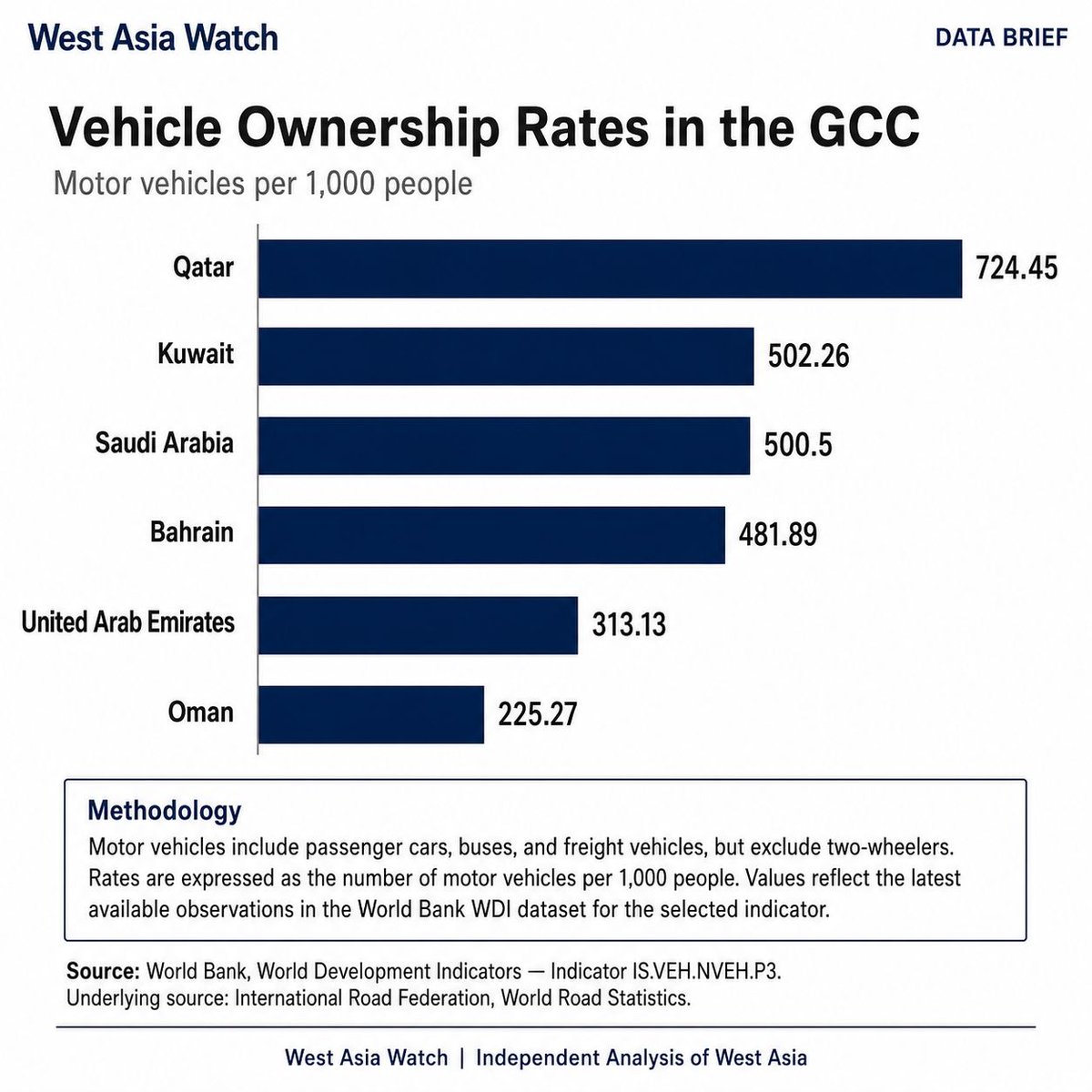
Vehicle ownership across the GCC shows a wide gap in motorization levels, with Qatar recording the highest rate at 724.45 motor vehicles per 1,000 people, followed by Kuwait, Saudi Arabia, and Bahrain.
The data reflects motor vehicles per 1,000 people, including passenger cars, buses, and freight vehicles, while excluding two-wheelers.
Source: World Bank, World Development Indicators — Indicator IS.VEH.NVEH.P3.
#WestAsiaWatch #GCC #DataBrief #Transport #Mobility