Dividir el trabajo en sprints es el mayor sinsentido de este sector. Los incentivos son horribles:
Si vas justo, quieres apurarte para acabar en tiempo. Si vas sobrado, extiendes tu trabajo para ajustarlo al sprint.
Me parece increíble que esto sea el “estándar” de la industria
Microsoft has released its own document parser for LLM use!
.
.
Introducing MarkItDown, a 100% open-source, one-stop solution for effortlessly converting any file to Markdown—perfect for text analysis, indexing, and more!
Here’s what makes it special:
↳ Converts PDF, Word, Excel, PPT, images, audio to markdown
↳ Extracts EXIF, OCR, and transcripts automatically
↳ Available via CLI, Python API, or Docker
↳ Offers LLM-based image descriptions
↳ Supports batch conversions
Link to the repo in next tweet!
_____
Find me → @akshay_pachaar ✔️
For more insights & tutorials on AI and Machine Learning.
🚨 Exciting News! We are releasing the code for xLSTM! 🚀 🚀 🚀
Install it via: pip install xlstm
We have already experimented with it in other domains and the results are looking great so far! Stay tuned for more news to come! 🔜 👀
Repository: https://t.co/yGbGM1eOnA
Just published React 19.0.0-rc.0.
This is the exact build we'll release as 19.0, unless an issue is reported that requires a breaking change.
Thank you to everyone who helped us get the release into shape!
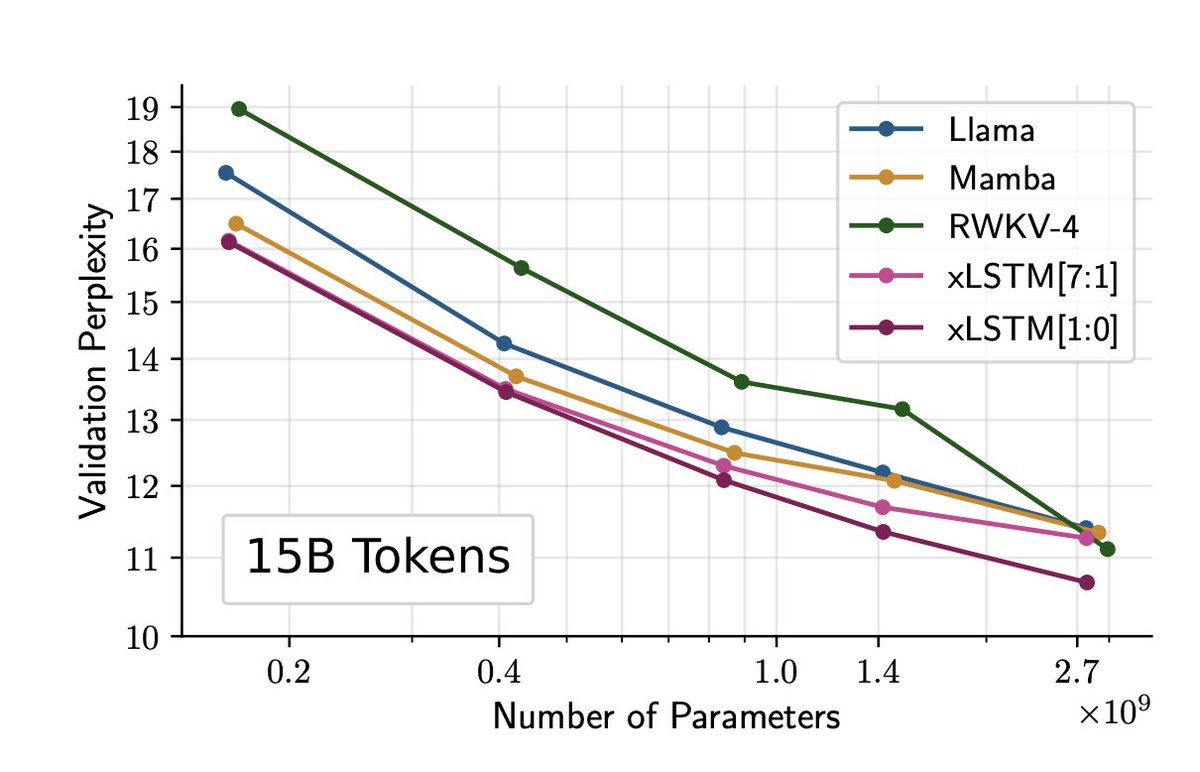
🔔the guy who invented the LSTM just dropped a new LLM architecture! (Sepp Hochreiter)
Major component is a new parallelizable LSTM.
⚠️one of the major weaknesses of prior LSTMs was the sequential nature (can't be done at once)
Everything we know about the XLSTM: 👇👇🧵
In my experience fast code tends to be simple. Slow code tends to be complex. More abstractions and harder to read (jump around).
I would practice a simpler programming style that produces fast code by default. This kind of code is easier to throw away and rewrite if needed.
https://t.co/LX7wPZr0UE: the "@nextjs of browser extensions". Built-in support for @reactjs and @typescript.
▲ ~/ npx extension dev
▲ ~/ npx extension build
▲ ~/ npx extension start
@cezaraugusto is the hero this world needed.
The software industry is rapidly converging on just three languages: Go, Rust, and JS.
It would be smart to learn one of those really well, and have at least a working acquaintance with the other two.
Announcing uv: an extremely fast Python package installer and resolver, written in Rust.
uv is designed as a drop-in alternative to pip, pip-tools, and virtualenv.
With a warm cache, uv installs are near-instant. Here, it's > 75x faster than pip and pip-tools.
Apple just released new programming language „Pickle” https://t.co/UuwXx9h5RS
„We created Pkl because we think that configuration is best expressed as a blend between a static language and a general-purpose programming language.”
… checking notes … without Xcode support for it 🥁
Nx 17.2 is here!!
📈 4M weekly downloads!
✨ Project Config v3 Landed
🦀 Rust for Speed, TS for Extensibility
🧊 Improved Module Federation Support
📦 New nx release features
🅰️ @angular 17 support
🐤 New canary releases!
Catch the full update here: https://t.co/Xy1YNmqTyb
🎉 date-fns v3 is out!
• Full TypeScript rewrite
• No more runtime type checking
• Minimal size is now 200 bytes!
• String arguments are back!
• UTCDate
• Node.js ESM support
• No more default exports
• New flat library structure
• No more IE
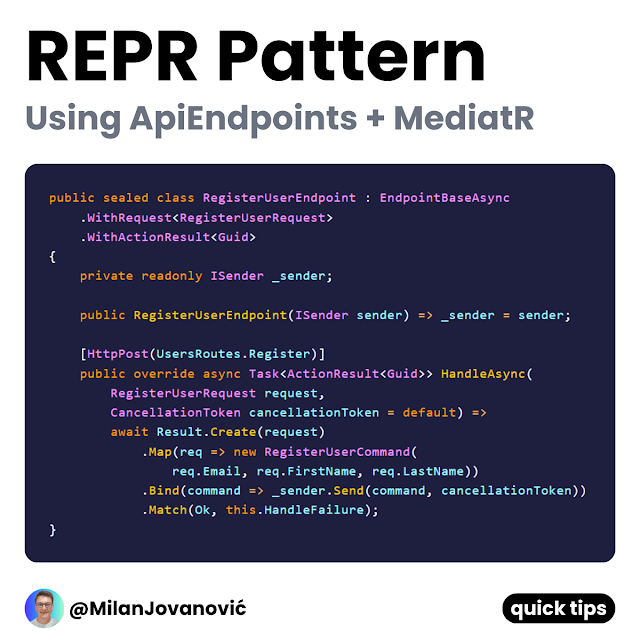
What is the REPR design pattern?
It's often mentioned together with Vertical Slice Architecture.
REPR stands for Request-Endpoint-Response.
Endpoint is the important keyword here.
It should be the opposite of a Controller.
Controllers become bloated quickly.
What if you embrace API endpoints?
Your API is designed around individual endpoint classes. Each endpoint has a single method for handling requests and can define an optional request or response.
REPR is a much simpler way to develop APIs.
P.S. If you enjoyed this, you will love The .NET weekly newsletter. More than 32,000+ engineers already read it.
Subscribe here: https://t.co/xip45XpWuB
Would you give REPR a try on your project?
A deep learning LSTM-based approach for forecasting annual pollen curves: Olea and Urticaceae pollen types as a case study
Interesting work @enbic2lab@itis_uma in collaboration with our colleagues in biology, be the first to read it!
https://t.co/e356gd1I7C