Today we're shipping screen-aware dictation.
First, we built a speedy speech-to-text (very fast, ~450ms).
But, many products do this!
So we went further. Now dictate using your screen as context. In Claude Code, it writes the prompt. In G-Mail, it replies in your voice.
Demo:
I’m convinced that a large % of programmers don’t actually like computers.
As a side effect, are also perfectly happy to throw away their reasoning to a model as soon as they can.
I don’t get it, at ALL. Don’t you *LIKE* understanding the magic of the machine?
You do realize hand-programming (I hate that I even have to specify hand now) is fun…right?
Today, we’re announcing Bonsai 27B: the first 27B-class model to run on a phone.
Bonsai 27B is the new multimodal flagship of the Bonsai family. Based on Qwen3.6 27B, it brings a new capability tier to local AI: multi-step reasoning, structured tool use, long-context workflows, and coherent agentic loops.
Until now, models in this class have been impractical to deploy locally. A 27B model occupies roughly 54 GB in 16-bit precision, and even a strong 4-bit build is around 18GB - too large for a phone and for most laptops.
Bonsai 27B changes that.
It comes in two variants:
• Ternary Bonsai 27B: 5.9 GB, 1.71 effective bits per weight, optimized for laptop-class quality.
• 1-bit Bonsai 27B: 3.9 GB, 1.125 effective bits per weight, optimized for phone-class footprint.
Everything is open-sourced today under the Apache 2.0 license.
The first experimental evidence of recursive self-improvement (RSI).
Autoresearching the autoresearch agent for eight days.
The result beats the harness we hand-tuned for two years, on held-out benchmarks: 🧵(1/7)
Boredom activates the brain’s default mode network.
Crucial for creativity and fostering a sense of self.
Boredom is a luxury in a world with constant overstimulation.
Following the amazing reaction to the Marble Curriculum yesterday, we've decided to make it open source 🛰️👇
Everything a child learns in primary school. 1,590 concepts. 3,221 connections across 8 subjects, from Math and Science to Computing and Life Skills. Anchored in the US and UK curriculums, standard by standard (NGSS, Common Core, DfE).
What you will find in the repo: every concept as structured JSON with its age band and the evidence a child must show to master it. Every prerequisite link marked hard or soft, with a written rationale. It's a true DAG you can compute learning paths on. Open license, you can build whatever you want with it.
Now is a unique time in history to be building in education. Getting AI and kids education right is likely one of the hardest and most important problems to crack over the next decade and we need as many smart and creative minds behind it.
We think a common solid basis, accessible to all and that can be built upon, is critical to move fast. That's why we're making this curriculum open source.
It's not perfect but we know it's a robust basis, and we believe that sharing it openly is the fastest way to progress in this field. If you're building in education, share this around you and tell us in comments if you find this useful and if you want to contribute.
We'll keep working and investing on it @withmarbleapp. Credit goes to @guillaume_boni for building this. I just made it look pretty.
Links below 👇
DeepSeek just released DSpark for V4 Flash & Pro, a new speculative decoding method boosting throughput by 51% to 400%!
DS also showed DSpark works well for other models like Gemma & Qwen
Github: https://t.co/EGVYpc1kcK
Paper: https://t.co/TaBMRVlaW9
HF: https://t.co/289jVU2pxh
- DeepSeek V4 Flash - Native Precision (FP4 + FP8)
- Fits on 2x RTX Pro 6000 GPUs + 256 GB DDR5 RAM
- Using KTransformers: KVCache-AI fork of SGLang for GPU/CPU memory inference
I have a somewhat obsession running applications on resource constrained systems to squeeze the maximum performance possible. Part of that comes from a past life working as a systems engineer, building & upgrading nationwide (USA) Video-On-Demand streaming backends, while navigating headless *nix servers around the time "cloud" was becoming a buzzword.
KTransformers gets less mention across the LLM inference-sphere despite being among the engines listed for many of the popular models on HuggingFace (alongside vLLM, SGLang, & llama.cpp). The KVCache-AI team is best known for providing a forked SGLang for hybrid GPU / CPU memory inference, benefitting MoE models. I expect these hybrid setups to gain in popularity, especially on the consumer side as hardware prices continue soaring.
"Necessity is the mother of invention" as they say, and local AI runners will continue finding more creative ways to run intelligence, whether that involves GPU/CPU memory offload, distributed training / inference, model weight / KV Cache quants, or REAPs.
Here I have DeepSeek V4 Flash running at a 1M context length on 2x RTX Pro 6000s GPUs, using its native mixed precision of FP4 + FP8. KTransformers allows you to reduce your GPU utilization by offloading experts per MoE layer onto GPU VRAM, with the remaining balanced across system RAM. KTransformers also has the ability to update GPU expert placement during inference from routing statistics collected during the prefill phase. There's also a lot of trial and error involved given the limited amount of kernel support for RTX Pro 6000s.
Two of the prompt load stress-test benchmarks I like to run are from the local-inference-lab/llm-inference-bench Github repo & AlienKevin/SWE-ZERO-12M-trajectories HuggingFace dataset.
Here are the main KTransformers SGLang optimized flags:
- Context Length: 1048576
- Total Number of Tokens: 1048576
- Chunked Prefill Size: 16384
- Max Prefill Tokens: 16384
- GPU Prefill Token Threshold: 1024
- GPU Memory Utilization: 87%
- Number of Experts per MoE Layer on GPU: 134 / 256
- Max Running Requests: 256
- CUDA Graph Max Batch Size: 256
- CUDA Graph Batch Sizes: 1 2 4 8 16 32 64 128 256
- Available GPU Memory: 20.81GB (anything less was too tight for agentic coding)
Below are the AlienKevin/SWE-ZERO-12M-trajectories benchmark results for 100 prompts with 10 concurrent, ~8k input tokens, & ~1k output tokens. Both Radix & Chunked Prefix Cache were disabled for the absolute worst-case scenario:
- Prefill Mean Batch Tokens: 35756.93 tok/sec
- Prefill Median Batch Tokens: 652.90 tok/sec
- TTFT Mean: 20.698s
- TTFT Median: 12.714s
- Decode Mean Batch Output Tokens: 27.39 tok/sec
- Decode Median Batch Output Tokens: 20.63 tok/sec
- Utilized CPU memory: ~200 GB
A more detailed write-up will follow, which'll include the methodology of calculating the number of experts per MoE layer on GPU, maximum number of tokens, and GPU memory utilization for a healthy balance for running tool calls & benchmarks in this hybrid setup.
Hopefully this'll be reproducible for you and on alternative GPUs, as well as current & future models. Let me know how it works for you! My future plans involve GPU/CPU memory inference tests for MiniMax M3, GLM-5.2, and Kimi K2.7-Code.
All links for all of the resources getting DeepSeek V4 Flash native mixed precision on 2x RTX Pro 6000 GPUs + 256 GB RAM can be found in the follow up post.
Students without access to LLMs are 2 to 8 times more creative than students with access.
That is the finding of a new paper comparing 2,200 college admissions essays written by humans before ChatGPT with essays generated by GPT-4.
The key point is not individual creativity. GPT-4 can write well, sometimes better than individual students. The problem is collective creativity.
Each new human essay added new semantic territory. New ideas. New angles. New experiences. New combinations.
Each new GPT-4 essay added much less.
The authors call this the diversity growth rate: how much novelty each additional text contributes to the collective pool of ideas.
Humans kept expanding the pool. GPT-4 made the pool converge.
Even when the authors pushed GPT-4 to be more creative, changed parameters, or used chain-of-thought prompting, the homogenizing effect remained.
This is the real danger of AI in education.
Not that students will write worse.
That everyone will write the same.
*
Full paper in the first reply
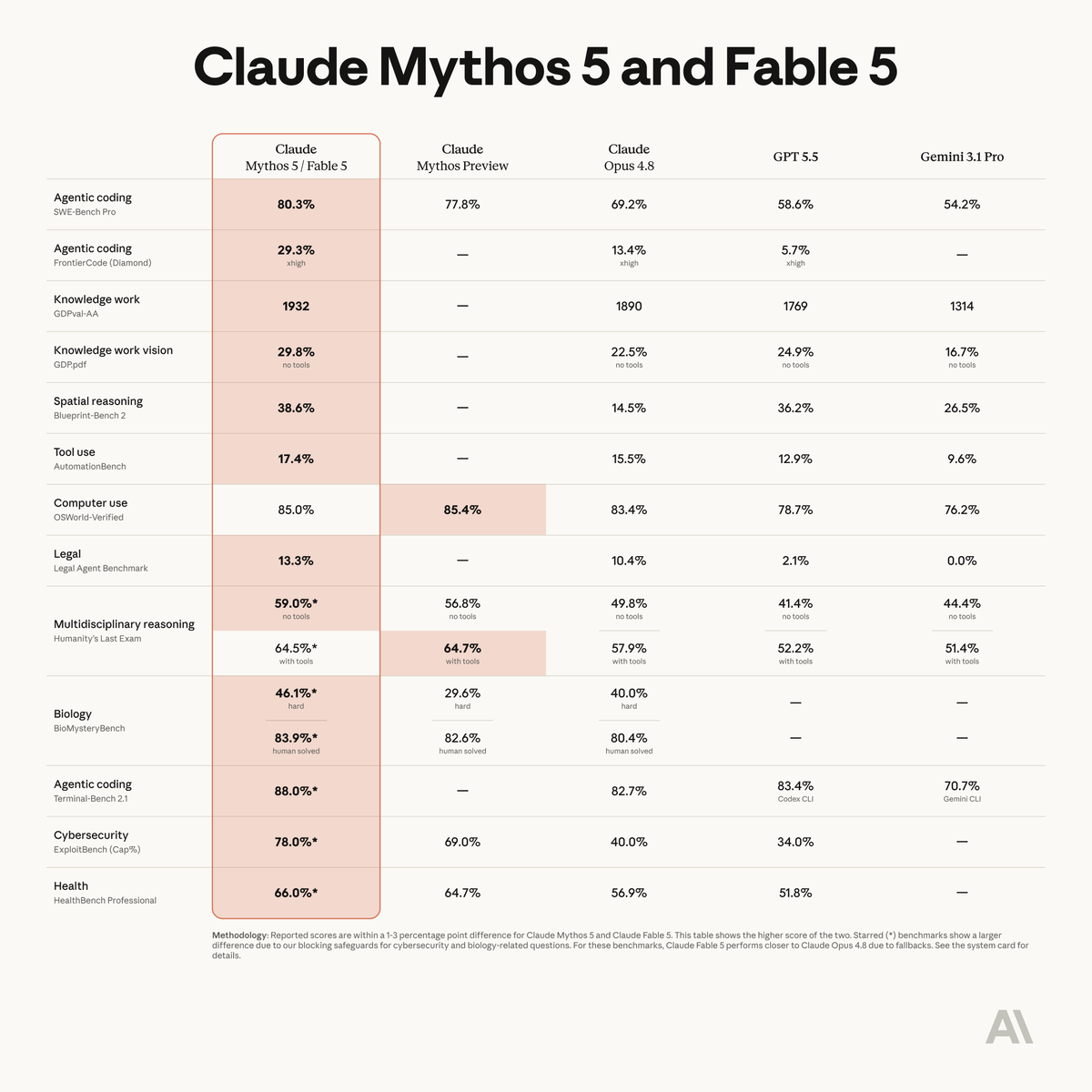
Fable 5 is state-of-the-art on nearly all tested benchmarks, with exceptional performance in software engineering, knowledge work, scientific research, and vision.
The longer and more complex the task, the larger Fable 5’s lead over our other models.
Introducing Claude Fable 5: a Mythos-class model that we’ve made safe for general use.
Its capabilities exceed those of any model we’ve ever made generally available.
A French engineer who lives quietly in Paris has spent 30 years writing software that the entire internet now runs on without knowing his name.
He wrote the code that streams every YouTube video, every Netflix show, every TikTok clip. He wrote the code that runs the virtual servers underneath AWS, Google Cloud, and Microsoft Azure. He calculated more digits of pi than anyone in history. He has no Twitter. He has no marketing. He just keeps shipping.
His name is Fabrice Bellard.
Here is the story, because almost nobody outside the systems programming world knows what one man has built.
Fabrice was born in 1972 in Grenoble, France. He studied at École Polytechnique, the top French engineering school. He never went to Silicon Valley. He never built a startup empire. He just wrote code.
In 2000 he started a project called FFmpeg, an open-source multimedia framework for encoding, decoding, and streaming video. He was 28. The project did one thing nobody else had done well. It handled every video and audio format that existed, in one library, on every operating system. He led it himself for years.
Today FFmpeg is the invisible engine of the internet. YouTube uses it. Netflix uses it. VLC uses it. Chrome and Firefox use parts of it. Every Android phone, every iPhone, every smart TV, every video editing tool you have ever touched runs FFmpeg somewhere underneath. If you have watched a video on a screen in the last 20 years, Fabrice's code processed it.
He was not done.
In 2003 he started QEMU, a machine emulator and virtualizer. He wrote it solo until version 0.7.1 in 2005. QEMU lets you run any operating system on any other operating system. It became the foundation of modern virtualization. KVM, the Linux kernel hypervisor, runs on top of QEMU. Every major cloud provider, AWS, Google Cloud, Microsoft Azure, IBM Cloud, runs virtual machines on infrastructure built around it. The Quick Emulator is the most cited piece of cloud infrastructure code on Earth.
He kept going.
In 2001 he won the International Obfuscated C Code Contest with a small C compiler that grew into TCC, the Tiny C Compiler. TCC can compile and boot a Linux kernel from source in under 15 seconds. In 2004 he calculated the most digits of pi ever computed at the time, using a personal desktop computer and an algorithm he derived himself called Bellard's formula. In 2011 he wrote a complete PC emulator in pure JavaScript that runs Linux in your browser, a project called JSLinux that engineers still cannot believe is real.
In 2019 he released QuickJS, a small but complete JavaScript engine that fits where V8 cannot. In 2021 he released NNCP, a neural network based lossless data compressor that immediately took the lead on the Large Text Compression Benchmark.
Then he turned his attention to large language models. He built TextSynth Server, a web server with a REST API for running LLMs locally. He released ts_zip and ts_sms, compression utilities that use language models to compress text and short messages at ratios traditional algorithms cannot reach. He released TSAC, a very low bitrate audio compression system. In December 2025 he released Micro QuickJS, a new JavaScript engine for microcontrollers, separate from QuickJS, designed for environments with almost no memory.
Fabrice co-founded a telecom company called Amarisoft in 2012, where he serves as CTO. Amarisoft builds 4G and 5G base station software used by carriers and labs around the world. He has been running it for over a decade while continuing to ship personal projects from his own home page at bellard dot org
He has no Twitter. He has no Instagram. He gives almost no interviews. His personal website is a flat list of projects with no styling, no fonts, no marketing copy. Just titles and links.
A quiet French engineer who never moved to Silicon Valley wrote the code that quietly runs the internet.
He is still shipping.
Two math olympiad champions wrote a training manual in 1993 on two old Macintosh computers, and every American kid who has won a major math competition in the last decade learned to think from it.
Their names are Sandor Lehoczky and Richard Rusczyk. The book is called The Art of Problem Solving. Most people in math know it as AoPS.
Since 2015, every single member of the US International Math Olympiad team has been an AoPS student. Not most of them. Every one.
That statistic sounds impossible until you understand what the book actually does.
Lehoczky and Rusczyk were not professors. They were competitors. Lehoczky earned the sole perfect AIME score in 1990 and led the national first place team. Rusczyk was a USA Mathematical Olympiad winner and a perfect AIME scorer in 1989. They had both survived the same brutal selection process the book was designed to train students for.
And the first thing they decided was that almost every existing math textbook was teaching the wrong thing.
School math gives you formulas. You memorize them. You apply them. You pass the test. Then you sit down in front of a real competition problem and the formula does not apply, and you have nothing underneath it.
That is the gap. The gap is not knowledge. It is thinking.
The entire premise of AoPS is that problem-solving is a transferable skill, not a bag of memorized tricks. A student who genuinely understands why a technique works can adapt it, combine it with something else, and deploy it in a context they have never seen before. A student who only memorized the technique freezes the moment the problem looks different.
The book teaches the difference between a formula and a method.
A formula tells you what to compute. A method tells you how to see. The students who win olympiads are not the ones who know more formulas. They are the ones who have trained themselves to look at an unfamiliar problem and recognize its structure. To see that this problem is secretly asking the same question as a problem they solved three weeks ago, just dressed differently.
Rusczyk calls this "learning to read the problem." Not reading the words. Reading what the problem is actually asking underneath the words.
The second thing they built into the book is tolerance for being stuck.
Most students treat confusion as a signal to stop. The book treats confusion as the starting point. Every chapter pushes students past the point where the obvious approach runs out. That moment of running out is not failure. That is where the actual thinking begins.
Lehoczky once described it this way. If you can solve a problem quickly, you are not learning. You are performing. Learning only happens when you are past the edge of what you already know.
The book was written on old Macintosh computers in 1993. Rusczyk launched the AoPS website in 2003. Today the community has over one million users. Thousands of students enroll in AoPS online courses every year. Most winners of every major American math competition are AoPS alumni.
A platform built by two kids who were good at math competitions has become the infrastructure that produces the next generation of mathematicians, engineers, and scientists who are good at thinking.
The formulas you memorized in school will eventually be obsolete.
The thinking you trained will not.
What is one problem in your life right now that you have been avoiding because you do not yet know the right formula to solve it?
A journalist in 1987 rewrote the 2,500-year-old Tao Te Ching as a series of short parables about programmers, and the book became required reading inside Silicon Valley because every line of the joke turned out to be deadly serious.
His name was Geoffrey James.
He was not a famous engineer. He was a technology journalist who had spent years inside the offices of early software companies watching the same disasters play out over and over again.
Managers piling more programmers onto failing projects. Codebases collapsing under their own weight. Corporate hierarchies producing endless documents that nobody read. Geniuses being interrupted by meetings until they quit and went home.
He could have written a serious management book. Plenty of serious management books already existed and almost nobody in software was reading them. He decided to do something stranger.
He picked up a copy of the Tao Te Ching, the foundational text of Taoist philosophy written in China around 500 BC, and he rewrote it line by line as if Lao Tzu had been a master programmer.
The result was published in 1987 as The Tao of Programming. 151 pages. Nine books. Roughly 50 short parables. A comedy book on the surface and a philosophy book underneath, written in deliberately ornate language that made you smile while you were absorbing arguments that have aged better than almost anything else published about software in the last 40 years.
The opening line of the book is the giveaway. Thus spake the master programmer. When you have learned to snatch the error code from the trap frame, it will be time for you to leave. The joke is that he is parodying the kung fu master from the old Kung Fu TV show. The argument underneath the joke is that real mastery in software is not measured by what you can build. It is measured by how cleanly you can recover when the system fails.
The book has been passed around hacker communities continuously since the late 1980s. It sits alongside Fred Brooks's Mythical Man-Month on the required reading list of serious software teams. People who have never heard of Geoffrey James still quote his lines without knowing where they came from. The reason it has refused to die for 40 years is that every line of the parody was always disguising a piece of real wisdom that nobody else was willing to say plainly.
Here are some of the lines, and what each one is actually saying.
"Even a perfect program still has bugs."
The line is funny because it sounds like a contradiction. The truth underneath is that there is no such thing as a finished program. Every system you ship is alive. It is going to encounter inputs you did not anticipate, hardware you did not test on, and edge cases your imagination could not produce.
Treating any piece of software as finished is the single most common reason production systems fail. The masters in the book are calm about bugs because they have stopped pretending bugs are exceptions. Bugs are the default state. The programmer's job is to keep them from compounding.
"Let the programmers be many and the managers few. Then all will be productive."
The line is funny because every software company in the world does the opposite. The truth underneath is that programming is a kind of work that runs almost entirely on uninterrupted thought, and the more layers of management you stack on top of it, the more interruptions you create, the more meetings the programmers have to attend, the fewer actual hours of deep work get done.
Every manager you add to a software team subtracts more productive hours from the engineers than the manager could possibly add through coordination. Brooks proved this formally in 1975. James said it in nine words in 1987.
"After three days without programming, life becomes meaningless."
The line is funny because it sounds like an addict talking. The truth underneath is that genuine craft work produces a kind of meaning that almost nothing else in modern life provides. The programmer who has not touched real code in three days is not just bored.
They are emotionally underfed. The masters in the book understand that the work itself is not a means to a paycheck. The work is the reward. The paycheck is a side effect. Everything that interferes with the actual work, no matter how prestigious or well-paid it looks, is making the programmer's life worse, not better.
"A manager went to the master programmer and showed him the requirements document for a new application. The manager asked the master, how long will it take to design this system if I assign five programmers to it? The master replied, it will take one year. The manager said, but we need this system immediately or even sooner. How long will it take if I assign ten programmers to it? The master programmer frowned. In that case it will take two years."
The line is the punchline of Brooks's Law disguised as a koan. Adding programmers to a late project makes it later, because every new person has to be brought up to speed by the existing team, which slows the existing team down, which extends the timeline. The book teaches this in 60 words. The same lesson takes most managers 20 years of failed projects to learn, if they ever learn it at all.
The deeper pattern is the one most readers miss the first time through.
James was not really writing about programming. He was using programming as a setting for a much older argument that Taoist philosophy has been making for 2,500 years.
The argument is that the world is governed by simple principles that get harder to see the more cleverness you stack on top of them. Force does not work. Pressure does not work. More resources do not work. The only thing that works is restraint, simplicity, and the patience to let the right shape emerge.
Lao Tzu was talking about how to govern a kingdom. James was talking about how to ship software. The wisdom is the same. The kingdom is the codebase. The emperor is the project manager. The advisors are the developers. And the entire collapse of every doomed software project in the last 40 years has had the same root cause that the collapse of every doomed dynasty has had for the previous 4,000.
People mistook complexity for competence.
The book has been sitting on the internet for free for almost 30 years. You can read all 151 pages in an afternoon. Most people who run it as a joke walk away quoting it for the rest of their careers.
What James understood in 1987 is even more true in 2026. AI can now generate millions of lines of code in seconds. The bottleneck has shifted entirely. The bottleneck is no longer typing speed. The bottleneck is judgment. The bottleneck is taste. The bottleneck is the ability to look at a generated codebase and feel, without quite knowing why, that something is wrong with it. That kind of feel is exactly what the book was teaching all along.
The Tao of Programming flows far away and returns on the wind of morning.
The masters in the book were never joking. The world just took 40 years to figure out they were not.
As the recently expanded partnership with @AnthropicAI demonstrates, @SpaceX is offering AI compute as a service at significant scale.
We are in discussions with other companies to do the same.
Over time, especially with orbital data centers, we expect to serve AI at extremely high scale.