@CamiRusso It is not just that. If there is so much more yield in crypto rails, everybody will take the money out of the banks. Then banks will no longer be able to lend credit (print new money) and the system will enter collapse. A new form of printing new money is needed in parallel.
2026 is the year that we take back lost ground in terms of self-sovereignty and trustlessness.
Some of what this practically means:
Full nodes: thanks to ZK-EVM and BAL, it will once again become easier to locally run a node and verify the Ethereum chain on your own computer.
Helios: actually verify the data you're receiving from RPCs instead of blindly trusting it.
ORAM, PIR: ask for data from RPCs without revealing which data you're asking, so you can access dapps without your access patterns being sold off to dozens of third parties all around the world.
Social recovery wallets and timelocks: wallets that don't make you lose all your money if you misplace your seedphrase, or if an online or offline attacker extracts your seedphrase, and *also* don't make all your money backdoored by Google.
Privacy UX: make private payments from your wallet, with the same user experience as making public payments.
Privacy censorship resistance: private payments with the ERC-4337 mempool, and soon native AA + FOCIL, without relying on the public broadcaster ecosystem.
Application UIs: use more dapps from an onchain UI with IPFS, without relying on trusted servers that would lock you our of practical recovery of your assets if they went offline, and would give you a hijacked UI that steals your funds if they get hacked for even a millisecond.
In many of these areas, over the last ten years we have seen serious backsliding in Ethereum. Nodes went from easy to run to hard to run. Dapps went from static pages to complicated behemoths that leak all your data to a dozen servers. Wallets went from routing everything through the RPC, which could be any node of your choice including on your own computer, to leaking your data to a dozen servers of their choice. Block building became more centralized, putting Ethereum transaction inclusion guarantees under the whims of a very small number of builders.
In 2026, no longer. Every compromise of values that Ethereum has made up to this point - every moment where you might have been thinking, is it really worth diluting ourselves so much in the name of mainstream adoption - we are making that compromise no longer.
It will be a long road. We will not get everything we want in the next Kohaku release, or the next hard fork, or the hard fork after that. But it will make Ethereum into an ecosystem that deserves not only its current place in the universe, but a much greater one.
In the world computer, there is no centralized overlord.
There is no single point of failure.
There is only love.
Milady.
Encrypted messaging, like @signalapp, is critical for preserving our digital privacy. Two important next steps for the space are (i) permissionless account creation and (ii) metadata privacy.
@session_app and @SimpleXChat are two messaging apps pushing these directions forward.
For this reason I've donated 128 ETH to each. Addresses available on their websites if you wish to follow on:
https://t.co/07ORUYDCu8
https://t.co/FQde3IK0uz
But also, actually download and use them!
Neither of the two are perfect pieces of software, they have a way to go to get to truly optimal user experience and security. Strong metadata privacy requires decentralization, decentralization is hard, users expecting multi-device support makes everything harder. Sybil / DoS resistance, both in the message routing network and on the user side (without forcing phone number dependence) adds further difficulty.
These problems need more eyes on them. I wish all teams working on these important problems best of luck.
3/ Ethereum provides a strong backbone to the onchain economy, secured by 1.1M+ validators & proven by 10+ years of uptime
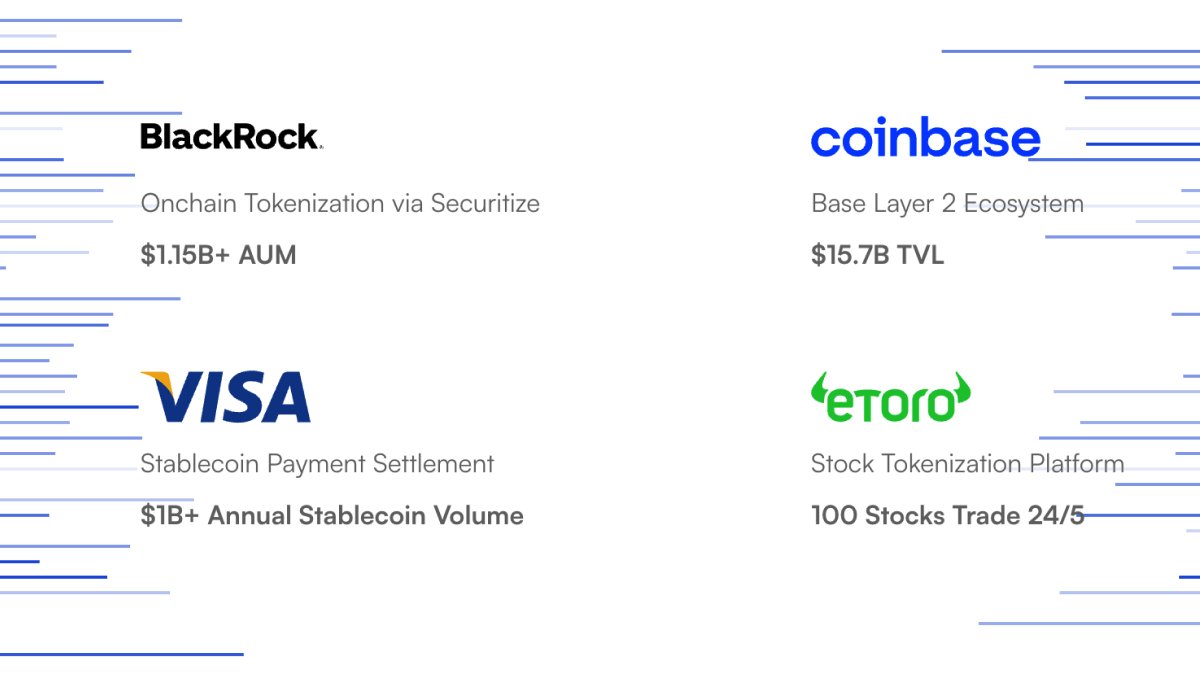
Onchain products from teams like @BlackRock@Visa@eToro@coinbase achieve billions in AuM, trillions in volume, and innovate on Ethereum
2/ Clear pathways are essential as institutions build on Ethereum
This site is a new resource from the EF's Enterprise Acceleration team, to
→ guide businesses adopting Ethereum
→ showcase the ecosystem building a new financial system
https://t.co/OSegLQ4gMx
1/ Now live: the Ethereum for Institutions site
Ethereum is the neutral, secure base layer where the world's financial value is coming onchain
Today, we’re launching a new site for the builders, leaders, and institutions advancing this global movement
Progress toward real-time proving for Ethereum L1 is nothing short of extraordinary.
In May, SP1 Hypercube proved 94% of L1 blocks in under 12 seconds using 160 RTX 4090s. Five months later Pico Prism proves 99.9% of the same blocks in under 12 seconds, with just 64 RTX 5090s. Average proving latency is now 6.9 seconds.
Performance has outpaced Moore's law ever since Zcash pioneered practical SNARKs a decade ago. Today's Pico Prism results are a striking reminder of that exponential curve.
Beyond performance, zkVM diversity is remarkable. At least nine zkVMs are racing toward real-time proving: Airbender, Ceno, Jolt, OpenVM, Pico Prism, R0VM, SP1 Hypercube, Ziren, ZisK. That diversity is strength, similar to CL and EL client diversity.
Fusaka, expected in December, will simplify real-time proving. EIP-7825 caps per-tx gas usage, enabling more parallel proving via subblocks. MODEXP, a prominent "prover killer", is being repriced with EIP-7823 and EIP-7883.
By year's end several teams will prove every L1 EVM block on a 16-GPU cluster, drawing less than 10kW total. The 10kW target—about the same as a Tesla home charger—matters for on-prem proving in garages and offices, eliminating reliance on cloud proving.
gigagas frontier
L1 throughput has grown 100x since genesis ten years ago, from 20 kilogas/sec to 2 megagas/sec. With zkEVMs we can 100x again, in half the time. The key is to bypass validators as Ethereum's current scalability bottleneck.
Lean execution proofs also decentralise validation. Goodbye 4TB NVMe, 8 cores, 64GB RAM recommended by EIP-7870. A Raspberry Pi running statelessly, or even a phone, will soon suffice. The scalability vs decentralisation dilemma is dying.
Zooming out, the lean Ethereum vision is gigagas L1 and teragas L2. Gigagas L1 (10K TPS) means high-value payments, trading, and social apps directly on mainnet. Teragas L2 (10M TPS) means welcoming the entirety of finance onto Ethereum.
Nov 22: Ethproofs day demo
Behind the scenes teams are preparing a special Devconnect demo. In 38 days my home validator will run on zkEVM proofs. My mighty Geth node will go dark—no more execution client.
Devconnect Argentina is Ethereum's world fair. World fairs unveiled the lightbulb, running water, cars, refrigeration, phones, escalators. Real-time proving is Ethereum's lightbulb moment.
Ethereum's future is bright. Believe in something :)
1/ It’s time for us to go public so you all can go private, and it’s time for us to be bold so you all can be safe.
As part of our work with the @ethereumfndn, @VitalikButerin and I are proud to be the faces of Kohaku. 🧵👇
🚨 GIVEAWAY: a ✨FREE dGEN1 Phone✨ ($549 🤯) to a random person that likes and retweets this post🚨
dGEN1 is an Ethereum Phone and Secure Hardware Wallet
It has an actual laser. Imagine having fun while using the future of crypto mobile 😂😍
Ethereum is for real-world commerce.
1/ Earlier this year I completed a research fellowship at the Ethereum Foundation studying how Ethereum can enable peer-to-peer marketplaces for real world goods & services.
Here are the key takeaways.
Builders: integrate dYdX perps, route orders onchain, and earn on every fill with Builder Codes - no whitelists, fully transparent.
And if you ship something cool, dYdX will spotlight it 🫡
Start building ➡️ https://t.co/oXO5RBOCbt