Argon has this amazing natural understanding of the world. It can do so many things from first principles.
Here's a pelican riding a bike, using fourier epicycles.
Video made by Argon.
Time-synced Lyria 3.5 music prompted by Argon.
I did say we'd be releasing our models periodically...introducing Gemini 4 Carbon, our next frontier model.
Following Argon's release just two weeks ago, Carbon shows the pace at which we’re pushing the frontier, it ranks #1 on the recently updated v5.0 of @ArtificialAnlys Intelligence Index at 59. It also leads across key cybersecurity evaluations scoring 88.2% on SEC-bench Pro for finding vulnerabilities, 54.8% on ExploitGym for exploitation, and 71.0% on CWE-bench for patching.
We’re seeing significant improvements in long-horizon tasks even compared to Argon, and we’ve strengthened frontier safeguards.
As we did with Argon, we’re going to roll it out gradually + responsibly. Some trusted cyber defenders will get access starting this week. We'll be expanding it to more partners through our Fairwind Program, ahead of wider availability soon, so hang tight!
Announcing Gemini 4 Carbon 👀
"Carbon illustrates the pace at which we’re pushing the frontier forward. Our researchers and models are working hand in hand to advance capabilities faster, while strengthening our safeguards in tandem."
https://t.co/MtqIxZytCH
Some more context on the weird star, Gaia DR3 4582145718700356096 ("fofr's star"). It's an old star, and according to our planet formation models, it really shouldn't have very large amounts of dust.
If it's dust, "it holds ~100,000x more dust than a system that old should"
This gets weirder.
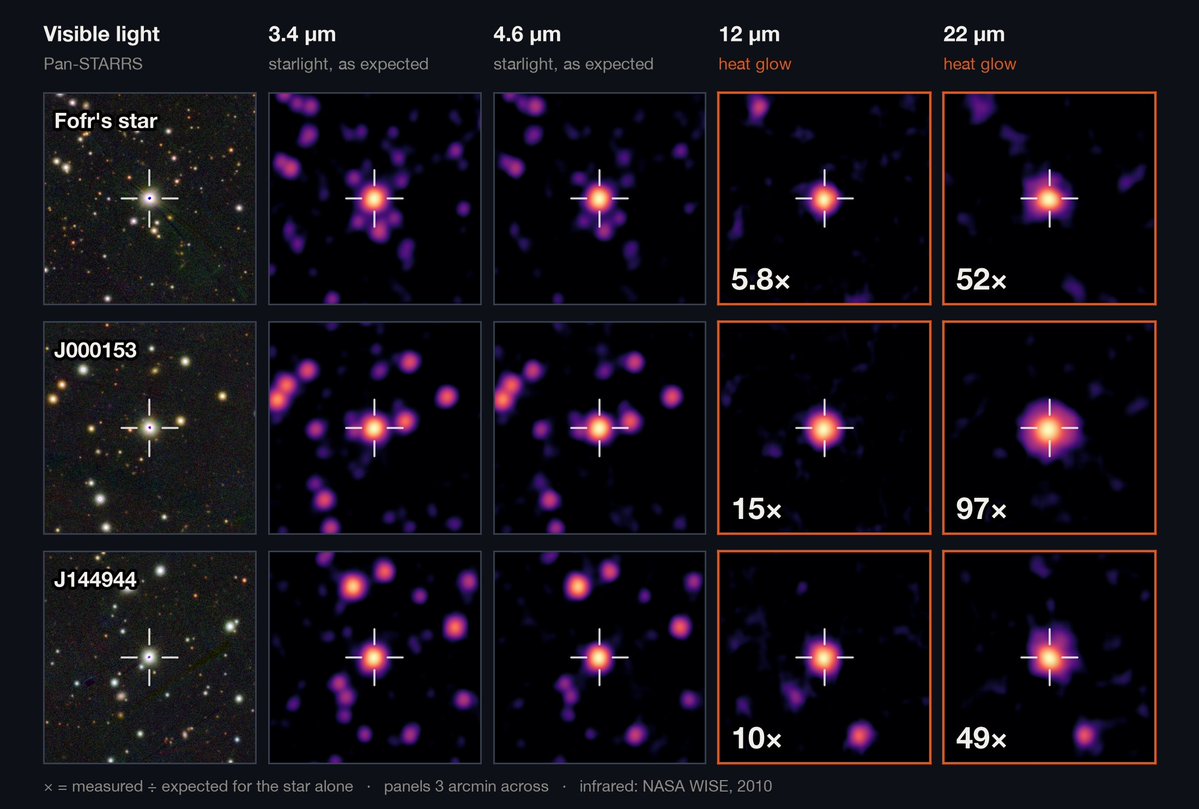
I searched ~750,000 Sun-like stars for the signature of Gaia DR3 4582145718700356096. At least two more have it, glowing right on the star:
J000153 (Gaia DR3 2874265305022213760)
J144944 (Gaia DR3 6225457312033584384)
All three look normal in visible light but shine 50-100x too bright at 22 microns, at 200-280 K, about Earth to Mars distance from each star.
If that’s dust, it’s at least a 200–300 km asteroid ground to powder. Dust like that usually comes from young planets colliding. This is what happened with our Moon.
But Fofr’s star isn’t young. It’s probably about as old as the Sun, old enough for a planet to have carried life for billions of years. And it holds ~100,000x more dust than a system that old should, based on the planetary formation models we have.
The best-known old case, BD+20 307, has a twin star circling it every 3.4 days, which may stir its planets up. None of these 3 stars have any companion.
So either our picture of how planetary systems age has a gap, or this isn’t dust at all, and something else is turning 1–3% of these stars’ light into heat.
Some tips on how I'm doing discovery work like this:
- make sure your pipeline reproduces known results blindly
- make sure it also rejects known imposters and instrument glitches
- never trust your results, always spin up an independent agent with a non-leading prompt to do an adversarial review, do this repeatedly
- have the reviewer re-verify from raw data
- whenever a reviewer finds something, try to distill a generic lesson from that into a skill or process
I found a weird star with Argon's help. Gaia DR3 4582145718700356096.
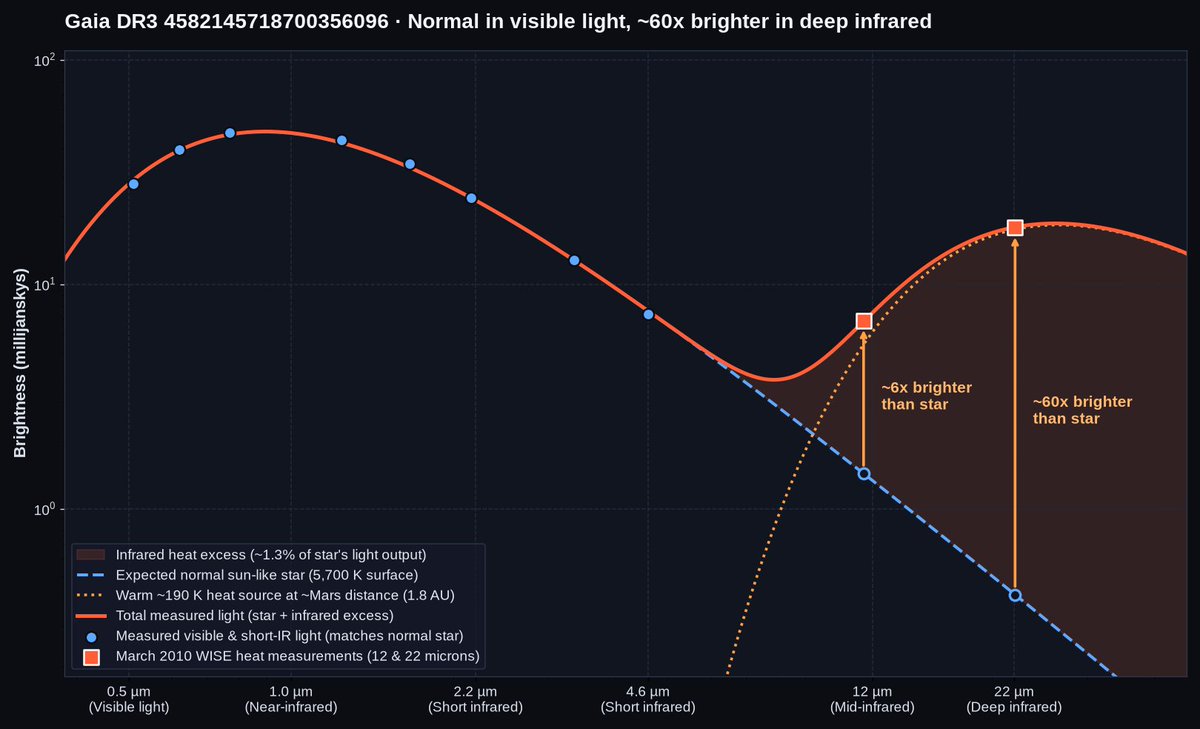
It's normal in visible light, stable and similar to our sun. In March 2010 it appeared ~60x brighter than expected in deep infrared heat (22 microns).
As if something around Mars-distance is catching 1.3% of the star's light and radiating it as heat.
Probably a huge cloud of debris from a major planetary collision. Or a radio-silent galaxy hiding behind it. But also the tiniest chance it's a technosignature.
Captured by NASA's WISE telescope, no observations at that wavelength since. Needs more data.
@nikodemszymansk It depends, but usually they have to get the data. Sometimes also put in constraints, to try and prove a claim through an alternate route.
Yep, all are from a 33hr window March 15-17 2010 (WISE ran out of outer coolant in August 2010, before its second pass)
Argon measured the offset against the star's 2010 Gaia position and it is very small, about a tenth of a WISE pixel:
- 22 microns: 0.22 ± 0.15 arcseconds southwest
- 12 microns: 0.25 ± 0.09 arcseconds south
I found a weird star with Argon's help. Gaia DR3 4582145718700356096.
It's normal in visible light, stable and similar to our sun. In March 2010 it appeared ~60x brighter than expected in deep infrared heat (22 microns).
As if something around Mars-distance is catching 1.3% of the star's light and radiating it as heat.
Probably a huge cloud of debris from a major planetary collision. Or a radio-silent galaxy hiding behind it. But also the tiniest chance it's a technosignature.
Captured by NASA's WISE telescope, no observations at that wavelength since. Needs more data.