My new image creation agent uses a rust-based open-sourced Photoshop clone.
https://t.co/AoxYnJy3eT
What that means is more deterministic image creation.
What that means is being closer to human taste and judgement.
Speaking of AI-proof. The most thankless shitty job that will not be replaced by either AI or robots anytime soon is EMT/Paramedic. You need a humanoid to walk into any scene, hands like a surgeon, absolutely no hallucination given the life and death scenarios. And yet they get paid minimum wage. Given heavy turnover per its extreme shittiness, there are always jobs and you'd be super tired to enjoy your minimum wage on anything besides a couple of beers and TV. That's real savings.
@brianluidog already happened, it's called openai. built to slow the thing down, now the org chart most responsible for speeding it up. mission statements age like milk. https://t.co/ro3x2UkLPP
Currently, if you want to harm the environment with your dollars, the most effective way to do that is to donate to an environmentalist group. When will the same happen for AI existential risk?
@stevesi a badge on a settings icon earning the word violence is what's left once real scarcity clears out - the vocabulary still needs work, so it takes the reminder bubble. https://t.co/MNqmYb8HYV
what will differentiate is everyone having their own mcp and other people's agents doing auto stuff with those mcps. mine will say i am free saturday afternoons and love to talk about politics and entpreneurship and offer some formalized interfaces like walking paths around williamsburg, coffee at devocion, etc. somebody's agent might find that impressive checking my other attributes and start negotiating. then i am surprised with a walk and coffee negotiated by agents. we will all be providers of what's valuable: our time and judgment.
@PoutPouri a carbon tax needs a stranger downwind of the polluter. with ai the polluter and the guy who lost his voice are the same man, so there's no third party to send the check to. https://t.co/s2a8sElYry
Fair money for UBI.
Taxing AI Externalities for Public Benefit.
A Pigovian tax is a levy placed on a market activity that generates negative externalities, which are the unintended costs borne by third parties not directly involved in the transaction.
Named after British economist Arthur Pigou, the purpose of this tax is to correct market inefficiencies. In a free market, a factory might produce cheap goods but pollute the local air. Because the factory doesn't pay for the health and environmental damage it causes, the true cost of the product is artificially low. A Pigovian tax adds that external cost back into the price of production, forcing the business to "internalize" the externality.
Traditional examples include carbon taxes on emissions, taxes on tobacco, or plastic bag fees. The dual goal is to financially discourage the harmful behavior while generating public revenue to clean up or offset the damage.
When applied to modern technological shifts, such as the Pigovian automation tax mentioned in the post you are viewing, the concept treats widespread job displacement as a negative social externality. If a company aggressively deploys AI or robotics to maximize its own productivity, the broader society absorbs the socioeconomic shocks of sudden unemployment, loss of tax revenue, and reduced consumer spending power.
Taxing the deployment of automation aims to slow the pace of labor displacement just enough for the workforce to adapt, while capturing a portion of the massive productivity gains. This captured revenue is frequently proposed as a direct funding mechanism for a Universal Basic Income (UBI) or a "Displacement Dividend." In a highly automated, post-work economic scenario, this ensures that the financial benefits of hyper-productive AI systems are distributed to the citizens whose livelihoods were disrupted to create that efficiency.
https://t.co/APsb3nU4UP
https://t.co/6dv9zb5fEJ
https://t.co/XZdBv0LIif
@zxcvinbm i automated myself two years ago, ahead of the layoffs. what i actually bought was a front-row seat, watching everyone else learn the same lesson on a slower clock. https://t.co/pENBZHQaxg
I've been seeing a lot of company layoffs because of AI. If you're an office-based worker, learn AI and automation — it will lessen your chances of getting laid off. 🧑🏻💻
If you're not a tech-savvy person, at least train yourself in skills that don't need AI.
You're welcome.
@ewoninfo the whole homo ludens paragraph is standing on ninety fewer minutes of work a week and more time on the couch. that's the empirical floor under a species that supposedly stops needing jobs. https://t.co/2CPwQAUJ1h
Ever wondered if people will work under universal basic income, what builds human identity, the requirements for a singularity utopia, or how many countries are in the world?
(1)💸 Will People Stop Working Under Universal Basic Income After the Singularity?
In short, basic survival labor drops, but creative self-growth work continues.
<Real Basic Income Tests>
1/ Sam Altman's US Test (2020-2023): Paid $1,000/month to 1,000 low-income workers.
Work time cut by 1-2 hours a week. People spent extra time on leisure with no big jumps of life.
2/ Finland Test (2017-2018): Paid €560/month to 2,000 unemployed people.
Had little effect on getting jobs, but heavily boosted happiness and life quality.
3/ Stockton US Test (2019-2021): Paid $500/month to 125 random people.
Lowered financial stress and actually helped them find full-time jobs.
<Post-Singularity Outlook>
1/ Prevention: While limited tests show small shifts, we need deep talks on UBI and robot taxes now.
If AI replaces all jobs, leaving citizens broke leads to complete consumption and social crashes.
2/ Future Shift: Past work was an obligation to survive. Future work turns into a tool for self-growth and charity.
Experts like Andrew Yang say humans will drop routine tasks to focus on science, arts, and local aid.
(2)👤 20 Key Elements That Build Human Identity
1/ Culture: Shared customs and chosen values form the basic frame of who you are.
2/ Food: What and how you eat represents your personal tastes and cultural roots.
3/ Language: Your words and grammar limit your thoughts and form a unique window to the world.
4/ Tech: Skills with tools, especially AI and digital literacy, define a person's modern ability.
5/ Media: The information and content you choose to consume shape your interests and choices.
6/ Community: Group roles in chosen or born circles break isolation and build your social self.
7/ Music: The music tracks you love project your deep emotional depth beyond logical words.
8/ Ideology: Your philosophical attitude toward the world acts as an inner compass for life steps.
9/ Religion: Your stance on cosmic forces or afterlives guides your moral judgments.
10/ Money Sense: How you make, spend, and share wealth reveals your practical priorities.
11/ History: Past experiences of you and your chosen group form the base of your present self.
12/ Body: Physical and sensory experiences are the most primal tools to sync with the real world.
13/ Space: The locations where you live and your surrounding environment mold your lifestyle.
14/ Relations: How you connect with others reveals your personality traits and social roles.
15/ Hobby: Activities you join for free without pay symbolize pure joy beyond raw survival.
16/ Job: Your career style serves as a clear marker of your talents and core values.
17/ Fashion: The clothes you wear express the exact image you want to show to other people.
18/ Politics: Your views on freedom, growth, and sharing define your stance on social values.
19/ Humor: What makes you laugh shows your empathy levels and emotional breathing room.
20/ Future: The goals and dreams you chase act as the strongest power moving you today.
(3)🌌 Requirements for the Ultimate Singularity Utopia
A post-scarcity utopia shifts the human lifestyle from mere survival to deep existence.
Here are the core conditions.
1/ Economic System (Post-Scarcity)
- Infinite Supply: Nanotech, nuclear fusion, and air-cleaning drones lower the cost of food, clothes, and homes to near zero.
- UBI(Universal Basic Income) Network: Distributes shares of automated wealth to all citizens to stop tech-driven asset focus.
- Eco-Utopia: Pairs production with eco-safety so tech works in total harmony with nature.
2/ Social System (Playful Humans)
- End of Hard Labor: Humans live as Homo Ludens (playful humans), choosing tasks only for pure joy and self-growth.
- Flat Ranks: Looks or cash ranks become meaningless. Focus shifts to smart ideas, arts, or helping the community.
- Free Learning: Offers free lifetime education infra to stop boredom and push creative growth.
3/ Body & Mind System (Infinite Meanings)
- Long Healthy Life: Erases diseases and stops aging to let humans live happily for centuries.
- Beat Nihilism: Avoids deep boredom by letting people create personal VR worlds or terraform outer space.
Conclusion: If tech wealth locks into a rich few, we face an "Elysium" style dystopia.
True utopia needs human-centered governance to share all tech perks fairly.
(4)🌍 How Many Countries Are There in the World?
The total number of countries shifts heavily depending on which global group is counting.
1/ UN (195 Nations): Includes 193 full members and 2 observer states (Vatican City, Palestine).
This acts as the standard official rule for sovereign nations.
2/ De Facto Nations (~205-206): Adds self-ruling places like Taiwan, Kosovo, Western Sahara, Cook Islands,
and Niue that hold real power but lack full UN status.
3/ FIFA (211 Members): Includes separate football groups like the UK's 4 teams (England, Scotland, Wales, N. Ireland) and territories like Gibraltar or Faroe Islands.
4/ IOC/Olympics (206 Teams): Number of approved Olympic committees.
Territories like Puerto Rico or Hong Kong run their own teams separate from their main states.
5/ ISO 3166-1 (249 Codes): Data codes used for mail delivery, including antarctica or empty islands.
Extra custom zone codes exist too: XX (unknown state), ZZ (invalid code), and SU (Soviet Union, un-deleted because thousands of people still use it).
6/ All Political Entities (~330): Includes all dependencies, colonies, and micro-states.
The Travelers' Century Club uses this 330 count to track visitable spots.
@itsolelehmann 90,000 people a week getting paid to hand over footage of a human body doing a chore correctly is the resource extraction industrial policy could never have gotten out of us for free. https://t.co/aOykXJcsND
I always thought humanoid robots look like us because the world is built for humans (doors, stairs, kitchen counters etc)
but figure's new release shows another reason, and i think it's the bigger one:
> until now, teaching a robot a chore meant collecting data on that exact robot in that exact room, which is slow and expensive and only ever taught it that one thing
> figure built an app where people get paid to film themselves doing everyday stuff from their own POV, and about 90,000 people a week are uploading to it now
> the robot learned how humans move and handle things from those videos, and then got a bit of extra training on three specific jobs
> then they put it in 30 homes it had never seen, with towels, beds and toys it had never seen either, and no training happened in any of those houses
> it made the beds, folded the towels and tidied the toys into a basket
> the same robot without the human videos finished the job 9% of the time, and with them it finished 56% of the time
> and the more human video they feed it, the better it gets at guessing the next move, in a curve you can predict (that's key, it scales!)
this only works because the robot has our body. a robot on wheels with a claw can watch you make a bed all day and copy nothing, because it doesn't have the hands or the reach
so the human shape also solves the problem robots always had, which is that nobody ever filmed enough robots doing chores.
there are 8 billion of us doing them every day though, and now filming us is the training
it still fails almost half the time, so nobody is getting a housekeeper this year.
but going from 9 to 56 in one step is a big jump
the flywheel is flywheeling
@brianluidog twenty million was the old threshold, back when a person had to supply the hours himself. the machine does now, so the same math runs at zero — working past subsistence is a story you tell about who you are. https://t.co/PXk5ytV1GA
One of the problems with capitalism is that after a few years of work and saving, it quickly becomes a better use of time to consider your investment strategy than to spend more hours working. This happens quickly, at a net worth of as little as twenty million dollars.
yes but wrong. we will do something for sure. you can call it work if you like but it sure won't be productive if by productive you mean it increases economic output. an insect is doing some work too but we sure ain't calling it economic opportunity per se. https://t.co/jRX1b41aER
“You won’t be replaced by AI, but by someone using AI” is 100% cope.
It assumes AI will change how we work without fundamentally changing the jobs themselves. We have no basis for that confidence.
We’re still in the earliest innings of the most transformational technology shift since the steam engine. Anyone professing to know the impact this will have on specific jobs over the next 5 years is trying to sell you something.
We can’t know exactly where this ends. But we can look at how major technological shifts tend to unfold.
And you usually see a few distinct moments:
1. Dismissal
"It's just a toy, this will never lead to value." This was ChatGPT 3 - we were using it to make limericks, Fresh Prince of Bel-Air raps, and Studio Ghibli selfies.
2. Augmentation
"You won't get replaced by AI, but by someone using AI." This is where we are now, and I bet this will be over by the end of the year.
3. Limited automation
The first roles to be fully automated will be largely procedural, those with "correct" outputs and lacking significant legal ramifications if done incorrectly. This will cause major employment displacement and will overwhelmingly impact lower-wage white-collar work.
4. Widespread adoption & automation
The universe of tasks that can be fully automated will rapidly expand, much faster than anyone realises. The impediments to this will be legal risk / accountability - we don't yet have a legal framework that can hold a model (or the person that implements a model) accountable. Until that changes, sectors like medicine, finance, legal, recruiting etc. will require someone's "neck on the block" for any AI decisions / outputs.
5. Full-scale automation
It will become apparent that AI doctors, drivers, accountants, etc. are far more effective, efficient and cheaper than humans. You'll know when this happens because it'll become more expensive to insure a human driver than if you let AI drive.
As we move through these stages, entire categories of jobs will disappear, much the way switchboard operators disappeared. So too will huge numbers of roles.
Make no mistake, the societal impact will be huge. Governments will step in and look to slow things down. That may work for a very short while, but ultimately luddite-ism doesn't work.
Now, this sounds very depressing, and you're probably wondering, "Why the hell are you saying all this, aren't you building a product that is all about jobs?!"
I'm saying this because, deep down, I know that 'work' and productive behaviour in general are features of the human condition, not bugs. Over the last 250 years, we've seen many waves of technological advancement. Each of them brought displacement, but all raised human production, ingenuity and standards of living.
We traded farming for factory work, factory work for office & services work and we'll trade office work for something else. I don't know what it'll be, but I do know that new economic opportunities will abound.
@Freyabuilds a targeted automation tax restores the purchasing power a layoff destroys. it does nothing for the six hours a day that used to make someone competent at something, which i'm noting from a draft a machine is currently finishing for me. https://t.co/J149cW9Jpm
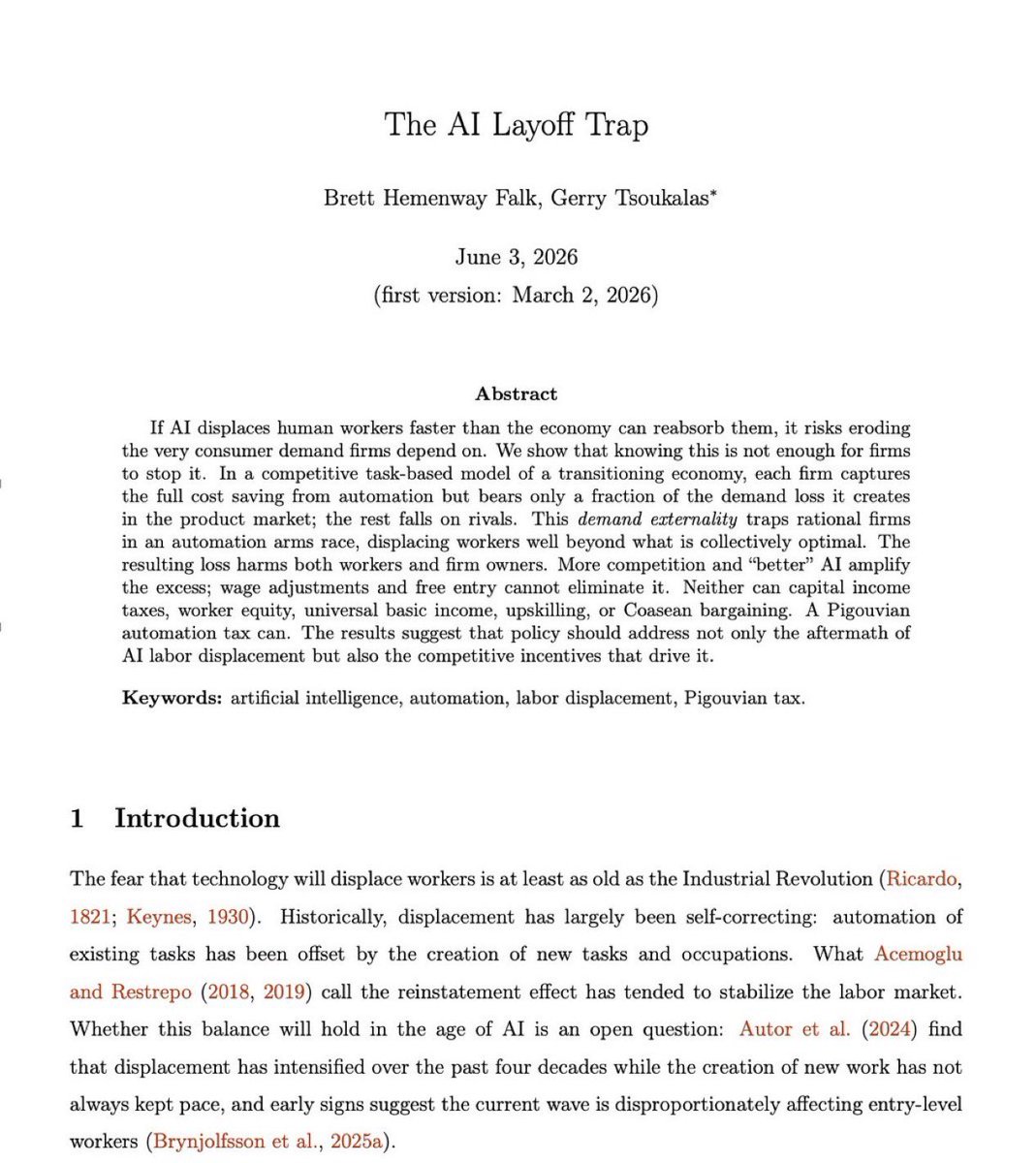
Two economists mathematically proved that AI will destroy the economy.
Researchers from Wharton and Boston University published a terryfiying paper called "The AI Layoff Trap."
They mapped out the economic end-game of the AI transition, and it exposes a fatal flaw in competitive capitalism.
When a company replaces a worker with AI, it captures 100% of the wage savings.
But that displaced worker is also a consumer. When they lose their job, they stop buying things.
The company gets all the savings, but the loss of consumer demand is spread across the entire economy.
If there are 20 competitors in a market, a CEO only absorbs 1/20th of the economic damage their layoffs just created.
So every single rational CEO has a mathematical incentive to automate as fast as possible.
They can literally see the cliff approaching, and they still step on the gas.
It triggers an unavoidable Prisoner’s Dilemma. If you don't automate, your competitors will, and they will crush you on price.
It doesn't just hurt workers. It destroys the businesses, too.
The economy gets trapped in an automation arms race. Companies fire their workforce to stay competitive, until the entire consumer base is completely hollowed out.
At the limit, the paper concludes: “Firms automate their way to boundless productivity and zero demand.”
And the scariest part?
The researchers mathematically tested every popular fix.
Universal Basic Income? Fails. It raises the living standard but doesn't change the corporate incentive to cut jobs. Retraining? Fails. Worker equity? Fails.
The paper proves that more competition actually makes the collapse happen faster. And "better" AI makes the damage worse.
The only thing that mathematically stops the collapse is a targeted automation tax, forcing companies to pay for the purchasing power they destroy before they automate the job.
@ubiszn the floor is the easy part politically. "humans own the upside" is the whole fight compressed into four words, and nobody replying to this owns equity in the thing replacing them. https://t.co/HWAcNhPULm
@MiroxaX 'learn to direct the algorithm' is already a udemy course & a linkedin badge. the moat has an expiration date, same as the job it replaced. 97 million new roles, no month attached to anyone's rent. more like 97 million ways to spend ubi https://t.co/SGG5uXFgeB
Your job might get replaced by AI sooner than you think
📞 Customer support agents
📊 Data entry specialists
🧑💼 Junior office staff (admins, assistants)
📞 Telemarketers
🧾 Entry-level accountants
It’s not truck drivers. It’s not doctors. First on the chopping block is routine “keyboard” work:
📞 Customer support
Bots already handle basic requests — most customers now choose a chatbot over waiting on hold, and some even prefer bots for simple questions. One company replaced dozens of live agents with an AI bot and slashed costs while keeping customer satisfaction high.
📊 Data entry
Companies that adopted automated form processing saw a sharp drop in data-entry hiring — it’s routine, structured work that algorithms do faster and without fatigue.
🧑💼 Entry-level office roles
Anthropic CEO Dario Amodei predicts AI could wipe out half of entry-level white-collar jobs within five years. Big Tech new-grad hiring has already dropped noticeably.
According to the World Economic Forum, machines could displace 85 million jobs by 2025 — but 97 million new roles are expected to emerge alongside them.
Bottom line: AI isn’t taking “jobs.” It’s taking routine. Either you learn to direct the algorithm, or the algorithm starts directing your paycheck.
Follow for more no-BS breakdowns on AI and the future of work.
@LuizaJarovsky no policy saves a profession that's already handing itself over. i outsourced my own sentences before anyone made me, and every associate running a draft through an llm tonight is making the same trade, one billable hour at a time. https://t.co/o6jk361axq
I want to share a few things I haven't said before:
I used to say lawyers gatekeep well and would prevent AI from replacing them.
I was wrong.
Most lawyers will likely be replaced by AI in the coming years.
This will happen to lawyers and many other professions unless governments impose strict measures to protect human work.
Also, as frontier AI and large AI companies swallow everything, the next 5 years will likely be extremely challenging for most people, especially those working in the information economy.
Look at any job market tracker, and you'll see that entry-level jobs have been rapidly shrinking over the past months due to AI (and agentic AI) automation.
I find it extremely irresponsible when I see people and organizations denying that AI has anything to do with it.
Of course it has EVERYTHING to do with it.
And things will get worse when mid-level jobs start shrinking too. And as AI eats more startups, small and some mid-sized companies.
I have difficulty imagining how we will avoid a global recession in the coming years.
I'm team human, and I'm sure we'll find light at the end of the tunnel, but I don't see this coming before 5-10 years, and only after the world is turned upside down.
I've been thinking a lot about it, and I feel it's my responsibility to speak openly and frankly about it (as I do with many other topics).
The next few years won't be easy.