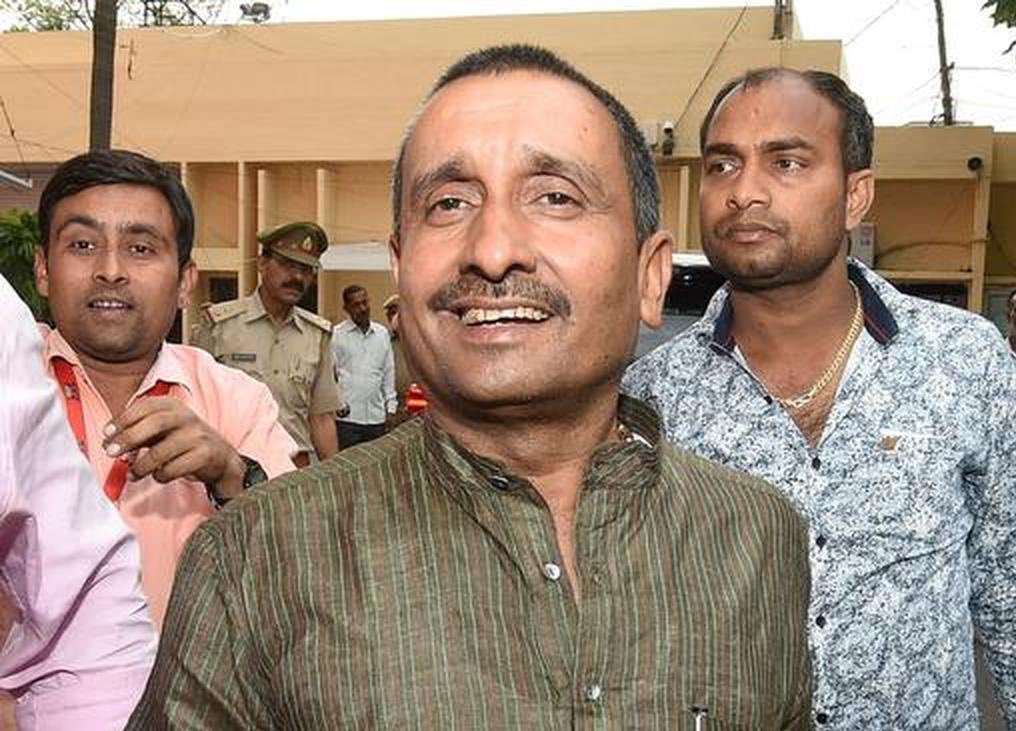
Rapist & former BJP MLA Kuldeep Singh Sengar:
>Raped a 17-year-old minor girl.
>Police did not act against him.
>Girl attempted self-immolation.
>Case was later taken up by CBI
>Killed victim's father
>a court convicted him of rape.
>sentenced to life imprisonment.
>a truck of his associates deliberately rammed into the victim’s car
>two aunts of victim died on the spot
>victim & her lawyer got critically injured
>Delhi HC suspended his life sentence.
>Delhi High Court also granted him bail.
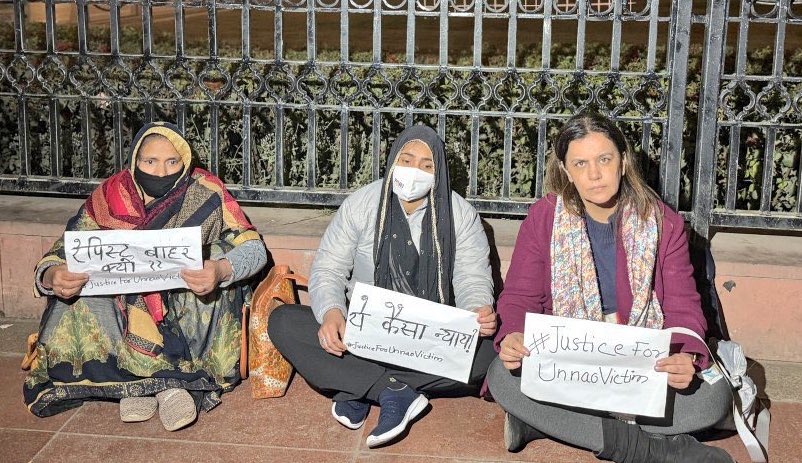
>Police detained the protesting family & victim at India Gate.
>Now, the lives of other family members are also under threat.
Law & order and judicial system of new India.🤡
What kind of judge is he? Since when is “disrespecting someone” equivalent to endangering the sovereignty of India? This is nothing but sanctifying a frivolous misuse of a serious legal provision. By that logic, anyone who didn’t vote for Prime Minister Modi, or anyone who critiques him or his government’s policies should be in jail. It is bizarre and plainly illegal. A judge who reasons like this has no business being on the Bench and should be impeached.
There seems to be an unrelenting push for surveillance from the Union Government. Despite the withdrawal of the mandatory pre-installation of Sanchar Saathi, a recent @Reuters report notes that COAI, a lobby group of telecom companies, is urging the government to require constant GPS-based location tracking on our phones. The SIM-binding regulation also remains in force, a development first reported and closely followed by @medianama. A few weeks ago, @PTI_News reported that Jio is pushing TRAI to dilute net neutrality protections.
Taken together, these three stories reveal a pattern of policy lobbying and regulatory moves in the telecom sector that threaten the rights of internet users in India. All Government Ministries and institutions must take urgent steps to restore public confidence and commit to making any regulatory changes only through a process of genuine and meaningful public consultation. In the interim, MEITY, the DoT and TRAI must make these communications from lobby groups public given they impact public interest.
IFF will continue to closely track these developments and push for your rights.
Link to stories:
1. Aditya Kalra & Munsif Vengattil, “Exclusive: India weighs greater phone-location surveillance; Apple, Google and Samsung protest” (December 5, 2025): https://t.co/a8Jp6VxZ5L
2. Kamya Pandey, “It’s Not Just Sanchar Saathi, New SIM-Binding Rules Could Change How Messaging Apps Work in India” (November 29, 2025): https://t.co/iVH4bcSaT4
2. Press Trust of India, “Jio urges Trai to adopt flexible net neutrality approach amid 5G evolution” (November 13, 2025): https://t.co/renkvMPwx2
More surveillance from the Indian Government, with mandatory GPS / Location tracking ON for our handsets? You won’t have the option of turning location off, and while Google, Apple and Samsung have opposed this, the Telecom Industry is pushing for it, Reuters reports.
Many of you have tagged me on this story, so let me explain what is going on here:
1. Impact it has on us: GPS on doesn’t mean we’re being tracked, but it does mean that we are all being forced to be minutely “trackable” all the time. The government may never want to track you, but this will drain your phone battery rapidly, and force you to charge it multiple times a day, and significantly reduce your phones battery life. It will also heat up your phone significantly. But the question that has to be asked: why is it that we need to make everyone trackable all the time, in order for one person to be tracked at one point in time?
This is disproportionate and badly thought through. Remember that Nitin Gadkari’s ministry MORTH is also planning to push GPS FASTAGs, instead of the RFID ones. They’ll make our cars more trackable.
Aadhaar is linked to mobile number is linked to SIM card is linked to to phone with GPS.
Aadhaar is linked to Driving License is linked to FASTAG (with GPS)
With this there’s no anonymity in the physical space.
We’ve already lost it for the most bit online. Now this too.
Also, GPS can give the government continuous location, not just when a tower handshake happens. Triangulation is episodic, and it updates when your phone pings the network. GPS updates every few seconds.
Trackable on foot. Trackable in the car. All of us. All the time. Like a report for our movements. A location graph!
2. Why is all this problematic?
The Centralised Monitoring System has GPS tracking ability (since 2010, I think. I reported on the Tender Document for Delhi Police), but it needs GPS to be on. Imagine how it impacts journalists meeting sources to report on the government. Imagine if two opposition party leaders are meeting planning to partner to form a coalition government after elections, or overthrow the sitting government in the state.
They’ve done nothing wrong, but they have something to hide. Whistleblowers, judges, lawyers…This isn’t good for democracy.
We also don't know how this will link up with NATGRID, the Indian governments ultimate surveillance system, which will take data from 21 public and private databases. Eventual plan is to expand it to over 1800 databases. More in the link in the next tweet in this thread.
3. No consent: same problem as Sanchar Saathi. The telcos want this forced on us. Users cant choose to NOT disclose their location, and hence this is a violation of privacy. Remember that India has no surveillance laws, and surveillance agencies are not accountable to Parliament.
The government has exempt itself from the Data Protection Law and now appears to be pushing for increasing surveillance, and making it perpetual. Of course, with the Supreme Court unwilling to look into matters of National Security (which is anything the government wants it to be, and is undefined), every act of surveillance can be justified under National Security.
Again, like with Sanchar Saathi and SIM Binding, there was no public consultation, no public disclosure. Same shit, different ministries. We’re supposed to be transparent and trackable all the time. Not the government.
4. The government has an alternative to GPS tracking: The government can track your location anyway, but not as well: Cellular towers can give a broader idea of where you might be by doing something called cell tower triangulation: they can estimate your location in a radius of 50-100 meters (maybe even better) because they’re comparing signals your phone receives from three different towers.
But it’s not as good GPS. You might remember that when you switched off GPS while using Maps, it used to switch from an exact location to a larger circle / range or a zone indicating where you could be. This is why.
Cell towers - 50-150 meters accuracy
GPS - 5 meters to even 1 meter accuracy
However Cell Tower tracking has been useful in the past. I’ve read SEBI reports on stock market manipulation by promoters, where it has historical data on peoples locations, like in a particular restaurant, validated by cell tower data.
We do this anyway, and triangulation appears good enough for SEBI to prove its case, why not other use cases? If triangulation is sufficient for criminal investigations, why do we need 24x7 GPS tracking of 1 billion devices?
5. GPS can help the government track you much much better: When we use Uber, Ola or Google Maps, it knows exactly where we are. Inside malls, it can even estimate which turn floor you are on. GPS tracking is very very precise, though not always accurate, because it uses satellite signals.
Your phone receives a ping from a satellite, and the time taken between when the satellite signal is sent and is received on your phone, along with cellular tower data, is used to calculate your exact location. Triangulation can’t recreate your path, your speed, the exact time you spent at an exact spot, or the difference between the entrance to an apartment complex and your front door. That’s why it’s the best way to track someone. You’ve seen Google Maps… This can create a perpetual history of where you’ve been all the time.
6. Every phone becomes an ACTIVE tracker.
It’s not just the government that will get the information from GPS — they’ll rarely use it. But every phone application can easily get access to your location because your location is perpetually on. Triangulation depends on telecom operators. Forced GPS forces your personal device to give up your location perpetually, and potentially to every app.
7. How SIM Binding changes things here: SIM Binding, which means that you social media/whatsapp account will be locked into the SIM essentially prevents people from running apps on secondary devices, or keep a clean device separate from their main identity, but use the same app. SIM Binding means you'll use the app on the same device and your movements will be mapped.
8. The game that the telecom lobby is playing: Here’s what is likely to have happened. The government must have told the telecom operators to improve location tracking. They’ve done it in the past. For this, telecom operators would have to invest in better hardware and improving the location sensitivity of cell towers. They don’t want to put in that money.
Airtel pushed back against the same thing in 2010 when the government asked it to upgrade systems to bring traceability down to 50 meters from 100 meters. What’s the easier counter - tell the government to screw the Internet companies and our handsets instead. Make the phone do the tracking. Shift the cost to the user. Burn their battery, not our capex.
Some links for you to read in the next tweet
SHOCKING: Reuters reports that @ConnectCOAI — which represent companies like Airtel, Jio, Vodafone Idea — is urging the Indian govt to engage in constant GPS-facilitated location surveillance of all Indians via their phones and to prohibit mobile OSes from notifying you when the govt is tracking you.
Google, Apple, Samsung and others are pushing back arguing it harms the fundamental right to privacy.
#surveillance #India #telecom #spyware #privacy
https://t.co/rjXF2HLvEx
The government has issued a press release saying that it isn’t mandatory for handset companies to install Sanchar Saathi. The government has no business infiltrating our phones.
While this is a welcome move, the other directive for forcing SIM Binding on Social Media and messaging accounts, has NOT been revoked.
I would call upon the government to suspend the SIM Binding directive as well, and start a consultation process on this issue, so that they can understand how it limits our usage of messaging apps.
SIM binding will impact those who use Whatsapp and Telegram on their desktops or multiple devices, inconvenience those who use Whatsapp web, and force people to buy expensive roaming plans from telecom operators, instead of a local SIM.
As per the statements made by Ashwini Vaishnaw when the Telecom Bill was passed, Department of Telecom has no jurisdiction over the Internet, and it is not the right government department for this. They have already shown how little they understand how the Internet works, and concerns that users have, with the Sanchar Saathi directive, for which also there was no public consultation, nor was their feedback taken. The same applies to SIM Binding.
I would also call upon Ministry of IT to ensure that other government departments that do not have jurisdiction over the Internet, do not hijack its remit. They have failed at this for the last three years at least.
Thank you for all your support in raising this issue. Like I used to say during the SaveTheInternet campaign for Net Neutrality, we’re in this together.
It’s our job to ensure that the Internet we love remains free, our privacy is protected, and our speech is not censored.
The Internet Freedom Foundation, which I’m no longer involved with, does exemplary work to protect our rights. Please consider donating to them. If SFLC India takes donations, please support them too. There's very little support for civil society organisations in India, and they're the ones who fight for your rights every single day.
Indian founders who benefit from India's Internet should donate to these orgs as a part of their CSR.
Also, lastly, I repeat: the SIM Binding directive also should to be revoked. More on the concerns related to that in the tweet below.
IFF's Statement on the Sanchar Saathi App Pre-Installation Directive
The Department of Telecommunications (DoT), specifically its AI & Digital Intelligence Unit (AI & DIU) on 21st November, 2024 has under the Telecommunications (Telecom Cyber Security) Rules, 2024 issued a sweeping Direction mandating the pre-installation of the Sanchar Saathi mobile application on all mobile handsets manufactured or imported for use in India. As a preliminary matter the DoT has yet to by itself disclose the full text of the direction. Initial reports by Reuters revealed it's existence and subsequently it's full text was disclosed by Medianama which form the basis of our statement, which will be followed up by RTI, analysis as well as steps, if required to support a challenge to it in a court of law.
The direction by requiring manufacturers and importers of mobile handsets to pre-install the Sanchar Saathi App represents a sharp and deeply worrying expansion of executive control over personal digital devices. The stated objective of curbing IMEI fraud and improving telecom security is, on its face, a legitimate state aim. But the means chosen are disproportionate, legally fragile, and structurally hostile to user privacy and autonomy. Clause 7(b) is the clearest expression of this. It requires that the pre-installed Sanchar Saathi application be “readily visible” and that, “its functionalities are not disabled or restricted.” In plain terms, this converts every smartphone sold in India into a vessel for state mandated software that the user cannot meaningfully refuse, control, or remove. For this to work in practice, the app will almost certainly need system level or root level access, similar to carrier or OEM system apps, so that it cannot be disabled. That design choice erodes the protections that normally prevent one app from peering into the data of others, and turns Sanchar Saathi into a permanent, non-consensual point of access sitting inside the operating system of every Indian smartphone user.
Viewed through the lens of the Supreme Court’s judgment in K.S. Puttaswamy (2017) that reaffirmed the fundamental right to privacy, this structure cannot pass the proportionality test. K.S. Puttaswamy requires that any intrusion into the right to privacy must meet the standards of legality, necessity, and proportionality. Even if we assume legality and necessity for the limited purpose of checking the genuineness of devices, the order clearly stumbles on proportionality. The government’s own ecosystem already offers less intrusive means to verify IMEI numbers and detect fake handsets such as the Sanchar Saathi web portal, SMS-based KYM (Know Your Mobile) services, and USSD codes all allow a user to perform this task without a permanent app baked into the firmware. There is no technical explanation in the order for why a one-time or occasional verification exercise justifies a resident, non-removable application with elevated privileges that lives on the phone for the lifetime of the device. Forcing a permanent app installation for a sporadic verification function is not a marginal overreach; it is a textbook example of disproportionate state action under the Puttaswamy standard.
The problems deepen when we look at the scope and safeguards. The order invokes “telecom cyber security” as a catch all justification, but it does not define the functional perimeter of the app. Clause 5 of the Directions refers to identifying acts that “endanger telecom cyber security,” an expression so vague that it invites function creep as a design feature, not a bug. Today, the app may be framed as a benign IMEI checker. Tomorrow, through a server side update, it could be repurposed for client side scanning for “banned” applications, flag VPN usage, correlate SIM activity, or trawl SMS logs in the name of fraud detection. Nothing in the order constrains these possibilities. In effect, the state is asking every smartphone user in India to accept an open ended, updatable surveillance capability on their primary personal device, and to do so without the basic guardrails that a constitutional democracy should insist on as a matter of course. IFF is deeply concerned with this direction that sets up a precedent to enforce client side scanning on all smartphones in India and calls for its recall.
As a first step we have filed a RTI with the Department of Telecom not only for a copy of this direction/order but also the underlying justification on how and why it was issued. We will fight this direction till it is rescinded.
More bad news for mobile phone users in India (after SIM binding): Our government is mandating a government app (sanchar saathi) on every new phone, permanently, Reuters reports.
Will be pushed to your phone via OTA. New smartphones need to have it. Users cannot delete it. This is a first. India has never before required an unremovable state app on every device. Russia does btw, with its MAX Messenger (started September 2025).
A few comments regarding this:
1. Sanchar Saathi is a lost phone tracker, but if it gets embedded with no possibility of removal, it becomes a government tracker on your device.
IF the government is allowed to get away with this, what’s next? A mandatory digital ID app? Digiyatra forcefully installed on each device? An app that disables VPNs or tracks your app and browser history? An app that sends copies of your messages to the government once a month?
Once the OS layer is opened to the state, it doesn’t close.
2. Legally, one can argue that your mobile phone is your personal space, and this is an invasion of your personal space.
It’s where we have our most private conversations. Exchange sensitive information with people we trust.
How do we know this app isn’t used to access files and messaging on our device, which is unencrypted on device? Or a future update won’t do that? This is clearly an invasion of our privacy.
3. Remember how the government exempt itself from much of the Data Protection Law. This explains why.
The Data Protection Law will make private companies more accountable and the Indian government less accountable.
4. Bloatware is already an issue with some phones (It’s why I don’t use Samsung). Now there’s more, and this time the government is forcing bloatware. I guess we’ll all have to root our phones now. When you buy a phone with bloatware, you're choosing to buy it with bloatware. This is different.
5. The way things work with India’s Department of Telecom, there was no public consultation, the order wasn’t disclosed. Just forced. This is dictatorial in nature. If they get away with this, more will follow.
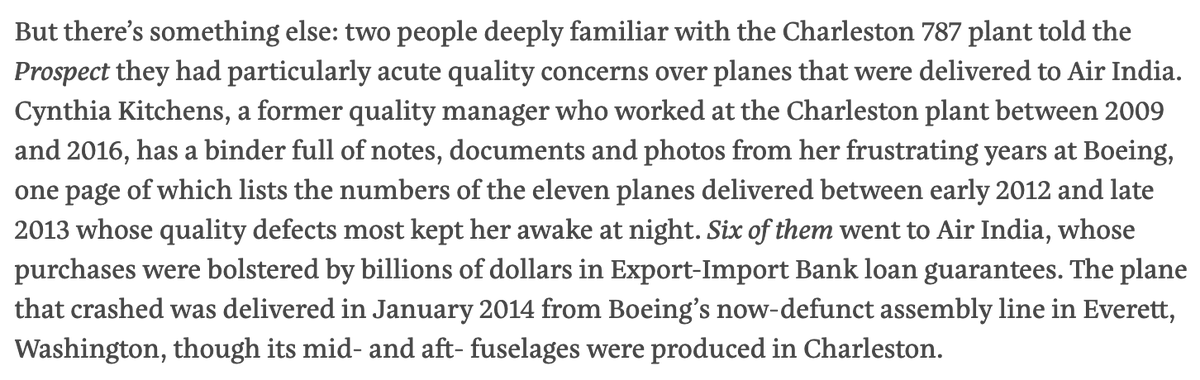
Wild story: a quality manager who warned about the shoddy construction of Boeing 787 Dreamliner planes was particularly concerned about the ones sent to Air India around a decade ago. That's when the Air India jet that crashed today was sent. From @moetkacik:
I don't think people realise the depth of the tragedy that has happened. For me this is just unimaginable.
A flight full of people that took off from Ahmedabad went down in flames killing nearly everyone on it. Including infants and children. Whole families wiped out (I find some solace in knowing that some families, all of them, died together, and none was left behind to live a life full of emptiness)
The ball of metal and fire then showered down on a major medical college hostel and canteen killing many undergraduate students, interns and senior residents.
Students were taking their lunch break, waiting to go back to class or the hospital to learn and attend to patients.
They had spent the majority of their lives reading and learning and painstakingly cracking the medical entrance exams are living their dream.
Some of them would have recently joined, taking loans and sacrificing so much. Including their parents. It was all of their dreams that went down in flames and rubble.
I see many accounts throwing conspiracy theories, playing the blame game, indulging in divisive politics, creating misinformation about what happened and others sharing gory images and details from the tragedy.
I wish we were more civilized and caring. We are humans first and humanism eclipses everything else. Let us share resources that can be helpful to those in need and their families.
For any related assistance, Gujarat State Government Police issued the following:
Landline: 079-23251900
Mobile: 99784 05304
Police Helpline: 079-25620359
A lot of the injured require blood and blood product transfusions. Details are in the image below. Please help them in any way you can. If anyone has other helpline leads for donations and support, please comment under this post.
Act like an adult and a compassionate human during colossal tragedy. It helps.
I am deeply sorry for the inconvenience that attending my show has caused to you. Please email me so that I can schedule your next vacation anywhere you’d like in India -https://t.co/rASktiolKE
The ground is being prepared for the final nail in the coffin. Here's how;
Take a trivial social media incident ✅
Add political propaganda ✅
Fuel it with manufactured social outrage ✅
Amplify it with paid news media ✅
Drag it into Parliament ✅
Invoke "law and order" ✅
Seek a judicial stamp ✅
If you can’t see the pattern, you’re not paying attention. The stage is being set for the Broadcast Bill again. Social media, the last refuge of free speech, will soon fall.
And no, I’m not defending Ranbeer’s comment. But when a nation starts taking jokes seriously while treating real crimes like rape, murder, and drunk driving as a joke… it’s truly doomed.
Enjoy while it lasts. 🙏