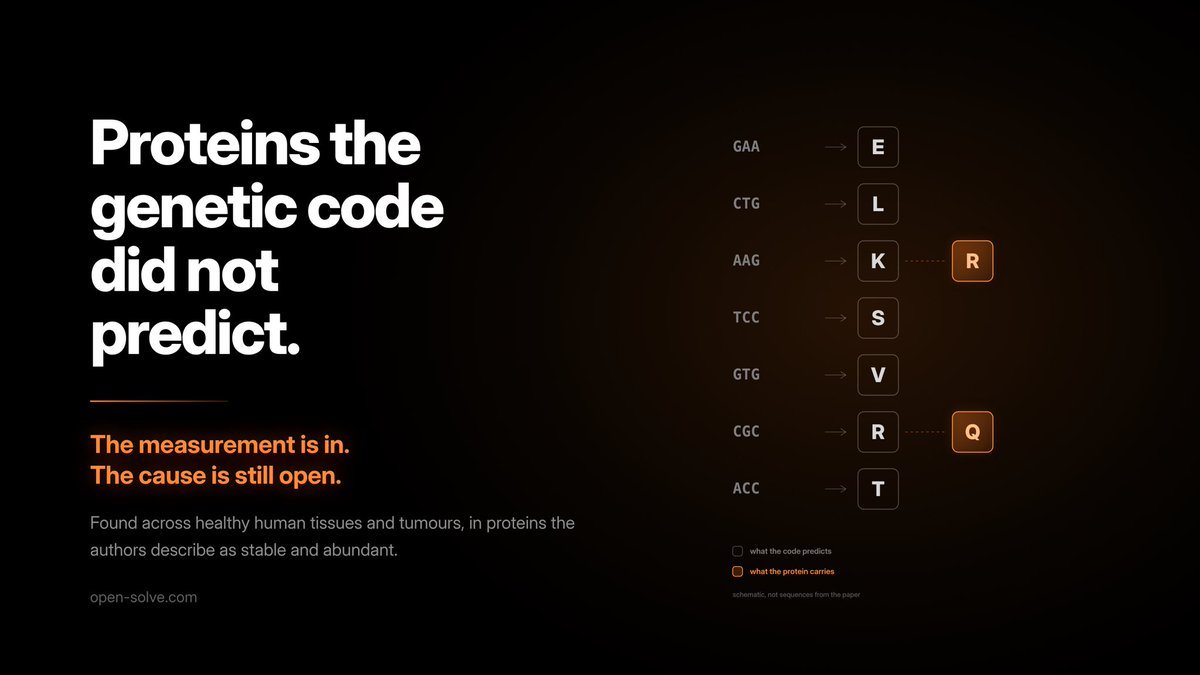
A Nature paper this year reports protein sequences that the genetic code does not predict. Across more than a thousand human samples, covering 26 healthy tissues and 6 cancer types, the authors report 8,746 unique amino acid substitutions across 1,767 genes, in proteins they describe as stable and abundant.
The careful bit is what they called it. The paper picks the term alternate translation and says plainly that the choice is neutral on purpose, because where the substitutions come from is still open.
That is what people are arguing about now. One reading is a real widening of the proteome. Another is that something between the DNA and the detector is responsible, in transcription or in how the spectra were matched to sequences.
The measurement is on the table. Its meaning is still being worked out, and that is worth watching.
🧬
https://t.co/zThyrCVWtb
@foreger01@notinvariant I promised to ship today. I could put it out right now, but it isn't good enough yet, and I'd rather not release something half-done.
So it's a little later: this evening.
Fed Governor Michael Barr, Nov 16: AI agents that can move money without human approval could turn bank runs into events that unfold in minutes.
https://t.co/gxnuqLaVEr
He also said big banks already see agents acting in customer accounts, and the banks can't verify the customer agreed to it. One of the fixes he named is consent tied to each transaction.
That's what AsAsked does for agent payments. Before the agent signs, the guard compares the payment with what the person actually asked for: amount, token, recipient, slippage. If it doesn't match, it refuses. Since 0.1.12 it can also check whether the payment address belongs to the site.
It won't stop a bank run. It makes sure each payment is one the person asked for.
Open source: https://t.co/tNU59AORIB
@foreger01@notinvariant Shipped one today: the guard now checks whether a payment address really belongs to the site the agent is paying. On GitHub, in the next release.
And tomorrow, a new tool on https://t.co/iPoMYbshrC.
Update: part of this is built already, on GitHub.
The guard now asks the site the agent contacted whether the payment address is its own: the x402 identity group's signed manifest (key in DNS) and ENS names. If the site's ENS name doesn't list that address, the payment is refused.
Few sites publish either yet, so most payments still get a warning, not a check. And it proves the address, not that the seller is honest.
In the next release.
Good question from @notinvariant: what if the shop's payment request itself is fake?
The guard checks the payment against that request. If the request is forged, it can't tell.
First fix is already in our code: the guard takes the shop addresses the person approved and refuses a payment to any other, whatever the request says. It ships in the next release.
Next we're looking at the shop itself: is it real, does the address belong to it, will it deliver. Not built yet, but that's where this goes.
Thanks for pushing on it.