噂のマイクロソフトによる、UNIXのcoreutil のポートを見てみた。find コマンドとか、たぶん衝突して無理だろうなぁと思ったら
「Integrated port of the original DOS command」
って書いてた。つまり、DOS の find.exe の機能と、UNIX の find の両方の機能を内蔵してるんだって
(1/3)
In the age of AIs, Rust is the new assembler, and that's how I'm using it.
I don't particularly like Rust. I have never hand-coded a single line of the language, and probably never will. Rust's developer and advocate community contains a lot of crazies I don't want to be anywhere near.
Nevertheless, I've shipped two Rust projects so far, I expect to have a third out soon, and I'm planning on a fourth.
Why? Since I'm doing all my coding with LLM assistance now, none of the things I dislike about Rust matter much anymore. I don't need to know how to write the language, only to read it enough to understand control flow and spot obvious bogons. And I don't need to deal with the crazies, because my robot friends are smarter than they are.
Rust has four properties that make it a good target nowadays:
1. LLMs are good at generating high quality Rust code.
2. Memory safety, memory safety, memory safety.
3. Rust is anal about things like lifetimes that other languages aren't. This means that LLM-translating out of it into a future language that I might like better should be easy, because it's a more exact specification of intended behavior.
4. Repeating: LLMs are good at generating high-quality Rust code.
Am I going to use it for everything? Oh hell no. I have a bunch of very nice Golang code that doesn't need to be moved to Rust because Golang is a better fit for its problem domain. And I have a bunch of small Python scripts that don't need to move either.
But over time, I expect almost all of my C code will in fact move to Rust. Because memory safety, memory safety, memory safety.
Someday, maybe, there will be a language with Rust's virtues that I don't dislike. At which point I will cheerfully translate all my Rust stuff out of Rust. Interlanguage translation is easy and cheap now.
I don't necessarily have to like the shape of a tool to recognize when it's good for a job.
What if I told you a neural network understands local change before it understands the full picture?
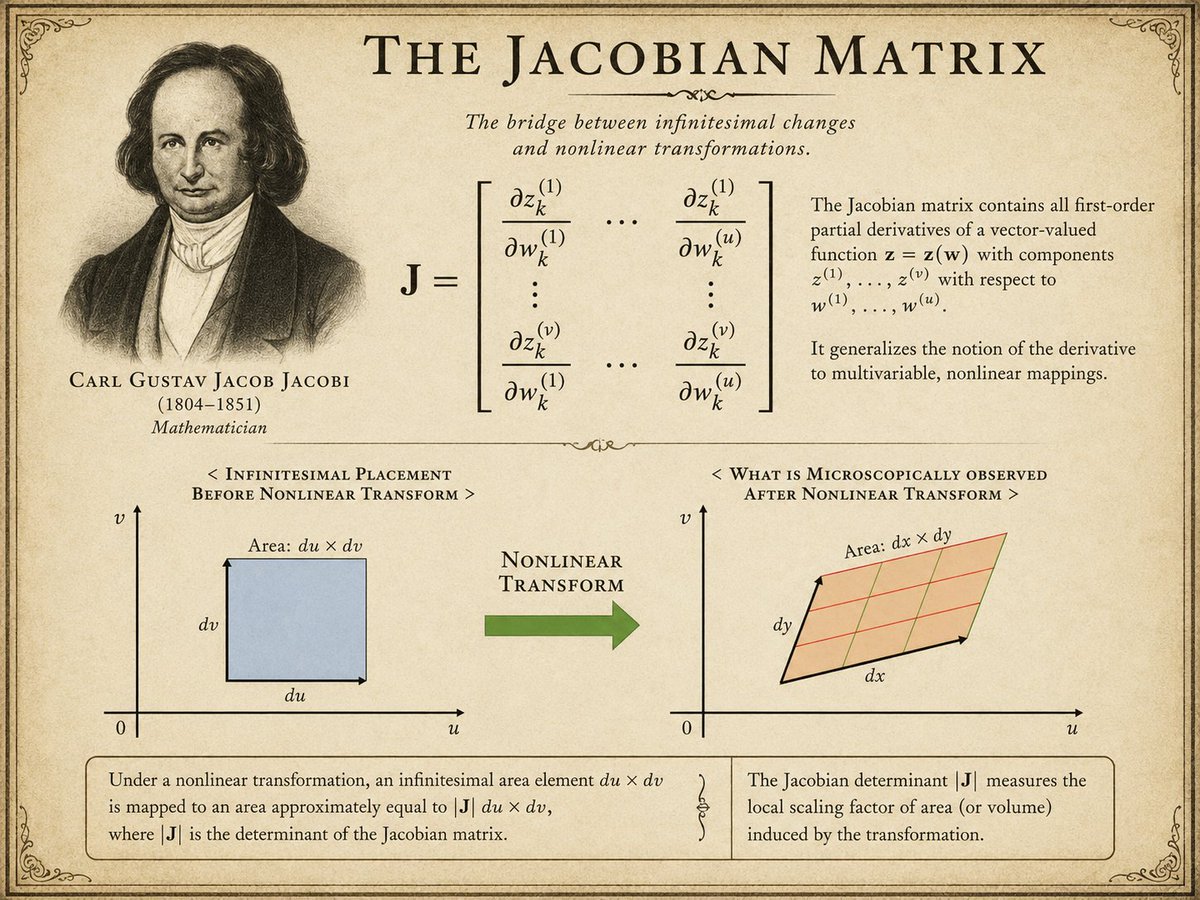
That idea is deeply connected to something called the Jacobian Matrix.
At first, it looks terrifying. A big matrix full of partial derivatives. But the intuition behind it is actually beautiful.
The Jacobian measures how small changes in input variables affect the output of a system.
Imagine slightly changing the pixels of an image.
Or changing one feature in a dataset.
How much does the prediction change?
The Jacobian tells us exactly that.
You can think of it as a “sensitivity map” for transformations.
If a system transforms one space into another, the Jacobian describes how the geometry changes locally.
Tiny squares can stretch, rotate, compress, or skew into completely different shapes.
That is why Jacobians are everywhere in AI & machine learning.
For example:
- Backpropagation relies heavily on Jacobians through the chain rule
- Neural networks use them to understand gradient flow
- Normalizing Flows use Jacobian determinants for probability density transformations
- Computer Vision uses them in geometric warping and image alignment
- Robotics uses Jacobians for motion and control systems
- Diffusion models and generative models often depend on transformations between latent spaces
The interesting part is this:
Most ML models are basically learning transformations.
And the Jacobian is what tells us how those transformations behave locally.
Step-by-step intuition:
- Start with an input vector
- Apply a transformation
- Measure how each output changes with respect to each input
- Store those local relationships inside a matrix That matrix becomes the Jacobian.
Carl Gustav Jacob Jacobi introduced this mathematical idea long before AI existed.
But today, modern deep learning silently runs on top of concepts like this every second.
Sometimes the most important parts of AI are not the flashy models.
They are the mathematical structures underneath them.
I’ve just released MiMo V2.5-Coder. If you have 128 GB of RAM, this is one of the best models you can run locally. It’s fast, and in all my experiments it outperformed Qwen 3.6 and DeepSeek 4-Flash. https://t.co/U6mL65YVR1