For steel factories in Germany, sometimes it’s just too expensive to operate. So they’re shutting down 🇩🇪 ⚠️
Many energy-intensive factories in Europe depend on the wholesale power market, and high prices due to the Middle East conflict threaten industrial production
عاجل
النيابة العامة في ليبيا تأمر بحبس مدير إدارة النقل البحري في المؤسسة الوطنية للنفط على خلفية تحقيقات أزمة نقص غاز الطهي
التحقيقات تكشف عن استئجار ناقلة تحوطها مخاطر قانونية.. وارتفاع تكلفة الغاز عقب نفاد مخزونه من المستودعات الليبية
#ليبيا#المؤسسة_الوطنية_للنفط #غاز_الطهي
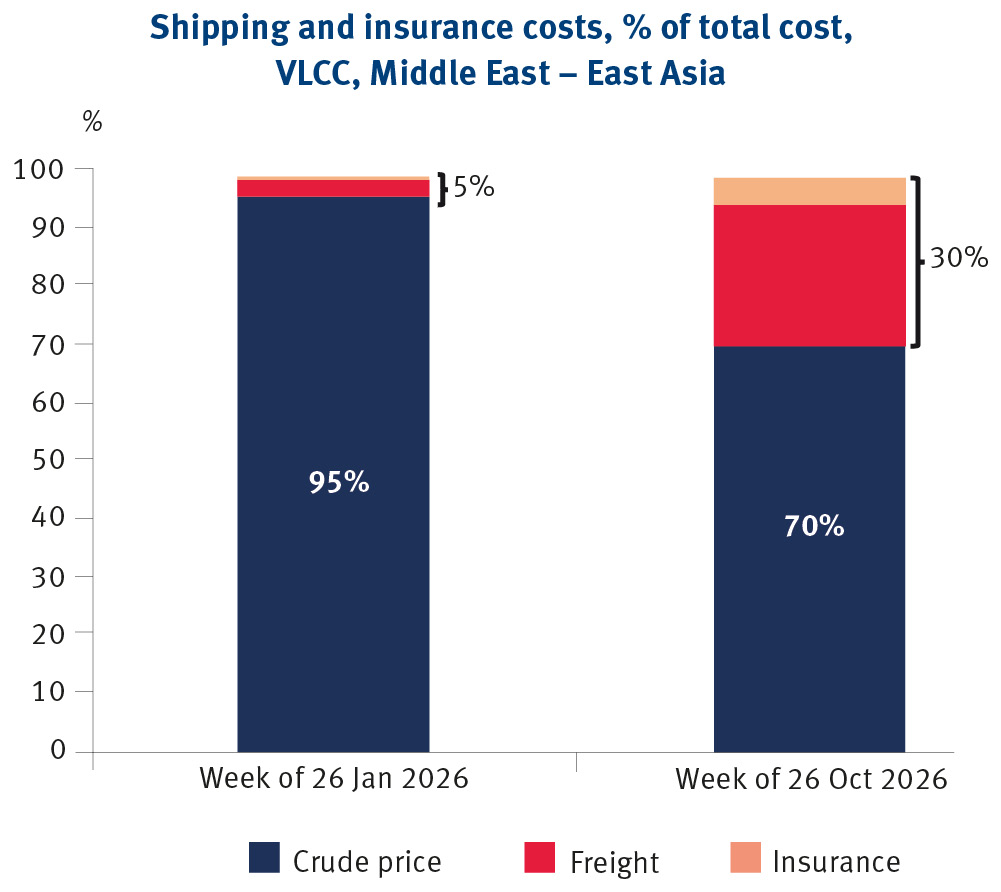
Normally, the combined cost of freight and insurance represents around 3% of the total cost of crude or petroleum products.
By the end of January 2026, the total share of freight and insurance for very large crude carriers (VLCCs) from the Middle East to East Asia was around 5% of the total cost.
By the end of October 2026, however, this share averaged 30% of the total cost.
These exceptionally elevated costs are, in turn, transmitted across the entire value chain. They increase and prolong the cost burden on producing and consuming countries and place additional inflationary pressures on the global economy.
Read more in the new brochure ➡️ https://t.co/gl6OT4UWQk
On the Transpacific trade, rates from Shanghai to Los Angeles increased 2% to $7,838 per 40ft container, while those from Shanghai to New York remained stable at $10,373 per 40ft container. Meanwhile, carriers continue to manage capacity via blank sailings. According to Drewry’s Container Capacity Insight, 15 blank sailings have been announced for next week, up from nine this week, indicating tight capacity. Despite capacity reductions, Drewry expects rates to decrease next week ahead of the upcoming Golden Week holiday
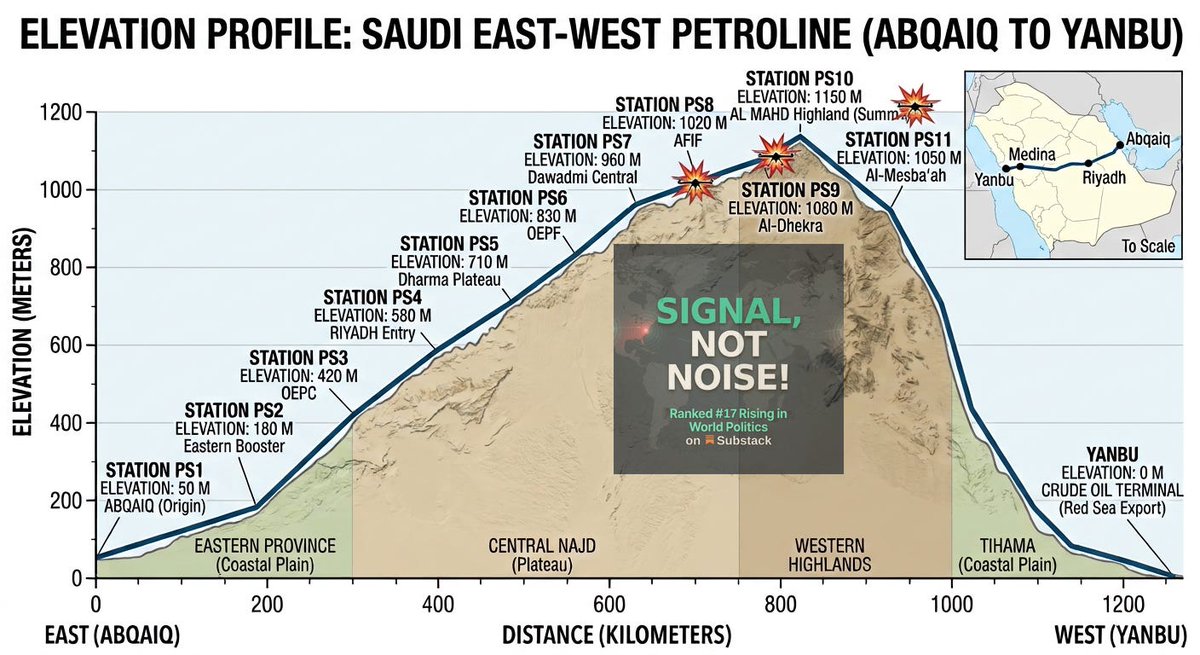
EXCLUSIVE INVESTIGATION: Some market and oil analysts are absolutely clueless about the depth of the damage that Aramco has experienced in Saudi Arabia at the 3 pumping stations...
The Ansrallah Houthi strikes on the three Saudi Aramco Pumping Stations (PS) was more likely than NOT facilitated with someone that had insider knowledge or working for Saudi Aramco that sold information to the Houthis.
After a 5 day investigation, I assess with high confidence that that the information was either sold to the Houthis OR they have a sympathizer working inside Aramco that gave them VERY specific technical information which enabled the missile strikes.
Why do I say this?
Because the Houthi military's target selection cell had too much technical details which enabled such a devastating blow, the target selection was far too sophisticated... They hit Pumping Station #8, PS #9 and PS #11 AND then the Yanbu terminal.
They did not hit PS 1 or any of the other sequence of pumping stations, WHY?
Because they knew or were told that if they strike PS 8, PS 9 and PS11, they would essentially decommissioned at least 400km of oil flow by striking the 3 Pumping Stations with multiple ballistic and drone strikes.
But what's also interesting is that some of these pumping stations are soo remote you cannot necessarily drive to them, or bring in the necessary crew needed, hence Aramco will have to fly the crew and the equipment to the site and for instance, PS #9 that was hit has its own airport at the pumping stations so they have fly everyone in and out daily.
They hit the pumps at highest elevation disabling any type of potential bypass or redundancy that can kick in.
This will likely take at least 3 to 6 months to repair. Not weeks!!
Full analysis with maps, and details here: https://t.co/RHkV4lr4Dy
Help amplify the Signal. You know what to do.
Signal, not noise!
$NVDA CFO on the circular-financing critique:
"We recognize the scale of this support, and we know some will call this circular financing. We see it differently. We’re going through a major computing platform shift. The creation of one of the most important technologies in human history—and these are once-in-a-generation companies. The technology leadership is proven. And their customer traction and usage are skyrocketing"
The biggest boxship delivery cycle in the industry’s history is colliding with a port sector already under pressure from congestion, disruption and years of underinvestment https://t.co/cx5sS7X2bh
BREAKING: Iran and Russia have signed a $25 billion agreement to build new nuclear power plants, including Iran's largest nuclear power plant to date, with Iranian President Pezeshkian set to meet Putin next week in Kyrgyzstan, per Mehr / IRNA.
The deal is between Iran's Atomic Energy Organization and Russia's Rosatom, covering construction of 4 advanced third-generation nuclear power reactors (~1,255 MW each, ~5 GW total capacity) on a 500-hectare site in Sirik, Hormozgan Province, southern Iran. This is Iran's largest nuclear power project to date, fitting into Iran's long-term goal of ~20 GW nuclear capacity, with Russia already contracted for up to 8 reactors in Iran overall.
This comes after Russia rejected the US request delivered by CIA Director Ratcliffe's visit yesterday to press Iran into reopening the Strait of Hormuz, warning that Russian entities would otherwise face designations under Operation Economic Outcast. Russia also told Iran the threatened measures were of limited consequence.
TotalEnergies CEO Patrick Pouyanne says oil is flowing the Strait of Hormuz “very quietly,” and his company is largest trader of Iraqi/Qatari crude.
Pouyanne says it costs ~$20 million per VLCC per SoH passage (including return) in freight and insurance. TotalEnergies is buying crude inside Persian Gulf at ~$50-$60 a barrel as producers are “desperate” for lifters, making the process profitable.
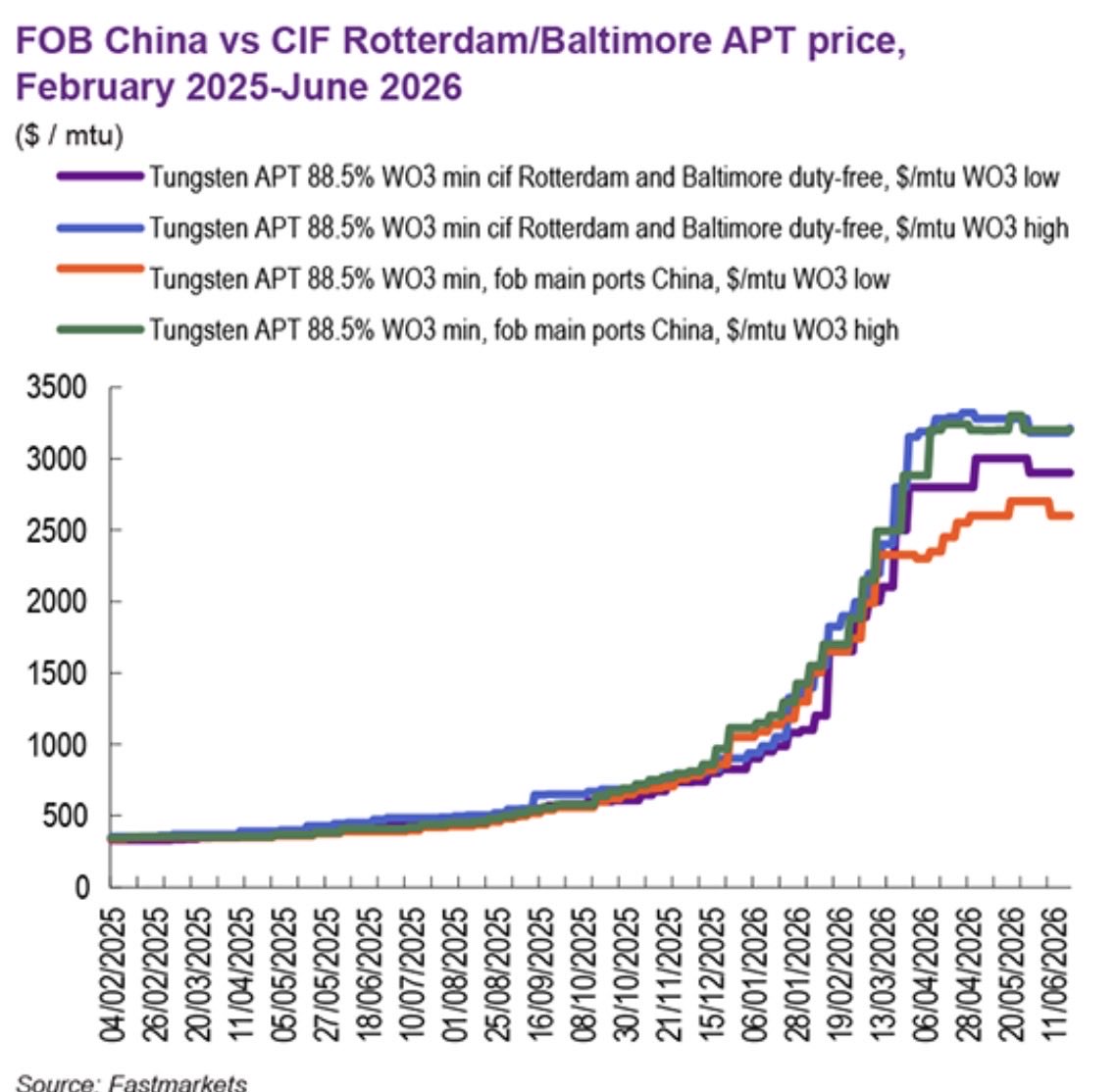
Tungsten markets fragmenting as domestic Chinese APT market diverges from exports
Domestic and export APT prices begin to diverge.
On one hand, prices for ammonium paratungstate (APT) on both an FOB China and CIF Rotterdam/Baltimore basis – that is, those reflecting export markets – remain closely linked.
But on the other hand, in recent weeks, sources across markets globally have reported that it has become apparent that domestic Chinese APT prices in particular have begun to decouple from export prices.
In the years that preceded the implementation of Chinese export controls on various forms of tungsten coming from the country, including APT, shifts in Chinese domestic prices would, sooner or later, be reflected in overseas markets – at least to some extent.
And in the immediate aftermath of the implementation of those export controls, domestic Chinese and export prices for APT were similarly supported by high input costs, keeping them more closely linked to one another.
But that link was now weakening. In recent months, tungsten concentrate prices have come down significantly in China, reducing input costs and contributing to decreases in domestic APT prices – but not in the export market for APT, where access to supply remained a critical driver.
Falling Chinese input costs weaken traditional price links
For example, Fastmarkets’ price assessment for tungsten concentrate 65% WO3, in-whs China, was 500,000-525,000 yuan ($73,584-77,263) per tonne on June 24.
The was a decrease week on week from 510,000-550,000 yuan per tonne, following a rebound earlier in June. But it was still down by some 50% from an all-time high of 1 million-1.05 million yuan per tonne, set on March 11.
On the other hand, Fastmarkets’ price assessment for tungsten concentrate, basis 50-70% WO3, spot price, cif global, has been $2,500-2,800 per mtu WO3 since May 29. The price began the year at $750-850 per mtu WO3 and had seen an almost unbroken run of increases over 2026 so far.
“The arbitrage mechanism that once linked domestic Chinese prices to international markets is becoming less effective,” a trader told Fastmarkets.
The export licensing requirements that led to restricted availability (in seaborne markets for APT in particular) have limited the arbitrage opportunities, creating something of a rupture in price relationships.
In the image, we can see the largest Strategic Petroleum Reserve (SPR) site in the United States: the Bryan Mound facility, known as the granddaddy of the reserves, featuring 20 caverns with a total storage capacity of 235 million barrels.
The caverns are designed with larger tops to facilitate future oil drawdowns, allowing raw water to be injected more easily to displace and remove the oil. The caverns also exhibit varying shapes because the salt removed during their initial creation dissolves at different rates due to local heterogeneities in the formation and variations in dissolution dynamics.
If we continue drawing the ENTIRE US SPR at current rate…. in about 10 weeks—the volume equivalent to these cavern below will be left under 235 million barrels out of the roughly 700 million barrels that could be stored across all SPR sites. 🫡🪒