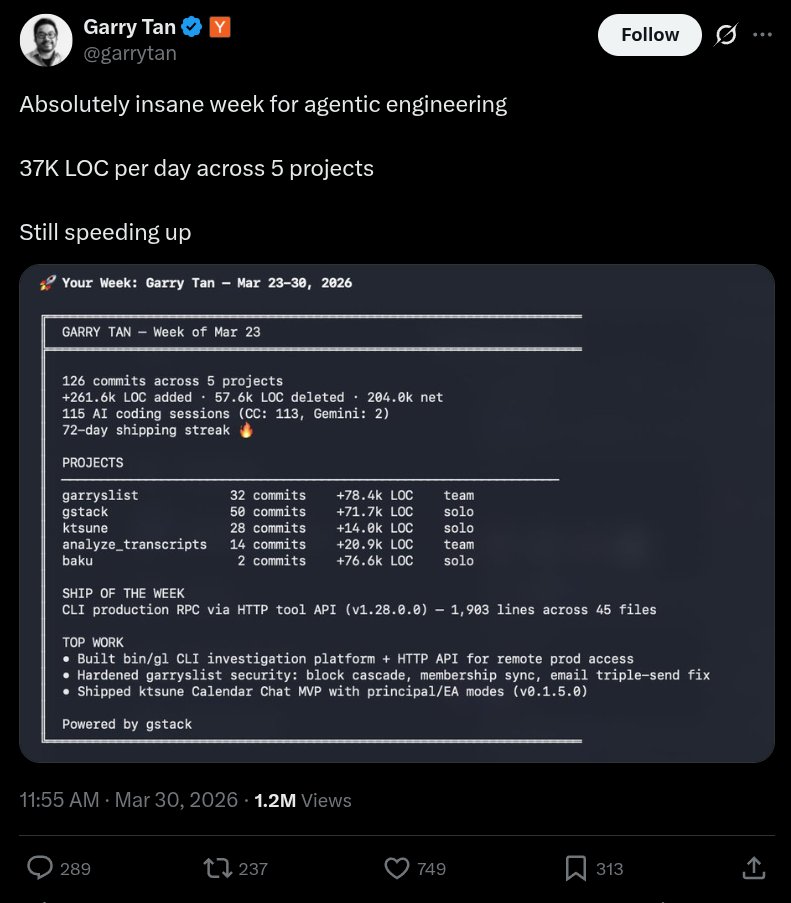
so... I audited Garry's website after he bragged about 37K LOC/day and a 72-day shipping streak.
here's what 78,400 lines of AI slop code actually looks like in production.
a single homepage load of https://t.co/TqaEZsF44N downloads 6.42 MB across 169 requests.
for a newsletter-blog-thingy.
1/9🧵
Prof. Donald Knuth opened his new paper with "Shock! Shock!"
Claude Opus 4.6 had just solved an open problem he'd been working on for weeks — a graph decomposition conjecture from The Art of Computer Programming.
He named the paper "Claude's Cycles."
31 explorations. ~1 hour. Knuth read the output, wrote the formal proof, and closed with: "It seems I'll have to revise my opinions about generative AI one of these days."
The man who wrote the bible of computer science just said that. In a paper named after an AI.
Paper: https://t.co/juSOmK9vOt
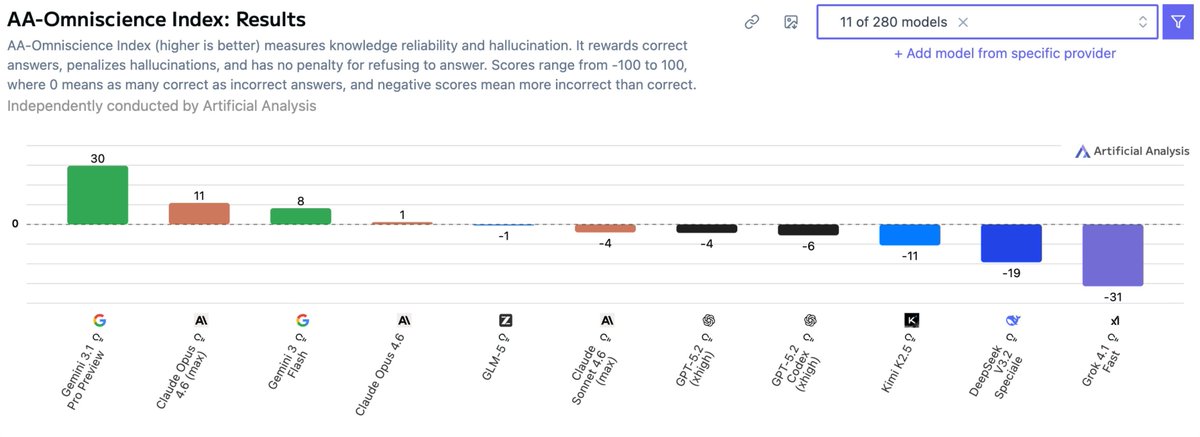
🚨 New Benchmark: I have to admit, this is a game-changer for me. TRUST ⬆️
While Opus 4.6 is the LLM of choice for Devs, and it appears Gemini 3.1 will not change that, this benchmark, AA-Omniscience Index from @ArtificialAnlys is a real game changer because it;
"...measures knowledge reliability and hallucination. It rewards correct answers, penalizes hallucinations, and has no penalty for refusing to answer. Scores range from -100 to 100, where 0 means as many correct as incorrect answers, and negative scores mean more incorrect than correct."
Bottom Line: Trust ⬆️
Prior to version 3.1, models like Gemini 3 Pro and Gemini 3 Flash had a major flaw. While they had the highest raw factual accuracy of any models, they also had abysmal hallucination rates (around 88% to 91% in tests used to elicit hallucinations). They were highly intelligent but refused to admit when they didn't know something.
Gemini 3.1's top score proves Google has successfully tuned the model's knowledge calibration, and it now successfully recognizes its own knowledge gaps and abstains rather than making things up.
In 1963, a little-known physicist and philosopher outlined a theory of the human mind that was decades ahead of its time, anticipating modern AI and neuroscience. One of his unpublished work starts like this:
He went on to develop a theory of everything, and yet, he kept a vast majority of his work unpublished.
When I read a sample of his work online, I felt like I was reading a prophecy of modern AI and the struggles of modern society.
@RichardSSutton@tdietterich Does that imply the scapegoating is not strong enough to change the system? Is it because taking those steps would make AI much less profitable? I am curious.
@fchollet That also doesn't't take into the long term effect. I can imagine the short term effect to become positive pretty soon but to have long term positive effects there will be lots of human efforts to design the right product for humans.
@VictorTaelin Without those proofs, the same set of people would still disapprove hard work to overcome the barriers. Math is just a convenient tool for them to make excuses for not trying harder. Impossibility proofs have guided the other set of people in how to better spend their efforts.
2/2 where it inherits enormous amounts of reasoning short cuts; it just eliminates the SFT step of post training.
Acknowledging this is important because large scale parallel pre-training is a critical reason why LLMs succeed, and also why they are limited.
1/2 While DeepSeek-R1-Zero is an amazing achievement, it is an overhype to consider it as AlphaZero for general reasoning, because AlphaZero was trained purely from self-play, while DeepSeek-R1-Zero was initiated from DeepSeek-V3-Base
@staysaasy@realGeorgeHotz No. Assuming p != np, factoring has been conjectured to one of the kind of problems that are harder than P but easier than NPC (hardest problems within NP). So if the rumor is true then factoring is not that kind of problem.