@zachtratar The plague of infostealer malware obtaining cookies and Google addressing the problem in @googlechrome began well before AI agents were a thing.
i think many are underestimating the size of the AI market by orders of magnitude because they still see AI as "person asks AI for help" rather than "AI is always working in the background and asks people when it needs help”
@rodriscoll SaaS isn't dead, just not as lucrative.
AI reduces the cost barrier significantly. That allows for more competition to enter the market and eat into profits.
Built clawsweeper, which runs 50 codex in parallel around the clock, scans issues/prs deep and closes what is already implemented or what makes no sense.
Closed around 4000 issues today, a few thousand are in the pipeline. (rate limits are rough) https://t.co/AiNNDcvGke
@dexhorthy But isn't that the start-up way? Build fast something that works, optimized later. Seems like @garrytan works exactly as one would expect in the start-up world.
@Tocelot@speedrun I started describing the future of mass adoption of consumer agents. But a lot of work still to be done to make it a reality.
https://t.co/Z8yvNKu1dt
a16z @speedrun request for startups: GUIs for Agents
we’re still in the MS-DOS era of agents today - CLI, terminal sessions, file directories deleted by openclaw etc. while a small slice of silicon valley are power users, we're SO early for the rest of the world
at Speedrun, we’re looking for bold founders excited to bring the power of agents to normies everywhere. there's a whole slew of products to be built here - from agent builders to marketplaces to managed infrastructure
one broad idea we’re excited about are visual abstraction layers for agents. if you don't know exactly what you want, a command line / chat interface is paralyzing - you need to see options
1 example - think of a GUI or visual command center inspired by strategy games (ex. Factorio) where agents and workflows are represented graphically. skills, tools, MCP connections, background processes, etc could all be configured and shown visually in a workspace
on UX, strategy games have long perfected agent management. zoom to get a birds-eye view of your agents, batch and queue orders via shortcuts, assign agents in multiplayer etc. a well-designed agent command center would make multi-agent orchestration for normies feel easy & intuitive
most folks today still haven't moved beyond ChatGPT. the potential is enormous - just as Windows unlocked mass-market use of personal computers, the right visual abstraction layer could unlock agentic work for everyone - from individuals to enterprise teams
if you share our vision, we'd love to chat!
My tweet last week about Google's AI adoption drew a lot of pushback, to say the least.
Since then, Googlers from multiple orgs have reached out to me independently and anonymously. They've expressed fear of being doxxed, concern about what they saw as bullying of me, and general corroboration of my original tweet. I haven't verified each person's story, but the picture these Googlers paint is consistent across sources. It is more specific than what I originally wrote, and somewhat bleaker.
What they describe is a two-tier system. DeepMind engineers use Claude as a daily tool. Most of the rest of Google does not. When the question of equalizing access came up internally, the proposed response was to remove Claude for everyone — which DeepMind objected to so strongly that several engineers reportedly threatened to leave.
Non-DeepMind engineers get pushed onto internal Gemini variants behind router-style names that obscure which underlying model is actually serving a request. Multiple engineers describe regressions and reliability problems severe enough that some senior people have stopped using the tools. A senior manager on a major product line reportedly flagged attrition concerns over exactly this issue.
Googlers say leadership knows the gap is real. The response has been to mandate AI usage in OKRs and individual expectations, and to stand up an internal token-usage leaderboard. Unfortunately, managers have been told both that the leaderboard won't be used for performance reviews and, separately, that it absolutely will. And I hear other stories that Google's culture is not adapted properly yet for high-volume coding.
Addy Osmani's reply on behalf of Google said over 40,000 SWEs use agentic coding weekly. I don't doubt the number. But weekly use of a thin tool is precisely the box-checking I described in the original post. Volume of opens isn't adoption — and "weekly" is a low bar that includes a lot of people who tried it once and went back to writing code by hand.
The clearest thing I'm hearing is that Googlers do want to use high-quality agentic tools. They are asking repeatedly for better ones. But overall, this is not a picture of an engineering org that is fine.
My goal in the first tweet, and now, is always the same — get more people using AI and agentic coding. Nobody is as far ahead as they might look from the outside, and none of you are as far behind as you might be worried you are.
To all the Googlers who've reached out: thank you. You took a real risk and I appreciate you. Be safe. And good luck getting good models!
The gap between "AI chatbot" and "AI agent" is the gap between a search engine and a smartphone. One answers questions. The other restructures your entire life.
You keep hearing AI will change everything. So far you've used it to rewrite emails and summarize articles. That's not the revolution. The revolution is the Ubiquitous, ambient AI agent. and it's not a decade away.
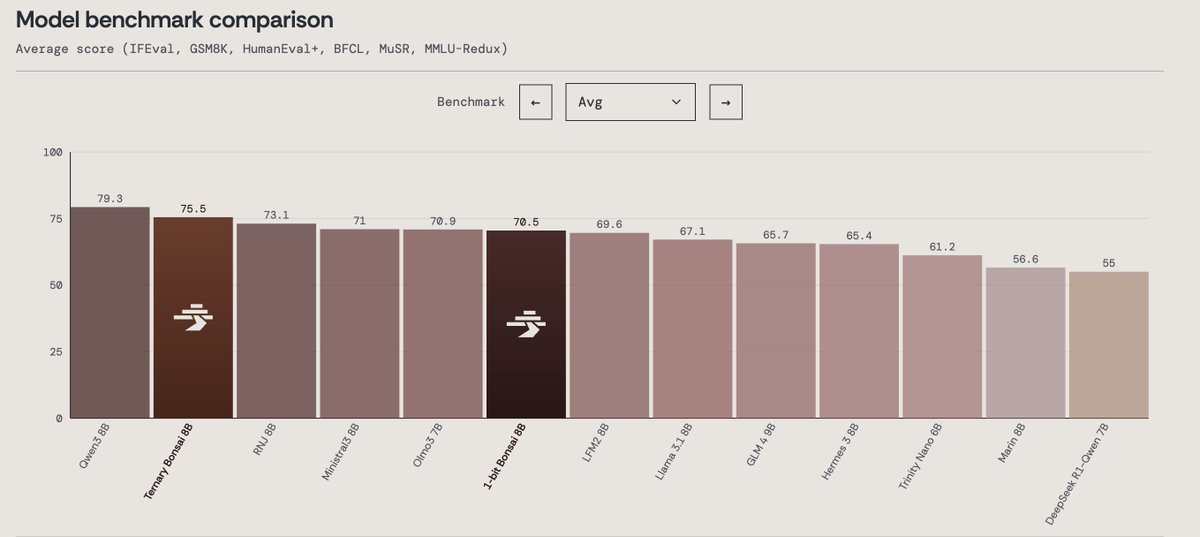
Today we’re announcing Ternary Bonsai: Top intelligence at 1.58 bits
Using ternary weights {-1, 0, +1}, we built a family of models that are 9x smaller than their 16-bit counterparts while outperforming most models in their respective parameter classes on standard benchmarks.
We’re open-sourcing the models under the Apache 2.0 license in three sizes: 8B (1.75 GB), 4B (0.86 GB), and 1.7B (0.37 GB).
@Russwarne Yes, you can get an LM to say just about anything. But the real gain with AI is creating a reviewer agent that has the rigor, standards, and skills to provide quality feedback and catch bad research at scale.
Judging by my tl there is a growing gap in understanding of AI capability.
The first issue I think is around recency and tier of use. I think a lot of people tried the free tier of ChatGPT somewhere last year and allowed it to inform their views on AI a little too much. This is a group of reactions laughing at various quirks of the models, hallucinations, etc. Yes I also saw the viral videos of OpenAI's Advanced Voice mode fumbling simple queries like "should I drive or walk to the carwash". The thing is that these free and old/deprecated models don't reflect the capability in the latest round of state of the art agentic models of this year, especially OpenAI Codex and Claude Code.
But that brings me to the second issue. Even if people paid $200/month to use the state of the art models, a lot of the capabilities are relatively "peaky" in highly technical areas. Typical queries around search, writing, advice, etc. are *not* the domain that has made the most noticeable and dramatic strides in capability. Partly, this is due to the technical details of reinforcement learning and its use of verifiable rewards. But partly, it's also because these use cases are not sufficiently prioritized by the companies in their hillclimbing because they don't lead to as much $$$ value. The goldmines are elsewhere, and the focus comes along.
So that brings me to the second group of people, who *both* 1) pay for and use the state of the art frontier agentic models (OpenAI Codex / Claude Code) and 2) do so professionally in technical domains like programming, math and research. This group of people is subject to the highest amount of "AI Psychosis" because the recent improvements in these domains as of this year have been nothing short of staggering. When you hand a computer terminal to one of these models, you can now watch them melt programming problems that you'd normally expect to take days/weeks of work. It's this second group of people that assigns a much greater gravity to the capabilities, their slope, and various cyber-related repercussions.
TLDR the people in these two groups are speaking past each other. It really is simultaneously the case that OpenAI's free and I think slightly orphaned (?) "Advanced Voice Mode" will fumble the dumbest questions in your Instagram's reels and *at the same time*, OpenAI's highest-tier and paid Codex model will go off for 1 hour to coherently restructure an entire code base, or find and exploit vulnerabilities in computer systems. This part really works and has made dramatic strides because 2 properties: 1) these domains offer explicit reward functions that are verifiable meaning they are easily amenable to reinforcement learning training (e.g. unit tests passed yes or no, in contrast to writing, which is much harder to explicitly judge), but also 2) they are a lot more valuable in b2b settings, meaning that the biggest fraction of the team is focused on improving them. So here we are.