Relevant Swings & Mechanical Failure Swing Rule
When identifying relevant swings, focus on the extremes of price on the daily chart. Lower timeframes often add unnecessary detail for intraday trade development, while daily bias should remain fluid as new market information emerges.
A failure swing occurs when price makes a deep retracement into a previous daily higher low without taking out its extreme. These deep runs are filtered out so you can identify the price extremes that truly matter.
Mechanical identification using the 0.8 Fibonacci level:
Mark the full high-to-low range of the daily candle.
Apply the Fibonacci tool to identify the 0.8 level.
If price penetrates the 0.8 level without breaking the candle's extreme, classify it as a mechanical failure swing.
Filter out these failure swings and continue looking left until you find the true extreme.
Key principle: Relevant swings can form at both daily highs and lows. Not every relevant swing requires a preceding failure swing. The goal is to separate deep runs into previous levels from the extremes that genuinely matter for your market analysis.
A reversal doesn’t always need to form on your execution timeframe.
A 4H reversal can be confirmed by a 1H or 30M two-stage structure, while a strength switch may be confirmed on the 15M.
Learn to read the internal structure of HTF candles. That’s where the real edge is.
A structured execution model:
Step 1: Identify a higher-timeframe reversal or continuation objective.
Step 2: Look for SMT or PSP at the relevant price level.
Step 3: For reversals, require the appropriate two-stage confirmation.
Step 4: For continuations, evaluate the relevant FVG and one-stage correlation.
Step 5: Move to the lower timeframe.
Step 6: Wait for a change in the state of delivery (CSD).
Step 7: Define your invalidation and target the relevant liquidity.
Every component has a purpose.
A strong trading model combines multiple layers of confirmation:
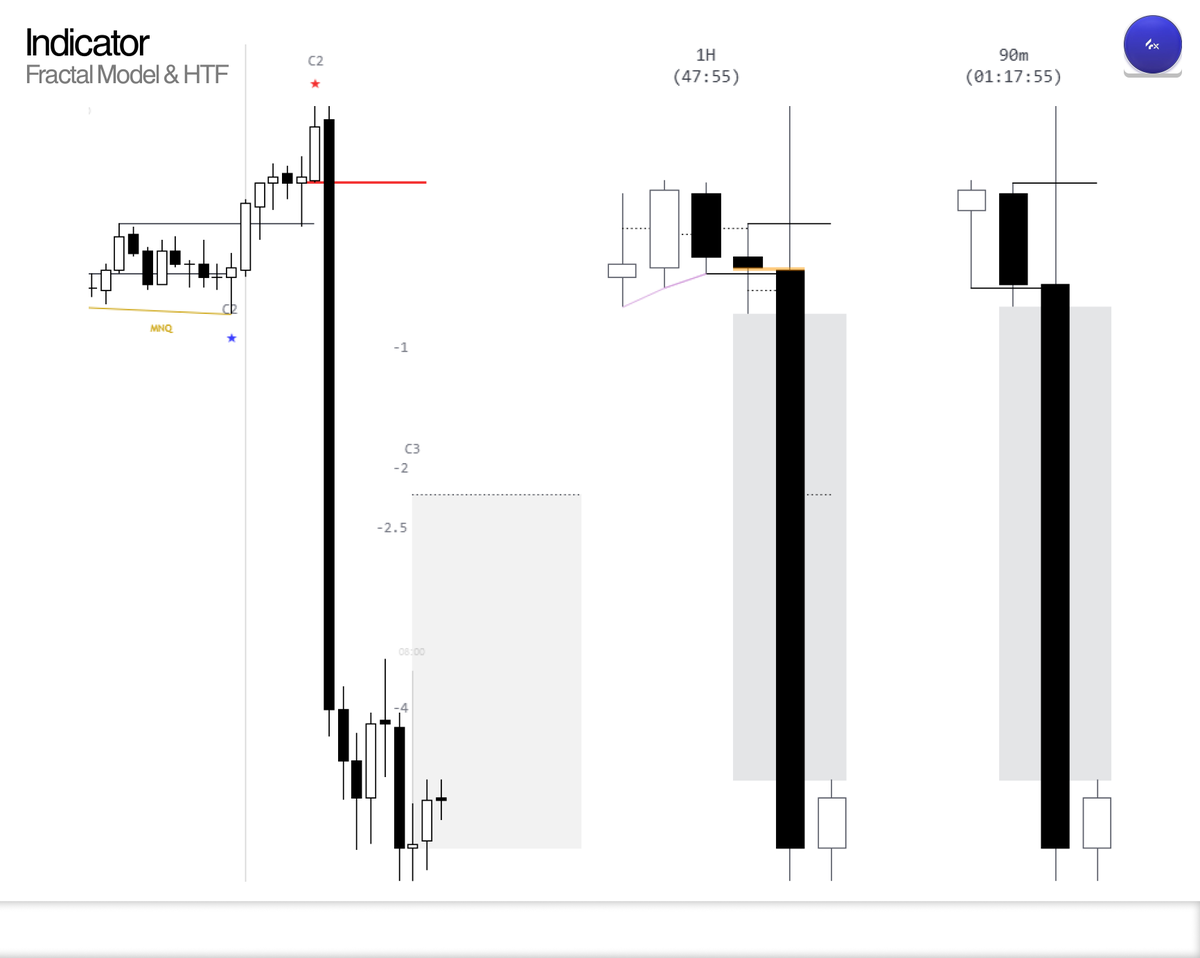
• Daily C2 → Trade the Daily C3.
• 4H C2 → Trade the 4H C3.
• Timeframe alignment → A 4H C3 opening into a 1H C2 creates a continuous sequence.
• Two-stage SMT → Identify relative weakness and strength between correlated indices.
• FVG + Equal Highs/Lows → Gaps near opposing liquidity are more likely to hold during retracements.
• NDOG → Use New Day Opening Gaps as additional confluence.
• Close-proximity liquidity → Target nearby liquidity instead of expecting unrealistic expansions.
The key: Understand the relationship between price, time, liquidity, and relative strength.
When markets are decoupled, reduce your expectations. You don't need a massive expansion to make a good trade.
Sometimes, taking 1.5R from a well-defined setup is better than holding for 3R and giving everything back.