$QS for people who are asking why the terms changed with VW, apparently VW is getting squeezed out in the market and they are cutting 100,000 jobs.. so them staying with $QS even under different terms of payment is actually a vote of confidence!
This CNBC debate stopped trading on the NYSE floor for 23 minutes
Brad Katsuyama looked at the president of BATS exchange and said "I believe the markets are rigged, and I also think you're part of the rigging"
Bookmark & watch it. It will change your understanding of trading forever
Some would say @DanBilzerian was living the perfect life. Cars, Money, Jets, Women, Mansions you name it! Dan has now been so called to action by the corruption, empty promises & genuine evil people in our government that he is running for Congress HIMSELF!
Support Dan here 👉🏼 @ElectBilzerian
In the 1920s, a Stanford psychologist tracked genius children for 50 years.
Malcolm Gladwell breaks down what he discovered:
Rich families → successful. Poor families → failures.
Not average. Failures. Genius-level IQs that produced nothing.
He spent 60 minutes at Microsoft explaining why we're wrong about success:
The psychologist was named Terman. He gave IQ tests to 250,000 California schoolchildren.
He identified the top 0.1%. Kids with IQs of 140 and above.
His hypothesis: these children would become the leaders of academia, industry, and politics.
He tracked them. And tracked them. For decades.
The results split into three groups.
The top 15% achieved real prominence. The middle group had average, moderately successful professional lives.
And the bottom group? By any measure, failures.
The difference wasn't personality. Wasn't habits. Wasn't work ethic.
It was simple: the successful geniuses came from wealthy households. The failures came from poor families.
Poverty is such a powerful constraint that it can reduce a one-in-a-billion brain to a lifetime of worse than mediocrity.
There's a concept called "capitalization rate."
It asks a simple question: what percentage of people who are capable of doing something actually end up doing that thing?
In inner city Memphis, only 1 in 6 kids with athletic scholarships actually go to college.
If our capitalization rate for sports in the inner city is 16%, imagine how low it must be for everything else.
Here's something stranger.
Gladwell read the birth dates of the 2007 Czech Junior Hockey Team:
January 3rd. January 3rd. January 12th. February 8th. February 10th. February 17th. February 20th. February 24th. March 5th. March 10th. March 26th...
11 of the 20 players were born in January, February, or March.
This isn't unique to the Czechs. Every elite hockey team in the world shows the same pattern. Every elite soccer team too.
Why?
The eligibility cutoff for youth leagues is January 1st.
When you're 10 years old, a kid born in January has 10 months of maturity on a kid born in October. That's 3 or 4 inches of height. The difference between clumsy and coordinated.
So we look at a group of 10 year olds, pick the "best" ones, give them special coaching, extra practice, more games.
We think we're identifying talent. We're just identifying the oldest.
Then we give the oldest more opportunities, and 10 years later they really are the best.
Self-fulfilling prophecy.
The capitalization rate for hockey talent born in the second half of the year? Close to zero.
We're leaving half of all potential hockey players on the table because of an arbitrary date on a calendar.
Kids born in the youngest cohort of their school class are 11% less likely to go to college.
11% of human potential squandered because we organize elementary school without reference to biological maturity.
Now here's the part about math.
Asian kids dramatically outperform Western kids in mathematics. The gap is enormous and consistent across decades of testing.
Some people say it's genetic. It's not.
It's attitudinal.
When Asian kids face a math problem, they believe effort will solve it.
When Western kids face a math problem, they believe the answer depends on innate ability they either have or don't.
Here's the proof.
The international math tests include a 120-question survey. It asks about study habits, parental support, attitudes.
It's so long most kids don't finish it.
A researcher named Erling Boe decided to rank countries by what percentage of survey questions their kids completed.
Then he compared it to the ranking of countries by math performance.
The correlation was 0.98.
In the history of social science, there has never been a correlation that high.
If you want to know how good a country is at math, you don't need to ask any math questions. Just make kids sit down and focus on a task for an extended period of time.
If they can do it, they're good at math.
Why do Asian cultures have this attitude?
Gladwell's theory: rice farming.
His European ancestors in medieval England worked about 1,000 hours a year. Dawn to noon, five days a week. Winters off. Lots of holidays.
A peasant in South China or Japan in the same period worked 3,000 hours a year.
Rice farming isn't just harder than wheat farming. It's a completely different relationship with work.
There's a Chinese proverb: "A man who works dawn to dusk 360 days a year will not go hungry."
His English ancestors would have said: "A man who works 175 days a year, dawn to 11, may or may not be hungry."
If your culture does that for a thousand years, it becomes part of your makeup.
When your kids sit down to face a calculus problem, that legacy of persistence translates perfectly.
Now consider distance running.
In Kenya, there are roughly a million schoolboys between 10 and 17 running 10 to 12 miles a day.
In the United States, that number is probably 5,000.
Our capitalization rate for distance running is less than 1%.
Kenya's is probably 95%.
The difference isn't genetic. The difference is what the culture values and where it spends its attention.
Here's the most fascinating finding.
30% of American entrepreneurs have been diagnosed with a profound learning disability.
Richard Branson is dyslexic. Charles Schwab is dyslexic. John Chambers can barely read his own email.
This isn't coincidence. Their entrepreneurialism is a direct function of their disability.
How do you succeed if you can't read or write from early childhood?
You learn to delegate. You become a great oral communicator. You become a problem solver because your entire life is one big problem. You learn to lead.
80% of dyslexic entrepreneurs were captain of a high school sports team. Versus 30% of non-dyslexic entrepreneurs.
By the time they enter the real world, they've spent their whole life practicing the four skills at the core of entrepreneurial success: delegation, oral communication, problem solving, and leadership.
Ask them what role dyslexia played in their success and they don't say it was an obstacle.
They say it's the reason they succeeded.
A disadvantage that became an advantage.
Here's what Gladwell wants you to understand:
When we see differences in success, our default explanation is differences in ability.
We forget how much poverty, stupidity, and attitude constrain what people can become.
We refuse to admit that our own arbitrary rules are leaving talent on the table.
We cling to naive beliefs that our meritocracies are fair.
The capitalization argument is liberating.
It says you don't look at a struggling group and conclude they're incapable. It says problems that look genetic or innate are often just failures of exploitation.
It says we can make a profound difference in how well people turn out.
If we choose to pay attention.
This 60 minute Microsoft talk will teach you more about success than every self-help book you've ever read combined.
Bookmark this & give it an hour today, no matter what.
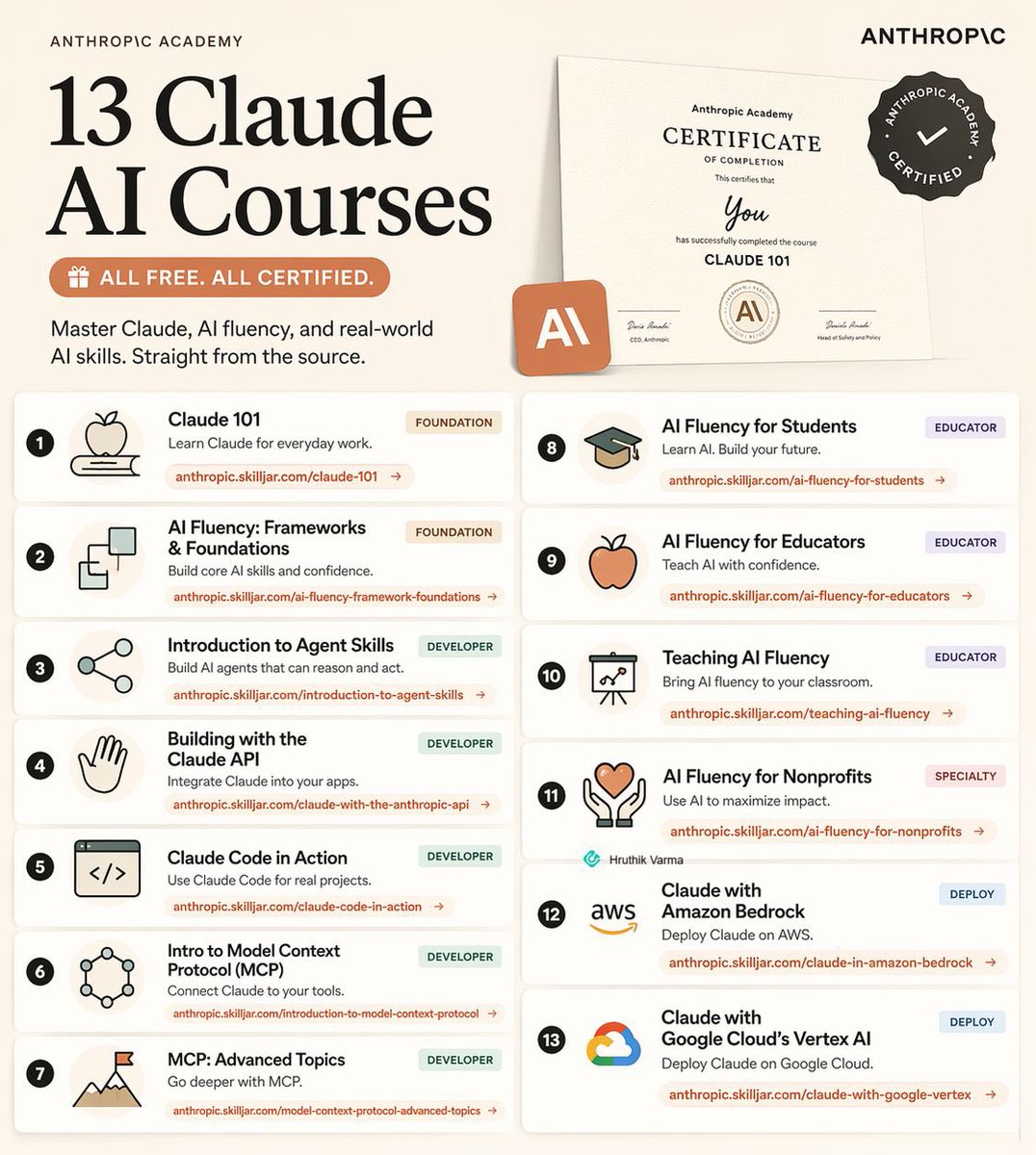
Claude just dropped 13 FREE AI courses (with certificates).
No $500 course needed.
No “guru” required.
Just real skills — straight from Anthropic.
Here’s the full list:
👇
1. Claude 101
https://t.co/lZpcdJ8BuX
2. AI Fluency: Frameworks & Foundations
https://t.co/USAV0Nq5U4
3. Introduction to Agent Skills
https://t.co/CwjLvjOnUi
4. Building with the Claude API
https://t.co/oquWGU6n0U
5. Claude Code in Action
https://t.co/r2r1GMiBaM
6. Introduction to Model Context Protocol
https://t.co/H74a7UKZoe
7. MCP: Advanced Topics
https://t.co/FGzNDboBUz
8. AI Fluency for Students
https://t.co/PKcYBT0hsx
9. AI Fluency for Educators
https://t.co/FwmI4bJ8sO
10. Teaching AI Fluency
https://t.co/IFGt8EQcvP
11. AI Fluency for Nonprofits
https://t.co/pZayqeTEdC
12. Claude with Amazon Bedrock
https://t.co/I9fpriI24s
13. Claude with Google Vertex AI
https://t.co/Kvz4uJqctq
—
If you go through even HALF of these…
You’ll be ahead of 95% of people using AI.
Most people won’t.
Because they’re still:
• Watching random YouTube videos
• Buying overpriced courses
• “Learning AI” without actually building
Don’t be that person.
Do this instead:
1. Save this post (you’ll come back to it)
2. Pick 1 course → start today
3. Share it with someone who needs this
Free. Practical. No excuses.
Instead of watching a 2 hour movie, watch this 1 hour MIT lecture by Jim Simons.
It’s basically Kasparov-level strategy applied to markets.
The Quant King reveals more than most Wall Street players learn in an entire career.
INSTEAD OF WATCHING NETFLIX TONIGHT.
Spend 1 hour with this.
Claude AI FULL COURSE that teaches you how to BUILD and AUTOMATE anything.
The people who watch this tonight will wake up tomorrow with a new skill.
Watch it and Bookmark it now.
this 1 hour MIT lecture on "option price & probability duality" will teach you more about options trading than a 2 month internship at Wall Street hedge fund
Bookmark & give it 1 hour, no matter what. It'll be the most productive thing you do this weekend.
This 16-min lecture on "Black Scholes model" by Nassim Taleb will tell you more about quant trading than a 2 month internship at Goldman Sachs or JPMorgan.
Bookmark it & watch today,no matter what. It’s the most productive way to start your week. Then read article below.
This 1 hour Yale lecture will teach you more about options trading & the exact models Hedge Funds use than most people learn in their entire careers on Wall Street.
Bookmark this & watch, no matter what. It’ll be the most productive start for your week. Then read article below.
This 1 hour interview with the mathematician who outperformed Buffett, Soros, and Dalio, generated $100B+, avg. 66% returns will teach you more about investing than a $200K MBA.
Bookmark this & give it 1 hour, no matter what. It’ll be the most productive thing you do this week.
Instead of watching an hour of Netflix, watch this 2-hour Stanford lecture on AI careers. It will teach you more about winning in the AI race than all the AI content you’ve scrolled past this year.