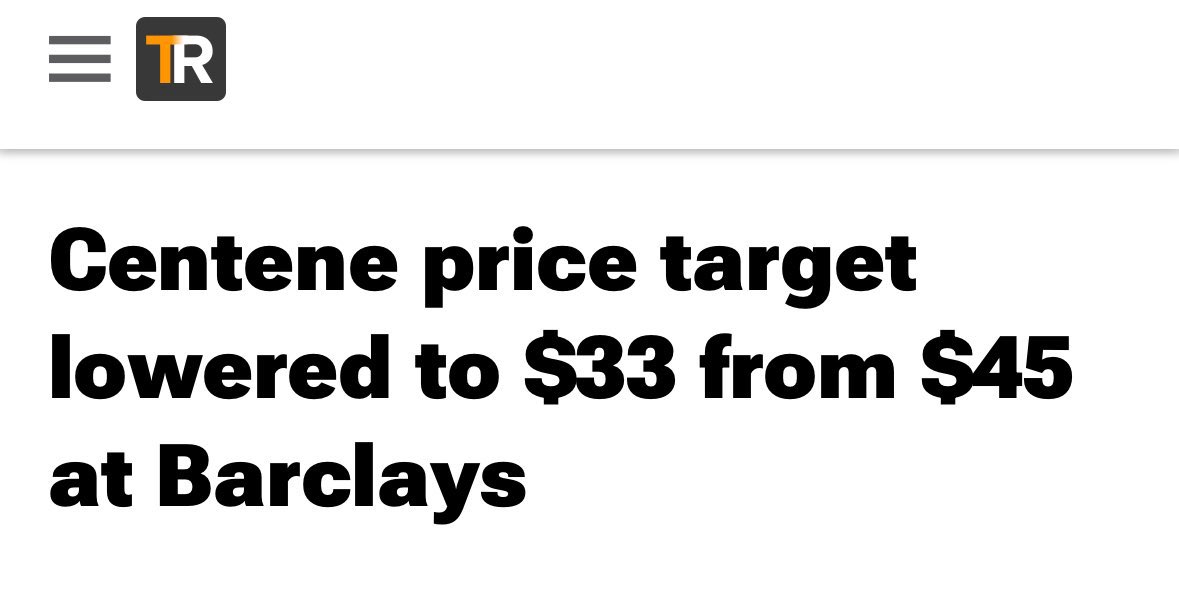
I flagged $CNC at $25. It's ~$70 now.
Mr. Market hates low-margin businesses so much it forgets margins can go up.
$CNC: 0.07x P/S then.
$DFH: ~0.11x P/S pro forma now.
Homebuilders do ~10% margins.
Same alarm 🚨. New opportunity
THE STRATEGY
Most people screen on P/E. But P/E breaks right when things get interesting: earnings dip, the multiple looks scary, everyone runs. And I’m there to pick up the scraps.
P/S is steadier. And the math is simple:
P/E = P/S • profit margin
So find a profitable company in a thin-margin industry where P/S has gone absurd. Then ask one question: what happens if margins just go back to normal?
$CNC
At $25, Centene traded at 0.07x sales. Seven cents for every dollar of revenue.
At a 1% margin, that's ~7x earnings. Cheap, but fine.
At 2–3%, which is normal for them, that's 2–3x earnings. Absurd.
The market priced it like margins would never recover. They didn't need to recover much.
$DFH
At $7.50, Dream Finders traded at ~0.165x sales standalone, ~0.11x pro forma with Beazer.
This one is cheaper than CNC looked. Insurers live on 2–3% margins. Homebuilders live closer to 10%. Even at half that, you're paying ~2x earnings.
And scale only helps. DFH runs a land-light model, so it doesn't sit on piles of expensive dirt. Add Beazer and you get more communities, more buying power, and less overhead per home.
WHAT COULD GO WRONG
Housing could slow further. Rates could stay high. The merger could get messy. All real. But at this price, the market already assumes the worst.
THE PATTERN
Low margins scare people off. And I love hated businesses. That's my whole edge. When a business earns 2% and trades like it earns 0%, I don't need a miracle. I need normal.
Long $DFH. Not advice.
Another big buying opportunity for $CNC — maybe one of the last before October SERFF approvals. don’t miss it.
Centene has pledged to reprice 100% of its Medicaid contracts, and we’ll know about final pricing and approvals around September-October — no later than November 1, 2025 Open Enrollment.
I see $CNC at $40 sooner than expected and probably even $50 within 1 year from now.
PS: “analysts” don’t exist for your benefit, remember that
More quick notes on $INTR
⭐️ 6x PE. Trades at 1/3rd the multiple of $NU with similar growth
🔥 ROE about = cost of equity but growing rapidly.
😌 0.85 book, maybe 1.1-1.2 tangible book
⭐️ 13 straight quarters of profit growth
🫨 Lula panic is overdone. Dropped 36% in one day. 20% discount to pre election Bolsonaro spike
✅ just completed forced BDR sale, $12m shares. Some additional selling pressure gone.
Risks
👎🏻 non performing loans: hovering at 5% and rising. A jump towards 6% is something to watch.
🤕 Lula said on a podcast he wants to cap credit cards. Unlikely but would hurt badly.
🫨 BRL currency risk (although significant risk already priced in)
🙅🏻♂️ Selic (Brazil rates) risk
New position. $INTR, a Brazilian bank. I feel good about this one. This one looks like a fat pitch.
How does a bank make money?
They borrow money from customers (deposits), pay some yield, then loan that money out at a higher yield. The difference (plus whatever other fees they charge) minus expenses is their profit. This concept of yield received minus yield paid out is called net interest margin. Their cushion is their own money (injected from owners, investors, profits, etc, not deposits), aka their equity. This concept of borrowing money with some capital base (your equity) is inherently the same thing as leverage.
How to value a bank?
Return on equity. Aka for every dollar an owner/investor puts in, what is their total return? It needs to be higher than the opportunity cost, aka the cost of equity. So simply,
ROE > cost of equity
Must be true.
Whats important is not just that a bank is growing, but that the money actually put in is growing at a faster rate than it could be growing elsewhere. Example, if a bank is growing 10% YoY, that’s great, but if interest rates are 13%, that means I could be getting paid 13% in a much safer place (the government). This is exactly the case in Brazil.
When ROE = cost of equity, valuing at book is fair. But if ROE is rapidly growing, is it still fair?
$INTR traded far above book for a long time. Now it’s about book value. But its ROE has grown massively over time. In about 6 years it’s gone from near 0% ROE to 16%. Soon, it will grow past cost of equity. Their stated goal is 25-30% long term.
If they pull it off, this thing will be worth a lot more than today. Sentiment is poor right now allowing you to scoop such a high potential opportunity at this price.
Nou kenbe pwomès nou…
Nou detwi kay Lanmò San Jou ak katye jeneral gang 400 Mawozo a.
Pifò ladan yo kouri ale san yo pa menm eseye goumen.
Ala lach yo lach! 🥲
PE LBO doesn't work for a company already $100B in debt. $CMCSA is cheaper on FCF and less levered. And, there's an even cheaper buy in Comcast spinoff, $VSNT , with actual capital return to shareholders.
$CHTR is going to have one hell of a 2027.
"The explosion of free cash flow that's about to take place as capex steps down."
That's the easiest layup possible. Complete control over it.
A PE firm is going to take CHTR private I bet. It's a layup.
Buy more hated businesses!
$DFH today was a great case study that buying a good business when literally EVERYTHING has gone wrong for them (trading below book, Iran, rates, doubts on Beazer deal and leverage, Hunterbrook short report) is a GREAT time to load up. At some point, when every possible negative sentiment has came through, there’s not a lot left to drag it down. And often times it slingshots back to normalcy …
It happened when the low cost medical insurers hit rock bottom last year ($CNC ) too. I wonder what the next one will be.
I like Brazil right now 🤔
Sometimes I think I should get a Tesla for full self driving
but then I remember I wouldn’t get the exhilarating feeling of being on the verge of death every time I eat and drive