Today, we share a breakthrough on the planar unit distance problem, a famous open question first posed by Paul Erdős in 1946.
For nearly 80 years, mathematicians believed the best possible solutions looked roughly like square grids.
An OpenAI model has now disproved that belief, discovering an entirely new family of constructions that performs better.
This marks the first time AI has autonomously solved a prominent open problem central to a field of mathematics.
At just 18, Ewin Tang (now at UC Berkeley) developed a groundbreaking classical algorithm for recommendation systems (the "Netflix problem") that matched the performance of a leading quantum algorithm; challenging assumptions about quantum advantage and sparking the field of quantum-inspired classical algorithms.
Her recent work continues to bridge classical & quantum computing: dequantizing ML/linear algebra algorithms and advancing quantum machine learning on quantum data. In 2025, she became the youngest winner of the Maryam Mirzakhani New Frontiers Prize; a powerful inspiration for emerging young minds in STEM!
so …. what cities are you losing your minds in ? 0.0 tickets are on sale now !!!!!!
i don’t know where to begin . this entire week has been a pinch me moment … we’ve been upgrading venues for my first independent tour and you’ve been selling them out .
so …. what cities are you losing your minds in ? 0.0 tickets are on sale now !!!!!!
i don’t know where to begin . this entire week has been a pinch me moment … we’ve been upgrading venues for my first independent tour and you’ve been selling them out .
In medical school, we are taught a golden rule: "When you hear hoofbeats, think horses, not zebras." It is a reminder to look for the common explanation before the exotic one. But after decades in cardiology, I’ve learned that if a patient is still suffering after the "horses" have been ruled out, a doctor must have the courage—and the curiosity—to go hunting for the zebra.
Sarah was a thirty-four-year-old marathon runner and a devoted mother who came to me after six months of being told she was "fine." She had been bounced from one specialist to another, each one pointing to her normal EKG and standard blood tests as proof that her crushing fatigue and racing heart were simply the result of "new mom stress." By the time she reached my office, she didn't just look tired; she looked invisible, as if the medical system had stopped seeing the woman and only saw the data.
Instead of re-reading the normal test results that had already failed her, I asked Sarah to walk me through her life. We talked about her training and her family, eventually landing on a backpacking trip she took to the Mendoza province of rural Argentina. She described staying in a charming, rustic cottage made of sun-dried mud bricks. She mentioned waking up one morning with a strangely swollen, purple eyelid that she assumed was a simple spider bite.
As she spoke, a memory surfaced from a biography I had read years ago about Charles Darwin. Most people know Darwin for his theories on evolution, but medical historians have long puzzled over the mysterious, debilitating illness that plagued him for decades after he returned from his voyage on the HMS Beagle. Darwin had written in his journals about being bitten by the "great black bug of the Pampas" while sleeping in mud-walled huts in South America. He spent the rest of his life suffering from heart palpitations and exhaustion that the Victorian doctors of his time could never explain.
I realized then that Sarah wasn't suffering from stress; she was likely hosting the same "silent killer" that may have haunted Darwin: Chagas Disease.
The "Kissing Bug" lives in the cracks of those mud-brick walls. It bites its victims—often near the eyes or mouth—while they sleep, passing a parasite called Trypanosoma cruzi into the blood. The danger of Chagas is that the initial symptoms disappear quickly, but the parasite can hide in the body for years, slowly weaving itself into the muscle and electrical "wiring" of the heart.
To confirm this, I moved beyond the standard tests. I ordered a specialized "Strain Rate" ultrasound, which doesn't just look at whether the heart is pumping, but at how the individual muscle fibers are stretching. We saw that while her heart looked strong to the naked eye, the fibers were "stuttering," a sign of early parasite-induced scarring. A specific blood test for the parasite's antibodies confirmed the diagnosis.
Treatment required a difficult, sixty-day course of anti-parasitic medication to stop the infection, paired with a protective heart regimen to keep her electrical system stable while the inflammation settled. Because we caught it before her heart was physically damaged or enlarged, the recovery was a success.
Months later, Sarah returned to my office, her vibrant energy restored. She brought me a leather-bound copy of The Voyage of the Beagle with a note tucked inside. She wrote that while other doctors had looked at her charts, I had looked at her. This case remains a vital reminder for my memoir: in a world of high-tech scans and AI, the most sophisticated diagnostic tool we possess is still the human story. When we truly listen, we don't just find the disease—we find the patient.
Good morning.
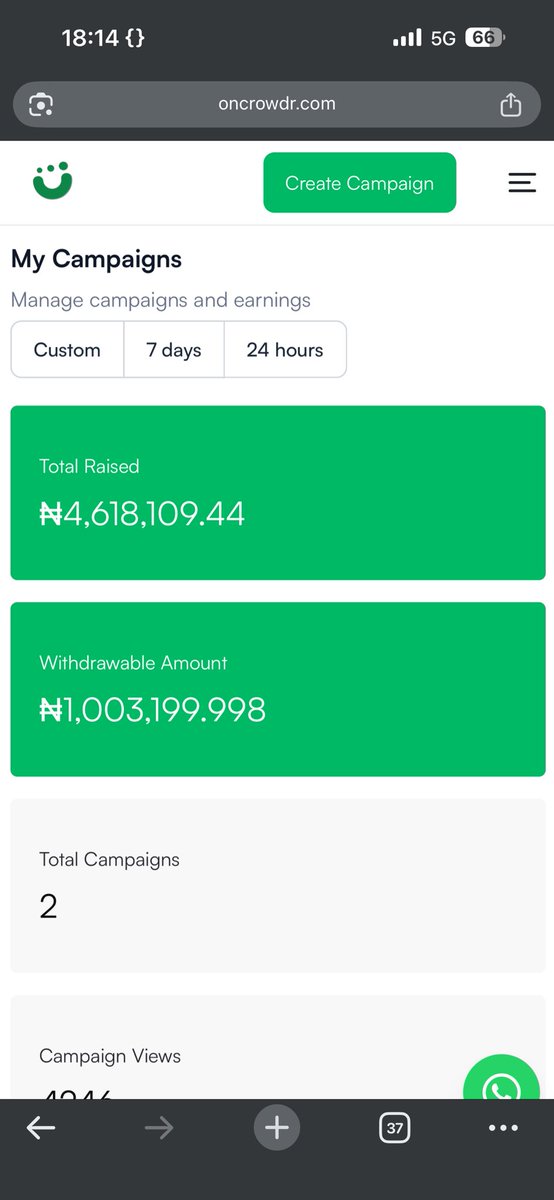
WE’VE RAISED 16M! #SaveTinaFromCancer
Tears in my eyes as I type this, I came out with fear and it was my last resort and only thing in my mind was to save my mum, but I couldn’t do with out you guys, my family, friends, tweeps who help rt and even donate, May the Lord bless you all abundantly!
Special thanks to 2nd Corinthians 8-Charitable Foundation who gave in 7M! Thank you so much everyone!
Below are all receipts from all money gathered from Naira to dollar and amount spent and what’s left.
Total
Naira: N16,118,695
Dollar: $621
I need your help urgently.
One of my team members, Douye Tungbulu @TunzDev, is going through every family’s worst nightmare.
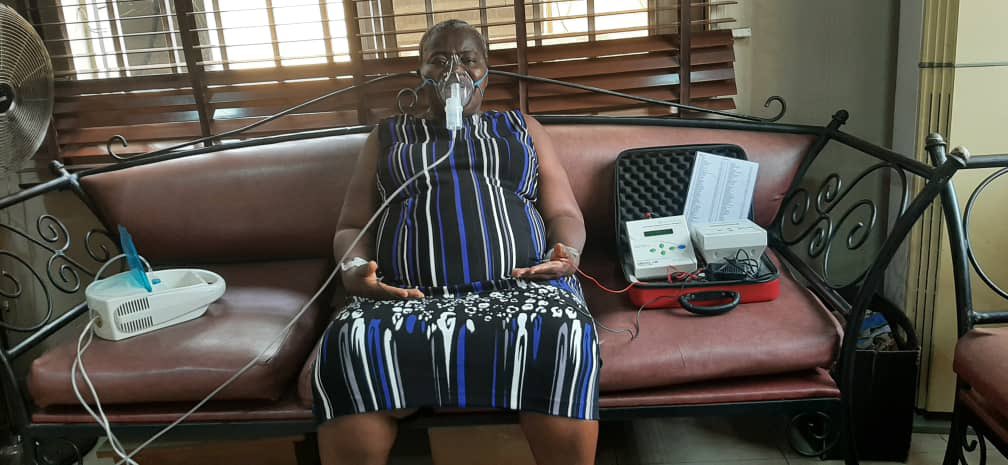
His mother, Tina, is battling stage 4 ovarian cancer. Three days ago, Douye asked for time off, and when I asked why, he told me she was in the hospital fighting for her life.
The medical bills are crushing ₦16 million total for her treatment. They’ve already spent ₦1.1 million out of pocket, and yesterday another ₦3.6 million was paid to begin her clinical procedures and first month of treatment. That’s ₦4.7 million down, but there’s still ₦11.3 million to go.
Douye is one of the hardest working, very dedicated to work. He shows up every day, delivers excellent work, and never complains. Now he’s watching his mother fight for her life while scrambling to keep her treatment going.
If you can donate ₦500, ₦1,000, ₦5,000, anything at all, please do 🙏🏽.
If you can’t, please share and retweet this. Time is not on our side.
DONATE HERE:
🔗 https://t.co/reXMP5nOrM
🔗 https://t.co/yRqT6EBTBn
OR DIRECT TRANSFER:
Bank: Palmpay
Account: 8075620197
Name: Douye Paul Tungbulu
Let’s rally around this family. Let’s help save Tina. #SaveTinaFromCancer
@Wizarab10@aproko_doctor@the_beardedsina
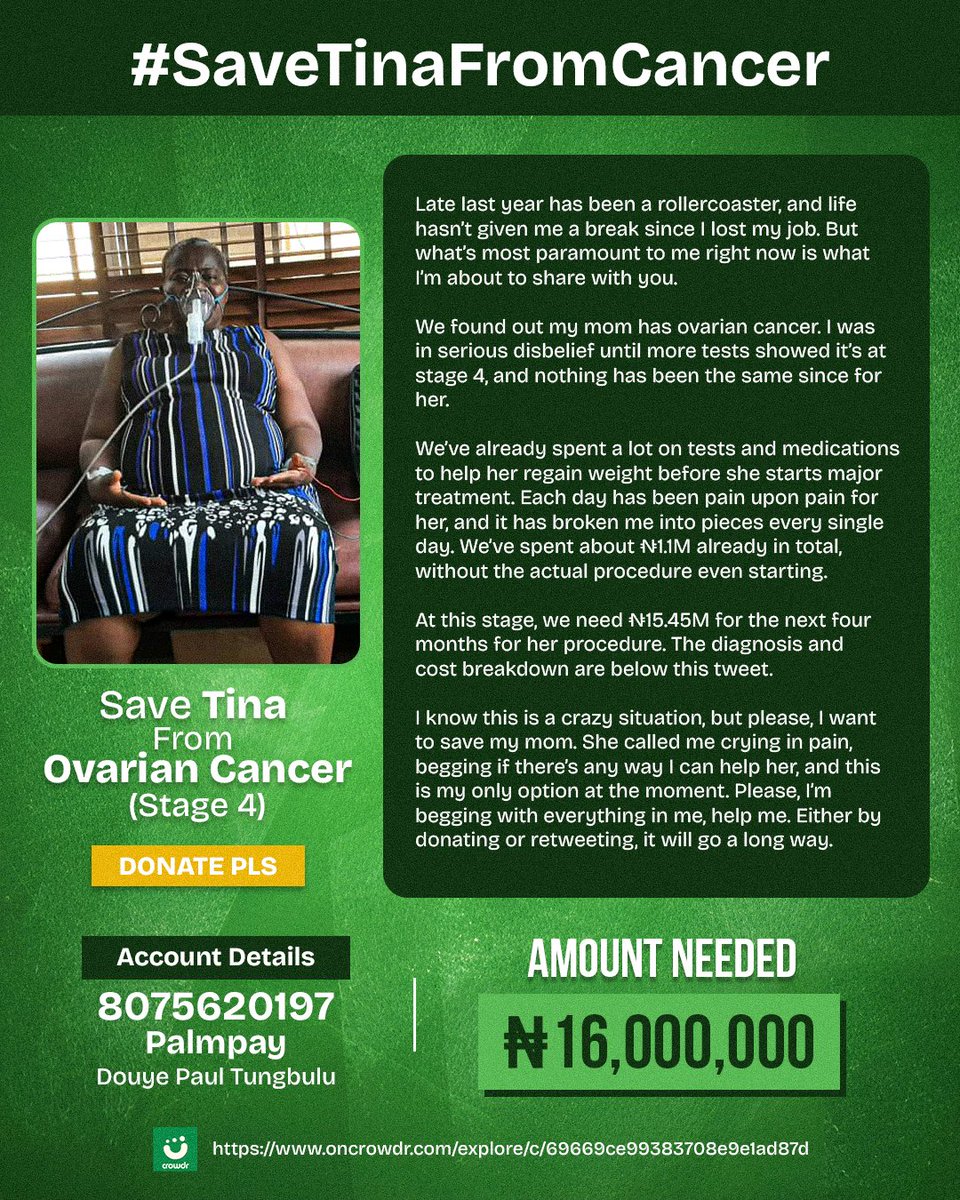
Late last year has been a rollercoaster, and life hasn’t given me a break since I lost my job. But what’s most paramount to me right now is what I’m about to share with you.
We found out my mom has ovarian cancer. I was in serious disbelief until more tests showed it’s at stage 4, and nothing has been the same since for her.
We’ve already spent a lot on tests and medications to help her regain weight before she starts major treatment. Each day has been pain upon pain for her, and it has broken me into pieces every single day. We’ve spent about ₦1.1M already in total, without the actual procedure even starting.
At this stage, we need ₦15.45M for the next four months for her procedure. The diagnosis and cost breakdown are below this tweet.
I know this is a crazy situation, but please, I want to save my mom. She called me crying in pain, begging if there’s any way I can help her, and this is my only option at the moment. Please, I’m begging with everything in me, help me. Either by donating or retweeting, it will go a long way.
Please, #SaveTinaFromCancer 🙏