Polymarket has become a safe haven.
The number of users has grown by 10% to 1.3 million. The volume on local exchanges is high, and uptime is 99.9%.
Polymarket has become a place where you don't have to guess, but bet on reality: for example, the president's tweet.
Polymarket works differently. Trading on CEX is an attempt to guess the market. Trading on Polymarket is an opportunity to profit from any outcome.
📉 On CEX: retail losses of $20 billion.
📈 On Polymarket: zero liquidations, just a redistribution between ���Yes” and “No.”
Different strategies, different outcomes.
Use @Polymarket @PolymarketTrade
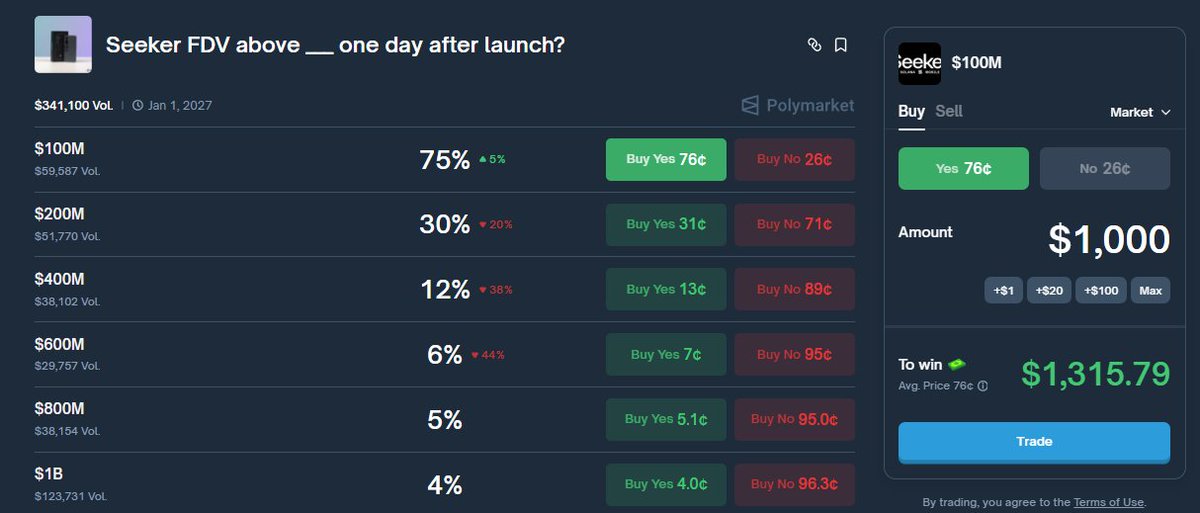
Seeker FDV + 30% on polymarket
Market: https://t.co/Qq8fxEMl2S
Mexc pre-market - $0.02
Polymarket - $0.01 - $0.02
Two options
100M - YES + 30%
100M - NO + 120%
I would bet on 100m YES
Since the pre-market valuation is adequate and there will be a listing on Coinbase.
FOGO - REKT
The project has had two rounds so far:
> the first - from unknowns, valued at ~$100 million
> echo community round - also ~$100 million
The token is currently trading on HL at a valuation of ~$1.1 billion.
The question is simple: has everyone there finally gone mad?
IMO yes. But there is a nuance
Listing on HL pre-market allows the project to earn money even BEFORE its normal release.
And every time there is a pre-market on HL, it's a stick up.
Short sellers have always been shaved there. Just remember Plasma.
Therefore, no one in their right mind will short - the chart is growing.
Numbers:
- pre-market vol: < $100k per day
- OI: ~$400k
And yet this story is worth more than $1b?
Tokenomics
https://t.co/3awOpVcj0l.
40% of tokens will go to TGE
Can a project with this structure be worth $1+b?
My answer is no if u use your head
My bet: < $500 million FDV - and that btw is already a good valuation for such a project
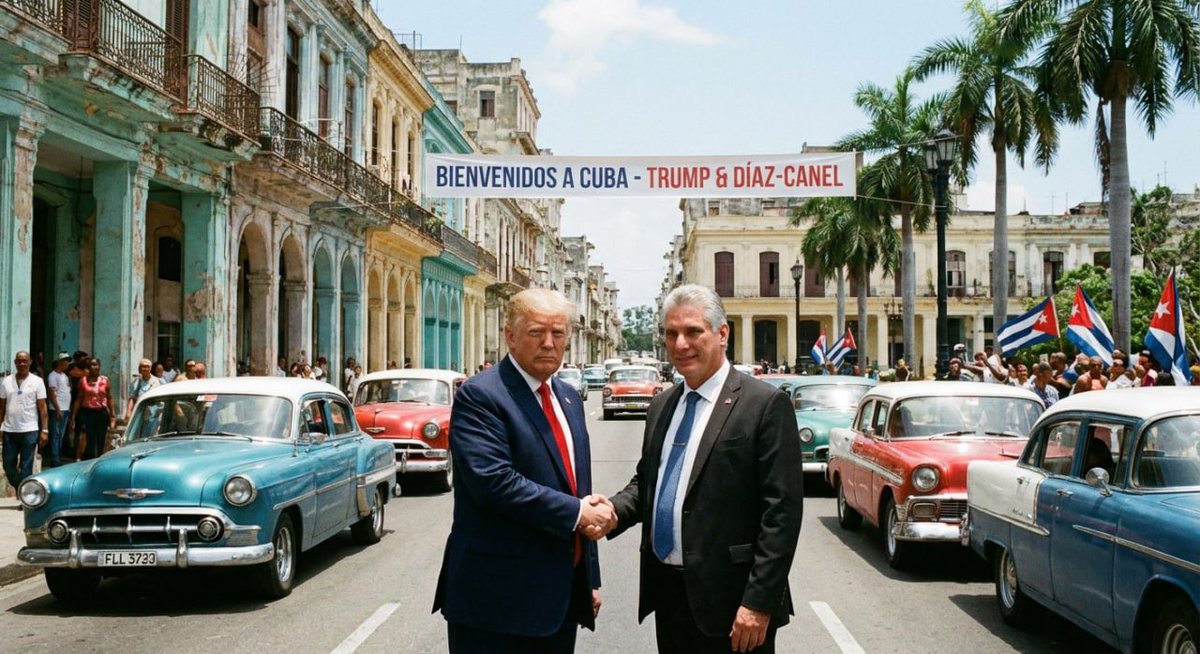
Cuba - how to earn money on polymarket?
Markets
1) https://t.co/v8xvHeB4bK
2) https://t.co/q5kAWhcyAA
3) https://t.co/e4kAo8Hg21
My analysis and review
In October 1962, the world narrowly avoided nuclear war when Soviet missiles were discovered in Cuba. That crisis ended in compromise. In January 2026, the Caribbean once again finds itself under the shadow of history - but this time, the script has been reversed. Then, Washington demanded the removal of foreign weapons from its “backyard.” Today, it is Washington that is forcefully reclaiming that backyard, determined to eliminate any external presence. And once again, Cuba stands at the epicenter.
What is unfolding is not simply a new round of sanctions. It is a deliberate strategy of economic suffocation. The seizure and disruption of oil shipments mark only the opening move. The objective is not invasion, but collapse from within. Cutting off Venezuelan oil supplies - previously about 35,000 barrels per day - is designed to push Cuba’s already exhausted economy over the edge, trigger widespread blackouts, and intensify an ongoing humanitarian crisis. Havana is preparing for the worst, placing its military on combat readiness.
This campaign rests on a resurrected and radicalized Monroe Doctrine, rebranded by the Trump administration as the “Donroe Doctrine.” The concept no longer tolerates even nominal sovereignty in the region. Mexico, Colombia, and especially Cuba are treated not as independent states, but as territories within a zone of enforced control. Cuba, once the site of foreign missile deployments, is the primary target - but the logic extends across the entire hemisphere.
This pressure is backed by overwhelming military power. With U.S. debt exceeding $38 trillion, Congress has nevertheless approved an unprecedented $1.5 trillion defense budget. The funds are being poured into the modernization of the nuclear triad, hypersonic strike systems, and the “Golden Dome” missile defense project - an initiative capable of dismantling strategic nuclear parity.
The impending expiration of the New START Treaty on February 5, 2026, is not an accident in this context. President Donald Trump has openly dismissed concerns about the treaty’s collapse, instead calling for a “better deal” that would force China into the framework. Russia has already suspended its participation, while China has rejected the demand as fundamentally unrealistic, given the disparity in nuclear arsenals. The result is the effective destruction of the arms control regime and the launch of an uncontrolled three - power arms race.
In parallel, the United States is preparing to deploy Typhon ground - based missile systems armed with Tomahawk cruise missiles in Germany, with similar plans reportedly under consideration for Japan. U.S. hypersonic weapons are to be positioned to target Moscow from the United Kingdom, Tehran from Qatar, and Beijing from Guam.
Seen through this lens, Cuba is a preemptive strike a test case ahead of a global redeployment of missile systems and a return to nuclear coercion as an instrument of policy. The stakes have risen to a systemic level: the architecture of nuclear security itself is being dismantled. The critical difference from 1962 lies in the absence of diplomacy. There is no search for compromise - only ultimatums.
The objective is not merely regime change in Havana, but the construction of a sealed strategic outpost in the heart of the Caribbean. History is repeating itself, but this time one side believes it holds all the cards and can dictate the ending. That belief is reckless, hubristic, and profoundly dangerous.
IRAN - how to make money on polymarket?
Markets: https://t.co/Q6DkGZBkPF
US strikes Iran by...? + 60% YES
Israel x Iran ceasefire broken by...? + 70% YES
Khamenei out as Supreme Leader of Iran by March 31? +132% YES
The protests that broke out on December 28 in Tehran’s Grand Bazaar over the collapse of the rial escalated into a political crisis within days. Everything continues to escalate.
While the unrest of 2009 and 2022 was suppressed through mass arrests, this time the streets are responding to violence with violence.
According to Iranian state media, protesters are armed with firearms and grenades. There are reports of casualties among the security forces: a police officer was shot dead in Malekshahi County, and two officers were killed and around 30 wounded in Lorestan Province.
The main slogan — “Neither Gaza nor Lebanon, my life for Iran” — strikes at the very heart of the Islamic Republic’s ideology. People are openly declaring that Iran’s costly foreign policy of supporting its regional allies is the reason for their poverty. Tehran’s opponents have been working with this narrative for a long time, and against the backdrop of suffocating U.S. sanctions and deteriorating living conditions, it has erupted into an uprising.
Current events inevitably bring to mind the bloody Arab Spring in Syria. The scenario is familiar: peaceful economic protests, harsh repression, the first victims, radicalization, and a slide toward civil conflict. However, the differences may prove decisive.
In Syria, “Bloody Friday” claimed the lives of more than 100 people. In Iran, according to various sources, between 16 and 36 protesters were killed during the first few days.
The scale of bloodshed is not yet comparable. The Assad regime almost immediately deployed army units to hold cities. The Iranian authorities, having learned the lessons of the past, are acting more selectively, albeit harshly. The head of the judiciary, Gholam-Hossein Mohseni-Ejei, has already promised: “There will be no leniency for the rioters.”
Perhaps the key difference is the unity of the elites during the crisis. In Syria, parts of the military command and political elite defected to the opposition early on. In Tehran, the political and security establishment — including the relatively moderate President Masoud Pezeshkian — is demonstrating unity in the face of the threat.
Another important difference is that Iranian society, especially its youth, is far more urbanized, educated, and connected to the outside world through the internet (which the authorities are now attempting to shut down). The slogan “Neither Gaza nor Lebanon, my life for Iran” serves as an explanation of events for an audience that has been bypassing information blockades for years — and this narrative has been building over the long term.
This is where a third, external actor enters the picture, capable of detonating an already dangerous situation. U.S. President Donald Trump has publicly stated: “If they start killing people… the United States will strike them very hard.”
This is a direct analogy with Libya: in 2011, the West, initially claiming to protect peaceful demonstrators in Benghazi, quickly moved toward military intervention, which ultimately led to the overthrow and killing of Muammar Gaddafi.
Now Trump is threatening Iran, and this time it does not appear to be empty rhetoric.
Such threats act like acid on the situation. On the one hand, they may encourage protesters by giving them hope for external support. On the other, they allow the Iranian authorities to blame the unrest on “the hand of Washington and Tel Aviv,” thereby consolidating their supporters.
In response, an adviser to Iran’s Supreme Leader, Ali Shamkhani, stated: “Any hand that encroaches on Iran’s security will be cut off.” In the event of an American strike, Iran could retaliate against U.S. bases in the region, potentially dragging the entire Middle East into the conflict.
Stability in Iran is now hanging by a thread. If the authorities resort to full-scale repression along a Syrian-style scenario, it will result in bloodshed but may suppress the protests. The cost, however, would be the permanent loss of support from a significant portion of the educated urban population — as well as the risk of provoking a direct confrontation with the United States.
If the protests expand and the security forces falter (as happened with the Syrian army in several provinces in 2011), the country could slide into a civil war with an unpredictable outcome.
Iran is approaching the most dangerous moment in its recent history. The streets are no longer afraid. The authorities are threatening to show no mercy. And the shadows of Gaddafi and Assad are already looming on the horizon. The choices made by Iran’s elites in the coming days will determine the fate not only of their country, but of the entire troubled region.
Just use @polymarket
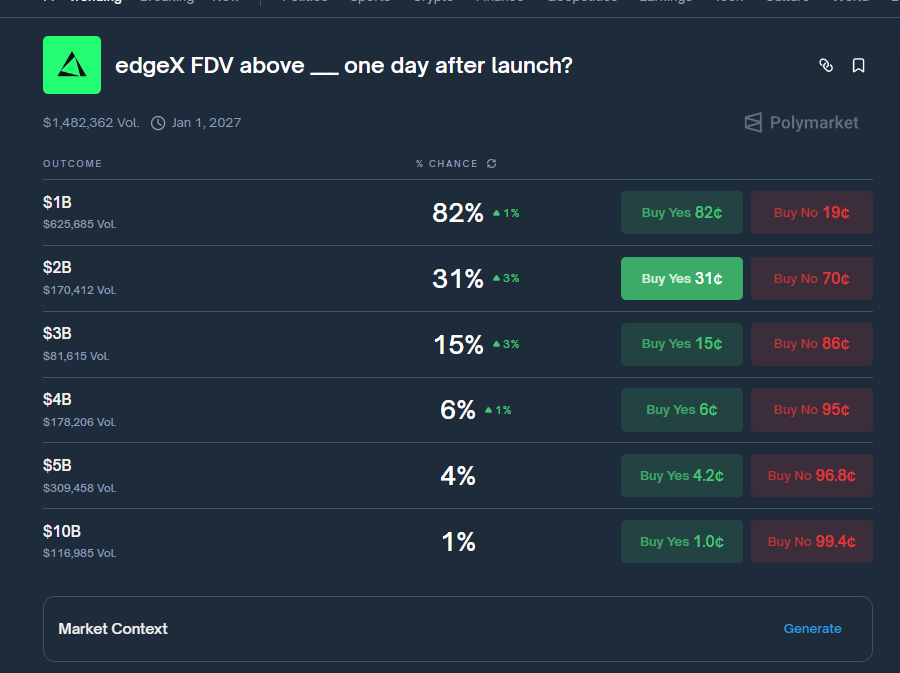
Edgex - new lighter
+200% and +20% on polymarket
+ airdrop
Project at the lighter and HL level
> Same volumes as lighter
> Has a commission and has earned a lot of money
> Pocket project Amber Group
> 25% on airdrop
> Launched $MARU, which has given 2x since launch and is now worth 500m FDV
> The only project from perps that has 82% on polymarket with a valuation >1B
How to earn?
Bet on the project's valuation
1B FDV +20%
2B FDV + 200% HR
Follow the link and trade - get points
https://t.co/5KFNcGe4lY
Polymarket event
https://t.co/p4Ad9yM5js
Just use @Polymarket
@bckfv_eth@Polymarket Captures will continue 100%
In order for ships not to be captured, there must be a precedent in the form of defense or direct confrontation