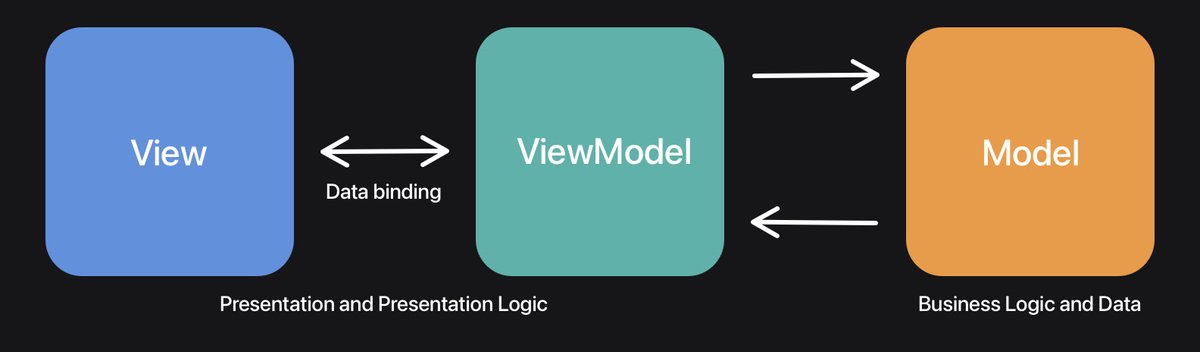
MVVM in SwiftUI is useful. Defaulting every screen to a view model is not. Antoine’s take is the right one: keep the view simple until the logic actually earns its own type.
MVVM is a popular architectural coding pattern in Swift & SwiftUI.
Use it to separate business logic and data from your views and combine it with protocols for next-level reusability.
Learn all about it:
https://t.co/pLRHmFiYpN
#swiftlang#iosdev
@DonnyWals Skill specialization seems unimportant because we can output code easily, but it is becoming crucial. Engineers should acquire skills to steer projects in the right direction, with the right architecture and best practices (practical Swift concurrency, for instance 😉).
For a long time, people were uncomfortable disclosing that their content is AI-generated. It feels like an "Aid," then comes the exposition, then imposter syndrome kicks in. A paradigm shift is needed because AI in any form has become a tool we ought to use on a daily basis and it's not a threat to our competences.
@krzyzanowskim +1 to that. I tried having dedicated LLM related list I can check like once or twice a week, despite unfollowing a lot, my feed is still invaded.
Just used the new toolbar APIs a new project of mine for the first time and this post landed at the perfect moment.
The visibility priority + ToolbarOverflowMenu combo especially clicked — finally feels like we have proper control instead of fighting the system’s automatic decisions. I actually didn't know about the pinning and minimization. Super helpful article!
@NilCoalescing@natpanferova Curious if you’ve hit cases where TimelineView’s cadence still wasn’t enough and you reached for a Timer or Combine, or has the schedule + context covered almost everything for you?”
What a shock.
The level of engineering experience here is incredible. These folks not only impacted Google as a company but also the whole world of Computer Science in the past 2 decades.
I just can't wait to see what they will bring to life.
Announcing Discovery Loop!
I am very excited to announce that, along with my longtime friends and collaborators @Sanjay_Ghemawat, @OriolVinyalsML and @quocleix, we are founding Discovery Loop (@DiscoLoopAI), a Public Benefit Corporation whose mission is to automate machine learning, science, and engineering to accelerate discoveries and progress. The four of us have worked together for 14 to 30 years, and have helped build some of the world’s most used products, infrastructure and AI models, and we’re excited to turn our attention to this ambitious endeavor.
♾
Learn more at: https://t.co/Rv3LMdLluK
Nice post — alignment guides really are slept on.
Honestly most of the time I just throw stacks + padding at it, get the illusion that's it's working and call it a day 😅
When do you actually reach for alignment guides instead? Or do you automatically thing about going that direction when building a view?
@twostraws Quartiles is actually a really fun game, solid choice for a Sunday Build.
Been meaning to dig into something like this in SwiftUI for a while — the tile combining + scoring looks like it’ll force some proper state handling. Sounds fun !
The cost of generating the proofs for all 10 of these breakthroughs combined was under $2,000 at Sol API prices. We’re excited to see what scientists and researchers are able to create with our upcoming Astra models!
An internal version of Astra, @OpenAI’s next major model family, solved 10 major open problems in mathematics, quantum complexity, and theoretical computer science.
We believe it will be a major step for scientific reasoning. https://t.co/iP6cyheZ7i
“75% of our engineers are running dozens or hundreds of agents.
The way you do it is Graph Engineering.��
From Jeff Dean Chef scientist at Google Deepmind