I’ve decided to leave NVIDIA. There are a few things I want to say.
As a robotics engineer at NVIDIA, I have seen Jensen as much more than the company’s CEO.
I admire his willingness to invest in a future that was not yet obvious. He committed to CUDA long before the deep learning boom and positioned NVIDIA for AI before it became everyone’s priority. Those decisions helped build the infrastructure that powers today’s AI.
I have seen that same vision in physical AI: investing in robotics, sharing open-source tools and projects, and building computing platforms that bring AI into the physical world. This is the work I do every day—and a future I believe in.
But what matters most to me is the culture he helped build.
Engineers are encouraged to explore, take risks, and learn from mistakes. Jensen reads employees’ Top 5 emails, follows their work, and engages directly. In a company this large, that connection matters. It makes an individual engineer feel that their ideas can still be heard.
That is why this has been so disappointing.
I do not have all the facts surrounding the allegations, and I cannot prejudge the investigation. My admiration for Jensen does not put him above scrutiny.
What I find difficult to accept is having to come to terms with his departure before receiving an explanation that helps me understand it. What this means for our direction, our culture, and the people doing the work remains unclear to me.
I have felt that engineers’ perspectives matter here. On this decision, I have not felt heard. That gap has been more painful than I expected.
I understand that some information cannot be shared immediately. But that does not erase the feeling of being left outside a decision that affects the company we help build every day.
A company’s greatness comes from its leadership, its governance, and the people who turn its ambitions into reality. Employees’ trust and sense of belonging are part of that, too.
Jensen’s vision and the engineering culture he shaped were important reasons I wanted to stay. His departure led me to decide that my own chapter here should also come to a close.
I leave with sadness and gratitude. The colleagues I have worked with, and the work we believed in together, will always matter to me.
These are my personal views.
NVIDIA DIDN'T JUST LOSE ITS STEVE JOBS. IT LOST ITS TIM COOK TOO
"Jensen is the one that got them building. He's the one that got the whole supply chain geared up."
"If it wasn't for Jensen Huang, the number of chips in the world today, the number of like all this stuff would be much much less." - ben thompson, sharp tech podcast
what i don't think people fully appreciate about losing jensen huang is that nvidia isn't just losing its ceo. it's losing the guy who spent over 30 years building relationships with the people who actually make the hardware behind this entire ai boom.
think about apple for a second.
apple had steve jobs, who imagined the next generation of technology, and tim cook, who turned that vision into hundreds of millions of products by building apple's supply chain in china, managing asian suppliers, and navigating tensions between washington and beijing.
jensen, in many ways, was (and arguably still is) both.
he bet on programmable gpus, cuda, accelerated computing, and eventually ai long before most people caught on. but he was also the guy flying across asia, convincing suppliers to make those ambitions possible.
there's a reason jensen spent so much time in taiwan with tsmc, and more recently having fried chicken and beer in seoul with samsung's jay y. lee, while building closer ties with sk group chairman chey tae-won.
those dinners weren't just for the cameras.
'personal relationships' matter in business everywhere, obviously. but in EAST ASIA, where political uncertainty, geopolitical tensions, and changing economic realities have long shaped business, there's another layer to all this.
jensen himself once said this about tsmc:
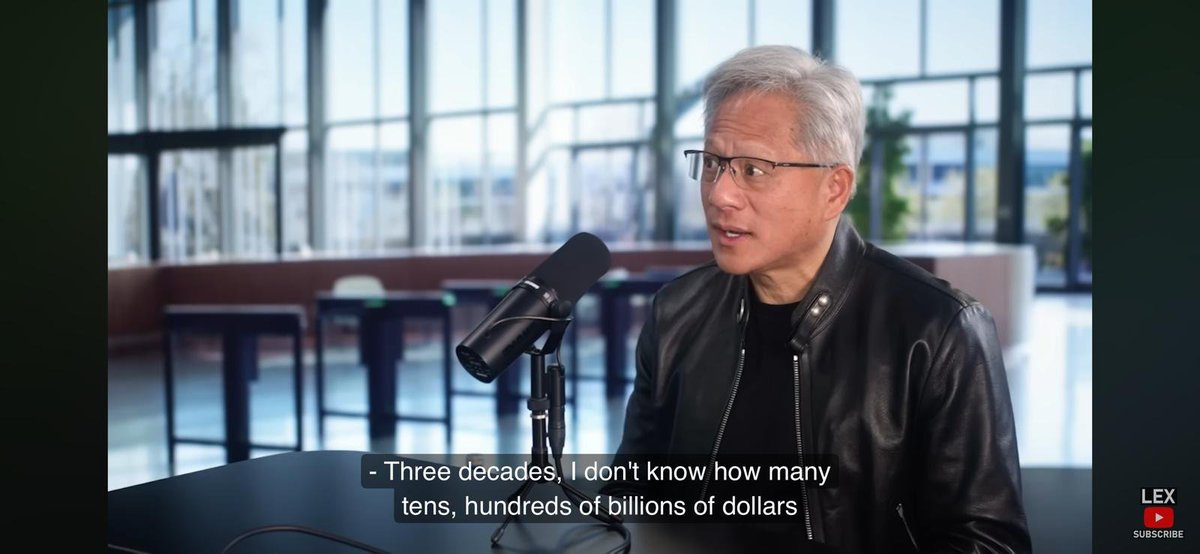
"Three decades, I don't know how many tens, hundreds of billions of dollars of business we've done through them (TSMC), and we don't have a contract. That's pretty great." - lex fridman podcast
which reminds me of something i wrote earlier about apple and its chinese suppliers.
apple takes contracts, rules, and standards almost religiously. foxconn and tsmc operate under strict commercial agreements too. yet apple's hardware empire also rests on decades of personal relationships and mutual dependence with its asian suppliers.
this goes back to the difference between western thinking rooted in 'abstract rules and principles' and east asian thinking grounded more in 'concrete realities and human relationships'.
in western capitalism, we tend to think in terms of contracts, spot prices, the lowest bidder, and expected returns. things we can measure, model, and put into legally binding agreements.
all of that matters in asia too, obviously, but it doesn't capture everything.
sometimes it's the person across the dinner table. someone you've known for 20 years, who kept his promises through bad times, and who you trust enough to bet billions on an uncertain future.
you can price a wafer, negotiate an hbm supply agreement, and model the return on a new fab.
but how exactly do you put a price on 30 years of trust?
tsmc, samsung, sk hynix, and the broader asian supply chain weren't just responding to nvidia's purchase orders. they were committing billions in capital and manufacturing capacity to an industry whose future was still uncertain.
jensen was personally convincing them that this "ai thing" was real, through years of working relationships and his keynotes at gtc, computex, and other events, where he was effectively telling the entire supply chain where nvidia was headed.
of course, these companies had their own perfectly rational reasons to invest. i'm not suggesting the "ai boom" happened because jensen had a few dinners and drinks with asian executives lol.
when the future is uncertain, personal trust can be just as rational as economic calculations when deciding whether to risk billions.
just look at apple. its contracts with suppliers kept changing, yet the relationships endured, with decades of hands-on involvement from tim cook.
which brings me back to nvidia.
apple had months, if not years, to prepare for life after steve jobs. nvidia had what, two weeks? a company whose vision, engineering, supplier relationships, and china strategy all revolved around jensen himself.
and while nvidia has plenty of capable executives, decades of personal trust and judgment don't automatically transfer to a new ceo, whether promoted from within or brought in from outside the company.
which is why i'm skeptical when people assume everything will carry on as usual simply because the ai boom is too big to stop.
"ai demand" may keep growing, though that doesn't necessarily mean nvidia will retain the same bargaining power or supplier relationships if the ai boom loses steam, the memory cycle turns, or geopolitical tensions worsen.
jensen wasn't just running a chip company. he was building relationships across asia, navigating the politics of washington and beijing, and shaping the next technological revolution.
so who on earth is going to fill that gap now?
and what if some of nvidia's biggest advantages were 'never transferable' in the first place?
#Nvidia #JensenHuang #TSMC #Samsung #SKHynix #HBM #Semiconductors #DRAM #AI
It's a pretty good sign of how out-of-touch the board was when they made the decision to get rid of Jensen. The nearly certain downstream effect is the collapse of NVidia:
1) 60 direct reports
2) New CEO is not going to be able to do 60 direct reports
3) Puts in traditional management structure
4) 80-90% of those reports get layered
5) They don't like it
6) They are all getting recruited hard by competitors
7) Most of them will leave (or retire, lol)
8) Their reports will also leave
9) Optional: replace them with second-tier players
10) Company collapses
If they are lucky, they will get a Marissa Mayer who comes in and engineers a $4B sale to Verizon for the remaining IP.
🚨 THE REAL DANGER ISN’T THAT JENSEN HUANG WAS PUSHED OUT.
THE REAL DANGER IS THIS:
Nvidia’s core engineers are already saying it out loud:
“If the board doesn’t bring Jensen back,
we’re going straight to SpaceX and Terafab.”
And they’re claiming Elon has already reserved seats for them.
This isn’t normal employee frustration.
This is a public warning that Nvidia’s soul could walk out the door.
On one side, the board is fighting its own founder.
On the other, Elon is standing there with open arms saying “you’re welcome anytime.”
If this letter is real,
the next few days could rewrite the entire AI chip landscape.
History rarely gives second chances.
This time, it might be happening in real time.
Who the hell does hundreds of billions of dollars in business without a contract?
Jensen Huang and TSMC. That’s who.
“Three decades, I don’t know how many tens, hundreds of billions of dollars of business we’ve done through them, and we don’t have a contract.”
Morris Chang even offered Jensen the CEO job at TSMC.
Can the new CEO Colette drink, do a Chinese-style 干杯 (bottoms up) roundtable dinner or Korean toast 건배 (geonbae), and replicate 30 years of relationships?
Who ever that pulled this shit will be remembered on the wrong side of history. Now let's all sign the letter to reinstate Jensen.
Mega Seven里,只有黄仁勋在任时的Nvidia,仍把芯片与数据中心供应链留在台湾,其余都力主回美国。
英伟达与台积电近30年合作,从未签过一份合同。
这在西方人眼里很难理解,但黄仁勋的见解是:
造芯片不是买现成商品,而是和代工厂一起摸索未知。工艺、良率、封装随时在变,任何想把一切写死的合同,都会越具体越脆弱。the more specific, the more brittle
所以黄仁勋选择rough justice:有时英伟达占便宜,有时台积电占便宜,几十年拉长看双方都赢。只要对方真心想让你成功,就比一堆法律条款更可靠。
张忠谋当年承诺“如果合作,我们会为你排除一切障碍”,台积电真的做了30年。这种说到做到的信用,本身就是最硬的保障。
西方人很难理解这套东方商业逻辑。它源自儒家伦理与华人关系文化,在复杂制造与长期合作中被反复验证。所以新上任的白人CEO能明白到这一层吗?