FTX will inject $18B in market tomorrow...
it means that altcoins will explode in day
$100 will turn in $100,000 with right alts...
here's 7 right lowcaps that will make 1000x first 🧵👇
Meta just declared war on its workforce.
3,600 layoffs in February 2025.
But this isn't just another downsizing.
It's the beginning of the biggest reset in tech history.
And it reveals the dark future of work that no one's talking about:
"When's QE?"
Everyone holding their alt bags waiting for QE, may have to wait much longer than they think.
QE is more of an emergency action to stimulate the hurting market.
QE comes when:
1) We're in a recession, and GDP is going down.
2) Inflation is low
3) We're in a financial crisis
4) Unemployment is high
5) Interest Rates are low.
Current Market:
1) Not currently in a recession
2) Inflation is sticky around 3%
3) The stock market and Bitcoin are near ATH's
4) Unemployment is 4% and trending down
5) Interest Rates have 2+ more cuts to go before FED is complete.
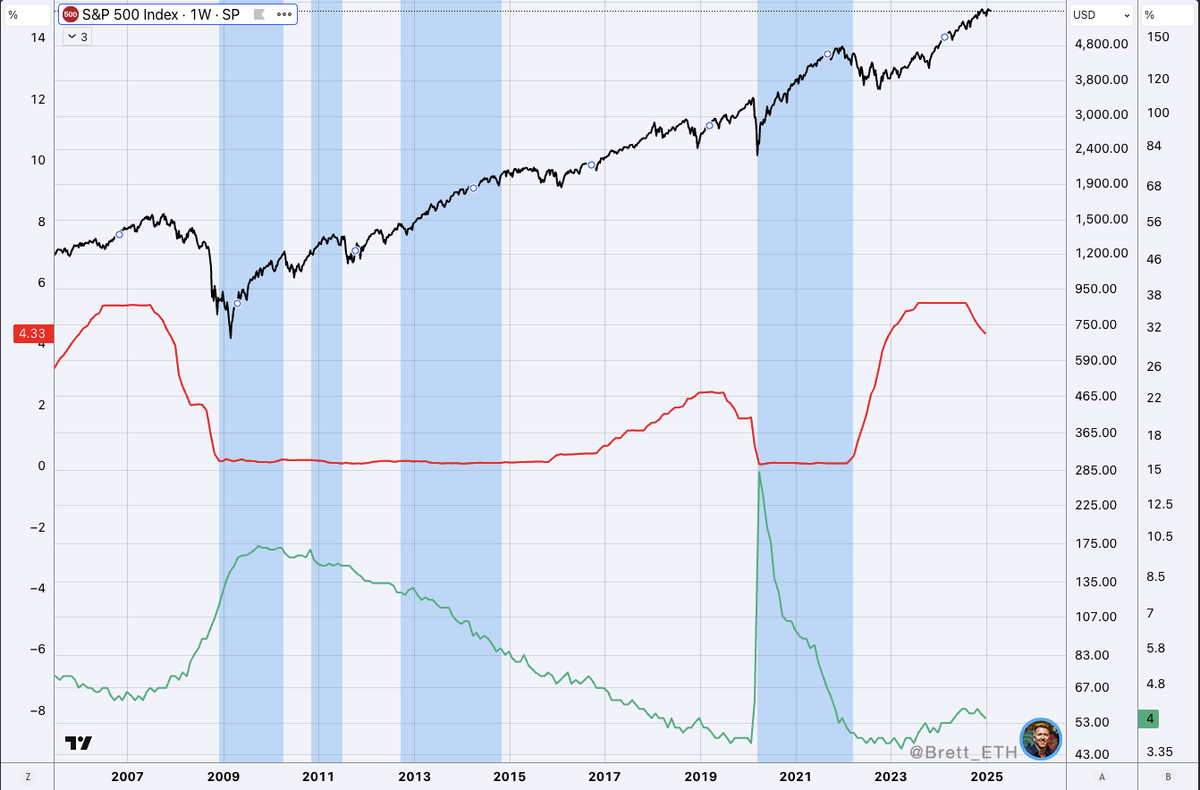
Notice When QE (Blue) happens.
1) After the stock markets crash (Black)
2) After the fed is done cutting rates (Red)
3) When unemployment is high (Green)
🚨 China is finally legalizing crypto!
They will unban $BTC and inject $1T+ into the market.
Several China-backed altcoins are set to skyrocket soon.
I’ve analyzed their financial reports and found the best Chinese alts with 100x potential 👇🧵
BlackRock is filing for Solana ETF in February 🚨
Solana will skyrocket to $1000 and the entire ecosystem will explode.
$150 in $SOL altcoins today = $25,000 in March.
Here's a list of alts that will pump 100x after ETF 🧵🔽
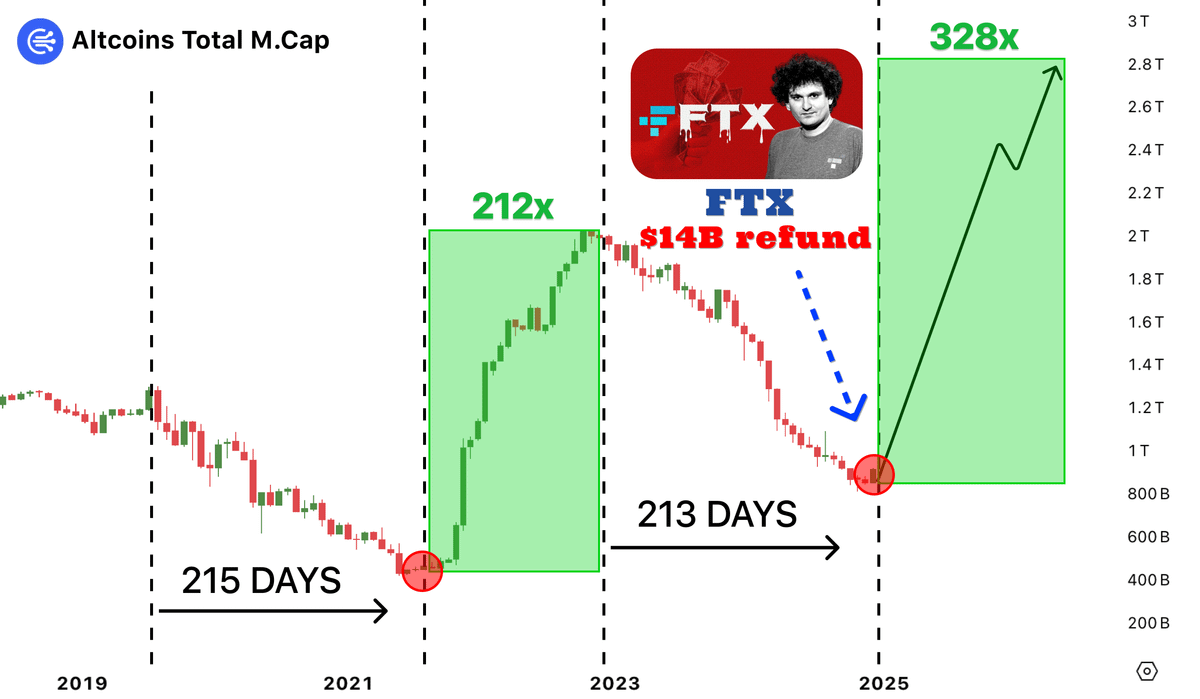
The biggest Altseason will start in 13 days...
FTX refund $14B and alts will go parabolic
Last cycle I turned $519 in $271,192 in days...
here's 7 right lowcaps that will make 1000x now 🧵👇
Google just announced a breakthrough in quantum computing.
It's called "Willow" - and it's making waves in the tech world.
But buried in their announcement was something fascinating:
A discovery that could reshape our understanding of computing itself...
Study: Each Government Regulator Destroys 158 Jobs
Fire him and you're 157 jobs ahead 🫡
Beyond the money DOGE saves, it's the many millions of jobs you create by firing government workers.
⚠️NUMBER OF UNEMPLOYED AMERICANS FOR AT LEAST 27 WEEKS IS RISING⚠️
1.6 million of Americans have been unemployed for 27 weeks & over, the most since January 2022.
The number has risen by 600,000 over the last 1.5 years.
In the past, such a surge occurred only in recessions.
Canada Mortgage Renewal Stats:
1st 6 month
Nov 1, 2023 to Apr 30, 2024:
Avg. each month ∼1.07% of all 🇨🇦 mortgages will be renewed: ∼75k/mo.
2nd 6 month:
May 1 to Oct 31, 2024
Avg. each month ∼1.36% of all 🇨🇦 mortgages will be renewed: ∼95k/mo.
12-24 months from now:
Nov 1, 2024 to Oct 31, 2025:
Avg. each month ∼1.78% of all 🇨🇦 mortgages will be renewed: ∼125k/mo.
wild stats on commercial real estate
• Blackstone said US offices now < 2% of portfolio, from > 60% in 2007
• Only top ~10% of office buildings in NYC are _not_ distressed
• NYC building recently sold for ~30% less than 2006 sale price
• ~$900bn in US cre debt coming due
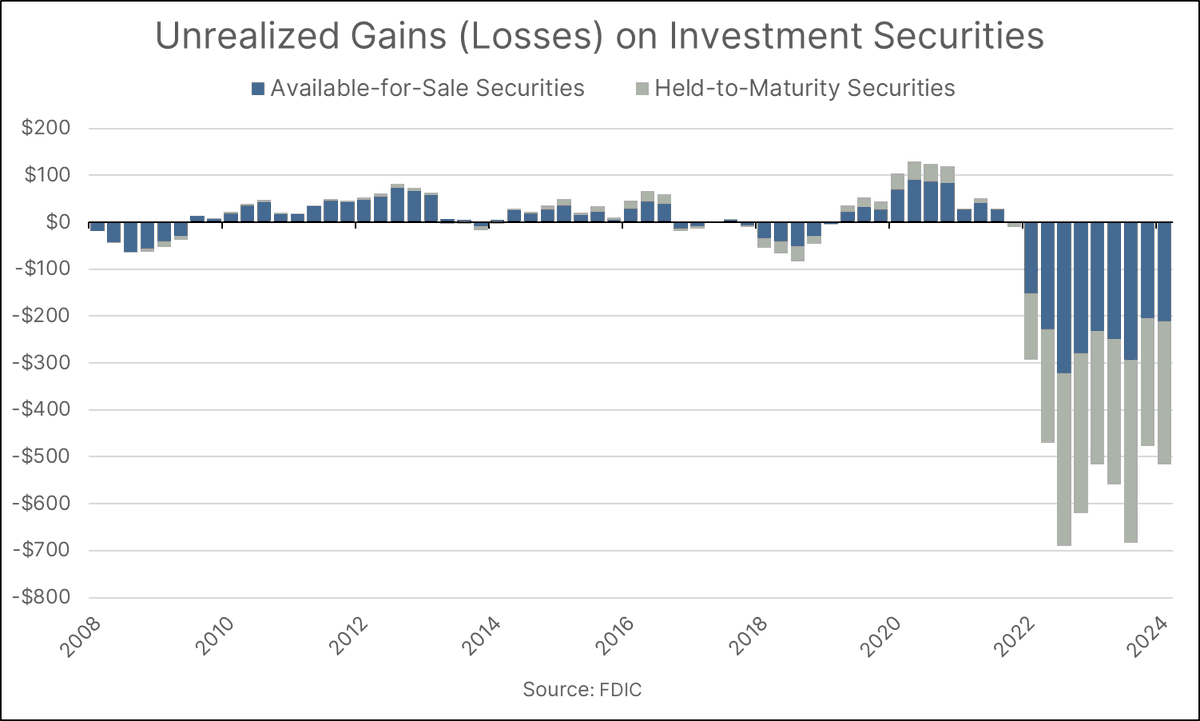
Over $500 Billion in Unrealized Losses | U.S. Banks
In recent years, the U.S. banking sector has experienced significant shifts due to rising interest rates and the aftermath of the COVID-19 pandemic.
One critical area of concern is the surge in unrealized losses on banks' securities portfolios.
This tweet aims to provide a detailed overview of unrealized losses, their implications, and the broader context within which these losses have occurred.
Background
Unrealized losses refer to the decline in the market value of a bank's securities portfolio that has not yet been actualized through a sale. These losses are crucial because they can affect a bank's financial health and decision-making even though they do not immediately impact reported income.
Since the Federal Open Market Committee (FOMC) began tightening monetary policy in March 2022, interest rates have risen across the yield curve.
This increase in rates has led to a significant rise in borrowing costs for firms and households and has severely impacted the value of banks' securities portfolios.
According to a study by the Federal Reserve Bank of Kansas City, banks saw the value of their securities portfolios erode by nearly $600 billion, approximately 30% of their capital holdings, due to rising interest rates.
Unrealized Losses: An Overview
Unrealized losses on securities are categorized based on how banks intend to handle these securities. Investment securities can be classified as either "held-to-maturity" (HTM) or "available-for-sale" (AFS). HTM securities are those that a bank intends to hold until they mature, and their value is recorded at amortized cost.
Changes in the market value of HTM securities do not affect a bank's reported assets or equity. Conversely, AFS securities are recorded at market value, and any unrealized gains or losses are reflected in the bank’s equity through accumulated other comprehensive income (AOCI).
As of the first quarter of 2024, the U.S. banking system held a collective $517 billion in unrealized losses, with $39 billion of this amount accumulating in the first quarter alone.
These losses have primarily been driven by higher interest rates, which have decreased the prices of fixed-income securities such as residential mortgage-backed securities (RMBS).
Implications of Unrealized Losses
Unrealized losses can affect banks in several ways:
Equity Costs:
As the value of a bank’s securities portfolio declines, investor perceptions of the bank's financial health may deteriorate, leading to increased equity costs.
Debt Funding Costs:
Increased liquidity needs and weakened financial strength can raise the cost of debt funding, which banks may pass on to borrowers through higher interest rates.
Reluctance to Sell Securities:
Banks may be less willing to sell securities at a loss, creating liquidity demands that can restrict future loan supply.
Mergers and Acquisitions (M&A):
Unrealized losses can dampen M&A activity, as potential buyers may hesitate to acquire banks with significant losses in their securities portfolios. This reluctance can result in a less efficient banking system and reduced aggregate lending.
Recent Trends and Regulatory Impact
The COVID-19 pandemic led to dramatic changes in bank balance sheets. At the onset of the pandemic, deposits surged due to federal support programs, and borrowers increased their cash holdings by drawing down existing lines of credit.
This influx of deposits, combined with a decline in loan demand, prompted banks to accumulate securities rapidly. By the end of 2022, banks had added approximately $2 trillion in new securities, primarily agency mortgage-backed securities and Treasury securities.
These securities, although considered low in credit risk, are not immune to interest rate risk. The rapid accumulation of longer-maturity securities during the pandemic increased the banks' exposure to duration risk, making their portfolios more sensitive to interest rate changes.
As interest rates rose, the value of these securities dropped sharply, leading to record-high unrealized losses by the end of 2022. Unrealized losses on all securities amounted to about 30% of aggregate Tier 1 bank capital, with losses on AFS securities alone accounting for about 10%.
To mitigate the impact on regulatory capital, banks have strategically increased their holdings of HTM securities. While unrealized losses on AFS securities reduce regulatory capital for large banks, HTM securities are reported at amortized cost, shielding their market value changes from affecting regulatory capital.
This strategic shift highlights how banks manage their portfolios to navigate regulatory requirements and market conditions.
The Broader Context
The rise in unrealized losses comes against the backdrop of higher interest rates imposed by the Federal Reserve to curb inflation. This period of monetary tightening, which began in the first quarter of 2022, has resulted in the ninth consecutive quarter of unusually high unrealized losses for the banking sector.
Historical data from 2008 through 2021 shows that unrealized losses and gains on investment securities ranged from $75 billion in losses to nearly $150 billion in gains, underscoring the unprecedented nature of the current situation.
Despite the increase in unrealized losses, the number of "problem banks"—those with a CAMELS composite rating of four or five—has also risen. As of the first quarter of 2024, there are 63 problem banks, up from 52 in the previous quarter.
These banks collectively hold $82 billion in assets, indicating that most of them are smaller institutions. The CAMELS rating system assesses a bank’s financial strength across six categories: capital adequacy, assets, management capability, earnings, liquidity, and sensitivity to market risk.
The current number of problem banks, representing 1.4% of total banks, is within the normal range for non-crisis periods.
Conclusion
Unrealized losses have emerged as a significant challenge for the U.S. banking sector in the face of rising interest rates. These losses, while not immediately impacting reported income, can affect a bank’s equity, funding costs, and overall financial stability.
The strategic management of securities portfolios, regulatory considerations, and the broader economic context all play crucial roles in how banks navigate this challenging landscape.
As the banking sector continues to adapt to these pressures, the ongoing monitoring of unrealized losses and their implications remains essential for maintaining financial stability and ensuring continued credit availability.
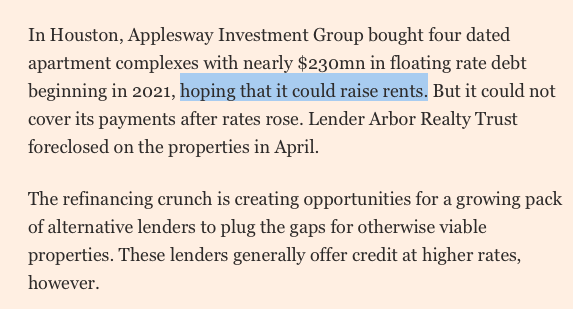
CRE Mess Not Letting Up: CMBS Delinquency Rates Jump in September as Office, Retail, and Lodging Deteriorate Further.
Rate cuts cannot fix the structural issues crushing office & retail CRE. But industrial, fueled by ecommerce, is in good condition
https://t.co/l1NkFm2Sj8