Hasta hace poco, si alguien me preguntaba qué estudiar, o si directamente valía la pena estudiar algo, no tenía respuesta. Ahora sí: Licenciatura en Sistemas Complejos.
Nueva carrera que lanzaron @fede_intern y equipo en la UBA (@UBAonline) . Viendo el plan de carrera y conociendo al equipo es la MEJOR preparación para el mundo que viene.
Combina inteligencia artificial, programación, matemática, física, economía, política y ciencias sociales. Empieza a dictarse en marzo de 2027, dura 4 años y es presencial. Ya se pueden inscribir. 👇
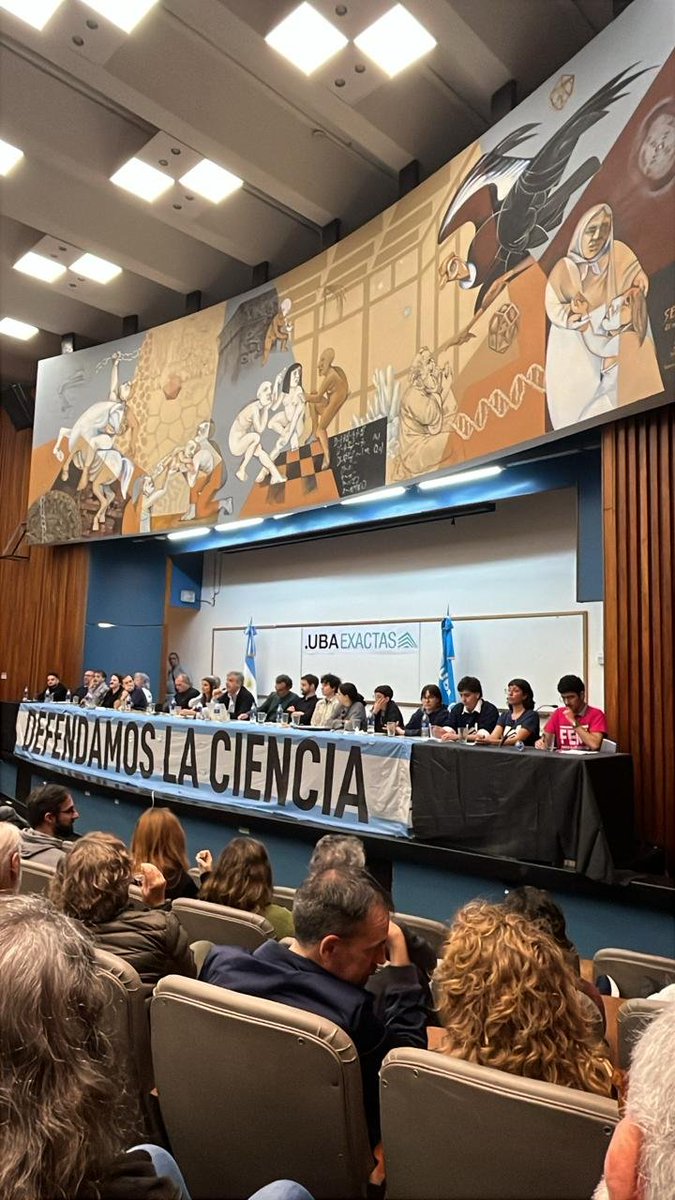
Ayer se presentó la Licenciatura en Sistemas Complejos en la UBA, impulsada por @fede_intern y LambdaClass. Tuve el gusto de poder acompañarlos. Escribí sobre por qué hace falta una carrera así y sobre por qué la filosofía tiene lugar en ella.
https://t.co/WhzrnI9ERt
Ocupate de vender. Gestionero hace el resto.
El sistema de gestión para pymes argentinas. Stock, ventas, facturación, cobros y finanzas en un solo lugar. Sin abono y sin permanencia.
https://t.co/dlIHjZOxJm
Hoy nota del re carajo en @421Net sobre toda la cuestión IA y su uso en la universidad. Básicamente, lo que propone la nota es que la cosa ya estaba rota.
Además, primera colaboración con autor español. Escribe Javier Gonzalez Patiño @javiergpatino
https://t.co/v2p7WUWQHF
Las comisiones por cobrar no deberían ser algo que simplemente aceptás y dejás de mirar.
Cuando gestionás un local, cada decisión impacta en los números. Podés vender mucho, pero también importa cuánto de esa plata termina quedando en el negocio.
Fue uno de los puntos que priorizamos al desarrollar el POS de Restolia. Integrar los cobros al sistema está bien, y con comisiones competitivas mejor aún.
En @ergodicgroup sabemos desarrollar software. Desde hace algunos años, también sabemos lo que implica operar locales gastronómicos.
Gestionamos cafeterías, restaurantes y bares como Fruto Café, Ōtoro y Palermo Wine Club.
Cuando buscamos herramientas para nuestros propios locales, muchas eran caras o no resolvían lo que necesitábamos.
Conocíamos el negocio del software y ahora conocíamos el problema de primera mano. Así nació @restolia.
Hoy la seguimos desarrollando desde la experiencia propia y el feedback de nuestros clientes.
https://t.co/16tFsEsVed
Congratulations @bellolandia. Amazing work. We always believed in what you were building and I’m sure we will be able to help achieve your next goals.
I highly recommend everyone to watch this amazing first episode of Electro Andes.
Congrats @bellolandia!
Over 271k views in youtube in less than 24 hours for Electro Andes first episode!!!
I'm proud of what we have built at @ergodicgroup. Argentina has amazing talent.
https://t.co/3EGm9OSBpR
Most analyses of how AI will impact society focus on the economy. But what happens to purpose and agency when civilization no longer needs us?
By @fede_intern
https://t.co/BDq9sIVsWc
@anaecorrea El problema es que esas regulaciones internacionales probablemente la armen ellos para establecer una barrera de entrada alta para que otros competidores no puedan entrar y ellos poder establecer un oligopolio.
I want to congratulate @WillyDuran65 on his new term as dean of the Faculty of Exact and Natural Sciences of the University of Buenos Aires.
Willy thanked Francisco Strambini and me, and he also thanked @class_lambda for its contributions and its relationship with the university. I value that a lot.
Most people on X have a somewhat wrong image of what Lambda is. Many believe we’re a devshop that works in crypto, when we have dozens of successful products in different industries and most of our core members are mathematicians, physicists, mechanical engineers, chemical engineers, civil engineers and industrial engineers and yes obviously computer scientists and computer engineers.
Lambda is and has always been deep tech.
If you want to build SaaS (something that we also do), you don’t need to understand what a Koopman operator is, finite element method or what Riemann zeta function is. But if you want to build companies at the frontier of science and engineering, you need people who understand things deeply and can work on hard problems.
That’s why Lambda’s relationship with the University of Buenos Aires, with the Faculty of Engineering and particularly with the Faculty of Exact and Natural Sciences is so important and strategic.
For me, the relationship with the university has always been strange and very personal. I’m a college dropout who, more than 15 years later, came back to reform the same degree program I had dropped out of. It’s a strange circle. I left the university without a degree, but part of the university is still shaping the way I think. I spent more than 20 years in the private sector learning how to build companies, products and technology.
Now I’m using everything I learned to build a new degree program at the University of Buenos Aires. I want to create an elite of builders who want to innovate. Not an elite based on money, family or status. An elite based on knowledge, work and the ability to turn science and engineering into companies and good public policies.
For me, this is not about proving that I never needed the university. It’s the opposite, it’s about giving back, closing a circle and helping create the education that I believe the next generation of builders needs.
If we want to create a better world, we need to create companies that are at the frontier of science and engineering and that work with universities and the public sector.
We also need to destroy this idea, that part of the left has, that companies go to public universities only to steal their knowledge or to destroy them. Real deep tech companies need strong universities. A deep-tech company has nothing to gain from a weak university.
But this works both ways. Universities also need a big and capable private sector with the ability to innovate, turn knowledge into products and give back to the universities that made that innovation possible.
Universities have the right environment to do research that is long term and doesn’t depend on the results of the next quarter. This is something that part of the right in Argentina doesn't understand. Companies need the public universtiy that is the one creating the most amount of professionals for our country and doing the best international research. The University needs money to be able to give freedom to researchers to work on difficult problems. Then companies have the ability to turn that research and knowledge into products, jobs and new industries. They have different roles, but they need each other. This shouldn't be an ideological debate but a practical one.
Willy and I have our differences, as all good friend have, but we also have a very strong bond. We believe in science. We believe the state should invest in it. We believe this is better for the country, for universities and for companies. It’s a win-win.
That’s why I value my relationship with Willy so highly. Even with our differences, we agree on what we want.
Thanks Willy and I hope you keep doing an amazing job.
two billion dollars have already been traded through the infrastructure we built with @class_lambda and @gattacahq for @ethereum L1.
three months ago it existed only in a few people's heads.
what do we do? we provide the infrastructure that lets propAMMs offer better prices to traders. today they are already quoting tighter spreads than @binance and much tighter than @Uniswap.
a propAMM is basically a digital market where professional market makers continuously update their buy and sell prices in real time, so traders can get prices closer to what an asset is actually worth right now. binance has to run the entire financial marketplace itself. on ethereum, thousands of applications share the same underlying financial infrastructure, so a market maker can focus almost entirely on offering the best possible price.
there are three ways a product grows:
1. better marketing (Liquid Death, Red Bull)
2. better product (macOS/iOS, Claude)
3. better technology that creates better economics
we are doing the third. we just connect companies with better tech and since we provide better technology people just use us.
ethereum produces a block every 12 seconds, but markets move in milliseconds. our infrastructure lets market makers continuously update their prices while the block is being built. this dramatically reduces the risk of trading against stale prices, which lets them quote tighter spreads and gives traders better execution.
better technology changes the economics of the market.
we will soon do $100 billion through this infrastructure without marketing and without a consumer facing product. we don't need to convince people to use it. since the price is better, the flow follows.
for now we're doing mostly stablecoins, BTC and ETH are being traded through it. eventually real-world assets will be traded on top of the same infrastructure. i'm convinced that in a few years we will have banks using it too.
we are making ethereum the best place on earth to trade assets. we're upgrading Ethereum and the whole financial world.
thanks @kubimensah/@gattacahq, @rj_aligned/@alignedlayer and my team at @class_lambda for letting me be part of this journey.
the last few weeks i've been thinking a lot about products and things i want to build outside of crypto/finance, more in the real world, that i hope can achieve the same kind of impact on a similarly short timeline. i will be sharing more in the upcoming weeks.