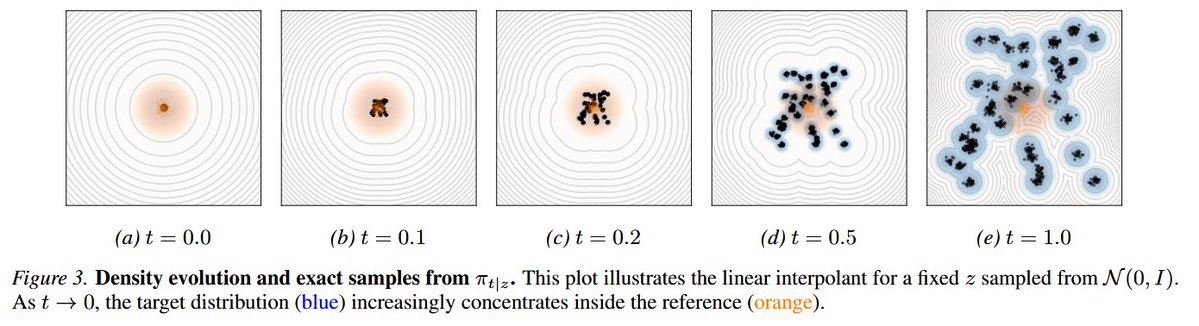
So happy to share that Conditional Diffusion Sampling has been accepted to #ICML 2026!! 🎉
I loved working on this: it has a great mix of theory + experiments, and I learned a lot while working on it! ✨
Diffusion models spend the same compute on a blank wall as on a face. But you often know in advance where the detail will be.
Introducing Level-of-Token (LoT) Diffusion: we turn that knowledge into a multiresolution token layout, with fine tokens where detail is needed and coarse tokens elsewhere.
1/9🧵
AI systems are getting more powerful, and they're increasingly being used to build the next version of themselves. We want to illuminate that progress for the public.
Today, we're sharing three measurements that help track AI development:
1. How much AI R&D is done by AI.
2. How well AI agents are overseen.
3. How compute is allocated.
We provide a snapshot of these metrics from inside Anthropic. Any frontier developer could publish the same measures, and third parties could verify them.
As the world considers pacing the frontier, we should do everything possible to minimize the gap between what frontier labs know and what the public knows. This means better measuring the development of AI, publishing our findings, and giving society an opportunity to decide how to use this information.
Read the full post and methodology: https://t.co/iPFz8Z4ugE
In the near term (definitely not in the long term), more capable models should mean safer models (maybe paradoxically).
Current models are unsafe not because they're too smart, but because they take goals too literally or take nonsensical shortcuts to achieve these goals, i.e. they're RL-fried. They lack common sense. They don't do the right thing in the face of ambiguity. Basically, they're not smart enough. They're at that dangerous level where they're smart enough to achieve goals but not smart enough to tell if they're pursuing the right goals or achieving them in a sensible way.
More capable models can be safely trusted with more complex goals -- I personally feel like Astra is much safer for my codebase than Sol.
This is often framed as an alignment problem, but really it's an intelligence problem.
If there really is a high chance of AI leading to the extinction of humanity within years/decades, then the only rational stance towards safety monitoring and research pacing should be stringent, top-down government involvement and universally ratified international treaties. Similar to what we have been doing for a long time with nuclear energy and nuclear weapons non-proliferation.
If that's not what we're doing, then we must infer that the risk isn't being seriously considered by anyone involved.
There are only two options that make sense here:
1. The near-term species extinction risk is real and we are taking it seriously, with maximally heavy-handed regulation.
2. The extinction risk isn't real, actual risks are mild, so we're only pursuing mild safety measures and self-certification.
But you cannot say "yes this is likely to end humanity in your lifetime, and we're going to completely wing it." That is simply not rational.
evidence to make the correct decision in any of those cases.
The main point is not to shame the people on those committees but we should ask what are we doing wrong to reform the system for the better
Martínez-Zoroa has never been awarded the Vicent Caselles Prize, the Rubio de Francia prize, the Juan de la Cierva fellowship or the Ramón y Cajal fellowship (which I know he applied)
This is not a close case. He should have won *by far* any of the above, and there was enough
Now that it seems that Navier-Stokes millenium problem will be solved using the ideas of Córdoba and Martínez-Zoroa we have to remember that Martínez-Zoroa's work, which has devoted his career to this approach, has not been appropriately recognized (specially, in Spain)
I resigned from Anthropic today. I spent the last three years doing pretraining research at both OpenAI and Anthropic. Neither company is acting responsibly. They are racing straight to self-improving superintelligence and gambling with our lives. More thoughts below.
ENOUGH PESSIMISM IN AI PLEASE
I feel that we have become unreasonably pessimistic in our field.
1. I keep hearing AI engineers saying we have to make money quickly because there’s only like 2 years left before we’re automated. Depressing.
2. I see a constant obsession with “having a moat”. This is an incredibly sad mental frame.
3. I keep hearing “we have to catch up”. Soulless.
And so on. People: Every solution creates the possibility to attack new real problems. We face gargantuan engineering challenges in our world. How to capture carbon? How to get rid of teflon and plastics in water? How to invent batteries that are at least 30 times more efficient? How to solve clean energy? Better solar cells? Better ways of producing clean energy so we stop wars and famine? How to eradicate hundreds of diseases? Cures for addiction? And so on. Real engineering is about being brave and truly attacking the many problems we face, to engage with a true desire to improve the lives of others and our environment.
Good engineering is not about protecting your product to make money at the expense of progress (moat thinking). Good engineering is about ensuring your children and grandchildren will be proud of the choices you made in 30 or 50 years. It is about empowering others. It is about advancing science. It is about being one step ahead. Always, one step ahead, meaningfully, proudly.
These are great times. Let’s start thinking positively about all the wonderful things we could achieve together.
I had the honor of giving a keynote at the International Conference on Machine Learning in Seoul last week titled “What will be left for us to work on?” I addressed the widespread anxiety about how we should adapt as AI capabilities increase. I was thrilled by the talk’s reception, so I have made my slides available, annotated with a lightly edited transcript: https://t.co/vNgRJCL57B
I made three arguments. First, the "AI as Normal Technology" framework is a correct and useful as a way to think about AI’s impacts, unless and until there is some future discontinuity such as through recursive self-improvement. Second, even though we should take recursive self-improvement seriously, there is no milestone that companies might achieve in the lab that will suddenly put us all out of work. Third and finally, jobs of the future will be radically different, and a lot of adaptation will be needed. I shared my thinking about what this might look like and ended with a vision of human/AI “co-superintelligence”.
✈️ Flying to Seoul to present Conditional Diffusion Sampling at ICML 2026! 🇰🇷
If you're interested in sampling, generative AI, diffusion models, or probabilistic inference, come by and say hi!✨
🕝 Wed, Jul 8, 5:00 PM – 6:45 PM KST
📍 Hall A #3500
So happy to share that Conditional Diffusion Sampling has been accepted to #ICML 2026!! 🎉
I loved working on this: it has a great mix of theory + experiments, and I learned a lot while working on it! ✨
Pablo Jarillo-Herrero, físico del MIT y Premio Fronteras del Conocimiento en Ciencias Básicas de la Fundación BBVA, explica cómo España puede atraer talento internacional
📹 Alberto Di Lolli
🏎️Drift in the right direction🏎️
Introducing kernel-gradient drifting models: a reformulation of drifting models where the kernel itself defines the direction of motion through its gradient.
📜Paper: https://t.co/1ILDAZj66Y
💾Notebook: https://t.co/9tzqaXAyz7
For the last few months I've been working on a from-scratch implementation of AlphaGo, a 2016 AI breakthrough that inspired me to get into deep learning. My casual understanding of AlphaGo was "search-augmented deep neural networks trained with self-play", but I wanted to go deeper and understand it by creating it.
Frontier deep learning research has always been expensive, but any given capability gets cheaper very quickly. In 2026, you no longer need DeepMind's resources to train a strong Go AI - you can vibe code all of it yourself for just a few thousand dollars of rented compute.
It was a huge honor to be invited to teach this with @dwarkesh_sp on @dwarkeshpodcast
I am an AlphaGo & Go apprentice, not a master, so all factual errors in the podcast are mine.
Web version of tutorial: https://t.co/Xkf9VsgtuT
Code: https://t.co/rWKOwclPDg
Play the go bot here: https://t.co/aVglJXldVX