La prossima settimana sarò a Perugia per #OrizzontiDigitali, dove parlerò di mechanistic interpretability. Sono felice ed emozionato di partecipare a questa bella iniziativa!
Ci vediamo il 22 ottobre!
We’re at #ICLR2026! 🇧🇷🚀
This afternoon, @frances55037016 and I are presenting the work done with @samuelefonio @simone7monaco and @fabreetseo: "Composable Sparse Subnetworks via Maximum-Entropy Principle" 🧠
Come find out how we isolate and recombine functional modules in NN!
4/4
Composition: in simpler regimes, weight summation works (and we see mode connectivity).
In harder regimes (deeper nets / harder data), logit-level merging is consistently strong, showing the modules are still the right circuits even when weight-space merge gets brittle.
Super excited for #ICLR2026!
This work uses the maximum-entropy principle + sparsity to train class-specialized circuits by design (not just post hoc), and shows they are composable.
Huge thanks to Samuele Fonio, @sacco_nico, Simone Monaco and @fabreetseo!
1/5 Composable Sparse Subnetworks via the Maximum-Entropy Principle will be presented at #ICLR2026 🎉
👉 https://t.co/9NqeFdMzQM
It’s about circuits, sparsity, and compositionality, with a training-time loss that shapes how circuits form. Congrats @frances55037016 !
3/4
More than a year ago we had the intuition that sparsity could help isolate circuits.
The key realization: sparsity alone isn’t enough, you want to train ignorance by design.
MaxEnt gives functional separation; pruning makes the circuits compact/reusable.
Paper accepted at #AISTATS2026!!
𝐑𝐚𝐧𝐤 𝐋𝐢𝐟𝐭𝐢𝐧𝐠 𝐚𝐧𝐝 𝐑𝐚𝐧𝐝𝐨𝐦 𝐍𝐨𝐧-𝐋𝐢𝐧𝐞𝐚𝐫 𝐌𝐚𝐩𝐬: once the size of a one-hidden-layer neural network exceeds a threshold, the hidden representations are linearly independent with high probability.
#RSTLess#Sapienza
@AntonioPuri00 and @frances55037016 recently delivered two seminars at Charles University in Prague: one on the evolution of recommender systems up to Sheaf Neural Networks, and one on how physics principles like entropy & renormalization groups can guide learning across domains.
@OpenAI Really interesting work! We explored a related direction a few months ago with our paper on composable sparse subnetworks. It will be presented at the Mechanistic Interpretability workshop at NeurIPS 2025. If anyone is interested, here's the link: https://t.co/4XFNMFL0mb
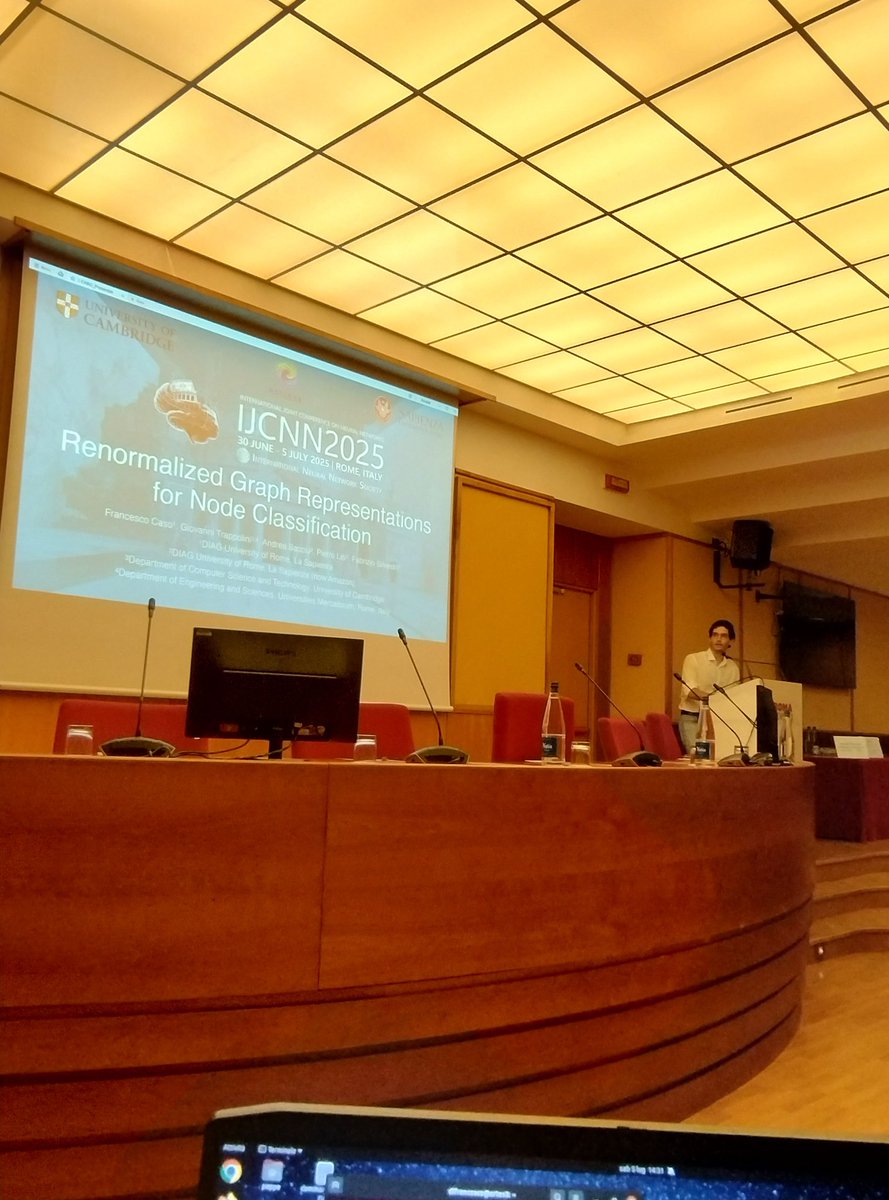
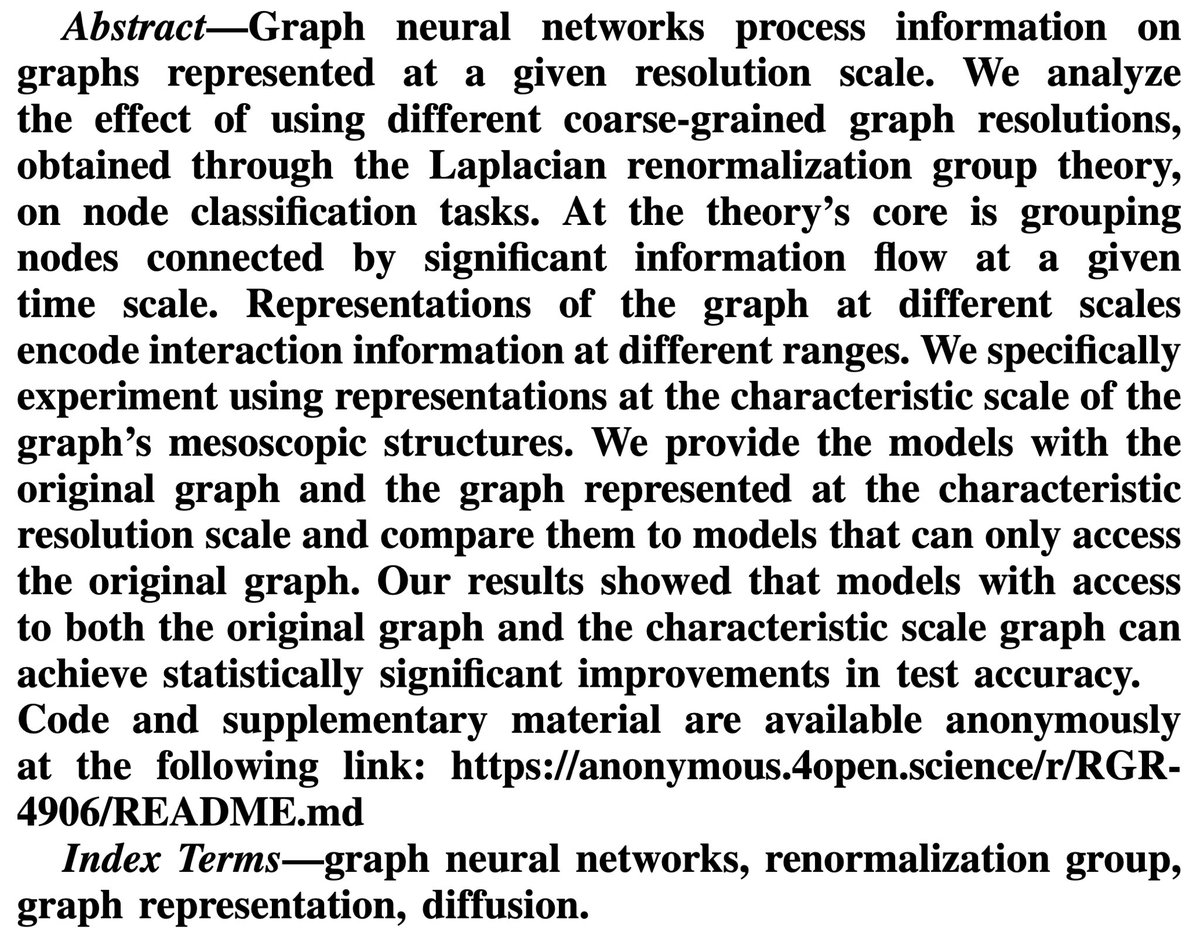
Next Monday will start the #IJCNN2025 conference! And our group will present lots of papers! On July 5th at 2.30 PM CET in Room Loyola @frances55037016 will present “Renormalized Graph Representations for Node Classification”. Preprint: https://t.co/u4iwg7wRrk
#Classication#ML
Our paper "Are Convolutional Sequential Recommender Systems Still Competitive? Introducing New Models and Insights" was accepted at #IJCNN! 🎉
With the right modifications, CNN-based SRSs can in some cases outperform attention-based models like SASrec by up to +53% in NDCG@10! 📈
Together with @frances55037016, Christian Giannetti, Andrea Drago, Pietro Liò, Andrea Marinoni, and @fabreetseo, we look forward to seeing you in Rome for the workshop! A unique opportunity to connect deep learning with pressing environmental challenges
We accept two types of papers:
📄 Regular (6–8 pages, included in IEEE proceedings)
📄 Short (2–4 pages, for new ideas/preliminary results not included in the IEEE proceedings)
Check the website for the full list of topics: https://t.co/uC4zenBP1z
🌱 Join us & submit your work!