[Thread of threads] #originsofSARSCoV2#DRASTIC
Compilation of relevant findings. Live thread.
Let's start with the Addendum and the 7896 clade recently confirmed to come from the Mojiang mineshaft
https://t.co/DftZnlGTcd
Full text of article:
Jay Bhattacharya, head of the National Institutes of Health, has written to Nature Medicine journal demanding a “formal, independent investigation” into why a key scientific paper misled the world about the virus causing Covid, and concealed the contributions made by three senior scientists to commissioning, reviewing and editing the paper.
In a career as a science writer that spans more than four decades, I have never seen an alleged case of scientific malpractice as influential. Like many others I have called for the paper to be retracted. Twice, the editor of the journal, Joao Monteiro, has been sent letters from numerous leading scientists demanding an investigation or retraction of the misleading paper. He has ignored us.
I know the paper entitled “Proximal Origin of SARS-CoV-2” was misleading because I was among those misled. At the time I sat on the science and technology select committee of the House of Lords and we were conducting an inquiry to try to understand this new virus threatening all our lives. The possibility that it had been accidentally released from a laboratory, if true, would have significant implications for the public-health response: a virus marinaded in human tissues in a laboratory for weeks would be far more infectious than one newly arrived from bats.
Parliamentary colleagues were asking me what I thought. To my shame, I told them a lab leak could be ruled out. I did so based almost entirely on the authority of this one paper. That very phrase “ruled out” appeared in the press announcement of the paper from the institution where the lead author, Kristian Andersen, worked. The article itself left no room for doubt: “we do not believe that any type of laboratory based scenario is plausible… our analyses clearly show that SARS-CoV-2 is not a laboratory construct.”
That these words appeared in Nature Medicine gave them a stamp of authority, or so I believed. The paper was subsequently viewed millions of times and cited in thousands of academic papers. The journal and the authors of the paper therefore had a special responsibility not to allow themselves to be misled. Yet we now know that Proximal Origin’s arguments were flawed and released Slack messages and emails show several of its authors were expressing exactly the opposite opinion in private both before, during and after publication. They still thought a lab leak was “friggin likely”, in the words of Andersen.
Worse than all that, congressional investigations have uncovered records strongly indicating that three of the most senior medical scientists in the world, Francis Collins (Bhattacharya’s predecessor as head of the National Institutes of Health), Anthony Fauci (head of National Institute for Allergy and Infectious Diseases) and Jeremy Farrar (head of the Wellcome Trust) had not only seen the paper before publication, but – according to a House Select Subcommittee report – had prompted its authors to write it in the first place, had reviewed it and even suggested alterations in wording. Fauci referred to the paper from the White House podium, giving no hint of his own role in it.
These men were heads of the bodies that funded the scientists’ work, yet they were not listed as co authors or acknowledged in the paper, despite the journal’s stated policy that authors disclose any funder’s “involvement in the conceptualisation, design, data collection, analysis, and preparation of the paper”. Farrar even suggested a change of wording to strengthen its conclusion: from “unlikely” to “improbable”. Why was he not acknowledged? Robert Garry, one of the authors, wrote to his colleagues: “Jeremy has been an amazing leader – should be author.”
Ed Holmes, another author, replied: “I agree, and I offered, but he wants to remain independent.” As we wrote to the journal editor in 2024: “This omission of a significant role played by the head of a funding agency, allegedly to maintain his ‘independence’, represents a serious breach of publishing ethics that completely undermines the credibility of the journal and calls into question the motivation behind the paper.” Answer came there none.
It should infuriate the journal’s editor that the paper appears to have been commissioned, designed and intended to shut down all debate about a possible laboratory origin of the most destructive pandemic in a century despite going directly against its authors’ own opinions. For the sake of science’s integrity the journal must act on Dr Bhattacharya’s letter.
@ClaudioVerduEge#RAEconsultas Con independencia de la costumbre de tildar este apellido reflejada en los medios, la escritura correcta de este apellido conforme a las reglas de acentuación es «Feijoo», sin tilde, por ser voz llana acabada en vocal.
@mlalanda Ha sido por el tipo de impacto: por alcance (tercermundista) y sin acordeón (gracias a la ingeniería). La energía cinética en el impacto se ha absorbido en pocos vagones. DEP
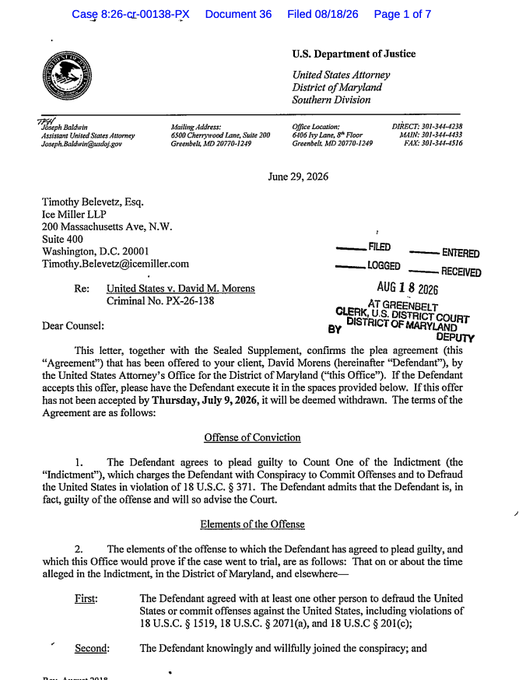
Fauci Senior Advisor David Morens pleads guilty to "Conspiracy to Commit Offenses and to Defraud the United States" in connection with conspiring with Fauci, Daszak, Keusch, and others to defraud the public about NIH-funded gain-of-function research and the origin of COVID.
David Morens, a former adviser to infectious disease expert Anthony Fauci, pleaded guilty to conspiring to evade public records laws and conceal government documents related to grant research funding and the COVID-19 pandemic https://t.co/YwfJkqDbHC
When you've lost even the @guardian, the game is up.
"Lab leak likely" is now all but universally conceded except in a few diehard corners of the BBC, @Nature etc.
A little credit to those who made it possible would be nice.
🚨🚨🚨 Gear up. Revealing three theses from Wuhan Institute of Virology which provides new details on Mojiang sampling, 4991 genome, 7896-clade, unpublished CoVs, coronavirus reverse genetics and more! All theses were supervised by Shi Zhengli. Links at the end of the thread.
2/ PhD thesis of Zeng, quite relevant also. Can be considered the precursor of the crucial article of Hu et al. (2017), published a few months later
https://t.co/5Zygpu6Ug0
🧵Natural and non-natural live isolates (WIV & related)
TLDR:
- A substantial portion of the research remains unpublished.
- Missing live isolate WIV15.
- No samples, isolates, chimeric and MA viruses in 2017-2019?
- What is "Rs4874" really?
https://t.co/25XbQLCQQb
[Thread] The mystery of “live isolate” Rs4874 with no WIV number assigned.
TLDR: Probably not a [pure] live isolate but a mere infectious clone. Just another case of academic cheating, to make sure the article was accepted by PLoS Pathog (Hu et al., 2017)
https://t.co/PdvFdmstyw
Update: The S7 Fig file itself (a pptx) still contains the
full source mosaics. The published figure is a set of crop windows over them.
Anyone can check: rename .pptx to .zip, open ppt/media/image1.tiff. Or just open the pptx and try to "crop" the pictures again (the full picture will show up).
https://t.co/PXrO4g5HHr
For the record: Zeng's thesis credits its Figure 3.1 — the construction scheme for the chimeric recombinant viruses, i.e. the experimental design of the entire chapter — to "Hu Ben et al., unpublished results".
Ben Hu is the first author of Hu et al. 2017 (PLoS Pathogens).
So the thesis and the paper are not two independent studies that happen to share sample names. They are one experimental set, described twice.
Thesis signed 2 June 2017. The paper was under review from 10 February to 17 October 2017.
Incidentally, Ben Hu is not thanked anywhere in the acknowledgements. BingJie Hu is, warmly.
https://t.co/mckqHD5sXj
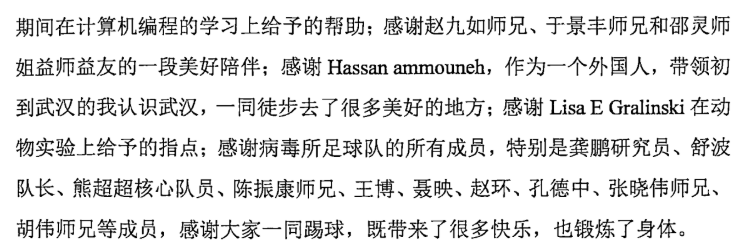
@Drinkwater5Reed Addendum. We overlooked this in Zeng’s thesis: “I would like to thank […] Lisa E Gralinski for her guidance on animal experiments” (动物实验). Gralinski (@lisagralinski, now deleted) is from Baric’s lab. What animal experiments? The thesis does not describe any.