So I was trying to understand why pull requests speeding up the Elixir version were being denied by the clankers while they were being accepted to Go/Express/Rust.
It turns out that, not only each project had a different starting point and a different prompt, but also each project also has a different set of verifications that they are required to pass!
For example, Elixir is the only guided to "preserve the pinned Rails reference behaviour", the only with a explicit verification that we are using Redis and draining its queue (so we cannot remove it while others can), and the only one actively enforcing it.
So it turns out that the people telling you to not read the code cannot even use AI to set up fair benchmarks (probably because they would have to read the code in order to do that).
You don't have to believe me, you can do your own research or ask your agent to do it for you. E.g. here is what Claude Code came back with: https://t.co/wL3VvhgshA
We’ve raised $40m in addition to the $50m we raised last October.
We’re seeing record-breaking growth in 2026, with lawyers booking 410 demos of Spellbook last week.
We now service 4,000+ in-house legal teams and law firms in 80 countries.
https://t.co/NooOYh3UQ2
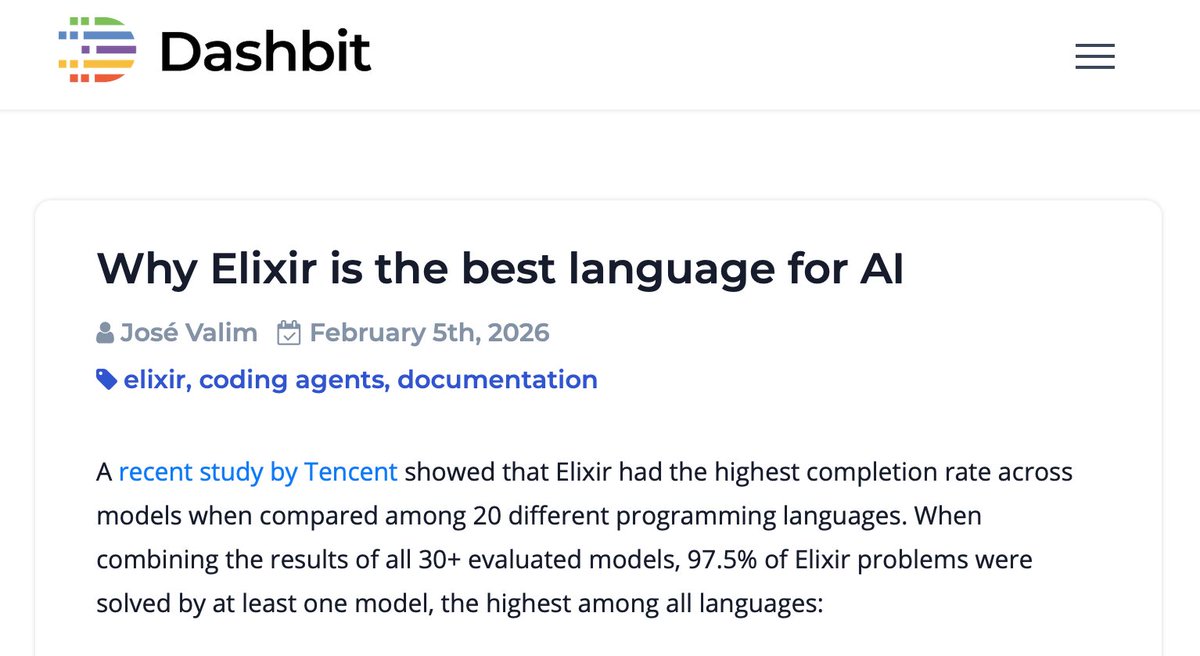
Here is my take on why Elixir is the best language for AI: immutability, documentation, stability, and tooling for coding agents.
It builds on the recent study in which Elixir had the highest completion rate across models among 20 different languages.
Link in the thread below.
@gvrooyen Some nice threads in here. Esp enjoyed the Raka quote. Will have to reread Raka and look for some AI analogies. Wrt literate programs, the way Elixir encourages documentation as integrated part of the code is partly why LLMs perform so well with Elixir accuracy.
Just encountered one of the most convincing Google account takeover scams I’ve seen.
Perfect American accent. Calm. Professional.
They start the call by saying someone tried to hack your Google account using a fake death certificate, then ask if you recognize a recovery email or phone number.
They ask if you’ve received any recent Google emails about an account you don’t recognize trying to recover access.
And sure enough, there’s a legit Google security email.
Here’s the trick.
The attacker isn’t trying to hack your account.
They create a throwaway Google account, set your email as the recovery email, then try to recover that account. Google sends you a real security email.
The scammer calls you live, references the email, and even tells you to verify the headers since it comes directly from Google.
The headers are real. That’s the point.
Then they tell you they’re locking down your account and that you’ll get a recovery prompt on your phone. You just need to approve it to stay safe.
The giveaway was the device and location in the prompt didn’t match me. When I pushed back, they claimed it was from their servers, which obviously makes no sense.
At that point I hung up. I have a personal rule to never approve anything I didn’t initiate, especially while on the phone.
Extremely well executed social engineering. I’m sure this works on a lot of people.
And if someone calls you about account security, assume it’s a scam
A few random notes from claude coding quite a bit last few weeks.
Coding workflow. Given the latest lift in LLM coding capability, like many others I rapidly went from about 80% manual+autocomplete coding and 20% agents in November to 80% agent coding and 20% edits+touchups in December. i.e. I really am mostly programming in English now, a bit sheepishly telling the LLM what code to write... in words. It hurts the ego a bit but the power to operate over software in large "code actions" is just too net useful, especially once you adapt to it, configure it, learn to use it, and wrap your head around what it can and cannot do. This is easily the biggest change to my basic coding workflow in ~2 decades of programming and it happened over the course of a few weeks. I'd expect something similar to be happening to well into double digit percent of engineers out there, while the awareness of it in the general population feels well into low single digit percent.
IDEs/agent swarms/fallability. Both the "no need for IDE anymore" hype and the "agent swarm" hype is imo too much for right now. The models definitely still make mistakes and if you have any code you actually care about I would watch them like a hawk, in a nice large IDE on the side. The mistakes have changed a lot - they are not simple syntax errors anymore, they are subtle conceptual errors that a slightly sloppy, hasty junior dev might do. The most common category is that the models make wrong assumptions on your behalf and just run along with them without checking. They also don't manage their confusion, they don't seek clarifications, they don't surface inconsistencies, they don't present tradeoffs, they don't push back when they should, and they are still a little too sycophantic. Things get better in plan mode, but there is some need for a lightweight inline plan mode. They also really like to overcomplicate code and APIs, they bloat abstractions, they don't clean up dead code after themselves, etc. They will implement an inefficient, bloated, brittle construction over 1000 lines of code and it's up to you to be like "umm couldn't you just do this instead?" and they will be like "of course!" and immediately cut it down to 100 lines. They still sometimes change/remove comments and code they don't like or don't sufficiently understand as side effects, even if it is orthogonal to the task at hand. All of this happens despite a few simple attempts to fix it via instructions in CLAUDE . md. Despite all these issues, it is still a net huge improvement and it's very difficult to imagine going back to manual coding. TLDR everyone has their developing flow, my current is a small few CC sessions on the left in ghostty windows/tabs and an IDE on the right for viewing the code + manual edits.
Tenacity. It's so interesting to watch an agent relentlessly work at something. They never get tired, they never get demoralized, they just keep going and trying things where a person would have given up long ago to fight another day. It's a "feel the AGI" moment to watch it struggle with something for a long time just to come out victorious 30 minutes later. You realize that stamina is a core bottleneck to work and that with LLMs in hand it has been dramatically increased.
Speedups. It's not clear how to measure the "speedup" of LLM assistance. Certainly I feel net way faster at what I was going to do, but the main effect is that I do a lot more than I was going to do because 1) I can code up all kinds of things that just wouldn't have been worth coding before and 2) I can approach code that I couldn't work on before because of knowledge/skill issue. So certainly it's speedup, but it's possibly a lot more an expansion.
Leverage. LLMs are exceptionally good at looping until they meet specific goals and this is where most of the "feel the AGI" magic is to be found. Don't tell it what to do, give it success criteria and watch it go. Get it to write tests first and then pass them. Put it in the loop with a browser MCP. Write the naive algorithm that is very likely correct first, then ask it to optimize it while preserving correctness. Change your approach from imperative to declarative to get the agents looping longer and gain leverage.
Fun. I didn't anticipate that with agents programming feels *more* fun because a lot of the fill in the blanks drudgery is removed and what remains is the creative part. I also feel less blocked/stuck (which is not fun) and I experience a lot more courage because there's almost always a way to work hand in hand with it to make some positive progress. I have seen the opposite sentiment from other people too; LLM coding will split up engineers based on those who primarily liked coding and those who primarily liked building.
Atrophy. I've already noticed that I am slowly starting to atrophy my ability to write code manually. Generation (writing code) and discrimination (reading code) are different capabilities in the brain. Largely due to all the little mostly syntactic details involved in programming, you can review code just fine even if you struggle to write it.
Slopacolypse. I am bracing for 2026 as the year of the slopacolypse across all of github, substack, arxiv, X/instagram, and generally all digital media. We're also going to see a lot more AI hype productivity theater (is that even possible?), on the side of actual, real improvements.
Questions. A few of the questions on my mind:
- What happens to the "10X engineer" - the ratio of productivity between the mean and the max engineer? It's quite possible that this grows *a lot*.
- Armed with LLMs, do generalists increasingly outperform specialists? LLMs are a lot better at fill in the blanks (the micro) than grand strategy (the macro).
- What does LLM coding feel like in the future? Is it like playing StarCraft? Playing Factorio? Playing music?
- How much of society is bottlenecked by digital knowledge work?
TLDR Where does this leave us? LLM agent capabilities (Claude & Codex especially) have crossed some kind of threshold of coherence around December 2025 and caused a phase shift in software engineering and closely related. The intelligence part suddenly feels quite a bit ahead of all the rest of it - integrations (tools, knowledge), the necessity for new organizational workflows, processes, diffusion more generally. 2026 is going to be a high energy year as the industry metabolizes the new capability.
Just realized majority of the west thinks Iranian people are Muslim…this explains a lot.
I think BBC etc have been so reluctant to report on this because it breaks the “identity” narrative. The Marxist framing is that people are reduced to a singular identity. Iranian=muslim=minority=oppressed. And that stands against Israel=white=jews. Except Iran is majority non-Muslim (according to every poll not run by Iran’s brutal government.) And the indigenous peoples are burning mosques in objection to their colonization and oppression.
And Israel has a sizable Muslim and Arab citizenry, not to mention sizable populations of black and brown Jews.
Iran’s revolution completely breaks their worldview.
Tehran’s streets, and cities around the world, echo with the footsteps of Iranian women and men demanding freedom.
Freedom to speak, to gather, to travel and above all to live freely.
Europe stands fully behind them.
We unequivocally condemn the violent repression of these legitimate demonstrations.
Those responsible will be remembered on the wrong side of history.
We call for the immediate release of all imprisoned demonstrators.
We call for the restoration of full internet access. And we call, at last, for fundamental rights to be respected.
@chris_mccord I signed up for https://t.co/y8VFoy1HKv and it looks great, but, i need it to access private github repos. Is there some plan for project config/secrets management similar to https://t.co/02TpWQiCgm apps?
@Apie Absolutely. But it goes for all us manufacturers. And their whole economy. It is massive own goal. Everyone other than Russia will hurt, but US will feel the brunt. Interesting times
@Apie Yup, but they were spending 1.5% gdp on US weapon systems. They’ll now spend 3% in other economies and other currencies. US seems to be thinking linearly in a networked world.
@Apie Boosting global trade while having USD as reserve currency has given US massive leverage and influence. That leverage only holds as long as everyone wants to trade with the US and in USD.
@Apie Rebuilding the rest of the world with the US economy at the center is what also made the US economy outgrow the others in that period. US is now saying they don’t want to be the center of world trade anymore. That’s going to hurt them more than the rest.
@Apie I use "stable" to mean something akin to a free market that behaves in quasi rational ways to predictable policy. If USA is navel-gazing in scrambling to establish a domestic manufacturing capacity for jeans, then they are not focussed on countering foreign and domestic dictators
@Apie Bitcoin indeed.
aside: VW did eventually admit and correct their emission cheating and CEO fell on his sword. They've pivoted hard into EVs since; the new Scouts and Rivian-partnered concepts even look good.