@Camp4 Great stuff as always. Thank you for everything that you do, I'm very grateful for all the material you've put out. It's made a big impact in my life!
“Now what?”
I spent my 20s, 30s, and half my 40s chasing fortune, only to be faced—like many before me—with this question. What I realized is that billionaires and broke people have one thing in common:
They’re both awake for 16 hours a day.
Rich or poor, our challenge is to fill that time with meaning. There’s a pervasive myth out there that having infinite money makes that task a layup. We imagine all the cool things we’d do, how happy we’d be, if only we had a billion dollars. And yet…
We know from observation it’s not that simple.
There are plenty of rich but miserable people out there—in fact, it’s more the rule than the exception. The reason for this is simple:
It turns out that the old cliché is true—the best things in life are free:
—Appreciating art & beauty
—Learning something new
—Helping someone else
—A great conversation
—Creating & building
—Mastery of a craft
—Experiencing love
—Enjoying nature
—Being a parent
—Becoming fit
It’s the parable of the fisherman and the businessman—we devote our lives to chasing a lifestyle that is already within our grasp.
To be clear, being poor sucks. We all have bills to pay, and having a fat bank account does buy time and access. But money is just the means, not the end.
Learn from me:
For two decades, I existed in the upper echelons of the business world, surrounded by The Most Successful People.
⚠️In all that time, I didn’t find a single person whose whole life was worth emulating.
So I pivoted, and became really good at turning time into meaning. Now, I have the luxury of doing whatever I want, but my answer to the question “Now what?” is… surprisingly mundane:
—Long walks
—Good coffee
—Reading & writing
—Lots of time outside
—Helping my kids thrive
—Investing in my marriage
—Pursuing mastery in rock climbing
—Going deep with an inner circle of friends
—Challenging work (building, but with boundaries)
The irony is, like the fisherman, this life was always available to me—I just had to embrace it.
P.S. If you enjoyed this post, would you please like/comment/repost?
Apologies for the TLDR, but when you step back, it is kind of wild what we’ve all lived through over the last five years. No wonder so many young people are anxious about the future—the ‘disturbance in the force’ feels stronger by the day.
I don’t have any grand takeaways other than this--the world could use an immediate course correction in the direction of boring--or we may really need those Mars rockets sooner than expected. One thing is for sure--Israel is making a compelling case for Golden Dome.
• A once-in-a-century pandemic shuts the world down. No matter how you view it in hindsight, both allies and adversaries were nearly unified in halting the global economy and banishing society to lockdowns and high-pressure mask & vaccination campaigns.
• We tried to print our way out of the system shock, triggering the most euphoric markets since the dot-com bubble—pre-revenue IPOs reappeared for some reason and people forgot that good companies generally don’t SPAC.
• The digital revolution kicked into overdrive—work-from-home, virtual education traumatized parents, Zoom cocktail parties, Peloton, DoorDash and MS Teams---probably the most painful development.
• Civil unrest emerged alongside deepening social and political divides.
• A disheartening end to the war in Afghanistan—trillions spent, thousands of lives lost and the Taliban is still running the show.
• Market euphoria gave way to historic inflation. Interest rates shot up to cool things down. The tide went out, and the “shitcos” failed. Centralized crypto exchanges gambled customer deposits. Hedge funds weren’t hedged. VC-heavy banks like SVB collapsed, triggering a temporary panic in the regional banking system. The big banks… got even bigger.
• For the first time since the Soviet invasion of Afghanistan, a nuclear superpower launched a full-scale invasion of a neighboring country. The West isolates Russia, and we witness a new asymmetric dynamic in warfare--cheap drones, missile swarms, all playing out in real time on social media.
• The metaverse and Web3 died quickly as the “Magnificent Seven” lead a market rebound on the promise of AI.
• China closes gaps--and maybe pulls ahead--in some of the most strategically important technologies. They tolerate risk, aren’t afraid to steal good ideas and make them better--and operate with a culture that—for all its flaws—just goes out and does big things without dragging decades of baggage behind it.
• Hamas launches a surprise attack on Israeli civilians, takes hostages and triggers a war that pulls in Iranian proxies like the Houthis--disrupting global shipping lanes and igniting a politically charged humanitarian crisis.
• Political winds shift again. A former President—also the frontrunner—is shot in an assassination attempt, the first since Reagan. Thankfully, he survives and is now our 47th President.
• The Pakistani and Indian Air Forces engage in the largest air-to-air exchange in decades. China’s latest fighters and missiles see combat success against contemporary French aircraft—signaling what many already knew--China’s military is approaching peer status.
• Israel launches the most sophisticated and devastating air campaign since Desert Storm—targeting Iranian military and scientific leadership, degrading air defenses, missile systems and nuclear infrastructure..and the conflict may just be getting warmed up.
All in just five years...
Hopefully our defense and policy leaders are paying attention and making some course corrections. Congressional leadership is mostly well-intentioned, but often fights for expensive job programs--exactly the kind of thing an over-consolidated defense industry encourages--even as we stare down an unsustainable $36 trillion national debt. That’s how you end up holding a fleet of battleships during the advent of the aircraft carrier....
Only this time, the analogy breaks down--because as a nation have forgotten how to build ships. So instead, we will have $300 million fighter jets we can’t afford, arriving a decade too late, in quantities that may not even matter—disrupted by million-dollar, hypersonic, laser-equipped drones that our adversaries will likely produce at scale. Until, perhaps, the dark horse Skynet T-1000 shows up.
This is the time--especially in such a politically charged environment--when we need to be finding more ways to come together instead of moving farther apart. A time to be rooting for America and our leadership, not betting on the next Polymarket catastrophe. Because if the next five years look anything like the last, military parades and trade imbalances will be the least of our problems.
I proudly present my most detailed photo ever of an extragalactic object: a 400 megapixel photo of the Andromeda Galaxy. Captured over a period of 3 months using 2 telescopes and thousands of photos.
My favorite part is the core, which I’ll zoom into in the reply for you.
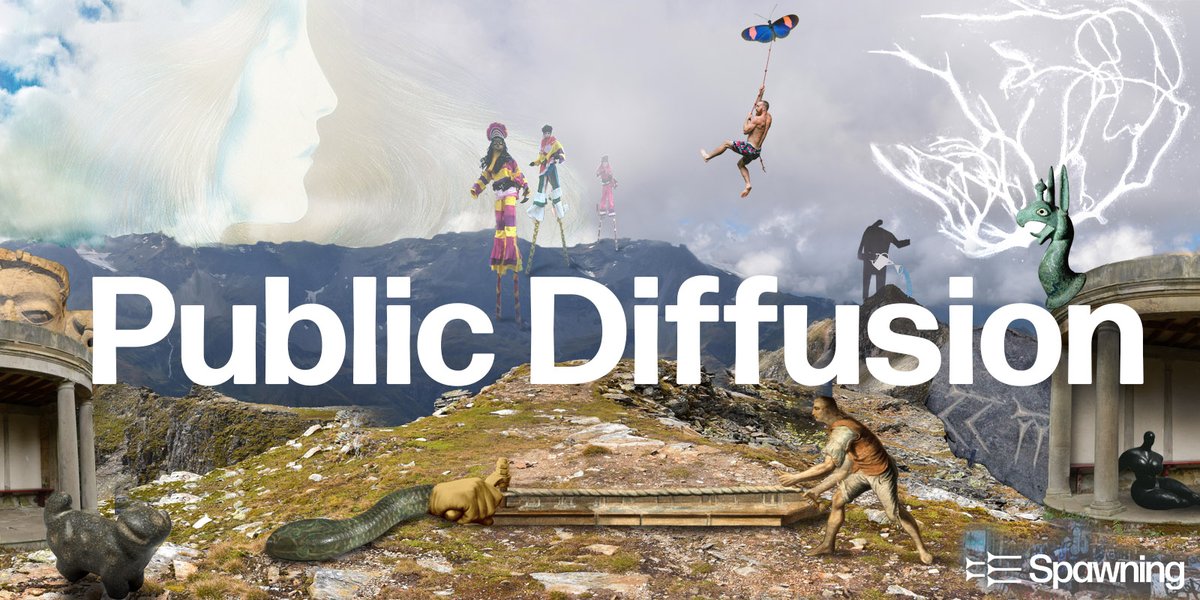
With Public Diffusion, @spawning_ set out to prove that it's possible to train a beautiful AI Art model using only images from the public domain.
As of today, we’re 30% into training our first model, and the early results speak for themselves.
Take a look…🧵
Building and taking a horizontal product to market is hard.
Surprisingly hard.
From the moment I put together the first @heyequals pitch deck, that was the warning.
I didn't *really* get it until I'd lived it.
Today on Wrap Text we share that story.
https://t.co/SgDrNh6JOc
Tony Blair explains the 3 key decisions Lee Kuan Yew took that made Singapore rich.
“Each one of them now seems obvious. Each one at the time was deeply contested.”
3 years of pricing experiments at Equals condensed into one blog post.
Since starting the company, we've tinkered a lot with pricing and packaging.
It's one of the single most impactful levers early stage companies can pull.
I think folks *don't* experiment with pricing enough, or take big enough bets when they do.
We've tried free.
We've tried completely sales led.
We've tried not listing pricing on the site.
@mattnhodges details all the plans we've had, why, and what we've learned in our latest installment on Wrap Text.
https://t.co/oE5IssskVC
Voyage of the Moons Created using still images taken by the Cassini spacecraft during it's flyby of Jupiter and while at Saturn.
Credit: NASA/JPL-Caltech/SSI/CICLOPS/ @kevinmgill