Warum das eigene Erfahrungswissen von Lehrer*innen häufig überbewertet wird und wie es dennoch gelingen kann, dieses Wissen als eine relevante Facette von Professionswissen von LuL zu verstehen, kann man ab jetzt hier nachlesen 🤗➡️ DOI: 10.5282/edoc.30254 https://t.co/wR3Tfo9uau
wie komplett scheisse in seinem Job als Lehrkraft muss man eigentlich sein, um zu glauben, dass Kinder nur durch Leistungsdruck, Noten und Zwang besser lernen, Kinder sind kleine lustige Gnome die buchstäblich danach SCHREIEN Neues zu lernen
15 bookmark-worthy tools for researchers that cost you nothing and will save you time (& nerves) when researching, writing and publishing.
A thread. 🧵
#AcademicTwitter #AcWri #PostDoc
—
#1: Track your time with Toggl ⌛
https://t.co/CSjKRFoS0i
• Understand how you are spending your time
• Track how long each task is taking you so you can plan accordingly
• Be more focused on the task at hand
I use Toggl daily.
—
#2: Proof-read your papers with Writefull 🔎
https://t.co/vcYBY2XFni
• AI-powered proof-reading tool specifically for scientific texts
• Integrates into Word and Overleaf
Members of my program - the Researchers' Writing Academy - love this one!
—
#3: Organise your references with Zotero 🗃️
https://t.co/5svcJL5Jly
• Open-source program
• Saves references from your browser
• Organises them in folders and using tags
• Creates bibliographies for your article
• Lets you co-create citation libraries with co-authors
—
#4: Stay focused with Forest 🌳
https://t.co/tToDcNi0Vv
• Start the app when you want to write or deep work
• A virtual tree starts growing
• When you leave the app to do something else, the tree dies
• The larger your forest, the more deep work you got done!
—
#5: Discover papers with Research Rabbit 🐰
https://t.co/LsfFCoGGRr
• Build your own citation network
• Label network entries
• Download paper PDFs
• Get alerts for new papers
—
#6: Visualise your thoughts with XMind 🧠
https://t.co/vVEhz5GIJl
• Intuitive mindmapping tool
• Embed hyperlinks, images & attachments
Excellent for organising references for review papers or brainstorming the story of your paper!
—
#7: Notion 🖥️
https://t.co/rCzNNJVHOr
• Powerful all-rounder
• Note-taking
• Project management
• Wikis & databases
Some members of my program - the Researchers’ Writing Academy - swear by it!
—
#8: Listen to scientific papers with Audemic 🎧
https://t.co/947nFj8RQF
• Highlight text while listening
• Take notes
• Get summaries that go beyond the abstract
—
#9: Record training or feedback videos with Loom 🎥
https://t.co/16fRAIIYvi
• Record your screen, webcam and/or audio
• Share the video link after recording
• 25x 5-min videos included in free plan
I use this one all the time!
—
#10: Project manage your papers with Trello 🗂️
https://t.co/ITAn01Y2R9
• Use lists, cards & checklist to organise the tasks in each project
• Collaborate with co-authors
• Communicate via comment function
PS: We provide you with several Trello templates inside our program!
—
#11: Choose your target journal with SciRev 📗
https://t.co/w4gbPzZd1g
• Compare publication speeds, peer review quality and journal statistics
• Contribute your own publishing experiences
• Made by researchers
—
#12: Compare journal policies with Transpose ↗️
https://t.co/nHtjkyRPBY
• Compare journal policies on open peer review, co-reviewing and preprint policies
You might be surprised how vague some journals are on these topics!
—
#13: Share methods on Protocols 🧪
https://t.co/Z2ZdpWbHWo
• Publish your chemical synthesis protocols, clinical trial descriptions or computational workflows
• Keep them updated
• Receive a DOI
• Run protocols as checklists
• Free for open research
—
#14: Cite correctly with CiteAs 💬
https://t.co/uMYRKULRZv
• Obtain the correct citation for preprints, software and datasets in one click
• Open-source tool
—
#15: Understand your research landscape with Dimensions 🌆
https://t.co/WAF5uRwmYl
• Analyse all research-related data (grants, papers, patents, datasets, online mentions, clinical trials, policy documents)
• Identify collaborators
• Find who has cited and used your work
—
TL;DR - 15 free tools for researchers you should bookmark now
#1: Toggl
#2: Writefull
#3: Zotero
#4: Forest
#5: ResearchRabbit
#6: XMind
#7: Notion
#8: Audemic
#9: Loom
#10: Trello
#11: SciRev
#12: Transpose
#13: Protocols
#14: CiteAs
#15: Dimensions
—
However, the best tools won’t make you more efficient at writing papers if you don’t have a streamlined writing process in place.
💻Therefore, if you liked this thread: Watch my free writing training 👇
📢 Wissenschaftlerinnen und Wissenschaftler (alle Fächer, alle Hierarchiestufen) für Teilnahme an kurzer Online-Befragung (max. 5 Minuten) gesucht! 📢
https://t.co/CJCxVO2QmV
Wir freuen uns über rege Teilnahme!
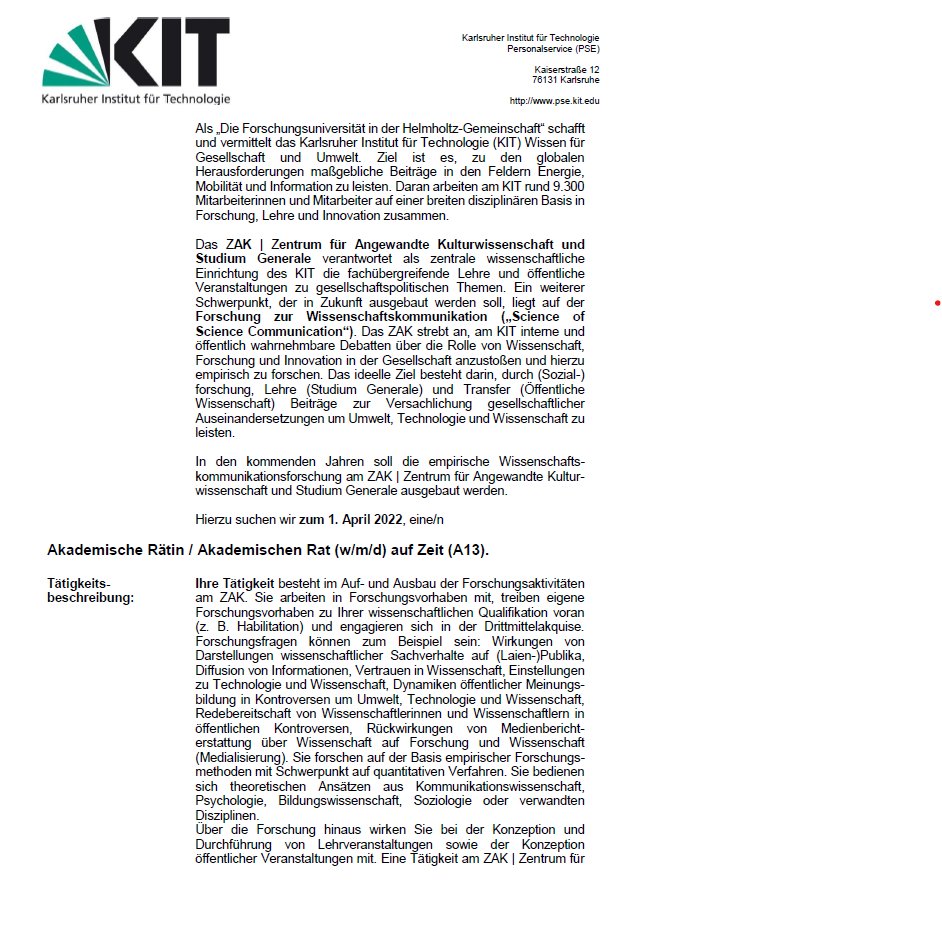
Job alert: Wie wirkt #WissKom, wer beteiligt sich daran, wen erreicht sie, kann #WissKom polarisierte Debatten versachlichen? Wir @zak_kit suchen eine:n Postdoc mit Interesse an solchen Fragen. Akad. Ratsstelle a. Z. Besetzung: 1.4., Bewerbung bis 5.1. https://t.co/ArM0HNi579
Interesse an Ergebnissen der Wissenschaft zu digitalen Medien? Für das Leibniz-Institut für Wissensmedien in Tübingen suchen wir eine*n Mitarbeiter*in Presse- und Öffentlichkeitsarbeit (m/w/d) mit Schwerpunkt Online
https://t.co/hHYbKiodyP via @IWMTue
Ist die #Lehrkräfteausbildung realitätsfremd? "Im #Referendariat ist es eine unrealistische Anforderung, von jungen Lehrkräften zu erwarten, sie hätten alles und jeden im Blick – aber genau diese Erwartungen werden formuliert", Dr. Carolina Börries. https://t.co/UhRyORwiYR #twlz
Extrem wenig Zeit, extrem viel Druck: Das #Referendariat steht in der Kritik: Expertin Dr. Carolina Börries sagt, es würde "absurde Anforderungen" stellen. Das ganze Interview gibt es hier: https://t.co/UhRyORwiYR #twitterlehrerzimmer#schule#lehramt#edubw
@dunkelmunkel Geht in etwa in die gewünschte Richtung: Schultz-Pernice, F. (2017). Vom Stolpern und Stocken des Blicks: Aufbau von Visual Literacy durch Wahrnehmungserfahrungen an den Grenzen der populären Filmsprache. 😏➡️ https://t.co/HxtSSIhwdi
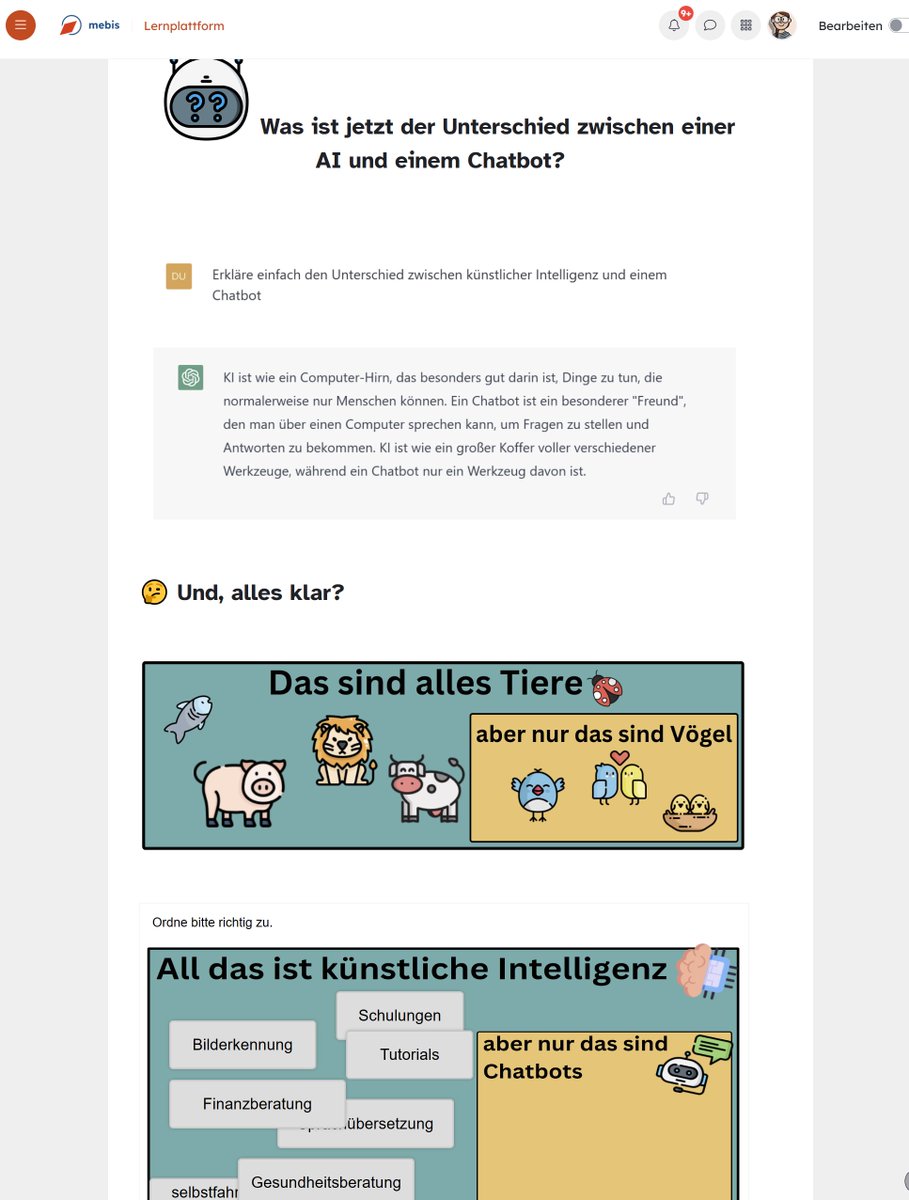
So, mein Kurs @mebis_bayern Kurs zu ChatGPT ist fertig. Es wird geklärt was Chatbots sind. Was der Unterschied zu einer KI ist und wie sich KIs entwickelt haben. Die SuS machen einen Turing Test und programmieren zum Schluss selbst einen Chatbot in Scratch. #moodlebande
Warum man in der Philosophie keine Aufsätze in hochrangigen internationalen Zeitschriften unterbringt:
– der Reviewer bemängelt, man habe einen wichtigen Beitrag nicht genannt: die eigene Diss
– der Reviewer bemängelt überhaupt nichts, das Paper wird einfach abgelehnt
/1