We were able to fine tune an open weight model (Qwen3.5-9B) on proprietary internal data at @coinbase, and it out performed frontier models, at much lower cost and speed, for a specialized task (fraud prevention in this case).
I think we'll see more of this pattern inside companies. The frontier models are amazing generalists. But increasingly you'll see specialist models out perform on more narrow tasks, either working on teams, or by themselves.
We're making it easy to fine tune models internally for our employees. We even have a skill for it in our internal harness that makes it easy to spin these up and start training them:
"/fine-tune-and-serve-llm I want to fine-tune Qwen for payments risk review. help me get started"
I imagine we'll have some backend services that could be replaced entirely by this new architecture.
What if you could train a model with a single prompt?
This week, Coinbase announced that they trained a 9B model that beat the frontier models in their domain while being significantly cheaper and 55% faster. It cost under $100 to train.
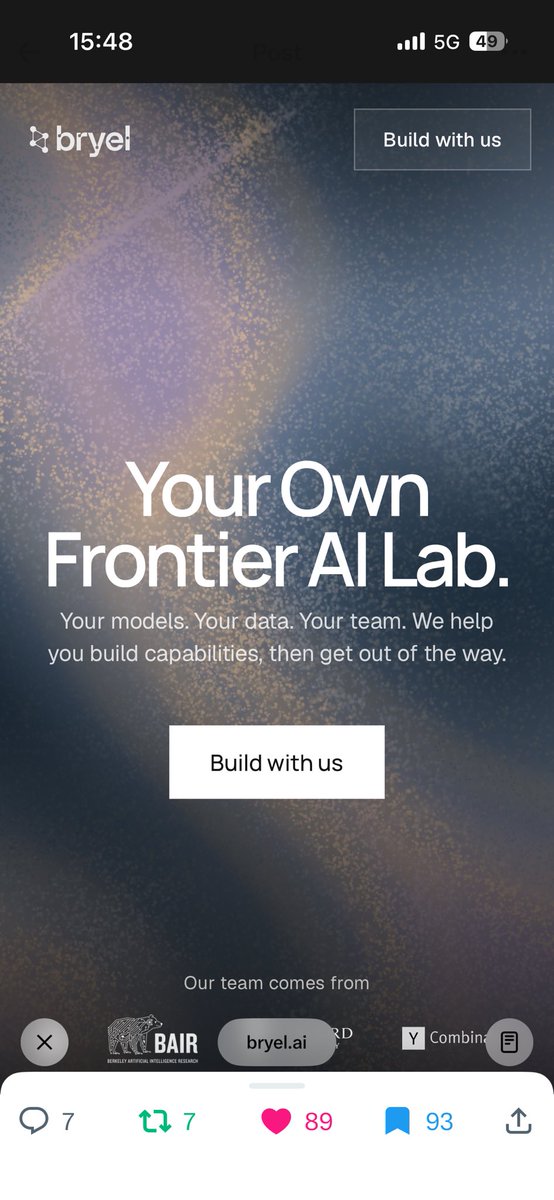
Today, we’re opening the same capabilities to you. Coming to you from the Bryel Foundry, our in-house tooling that we’ve used to train models for unicorns.
Just one prompt, a teacher, and within 7 days, you will receive a custom model that is up to 2x cheaper in a specific domain of your choice.
Book a demo at https://t.co/v3RDWb2MtZ
Why use many token when few do trick?
Caveman is backed by @ycombinator (F26).
It started as a joke to get my AI bill under my grocery bill by having Claude speak like a Caveman. 111k GitHub stars later, it's a company.
Today: Caveman 4.0 and Caveman Cloud.