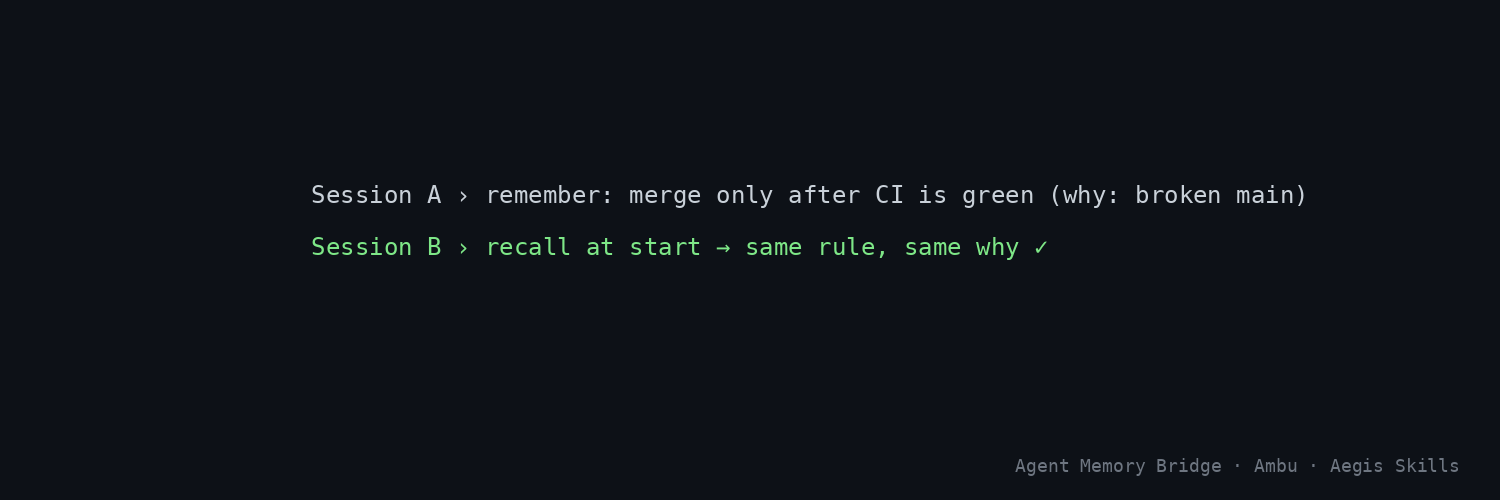
Coding agents forget why a decision was made, and retry the same broken fix. I build Agent Memory Bridge for the first, Ambu for the second. Short demos here.
my docs promised more than the code could back up. Agent Memory Bridge v0.38.1 and v0.38.2 fix the wording: no zero-lock or latency claims, and the gateway docs now list the audit fields and what a token doesn't prove. No behavior change, still 17 tools.
https://t.co/u0gyWCFUdJ
@somora_ai yes, in the optional gateway: a client can have namespace limits and an optional type list, so a write allowed in A is refused in B if B is outside that client's namespaces.
write access for an agent shouldn't mean every kind of record. in Agent Memory Bridge v0.38.3, you can give each HTTP gateway client a list of record types it may store, annotate or revise. what do you scope your agents' writes by? https://t.co/FeOFC4g5Hp #MCP
agent memory should have a recheck date based on its last confirmation, not when it was written. if that date passes, flag the note for review instead of treating it as current. old doesn't mean wrong, but unchecked isn't verified. #AIAgents
@amirsadjady ha, that's the part that worries me too. i'd rather it add a correction next to the old note than rewrite it. do your agents ever get to edit past records?
@shrey_sancheti just the path it declared. depends_on_repo is path@commit, so a change somewhere else in the repo won't flag it. and if that path is dirty or git can't be read, you get unknown, not current.
an old decision that still shows up in recall keeps steering the agent. in AMB, revise writes a new record that supersedes it, and default recall drops the old one before it hits context. kept, not deleted. the catch: someone still has to run revise. https://t.co/kKAEBtfbGE
lesson from building agent tools: if the same check fails the same way twice, stop. a third retry rarely knows something the first two didn't. it just burns rounds and buries the real error. a clean halt you can read beats a long loop you can't. #AIAgents
@shrey_sancheti a human or the agent triggers it. AMB doesn't call revise for you. if a decision declares the repo path it depends on, recall flags it needs_recheck when that path changes. otherwise, noticing a decision went stale is still on you or the agent.
@kurt_glore makes sense. the part I'd watch is what the observer reads. the agent's own summary says it went fine, the diff a human had to fix shows where it broke.
@kurt_glore review time is the part I'd count first. if an agent says "done" and a senior dev still has to redo the check, that's the real cost. I'd track how often "done" held up once the tests ran, not how much code it wrote.
@Block4Roots the notes file works until a decision changes and the old line is still sitting there. that's the gap I built Agent Memory Bridge for: a decision gets superseded, not overwritten, so the agent sees what's current and what it replaced.
@swapskp for the what-can-it-touch part I'd start boring: its own service account, namespace-scoped RBAC, no cluster-admin. the verify part needs a log per tool call, not just a session transcript.
@evansims one cheap thing on the install side: approved npm installs run with --ignore-scripts, a temp HOME and a clean PATH. lifecycle scripts don't run, and ~ points at an empty dir, not your real ~/.claude.json.
@Alex_Vainshtein same thing happened to me with retries, the agent kept trying the same broken fix. so I wrap the run, hash the normalized failure output, and stop when the same failure shows up twice. exit code, not a polite paragraph.