New paper out!
With Dr. @FranzEssl1 , Dr. Bernd Lenzner and Dr. Stefan Dullinger, we reviewed 812 vegetation resurvey studies to understand how local plant diversity changes across habitats, drivers and study durations.
https://t.co/3LpwkpLIvz
(Open Access)
1/3
Known #extinctions are just the tip of the iceberg. Many human-driven losses remain undocumented—so-called #DarkExtinctions, absent from the IUCN #RedList, biasing our view of biodiversity loss.
Check our new paper in Nature Reviews Biodiversity, led by @FranzEssl1 :
https://t.co/LYzpTmHuFn
We modeled nearly 10,000 species to project their spread through 2100. The absolute increase in invasion area is moderate, but the spatial shift is substantial.
Read the full study here https://t.co/3K6ghIbQCs
@NatureEcoEvo
Our final #WilhelminenbergSeminarTalk this year was with Franz Essl @franzessl1.bsky.social, who gave us captivating new insights into the global re-shuffling of species. 🌿🧪
@KLIVVWien@univienna
https://t.co/dyR8R81jei
Our next talk will be on the 14th of January!
Temperate deciduous forests are found in three global regions. We compared taxonomic and phylogenetic diversity of forest plant communities among these regions in a new Ecography article led by Javier Loidi and Josep Padullés Cubino:
https://t.co/CQ0LeYnAkJ
@EcographyJourna
In our new article (Midolo et al., Ecology Letters), we show that plant species richness in European plant communities generally decreased between the 1960s and 1980s. However, since the 1990s, this trend seems to have stopped or even reversed. https://t.co/ieQk0M6RCh
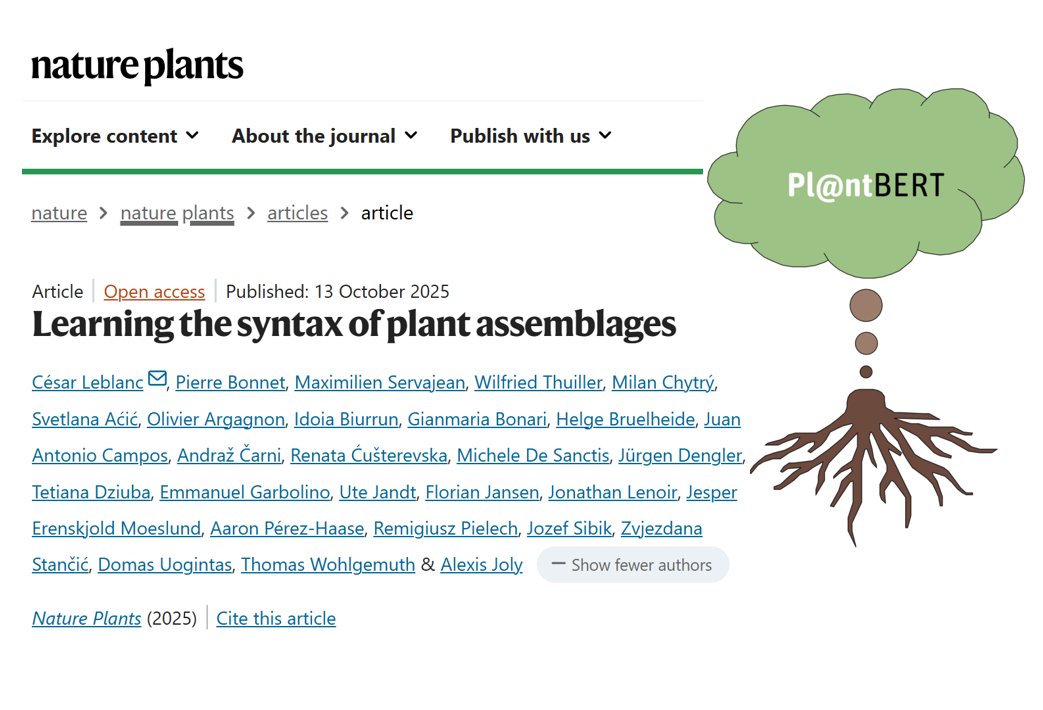
Our new paper in Nature Plants, led by César Leblanc, introduces Pl@ntBERT, an AI model inspired by language models like ChatGPT, trained on > 1M vegetation plots from the EVA database.
Paper: https://t.co/VQi6LNYgVB
Demo: https://t.co/60yEmg4Ekg
GitHub: https://t.co/3ojVkBGBnJ
🌿New Research: "Understanding the role of pluralistic ignorance in biodiversity conservation: A research agenda"
🌏Read more about this important research #OpenAccess in GEC: https://t.co/pGdg8nbiLX
Do biodiversity drivers have no long-term effects? 🚨Still the dominant assumption.
We propose a paradigm shift in Trends in Ecol & Evol: 🔗 https://t.co/asd1ZhkqWL
Many thanks to @EkoLogIt , @RonanMarrec, @FranzEssl1, @IngolfKuhn, @t_ergon
Why relying on the "equlilibrium assumption", i.e., biodiversity being in an equilibrium state w/ its environmental conditions, to model biodiversity changes?
➡️ We propose a paradigm shift: embracing the quasi-permanent non-equilibrium state 🤯
https://t.co/CsmRj59YX1
New global study! 🏔️🌱 Non-native plants don’t just follow mountain roads—they spread along hiking trails too, even off-trail.
@MIREN_mountains data from 9 regions shows trails are key invasion pathways.
https://t.co/e8gkc6uVYc #InvasionEcology#MIREN#Mountains#Biodiversity
A new paper published in New Phytologist. We conducted a global meta-analysis of 81 shrubland sites subjected to experimental warming, shifts in precipitation, and nitrogen addition to quantify seven types of vegetation responses.
https://t.co/rcQB4xI8I9
🚨 Job Alert: Join our team at Uni Göttingen as a Postdoc in Ecology & Biogeography! 🌿🌍
📍 Germany
🕒 3+3 years
🧪 Research + light teaching
💡 Build your own line of research
Apply now! #ecology#postdoc#macroecology#academicjobs
EVA-MAP: https://t.co/xjy6AVEvKo
We have launched a new online map of vegetation plots available in the European Vegetation Archive (EVA) and the ReSurveyEurope database. You can select plots using a filtering form or drawing an area in the map, explore plot metadata and export the list of selected plots with their metadata.
[Note that it can take some time to upload data after the first opening.]
The application has been prepared within the MOTIVATE project (https://t.co/mlCIepn9bx): it should motivate vegetation scientists to go to white spots in the map and conduct vegetation surveys or resurveys there.
Thanks go to Adam Mertel, Ilona Knollová, all the data contributors and the Biodiversa+ grant scheme.
Leonore macht’s. Und ich bin sehr, sehr froh drüber. Liebe @lgewessler, du schreckst vor keiner noch so großen Herausforderung zurück und kämpfst verlässlich für eine bessere Welt. Ich verneige mich – vor deiner Entschlossenheit, deiner Klarheit und deiner Kompetenz! 1/2
New study in @Nature: we focus on the diversity that's missing - “dark diversity.” Human impact means only 1 in 5 species persist in disturbed areas versus 1 in 3 in pristine ones.
My summary of the project & its implications: https://t.co/0gyz8Bm7cM









![MilanChytry's tweet photo. EVA-MAP: https://t.co/xjy6AVEvKo
We have launched a new online map of vegetation plots available in the European Vegetation Archive (EVA) and the ReSurveyEurope database. You can select plots using a filtering form or drawing an area in the map, explore plot metadata and export the list of selected plots with their metadata.
[Note that it can take some time to upload data after the first opening.]
The application has been prepared within the MOTIVATE project (https://t.co/mlCIepn9bx): it should motivate vegetation scientists to go to white spots in the map and conduct vegetation surveys or resurveys there.
Thanks go to Adam Mertel, Ilona Knollová, all the data contributors and the Biodiversa+ grant scheme.](https://pbs.twimg.com/media/GqUtXiCW8AEe_j6.jpg)


